Development charges, which are paid to enhance or intensify the use of
some sites, are headed north for residential use at the upcoming DC rate
revision effective March 1, say property consultants.
They cite the increase in private home values since last year as well as
aggressive land bids for residential sites at state tenders in the past six
months.
On average, DC rates for landed and non-landed residential use could rise
about 5 to 10 per cent. However, consultants are predicting that rates for
commercial, industrial and hotel use could remain flat.
The upcoming DC rate revision will also be monitored by those trying to
embark on collective sales, especially for sites whose redevelopment would
involve sizeable DC payment. DC is part of total land cost to a developer.
If the DC rate increases significantly and the value of the site remains
constant, the developer will offer owners less for the site, explains CB
Richard Ellis executive director Jeremy Lake.
‘The problem today is that there’s already a price gap between
owners’ and developers’ expectations. This will be compounded if
there’s a significant hike in DC rates, in the case of sites with a
significant DC component. The current environment (of rising private
residential price expectations) is not conducive to owners reducing asking
prices,’ he adds.
‘Hence for en bloc sites with significant DC component, the exposure to
DC volatility can be very unhelpful in a rising market, whereas sites with
zero or low DC component are fairly immune to DC volatility and those are
good sites to work on.’ Mr Lake reckons that the next DC rate revision on
Sept 1 may be more keenly watched – than the March 1 update – as a
higher number of en bloc sale efforts are likely to be at a more advanced
stage then.
DC rates – which are revised on March 1 and Sept 1 each year – are
specified by use groups (such as landed and non-landed residential,
commercial and hotels) across 118 geographical sectors throughout Singapore.
The review is conducted by the Ministry of National Development in
consultation with Chief Valuer, who takes into account current market
values.
Colliers International is projecting 8 to 10 per cent rise in average DC
rates for non-landed residential use from March 1. The biggest hikes of up
to 20 per cent are likely to be in places like Serangoon Avenue 3, Upper
Thomson Road and Sengkang West Avenue where winning land bids at state
tenders have been at substantial premiums of 48-86 per cent to land values
imputed from the Sept 1, 2009 DC rates for these geographical sectors, says
the firm’s director Tay Huey Ying.
Suburban locations could see a bigger rise in DC rates than upmarket
locations as last year’s rebound in home sales and prices was led by the
mass market segment, she argues.
Private-sector land deals too point to higher DC rates. For instance, the
Parisian site at Angullia Park was sold in October at $2,058 psf per plot
ratio – about 70 per cent above the DC-rate implied land value for the
area.
DTZ’s SE Asia research head Chua Chor Hoon reckons that non-landed DC
rates will go up 15 to 25 per cent from March 1. Jones Lang LaSalle’s
associate director (research and consultancy) Desmond Sim predicts 10-15 per
cent hikes in non-landed residential DC rates in mass-market suburban
locations, outpacing a 5-8 per cent rise in prime districts.
As for landed residential DC rates, he forecasts a 10-15 per cent
increase across all geographical sectors, with a bigger increase likely for
Sentosa Cove and Good Class Bungalow Areas.
CB Richard Ellis executive director Li Hiaw Ho notes that the official
price indices for detached, semi-detached and terrace houses rose 20-odd per
cent from July to December 2009. In addition, 2009 saw the highest total
value of GCB sales at $1.64 billion. He forecasts an average 5-10 per cent
rise this round for landed rates.
Mr Li forecasts DC rates for commercial and industrial use will remain
unchanged or even fall very marginally.
Colliers’s Ms Tay, who is projecting an up to 5 per cent climb in
average DC rate for industrial use, says: ‘The government is unlikely to
make significant upward adjustments to DC rates for industrial use group in
general in the upcoming review given the nascent recovery of the
manufacturing sector and the industrial property market. Also, JTC Corp
industrial land rents have not been adjusted since they were revised
downward in January 2009, says Ms Tay.
She reckons commercial DC rates will remain largely unchanged as office
rents have remained weak.
2010 February 24 BUSINESS TIMES


Sentosa has seen a big jump in
development charge (DC) rates, reflecting higher land values on the island
following this month's opening of Resorts World Sentosa (RWS).
On average, the government is raising DC
rates (payable for intensifying or enhancing the use of some sites) about 12
per cent for landed residential use from March 1; but in Sentosa, they will
climb 17.3 per cent. For non-landed residential use, Sentosa saw a 10 per
cent hike in DC rates compared to the average rise of about 8 per cent. And
while DC rates for commercial use will be cut roughly 2 per cent on average
against the backdrop of weak office rentals, Sentosa is the only location
where they will be raised - to the tune of 12.5 per cent.
It is also the only location where the
government increased the hotel-use DC rate; the hike was 12.2 per cent. In
all other locations, the DC rate for hotel use (which also covers hospitals)
was left untouched.
DC rates - which are revised on March 1
and Sept 1 each year - are specified by use groups across 118 geographical
sectors throughout Singapore. The review is conducted by the Ministry of
National Development in consultation with the Chief Valuer, who takes into
account current market values.

Some analysts pointed to an interesting
trend emerging in the Central Business District. DC rates for commercial use
in the CBD fell further while non-landed residential rates rose and actually
surpassed the commercial rates. This could mean paying a higher DC for those
who redevelop old CBD office blocks into apartments and could impact such
conversions, especially in the case of 99- year leasehold sites as their
owners would also want a lease top- up, says DTZ's South- east Asia research
head Chua Chor Hoon.
Jones Lang LaSalle's SE Asia research
head Chua Yang Liang goes a step further, predicting that the new trend
could have an 'unexpected effect of encouraging the redevelopment of
existing older office stock into the same office use and discouraging
conversions to residential'. Jones Lang LaSalle's (JLL) analysis showed that
DC rates for non-landed residential use were raised for 116 geographical
sectors and left unchanged for the remaining two areas.
The biggest hike of 15.4 per cent was
seen in three sectors: 91 (which covers the Mountbatten, Meyer and Broadrick
areas); 98 (Tampines, Bedok Reservoir, Bedok North, Kembangan); and 101 (Paya
Lebar Way/Eunos/Sims Avenue).
This was followed by Sector 76 (Everton/Spottiswoode
Park) with a 14.5 per cent increase. Market watchers attribute this to last
October's en bloc sale of Dragon Mansion at a land price about 68 per cent
above the land value implied by the prevailing Sept 1, 2009 DC rate for the
location.
Also, the geographical sectors covering
Serangoon Ave 3, Upper Thomson Rd and Sengkang West Avenue - where
residential sites have been sold at bullish prices at state tenders in the
past six months - were raised 12.5 per cent, 10.5 per cent and 9.1 per cent
respectively.
Colliers International executive director
(investment sales) Ho Eng Joo said that overall, the growth in non-landed
residential DC rates may hamper developers' landbanking plans, especially
for collective sales sites that require DC payment.
Credo Real Estate managing director
Karamjit Singh, however, said yesterday: 'Three quarters of the en bloc
projects our company is working on don't involve any DC payment. As for the
rest, DC as a component of the entire land cost is not very high and hence
the increase in DC rates will have minimal impact on the en bloc sale
exercise.'
For landed residential use too, charges
were raised in 116 sectors and left unchanged in the other two.
Besides Sentosa, other areas with the
biggest hikes include Holland/Dunearn Rd/Sixth Avenue (up 17.1 per cent) as
well as the Good Class Bungalow areas of Botanic Gardens/Gallop Rd/Tyersall
and Ridout/Peirce Hill/Swettenham Road (each up 16.9 per cent), JLL's
analysis shows.
Commercial DC rates were trimmed between
3.2 and 13.3 per cent in 23 sectors. The biggest chop was in the Cecil
St/Robinson Road area. There were also cuts in other parts of the financial
district, such as Marina Bay, Raffles Place and Fullerton Road, as well as
in the Thomson/Moulmein, Newton Circus, Bugis and Tanglin/Cuscaden areas.
- 2010 February 27 BUSINESS
TIMES
Enbloc sales modified
A new amendment bill introduced in
Parliament yesterday will make it harder for property owners to keep
re-trying for a collective sale.
But analysts said other changes - such as
allowing contested sales to bypass Strata Titles Board (STB) hearings and
reducing the number of extraordinary general meetings (EGMs) that must be
held - could help to speed up the en bloc sale process.
A key revision that has been tabled will
make it harder for motivated owners to re-start an en bloc process once it
fails as there will be a two-year restriction period.
Within this restriction period, the first
re-try to convene an EGM will need 50 per cent of share value or number of
owners. And for the second and subsequent re-tries, 80 per cent will be
needed.
Right now, the support of either 20 per
cent of owners by share value or 25 per cent of the total number of owners
is needed to call an EGM to start the process.
'The objective of this change is to
discourage numerous attempts at en bloc sales where there is insufficient
level of interest and support from owners,' said the Ministry of Law in a
statement. It also added that this move prevents management committee funds
from depleting.
The amendment bill to the Land Titles
(Strata) Act also looks to streamline the role of the STB and balance the
interests of minority and majority owners. The changes are expected to take
effect in June.
'In recent years, a number of en bloc
sale applications have become highly contentious, with objectors raising
questions on points of law ranging from fiduciary to constitutional law,'
said the Ministry of Law. 'Many of these cases have ended up in the High
Court and even the Court of Appeal. This has resulted in lengthy and costly
proceedings.'
In addition, once a sales committee (SC)
is formed it will have one year to obtain the first signature for the
collective sale agreement (CSA) or it will be automatically dissolved. This
is to ensure that the sales process is not dragged out.
Analysts were not too worried about the
two-year restriction period.
Credo Real Estate managing director
Karamjit Singh said en bloc transaction volumes are driven more by market
forces and owners' expected gains.
'But having said that, the two-year
restriction period following a failed attempt may be disadvantageous to some
projects that may want to capitalise on improved market sentiments, should
that happen after the failed attempt,' said Mr Singh.
But Chua Chor Hoon, head of DTZ's
South-east Asia research team, said that the two-year restriction period
could have a large impact as the definition of a failed attempt covers a
whole host of situations - including right at the beginning, when the quorum
required for an EGM to discuss a collective sale is not met within an hour
and the EGM is dissolved.
The new amendments could also speed up
the process 'in theory'.
'It helps to eliminate some of the
ambiguities in the current legislation and will help to expedite the
process,' said Ho Eng Joo, executive director for investment sales at
Colliers International.
The Ministry of Law last amended the Act
in 2007, introducing changes to make the en bloc sale process more
transparent.
Then, it was decided that SCs will have
to be properly formed and elected. It was also decided that CSAs will have
to be witnessed by lawyers who can clarify doubts and explain terms and
liabilities. And even after they signed, potential sellers were given a
five-day 'cooling-off period' during which they can change their minds.
This latest round of changes comes as
activity in the collective sales market appears to be picking up after
falling off sharply in 2008 and 2009.
According to data from CBRE Research,
there were 110 collective sale transactions worth a total of $11.9 billion
in 2007. This fell to eight deals worth $381 million in 2008 and just one
deal worth $101 million in 2009 as the property market took a downturn.
But since the start of this year, five
collective sales worth $275 million in all have gone through - signalling
that the en bloc market could be picking up again.
'There has been more interest on the
ground from Q3 and Q4 last year,' said Jeremy Lake, executive director of
investment properties at CBRE.
Most analysts were also disappointed that
two measures, in particular, were not axed.
'I am disappointed that they have not
removed the cooling off period of five working days, notwithstanding the
requirement that a solicitor must witness the signatures of the owners
executing in Singapore,' said law firm Rodyk & Davidson partner Norman
Ho. CBRE's Mr Lake likewise pointed out that the requirement for the CSA to
be witnessed by lawyers is the 'biggest hindrance' to a collective sale
going through.
'The main problem that SCs face at the
moment is securing the 80 per cent or 90 per cent agreement needed and that
is principally due to the need to have the signing witnessed by lawyers,' he
said. Sometimes it was difficult to get a lawyer and owner together at the
same time to get the CSA signed, he said.
- 2010 April 27 BUSINESS
TIMES
While the market mulls over the impact
that rule changes will have on collective sales, the spotlight has fallen on
developers sitting on prime sites acquired during the previous en bloc boom
in 2006-2007.
 |
| Hot asset: Developers
of prime sites like Farrer Court (above) will time their project
launches more carefully |
If the proposed changes make it tougher
for prime freehold residential sites to make their way to the market, that
will be good news to developers who are already holding such sites acquired
earlier.
A compilation by property consultant CB
Richard Ellis shows that developers currently have 26 sites in prime
districts 9, 10 and 11 snapped up in collective sales in 2006 and 2007 where
new projects are still to be launched.
These sites are planned for redevelopment
into nearly 4,300 new homes. Outside the prime districts, developers could
build a further 4,700 homes on 16 sites purchased through collective sales
in 2006-2007
CapitaLand, City Developments Ltd (CDL),
Wing Tai, GuocoLand and Overseas Union Enterprise are among the developers
who bought prime district en bloc sale plots earlier. For instance,
CapitaLand, together with its partners, acquired the Farrer Court plot and
is planning a 1,715-unit redevelopment project. Hong Leong Group (including
CDL) has exposure to six sites slated for development into over 600 units in
locations like Leonie Hill, Anderson and Thomson roads.
These sites and projects will become more
precious to developers and they will want to time their launch more
judiciously if it gets tougher to replenish landbank in this segment through
en bloc sales, say industry observers.
CB Richard Ellis executive director
Jeremy Lake says: 'The proposed amendments are unlikely to facilitate the en
bloc process significantly and as such, the number of collective sales
coming to the market is likely to remain relatively limited.
'From a developer's point of view, it
will be more difficult to replace landbank in prime areas so those who have
such sites may think more carefully about the timing of launch of new
projects on these sites as it will not be easy to find replacement land.'
Giving a more pessimistic take, a
developer said: 'I don't think anyone would be too far wrong to say that en
bloc sales are just about the only source of supply for prime district
freehold sites. The proposed amendments to the Land Titles (Strata) Act will
put the 'last nail in the coffin' for en bloc sales in the near future, and
the market will be completely dried up for freehold District 9, 10, 11 land
supply.'
This will create upward pressure on land
prices, he added.
Putting things in perspective, DTZ senior
director (investment sales) Shaun Poh says: 'En bloc sales in many
developments have already been activated and these are unlikely to be
affected by the proposed amendments. The supply from this source should be
enough for the market for the time being.
'However, the future pipeline of en bloc
sales will be affected.'
On Monday, the Ministry of Law released
proposed amendments that will among other things make it harder to restart a
collective sale within two years of a failed attempt. Any attempts to
convene EGMs to appoint a sales committee during this period will require
higher requisition levels from owners - 50 per cent by share value or total
number of owners for the first re-try and 80 per cent for any subsequent
attempts.
'Already it's not easy to secure
requisitions for EGMs based on existing thresholds of 20 per cent by share
value or 25 per cent of number of owners,' says DTZ's Mr Poh.
'Now that they're proposing to raise the
threshold for restarting previously failed en bloc attempts, it's going to
be more difficult for those who want to have another shot when, say, the
market suddenly turns hot.'
On a more positive note, Credo Real
Estate managing director Karamjit Singh notes that the instances of failed
attempts that will be affected by the two-year restriction do not cover
cases where owners' 80 or 90 per cent majority consent was secured but the
Collective Sales Agreement (CSA) expired because a buyer could not be found
in time.
'The projects that may be affected are
likely to be those that had attempted an en bloc sale when they should not
have, either owing to the project not being fundamentally 'enblocable' or
the market was not on their side to an extent that the majority owners
rejected the proposal,' he said.
MinLaw hopes its proposal will discourage
repeated attempts at en bloc sales where there isn't enough support from
owners.
Industry players lauded MinLaw's proposal
to streamline the number of EGMs, which should speed up the process. 'We
expect to see further en-bloc activity this year,' said Chris Fossick,
managing director Singapore and South East Asia for Jones Lang LaSalle.
Others, however, complain that the the
ministry is not doing anything to mitigate bottlenecks caused by the need to
have lawyers witness signing of the CSA.
This has also jacked up legal costs. Some
have suggested doing away with this requirement since those who sign are
given a five-day cooling-off period. - 2010
April 29
BUSINESS TIMES
Property Groups find Asset-Divestiture
trying
of aborted divestments by Singapore
property groups lately highlights the challenges of relying on asset sales
in the current environment.
Last weekend's edition of BT featured two
stories on the same page, on Singapore's two biggest listed property groups
- CapitaLand and City Developments Ltd (CDL). Both are in the same boat,
with their respective planned divestments of overseas assets not completed.
CDL's London-listed hotel subsidiary
Millennium & Copthorne Hotels announced that the agreement for the
disposal of Millennium Seoul Hilton hotel to Korean group Kangho AMC Co had
been terminated as the buyer was unable to finalise its financing
arrangements amid the global financial turmoil.
CapitaLand's 30 per cent-owned associate
Inverfin Sdn Bhd, which owns Menara Citibank tower in KL, reported that the
sale-and-purchase agreement for the sale of the office tower had been
terminated as the buyer, IOI Corporation Bhd, did not pay the balance
purchase price on the completion date.
There have also been instances of
transactions of Singapore buildings not being completed. Ho Bee announced
last month that its proposed $30 million sale of Frontech Centre, an
industrial building in Bukit Merah, had fallen through. The buyer is
understood to have been US fund group Angelo Gordon. BT also reported last
month that Australian property fund manager Blaxland did not go ahead with
completing its planned acquisitions of eSys Technologies' building in Changi
North and SH Cogent Logistics' warehouse building in Penjuru Close in Jurong.
The pullouts reflect the difficult
conditions for property investment sales, caused by several factors.
Firstly, funding is tight. But even potential buyers with financial muscle
may get cold feet or decide it simply makes more sense to walk away from
their purchase now and forfeit the deposit, as sliding property values will
present more attractive investment propositions in due time. There may also
be other issues at play, such as exchange rate fluctuations. For instance,
from a potential buyer's perspective, the Aussie dollar's 21 per cent
depreciation against the Singapore dollar in the past three months would
make purchasing Singapore properties less attractive.
Putting things in perspective, a seasoned
property consultant said: 'The current climate makes asset sales difficult,
whether you're selling an apartment or a shopping centre.'
Property groups will have difficulty
selling assets even to their sponsored real estate investment trusts (Reits).
With the stockmarket slide, Reits are trading at very high yields, which
makes it difficult for them to make yield-accretive acquisitions. And the
current tight funding environment affects Reits as well; their priority
these days is refinancing existing debt instead of sourcing new debt for
further acquisitions.
The situation is likely to continue for
at least the new few quarters; that will have implications for Singapore's
property groups. Heavyweight CapitaLand has booked handsome profits from
divesting assets in the past few years. In the past two years, the group has
divested some $9 billion of assets - an exercise that has generated well
over $1 billion in profits.
The group still has other assets that it
could potentially divest, such as its industrial property portfolio here and
even some of the office blocks held by its sponsored Reit CapitaCommercial
Trust.
Prior to the global financial crash,
CapitaLand would have had a high chance of success if it had continued on
its path of asset disposals. Now, buyers are scarce and even those that are
around would demand distressed sale prices (as cushion against further
declines in property values after their purchase).
The trying financial climate will affect
asset divestment strategies of even a heavyweight like CapitaLand. But at
least it has stronger financial muscle to weather this storm even if it
can't make major divestments in the near future.
Smaller players are not in the same boat.
Some companies burdened with heavy debt and which had been hoping to unload
some of their properties to improve their balance sheets will be caught if
they can't sell their assets.
Hopefully, the malaise in the property
investment sales market will not drag on too long.
- 2008 December 2 BUSINESS
TIMES
Property market now shows classic
signs of downturn
Analysis of Q3 caveats by DTZ points
to new trends relating to subsales, foreign buying, HDB upgraders
Three classic signs of a Singapore
property downturn have emerged in the third quarter - a slide in subsales
and foreign buying, but a bigger share of HDB upgraders in the private home
buying pie.
Property consultancy DTZ's analysis of
caveats for private home purchases shows that total subsales of non-landed
private homes fell 8 per cent to 473 units in Q3 from the previous quarter.
Subsales also accounted for a smaller 13 per cent share of purchases of
non-landed private homes in Q3, compared with 16 per cent in Q2.
Subsales of high-end condos/apartments
slowed down even more in Q3 2008. The number of subsale purchases involving
units priced at least $1,000 psf fell 24.2 per cent quarter-on-quarter to
only 213 transactions, accounting for 45 per cent of overall subsales of
non-landed private homes in Q3, against 54 per cent in Q2 2008.
The number of foreign buyers (including
permanent residents) of private homes (both landed and non-landed) slid 6
per cent quarter-on-quarter to 903 in Q3. Also, these buyers made up 22 per
cent of total private home deals in the quarter, down from 25 per cent in
Q2.
DTZ senior director (research) Chua Chor
Hoon said: 'A large proportion of foreigners buy for investment. Hence when
prices are falling, there is less interest. Furthermore, with economies and
property markets slowing down all over the world, many of the foreigners
have been affected back home and they may pull out their overseas
investments.'
DTZ executive director Ong Choon Fah also
points out that attractive property values are emerging in other cities
which Singapore will be competing with. 'Foreign investors
have lots more opportunities to
consider where to invest,' she added.
The dip in subsales may be due to the
fact that it has become more difficult for 'specuvestors' and speculators to
offload their properties in the current quiet market.
'For investors who take a long-term view,
especially for better assets, the tendency would be to ride out the market,'
says Mrs Ong.
HDB dwellers tend to make up a bigger
proportion of private home buyers during a property downturn. 'Many of them
are buying for owner occupation. Some may be sitting pretty on gains on
their existing HDB flats which they bought directly from the HDB some years
ago. Together with CPF savings, it may be easier for them to cross over to
private homes,' notes Mrs Ong.
Buyers with HDB addresses picked up 1,718
private homes in Q3, up 34 per cent from the previous quarter.
Their share of caveats lodged for private
home purchases rose to 41 per cent in Q3, from shares of 34 per cent in Q2
and 28 per cent in Q1 this year. HDB upgraders' 41 per cent share of private
home purchases in the July-Sept quarter was the highest quarterly share in
four years.
'The trend was supported by the narrowing
gap between HDB resale flat prices and private home prices in Q3, as HDB
resale prices continued to increase while private home prices fell,'
Ms Chua said the latest Q3 jump in
private homes bought by HDB dwellers was mainly in the primary market. The
number of units these HDB dwellers picked up from developers leapt 89 per
cent from Q2.
Livia in Pasir Ris and Clover by the Park
in Bishan were the two most popular projects among HDB buyers in Q3, with
192 units and 142 units respectively sold to HDB upgraders.
Analysts say HDB upgraders' share of
total private home purchases may rise further. In Q2 2002, their share
surged to 81 per cent and at the trough of the Asian Financial Crisis
property slump in Q4 1998, the figure was 68 per cent.
Subsales refer to secondary market deals
in projects that have yet to receive their Certificates of Statutory
Completion. This may be anywhere from three to 12 months after the project
gets its Temporary Occupation Permit (TOP).
DTZ said that for total subsale deals of
non-landed private homes, the median price continued to fall in Q3, easing
11 per cent quarter-on-quarter to $941 psf - the lowest since Q3 2006,
according to DTZ. 'In view of softening market demand, owners are more
realistic in asking prices,' it said.
The Sail @ Marina Bay got the strongest
subsale interest in Q3, with 30 deals (compared with 34 in Q2). The median
subsale price for the project slid 6 per cent quarter-on-quarter to $1,719
psf, following a 14 per cent slide in Q2.
Median subsale prices also fell 3 per
cent for Park Infinia at Wee Nam to $1,380 psf, The Esta (slipping 5 per
cent to $910 psf) and City Square Residences (down 6 per cent to $960 psf).
Mrs Ong expects subsales to continue
trending downwards although there will be spikes as major projects get their
TOP. That's when there's usually more sales activity as the finished product
can be viewed by potential buyers and the prospects of renting the units
would increase the appeal of such homes to potential investors.
- 2008 December 2 BUSINESS
TIMES
Singapore firms top wealth-creation
chart
They occupy
33 of leading 100 positions in Asean in a Wealth-Added Index; SingTel heads
the pack
Singapore companies have done a stellar
job of creating wealth for shareholders, despite market volatility and a
higher cost of capital.
The first-ever ranking of the top 100
South-east Asian companies in terms of US-based consulting firm Stern
Stewart & Co's 'Wealth Added Index' (WAI) finds a total of 33 Singapore
companies on the list, the largest number among Asean markets.
In pole position is Singapore
Telecommunications, as at June 30. Keppel Corp is ranked seventh, and
CapitaLand ninth.
Stern Stewart has also come up with the
top 100 WAI ranking for Singapore alone, as well as industry specific
rankings. In the regional real estate sector, for example, Singapore
companies accounted for eight of the top 10, led by CapitaLand and City
Developments.
WAI is a metric developed by Stern
Stewart in 2000, based on the idea that companies create value for
shareholders only if their total returns - share price plus dividends -
exceed an imputed 'cost of equity'. The latter is the minimum return
investors should earn for taking on the risk of investing in shares.
The strongest testimonial to the use of
the wealth added metric is Temasek Holdings, which on Monday released its
latest annual report. Temasek uses wealth added as an internal benchmark,
and that extends even to its staff compensation structure.
As Temasek explains: Wealth added (also
called economic profit) factors in the capital employed to produce the
returns and the risks associated with each investment. 'To achieve positive
wealth added, we need to deliver more than the capital charge, which is the
risk-adjusted hurdle applied to the capital employed.' In the year ended in
March, the group's wealth added was minus $6.3 billion. The group's
five-year cumulative wealth added was a 'healthy' $60 billion above its risk
adjusted cost of capital hurdle.
Erik Stern, president international of
Stern Stewart & Co, said the firm set up an office here in 1997 mainly
to work with the Temasek group. The firm maintained its office here for
about five years. It has since closed it, but is looking to re-establish
itself in the region.
'To people who want to know more about
economic value added (EVA) and the value mindset, I tell them to read the
Temasek annual report. There is nothing better. So many companies want to
look like they care about shareholder value. Read any annual report, then
read Temasek's. There is a very big difference.
'(Temasek) acts and lives it. We're
thrilled to be associated with them; they make us look good. They know what
this is all about.'
Stern Stewart first developed two metrics
in the 1980s, one of which is economic value added (EVA), focusing attention
on the cost of capital. EVA is a performance metric, to indicate whether a
company has produced value for investors. Its calculation takes after tax
operating profit and subtracts an annual charge - a sort of rental charge -
on debt and equity.
It is unclear how widely used EVA or
wealth added is among Singapore companies. SingTel uses a different metric
internally. CapitaLand, however, includes an EVA calculation in its annual
report, and tots up the group EVA attributable to equity shareholders.
Mr Stern said the metrics were developed
in an effort to overcome the limitations of other metrics, such as total
shareholder return, which simply measures the change in a company's price
plus dividends between two points in time.
Accounting measures like net profits and
sales also do not provide any benchmark for performance, or help in investor
decision making. 'The concept of EVA is like meritocracy; there is no
cutting corners. The objective is to get employees to think and act like
owners, so that they act like the money they're given is their own. That
concept is very similar to the Singapore mindset.
'I believe there is no accident that
Singapore companies' performance is good. People here are very modest. They
say, let's see what happens in the future, and there will be a lot of
competition..
'It pays to remember that capital has a
cost and shareholders deserve to earn a return on that. If Singapore
companies forget that they may find that the paradise they created will be
owned by others. As great as they've done, what matters is going forward.'
One point of contention may be the
calculation for the cost of equity, which is based on a market's government
bond adjusted by a company and market risk premium. Some of Stern's input
data are taken from Bloomberg.
Managers, he said, should focus on EVA as
an internal measure, and not the share price. 'Companies that consistently
make good decisions will see strong performance. The marketplace is showing
some fear of the future. The question is what can companies do about it.
'Companies that are well managed usually
do well in a downturn and take market share from those that are not well
managed.'
There are four drivers of wealth added,
which are quantified in the rankings. These are operations; strategy or
growth expectations; external financing and governance. The proxy for the
latter is a company's cost of equity.
'Our view of governance is that managers
must earn the required rate of return as the minimum. But if they don't earn
that, they have not been a good steward of capital.'
- 2008 August 28 BUSINESS
TIMES
Property firms report weak set of Q2
numbers
Most
developers see their business hit in 3rd and 4th quarters
Hit by
fewer home sales, lower revaluation gains from investment properties, drops
in divestment gains - and even the stronger Singapore dollar - property
companies largely reported weak results for the second quarter.
And the future doesn't look rosy either.
Most listed developers have warned that
the global slowdown and weakening market could hit their business in the
third and fourth quarters. Even the most upbeat are only 'cautiously
optimistic'.
The big three developers - CapitaLand,
City Developments and Keppel Land - all posted lower profits for Q2.
CapitaLand, Singapore's and South-east
Asia's largest developer, said its Q2 profit fell 43.5 per cent to $515.2
million, partly due to lower revaluation gains from investment properties,
lower portfolio gains and development profits, and the absence of previous
write-back provisions. Analysts called the results disappointing.
City Developments saw Q2 net profit drop
15.1 per cent to $165.2 million. Among other factors, CityDev was hurt by
the translation of its overseas hotels earnings at weakening exchange rates
due to the strengthening Singapore dollar.
Keppel Land reported that Q2 profit fell
16.4 per cent to $52.7 million as it sold fewer homes in Singapore and
abroad.
'I think the mood is generally very
cautious, and this has hurt the developers,' said an analyst. 'The trend is
likely to continue for the rest of the year.'
Right now, the fear is that sectors that
are currently contributing strongly to top lines, such as hospitality, may
soon start to weaken.
The Ministry of Trade and Industry's
latest quarterly economic survey showed there are increasing signs that
segments within services - including the retail trade and hotels - are
showing slower growth.
Property stocks with exposure to those
sectors - such as CapitaLand, CityDev and UOL Group, to name just a few -
could see contributions from those divisions drop.
For UOL, for example, a 4 per cent
increase in Q2 in revenue was due largely to hotel operations, with its
hotels in Singapore, Australia and Vietnam performing better.
As for the residential market here,
Citigroup has said prices of luxury homes could correct sharply, which could
have a negative impact on some developers.
'Scrapping of the deferred payment scheme
and tighter bank financing for investment properties may have also hurt
property transactions, which are off some 70 per cent from recent highs,'
Citi noted in a recent report. 'Some developers may have also over-committed
in terms of land purchases during the boom periods.'
Citi analyst Wendy Koh expects a 20-30
per cent price correction for high-end properties from their recent peak,
and reckons the mid-tier is likely to decline 10-20 per cent.
- 2008 August 15 BUSINESS
TIMES
Optimistic outlook for Asia-Pac
market, says DTZ report
Institutional investors are seeing some
property yield spreads over 10-year bond rates widen globally but DTZ
Research believes the correction in real estate markets has some way to go.
According to a recent DTZ Research
report, Money Into Property, the yield spread over the local 10-year bond
rate in Singapore increased by about one percentage point in the first
quarter of this year on a year-on-year (yoy) basis to just under 4 per cent,
and is higher than that in China and Japan, which both have yield spreads of
under 3 per cent.
While the high yield spread implies
growth potential and profitability in the real estate investment market, DTZ
Research did add, however, that Singapore is not immune from the weakening
global financial market outlook, with investors becoming increasingly
cautious.
DTZ executive director and regional head
for consulting and research Ong Choon Fah said: 'With prospects for capital
growth limited, investor focus has returned to occupier fundamentals.'
In Singapore, DTZ says that rentals for
prime office space in Raffles Place grew 1.1 per cent quarter-on- quarter (qoq)
to $19 per square foot per month in the second quarter of this year.
In the Shenton Way/ Robinson Road/Cecil
Street area, average rentals in Q2 increased 2.6 per cent (qoq) to $11.80
psf per month. In the HarbourFront area it's up 5.3 per cent (qoq) to $10
psf per month.
Rentals in Marina Centre and Orchard Road
were flat at $15.50 and $13.50 psf per month respectively.
DTZ said that the supply crunch in the
Central Business District will ease from 2010 with potential supply of new
office space from the second half of this year to 2013 estimated to be 12.1
million sq ft.
Already, the average islandwide occupancy
in the second quarter of this year has dipped slightly by 0.2 percentage
point (qoq) to 96.9 per cent.
Average occupancy of office buildings in
Raffles Place and Marina Centre dropped 0.3 and 1.2 percentage points to
97.4 and 98.6 per cent respectively.
Still, DTZ believes that the outlook for
Asia Pacific is relatively optimistic, supported by the occupier market and
improving investment access.
'Globally, we expect investment
transactions to be around US$500 billion in 2008, down 30 per cent on 2007.
This shift reflects weakness over the first half of 2008 and a relatively
modest pick-up thereafter, which is likely to be driven principally by the
Asia Pacific market,' added Mrs Ong.
Increases in yield spreads were greatest
in Europe with the UK seeing the biggest year-on-year rise of almost 2
percentage points in Q1 2008 to just under one per cent.
DTZ notes that the rate of fall in
capital values has been slowing in recent months in the UK, so that while
investment returns remain in negative territory, some improvement has been
evident.
According to DTZ estimates, investment
transactions in the UK appeared to stabilise in Q1, with the market's
relatively sharp repricing beginning to attract foreign-equity-based
investors, notably German funds.
At the same time, DTZ said an increasing
number of new opportunity (or 'vulture') funds have been set up to pick up
distressed assets in the UK market at bargain prices, while sovereign wealth
funds are also waiting in the wings.
- 2008 July 7 THE
BUSINESS TIMES
Singapore property market approaching
peak: report
Singapore is
still a safe haven for property investments but a market peak is
approaching, Pacific Star says in a recent report.
The Singapore-based property group is
most bullish on the retail sector here, recommending that investors add to
investments in that segment. The residential and office sectors, on the
other hand, are rated 'neutral'.
In the same vein, OCBC Investment
Research reiterated its 'neutral' view on the residential sector here in a
June 12 report.
According to Pacific Star, the retail
market here is tightening. Vacancy rates have fallen to levels not seen
since 1993 and rents continue to climb slowly, with an increase of one per
cent in Q1 this year, after a 0.6 per cent rise in Q4 2007.
Retail spending is expected to increase
in line with growing tourism and rising incomes.
'Marketing agents report that Orchard
Central and Ion Orchard, two prime (upcoming) shopping centres in Orchard
Road, are attracting strong rental enquiries from retailers that currently
do not operate in Singapore,' Pacific Star's report said. 'Rents at Ion are
expected to significantly surpass current prime retail rents.'
For the office sector, the current
demand-supply imbalance is expected to support rents till 2009, said Pacific
Star. 'Office demand is still firm with leasing agents lamenting the lack of
available space rather than a lack of enquiries, although the number of
enquiries would have fallen somewhat.'
But an above-normal supply of office
space will put pressure on rents from 2010, even if growing demand from the
services sector prevents any excessive correction, it said.
In the residential segment, Pacific Star
expects the current stupor to continue, as there are few catalysts for the
rest of 2008. It believes prices and transaction volumes will continue to
soften for the rest of the year.
However, the initial catalysts for
recovery are expected in 2009, when Singapore's economic growth is expected
to exceed that of 2008, according to Pacific Star.
The recovery will be fuelled by
immigration and higher incomes that will make it more affordable for
Singaporeans to buy mid and high-end private homes, it said.
In a report on the residential market
here, OCBC sounded a warning, saying past trends point towards another price
correction over the next few quarters.
On the other hand, interest in mass
market properties should come back, said OCBC.
'Given that only five projects with total
of 1,139 units are expected to be launched in the outside central region
between Q2 2008 and Q3 2008, this should ease concerns of oversupply and
drive the take-up rate higher over the next few quarters,' analyst Foo Sze
Ming noted. - 2008 June
24 BUSINESS
TIMES
Investment sales could hit $25b this
year
Despite the current subdued mood,
property investment sales this year could be substantial - about half of the
record $54.48 billion clocked last year, CB Richard Ellis estimates.
It bases the estimate on a tally of $5.91 billion of investment sales
deals struck in the first two-and-a-half months of this year.
'Assuming Q1 2008 ends with $6 billion, the full-year figure could be
around $24-25 billion. That would still be the third most active year on
record, after $54.48 billion in 2007 and $30.59 billion in 2006,' says CB
Richard Ellis executive director (investment properties) Jeremy Lake.
Investment sales are seen as a gauge of major players' confidence in the
sector's mid- to long-term prospects.
CBRE's definition of investment sales includes those with a value of at
least $5 million, comprising government and private sales, buildings and
land, strata and en bloc. It also includes change of ownership of real
estate via share sales.
It bases the estimate on a tally of $5.91 billion of investment sales
deals struck in the first two-and-a-half months of this year.
'Assuming Q1 2008 ends with $6 billion, the full-year figure could be
around $24-25 billion. That would still be the third most active year on
record, after $54.48 billion in 2007 and $30.59 billion in 2006,' says CB
Richard Ellis executive director (investment properties) Jeremy Lake.
Investment sales are seen as a gauge of major players' confidence in the
sector's mid- to long-term prospects.
CBRE's definition of investment sales includes those with a value of at
least $5 million, comprising government and private sales, buildings and
land, strata and en bloc. It also includes change of ownership of real
estate via share sales.
Mr Lake reckons momentum this year will be generated by the sale of
income-producing completed properties like malls, office blocks and
industrial buildings, as well as the sale of sites through the Government
Land Sales Programme, while the collective sales market has stalled.
'Continued strong growth in Asia, coupled with Singapore's position as a
financial services hub and popular business destination for MNCs, will help
maintain a healthy level of investment activity in the Singapore property
market,' CBRE said in a report issued yesterday.
CBRE's analysis shows the private sector made up 55 per cent or $3.27
billion of the $5.91 billion investment sales deals sealed in the first
two-and-a-half months of 2008.
Land sales by the public sector contributed the remaining 45 per cent or
$2.64 billion.
The biggest land deal so far this year was the award of a hospital site
at Novena Terrace/Irrawaddy Road to Parkway Holdings for $1.25 billion
($1,600 per square foot per plot ratio).
Splitting deal value by sectors, CBRE said the residential sector
accounted for $2.23 billion or 38 per cent of total investment sales.
'Compared with the heightened investors' interest in en bloc acquisition
witnessed in 2007, investors' demand for private residential land continued
to be lukewarm in the first quarter of 2008,' it said.
'Developers are no longer as keen to acquire more sites compared to last
year as most of them have built a relatively strong inventory of freehold
residential sites from the robust collective sales market in 2007.
'Developers have already taken the cue to act cautiously. The buying of
sites has been so far limited to specific choice sites since the response to
recent new launches has been subdued.
'In addition, the release of more affordable 99-year leasehold
residential sites by the government for sale in the first half of 2008 may
sway some buying interest away from prime freehold residential sites in the
private sector.
'The only successful collective sale deal in Q1 08 was Ban Guan Park,
which was acquired by Link THM Holdings for $31.10 million ($870 psf per
plot ratio).'
The office sector accounted for 34 per cent or $2.01 billion of
investment sales so far in 2008, on the back of big transactions like
Hitachi Tower for $811 million or $2,901 psf, Singapore Power Building
($1.01 billion or $1,820 psf) and One Phillip Street ($99.02 million or
$2,749 psf).
'Going forward, strong office demand and potential for further rental
escalation would lead to more acquisitions of office properties in 2008.'
CBRE said. 'The sustained influx of foreign investors should continue to
lead to steady activity in the office investment market.'
- 2008 March 18 BUSINESS
TIMES
New entrants flock in as property
sector booms
The property boom over the past two years
has drawn many new players who are looking to reap the high returns that
property development has to offer.
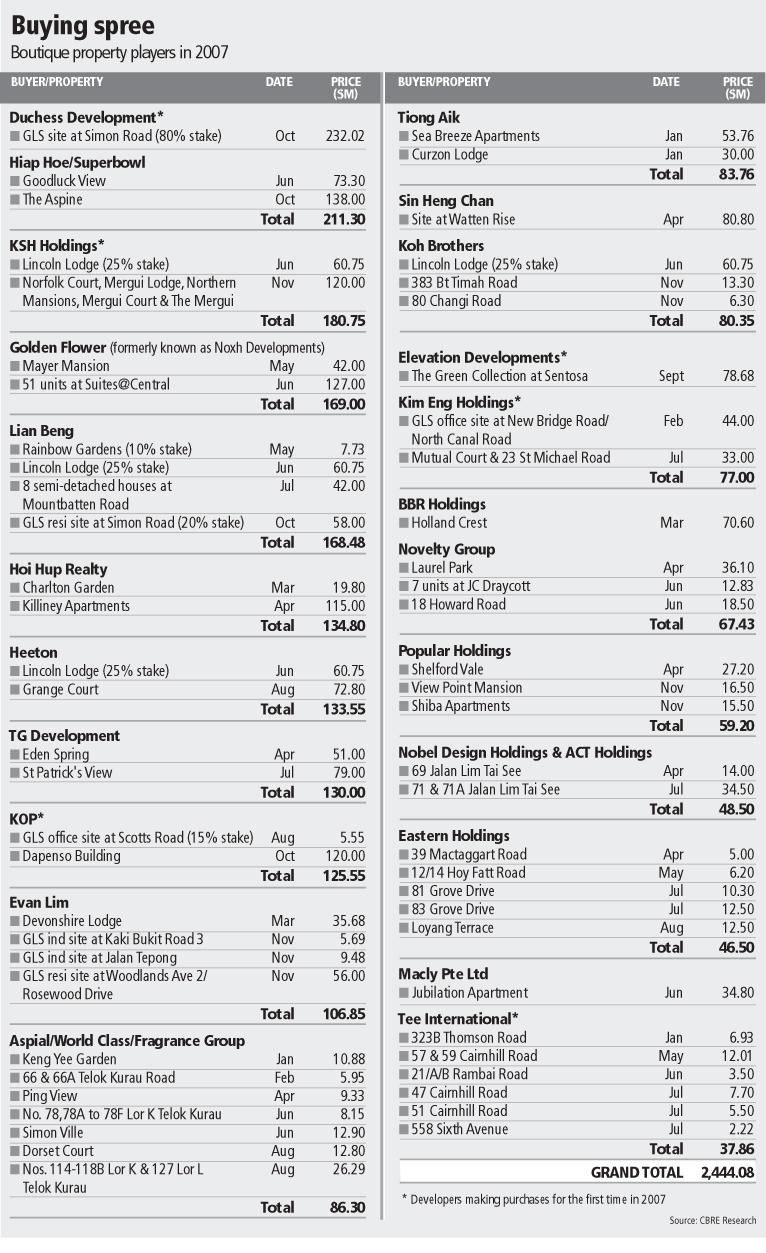
Six companies made their maiden property purchases
this year, data compiled by property firm CB Richard Ellis (CBRE) show.
Among them are companies that have made a name for themselves in other
businesses, such as construction company KSH Holdings and brokerage firm Kim
Eng Holdings. Others are lesser known, like Duchess Development which was
formed by two stockbrokers.
In addition, three other companies - BBR Holdings,
Popular Holdings and Eastern Holdings - first made their appearance in 2006
with land purchases. This year, they have gone on to snap up more sites.
'When the market is good, it draws in players who
may not have been active before,' said CBRE executive director Jeremy Lake.
He noted that many of the new entrants are
construction companies that might have decided to take on development risks,
after watching their developer clients reap big profits. During a property
boom, such risks are lessened.
'If you get your timing right in property, the
profits can be substantial,' Mr Lake said.
Experts said that the same trend was seen during
the last property boom, which lasted from 1993 to 1996.
Companies that did not look at property
development in the past are now beginning to do so because of the fatter
margins.
One example is SuperBowl, which teamed up with its
parent company Hiap Hoe to buy two sites for a total of $211.3 million.
SuperBowl's managing director Teo Ho Beng told BT
that while the company will continue to focus on its core leisure and
entertainment business, it will also increase its exposure to property
development where the margins are better.
Similarly, KSH Holdings sees good opportunities in
property development. The company's chairman and managing director Choo Chee
Onn said that his company invested in residential sites this year because
the opportunities opened up at the right time.
'Going forward, we will buy more sites if the
right opportunities arise,' Mr Choo said in an interview. The company spent
$180.8 million on two residential sites this year.
The first site, which KSH acquired in June with
three other partners, was the construction company's first purchase of a
land parcel.
Other companies branching out from their
traditional core businesses for the first time this year include electrical
and mechanical engineering firm Tee International.
However, new developers and developers looking at
boutique projects still account for only a small chunk of total purchases in
2007.
CBRE's data shows that the bulk of sites sold this
year went to big players such as companies linked to banker Wee Cho Yaw (UOL
Group, Kheng Leong, United Industrial Corp and Singapore Land), Malaysian
tycoon Quek Leng Chan's GuocoLand and property giant CapitaLand.
New and boutique developers together bought some
$2.4 billion worth of land sites in 2007, which account for about 5 per cent
of total investment sales so far this year.
In 2006, such developers accounted for about 4 per
cent of all investment sales, while in 2005, the figure was about 3 per
cent.
However, property analysts warned that these new
entrants are by no means guaranteed success. For starters, most bought sites
in the more central areas of Singapore, where the price gain is expected to
moderate this year even as construction costs are set to keep climbing,
leading to a drop in margins.
'For the high-end residential segment, there is
now risk of a potential correction,' said OCBC Investment Research analyst
Winston Liew.
New developers might not have the resources to
keep construction costs down unless they are contractors themselves, experts
said.
Next year, established developers who have carved
out niches are likely to do best, analysts said.
'Going into 2008, we look for developers with
specific niches and themes to outperform the sector as a whole,' said CIMB
property analyst Donald Chua. The research firm believed that listed
smaller-cap developers are likely to trade at a discount to target
valuations in 2008.
OCBC's Mr Liew advocated being defensive when
choosing property developer stocks. 'We prefer developers that are domestic
focused with substantial pre-sold projects, opportunities to unlock value
from investment properties and finally offering valuation upside,' he said.
- 2007 December 24 SINGAPORE
BUSINESS TIMES
Kuwait outfit snaps up 97 apartments
in $818m deal
Purchase of units in GuocoLand's condo under
development in Bukit Timah is biggest of its kind

Money spinner: GuocoLand's pre-tax
profit from the sale of the 97 units alone works out to around $500 million.
The company bought the former Casa Rosita site in April 2006 for $280
million or $706 psf per plot ratio
Foreign institutional investors continue to bulk buy apartments in new
residential developments in Singapore.
The latest deal - and biggest such transaction to
date - is Kuwait Finance House's $818.4 million purchase of 97 four-bedroom
apartments in GuocoLand's freehold condo, Goodwood Residence. The property
is being developed on the former Casa Rosita site.
The average unit price is understood to be
slightly over $3,000 per square foot. This is a new high for the prime Bukit
Timah area; it is about 25-30 per cent above the $2,500 psf average price
that Sui Generis is fetching at nearby Balmoral Crescent.
At over $800 million, the deal is the 'single
largest purchase of units in a Singapore residential project under
construction', says GuocoLand group president and CEO Quek Chee Hoon.
Industry observers' back-of-the-envelope
calculations show that GuocoLand's pre-tax profit from the sale of this
first batch of 97 units alone works out to around $500 million.
The four-bedders bought by a fund managed by
Kuwait Finance House (Malaysia) Berhad range from 2,500 sq ft to 3,900 sq
ft, GuocoLand said.
The Singapore property arm of Malaysian
tycoon Quek Leng Chan is likely to release the remaining 113 units in the
210-unit freehold condo for sale in the first quarter next year, depending
on market conditions. The development includes apartments with two and three
bedrooms, as well as penthouses.
The largest penthouse, a duplex unit of
about 12,000 sq ft with a rooftop pool, is expected to go for nearly $40
million. The WOHA Architects-designed project also includes 15 cabana-styled
apartments.
This is not KFH's first such investment
in the Singapore property market. A few months ago, an Islamic real estate
fund set up by KFH and the Malaysian government-owned Amanah Raya Berhad,
picked up two blocks (with a total of 56 apartments) at Reflections at
Keppel Bay for about $286 million.
Other recent foreign bulk purchases of
apartments in new projects here include Macquarie Global Property Advisors's
$136 million acquisition of 19 units at 8 Napier, at an average price of
$3,550 psf.
A Spanish private-equity fund is believed
to have bought 20 apartments at The Cascadia, further down Bukit Timah Road,
at about $1,600 psf.
While Singapore developers and property
consultants are cautious about prospects for high-end residential prices
next year - most are expecting modest gains of up to 10 per cent, after a
nearly 50 per cent spike this year - the outlook appears rosier to foreign
investors, market watchers say.
'From the perspective of these foreign
funds, they must place out monies they have raised. If they look at US,
there are sub-prime and credit squeeze problems. Growth in Europe is slow.
Frankly, they may not have a lot of options but to look to Asia,' the
research head of a property fund management outfit said.
Also, Singapore appears an island of calm
in a sea of turbulence, he said. 'It's relatively stable, will soon have the
integrated resorts and F1 attractions, and the island has positioned itself
as a wealth management hub - these are still important factors drawing
foreign institutional money to Singapore property.'
Goodwood Residence, which will comprise
two 12-storey blocks, is slated for completion in 2010.
The development has received the Building and
Construction Authority's Green Mark Award (Platinum). Goodwood Residence
will have more than 500 trees (including 58 preserved trees) planted in the
estate. In addition, the development site shares a 150-metre-long boundary
with the lush Goodwood Hill.
GuocoLand bought the former Casa Rosita site in
April 2006 for $280 million or $706 psf per plot ratio.
Other upcoming Singapore condo projects by
GuocoLand include Sophia Residence, with about 270 units, which the group
plans to release around Q3 next year, and an upscale development on the
Leedon Heights site that is slated for launch in 2009.
KFH is also co-sponsor - together with Singapore's
Pacific Star Group - of the Baitak Asian Real Estate Fund, whose major
investments include a stake in KL Pavilion, a mega development with luxury
residential, mall, office and hotel components in the prime Bukit Bintang
area of Kuala Lumpur. - 2007 December
19 SINGAPORE
BUSINESS TIMES
S'pore builders seen lagging Asian
peers
Policy risks,
fallout from sub-prime crisis may hurt property developers in 2008
Singapore's property companies may lag
behind Asian real estate developers for a second straight year in 2008 as
government limits on speculation cool the housing market.
CapitaLand Ltd, South-east Asia's largest
developer, is suffering its biggest quarterly decline in more than six years
after the government raised development charges by as much as 58 per cent.
The Singapore Property Equities Index has dropped 19 per cent so far this
quarter, the most since a 35 per cent plunge in the third quarter of 2001.
International buyers, who accounted for
more than 40 per cent of real estate purchases in 2006, bought 38 per cent
fewer properties last quarter as capital-market gridlock caused by rising US
sub-prime mortgage defaults curbed borrowing worldwide. The supply of new
homes for sale next year may almost double by value compared with 2006,
weighing on prices, according to CLSA Ltd.
'We can find better propositions
elsewhere in the region, where there's more growth and value to be found,'
said Leslie Phang, who helps manage US$1 billion at Commonwealth Private
Bank in the city. He does not own local builders and prefers Hong Kong
developer Sun Hung Kai Properties Ltd.
The decline in Singapore's property gauge
compares with a 10 per cent drop in the Bloomberg Asia Pacific Real Estate
Index, which tracks 164 companies. The Bloomberg World Real Estate Index has
slipped 8.9 per cent this quarter. Singapore's property index climbed 1.3
per cent yesterday, the biggest rise since Nov 29.
Singapore's home price index increased
8.3 per cent in the three months ended September from the second quarter.
That matched the June quarter's pace, the first time the growth rate failed
to rise since mid-2005.
Demand for apartments grew this year as
banks hired more expatriates. New York-based Morgan Stanley, the No 2
securities firm by market value, said in February that it would open a local
prime brokerage office servicing hedge funds. Citigroup Inc, the biggest US
bank by assets, followed with its own prime brokerage office in March.
About 19,200 jobs were created in
financial services through September this year, government data showed.
Foreigners accounted for about 43 per cent of total purchases in 2006, up
from 14 per cent in 2005, according to CLSA, the Asian investment-banking
arm of Paris-based Credit Agricole SA. Singapore home prices rose 13 per
cent last year, beating all other Asian markets, according to Global
Property Guide, a Manila-based researcher.
The number of foreign purchases fell 38
per cent to 2,073 last quarter, from a record high of 3,332 in the three
months ended June 30, according to DTZ Singapore, the local unit of DTZ
Holdings plc, a London real-estate brokerage.
The government scrapped a program on Oct
26 that allowed buyers of planned apartments to pay 10 per cent of the
asking price and defer the remainder until completion. Builders face higher
fees on new developments after the government raised charges by 58 per cent
for apartment projects and by 42 per cent for commercial properties,
starting Sept 1.
'There are still a lot of policy risks in
this segment,' said Daphne Roth, vice-president of equity research at ABN
Amro Private Banking in Singapore. 'The government doesn't want home prices
to go up too much, too quickly and the policy changes introduced so far have
already impacted the market.' CapitaLand has slumped 25 per cent in
Singapore stock exchange trading during the fourth quarter, set for its
biggest quarterly drop since a 47 per cent plunge in the three months ended
September 2001. It has lost 29 per cent after reaching a record high on Apr
26, even though third-quarter profit more than doubled from a year earlier.
City Developments Ltd, controlled by
billionaire Kwek Leng Beng, declined 18 per cent since the start of this
quarter and plunged 23 per cent from its all-time high on June 19.
The selloff has left local property
shares cheaper than their regional peers. The Singapore Property Index is
valued at 11 times earnings, less than a third of its high of 38 times in
March 2006. The Bloomberg measure of Asian real-estate stocks is valued at
19 times, while the global index is at 17 times.
Thue Isen, who helps oversee US$1 billion
at Bankinvest Group in Singapore, including shares of CapitaLand and City
Developments, said that the decline is a chance to buy local developers,
which he finds more attractive than those in Hong Kong and China.
'People's expectations for the property
market here have definitely dampened, which justifies some of those
declines,' he said. 'If you look at economic and income growth and new
offices starting up, the fundamentals haven't changed that much, so the
pullback looks a bit excessive.'
CIMB-GK Research, based in Singapore, cut
its price forecasts in a Dec 10 note. Properties costing at least S$1,200 a
square foot may climb 8 per cent in 2008, compared with an earlier forecast
of 15 per cent. Overall home prices will rise 15 per cent from a previous
estimate of a 25 per cent increase, said Donald Chua, a Singapore-based
analyst.
The brokerage, a unit of CIMB Bank Bhd,
Malaysia's largest investment bank, also cut its rating on the industry to
'underweight' from 'overweight', citing slowing growth. The firm lowered its
recommendation on CapitaLand to 'neutral' from 'outperform'.
CLSA forecasts that as many as 12,000 new
homes under construction could be up for sale in the next year to 18 months
in the most expensive residential districts, driving up supply and hurting
prices. The 'unprecedented' inventory is worth S$21 billion, almost twice
the S$11 billion invested in real estate in 2006, according to Yew Kiang
Wong, a CLSA analyst in Singapore.
'There's just too much negative news out
there right now, with the government regulations and concerns over
sub-prime,' said Nicole Sze, Singapore-based investment analyst at Bank
Julius Baer, which manages US$350 billion. 'We're unlikely to see the same
kind of broad-based rally that we've had.'
- 2007 December 20 BLOOMBERG

Circle Line key to higher plot ratios
Study
looks at how Master Plan 2008 could change landscape, usher in new
initiatives
When Master Plan 2008 is unveiled
sometime this year, certain areas are likely to see an increase in plot
ratios. A study by Jones Lang LaSalle has tried to zero in on which areas
could be allowed more intensive use of land.

Its conclusion: Look out for undeveloped
state sites within walking distance of Circle Line MRT stations,
particularly those that intersect with existing MRT lines. They are the top
candidates for higher plot ratios.
The property consulting group
specifically highlighted the areas near Paya Lebar MRT Station, Buona Vista
MRT Station (which will see the Circle Line intersecting with the existing
East-West Line) and HarbourFront MRT Station (Circle Line crosses North-East
Line). Also, while Buona Vista is shaping into an R&D/commercial hub,
the HarbourFront district's redevelopment potential is increasing because of
projects in Sentosa and Keppel Bay nearby.
Another promising area is in the vicinity
of the Circle Line Station at Telok Blangah. Although it does not intersect
with an existing MRT line, it will benefit from a spillover from the ongoing
redevelopment in Sentosa and HarbourFront.
JLL does not see major, across-the-board
increases in plot ratios in MP 2008. But it argues that intensifying land
use for undeveloped state plots along these stations will spread social
benefits from the government's investment in the Circle Line to more people
and also improve accessibility.
Raising plot ratios (ratio of maximum
potential gross floor area to land area) will also address the issue of
rising demand for Singapore's properties and prevent overcrowding in
specific areas such as the central and CBD regions.
Although the Circle Line also touches
locations near Dhoby Ghaut and Bishan MRT stations, JLL excludes them as
these areas already have high plot ratios.
The study also suggests that white sites
- with a range of uses and change in use mix allowed - will be more readily
available islandwide instead of being confined largely to the CBD. 'It
further promotes creativity in future projects,' says JLL's head of research
(South-east Asia) Chua Yang Liang.
He also sees the Urban Redevelopment
Authority introducing more mixed use, rather than traditional single-use
zones, to 'further provide the flexibility needed to accommodate changing
demand patterns as a result of shifting demographics'. MP 2008 could also be
more tolerant of non-traditional types of residences. For instance, obsolete
industrial buildings could be re-modelled along the lines of New York's
Manhattan lofts. 'This will accommodate shifting market forces and tastes,'
Dr Chua argues.
JLL also suggests that URA may realign
traditional industrial estates to support demand needs of the
knowledge-based economy or rezone them for other uses. 'For example,
industrial areas within housing estates such as those found in Jalan
Pemimpin could potentially be rezoned to residential or possibly an
education hub,' it said. After all, the area is near Raffles Institution and
Raffles Junior College.
MP 2008 could also extend the 'work, live
and play' concept beyond Marina Bay into the suburbs as Singapore cannot
live by its business image alone, JLL predicts. 'We can expect to see more
areas designed for cultural developments, for example, the civic, cultural
and retail complex in Buona Vista, and new conservation areas that serve to
retain the fabric of the collective memory,' Dr Chua said.
JLL also expects to see many more
recreational zones across Singapore. 'The likes of the recent Punggol
announcement will be more common,' the study said.
On the back of Sentosa Cove's success,
JLL expects other islets around Singapore like Southern Islands and Pulau
Ubin to be put for waterfront residential use.
In the existing CBD, JLL suggests that
Shenton Way will see a further shift towards a mixed-use (including
residential) district, once the current office supply crunch eases. In May
last year, URA announced a temporary ban on conversion of office use in the
central area, including the CBD, to other uses until end-2009.
Last year, the government identified
Jurong East and Paya Lebar for development into business hubs. Dr Chua says
land around Paya Lebar MRT Station will be intensified in line with
government plans to transform it into a sub-regional centre and that the
location will be ideal for cost-conscious office tenants.
However, Dr Chua suggests that the area
around Jurong East MRT Station is more suited for research and development
because of its proximity to universities, the Science Park and one-north
rather than as an alternative backoffice hub along the lines of Tampines.
National Development Minister Mah Bow Tan
last year also ruled out massive, across-the-board islandwide increases in
plot ratios for MP 2008 to cope with a higher population target of 6.5
million. The Master Plan, a detailed land use plan that guides Singapore's
medium-term physical development, is reviewed every five years.
- 2008 January 4 SINGAPORE
BUSINESS TIMES
RESIDENTIAL
Property boom expected to continue
Robust economy, jobs growth, strong housing demand and en bloc sales
proceeds are key drivers
The bullish sentiment in Singapore's
residential market continued into 2007 from where it left off in 2006. In
the first nine months of this year, the market recorded a total of 29,331
sales transactions worth some $52 billion. This represents a year-on-year
increase of 89 and 116 per cent respectively.

The demand for high-end residential housing has been growing at a
feverish pace over the past two years and although the stock market plunge
may have affected investor sentiment, new benchmark prices continued to make
headlines over the past two quarters. Rising fast to support the high-end
residential sector are the mid-tier and mass market segments, which have
picked up significantly since early 2007 with record prices set at several
project launches. Strong economic outlook, coupled with higher salaries and
bigger bonuses and rapid jobs growth have brought new impetus for investors,
home owners and speculators to upgrade and/or to purchase.
Comparing average prices with those at the end of 2006, the average price
for homes in the super luxury market segment (luxury developments which
crossed the $2,500 psf mark in Q4/2006) jumped 42 per cent to $3,700, while
the high-end market segment (luxury developments in Districts 1, 4, 9, 10
& 11) rose by 36 per cent to $2,076 per sq ft. The average prices for
both mid-tier and mass market developments have also risen by more than 50
per cent, albeit from a lower base, to $1,250 per sq ft and $700 per sq ft
respectively.
One major market driver is en bloc sales, which have been very active
since early 2005. However, with the prolonged US sub-prime credit woes,
hikes in development charge rates and the tightening of en bloc sales
legislation, the en bloc sizzle has taken a breather from the end of the
third quarter of this year.
This has been a phenomenal year for en bloc sales. Since January, some 95
en bloc sales with a total value of $11.3 billion were transacted, compared
to 65 transactions totalling $7.5 billion for the whole of 2006. The
displaced tenants and owner-occupiers from these properties have contributed
to the overall increase in rentals and capital values of homes in the
mid-tier, mass and public market segments.
Notwithstanding the stock market shock in the third quarter, the buying
momentum is expected to resume between next month and early 2008 given the
wave of purchases from displaced en bloc-owners who are expected to collect
their money and buy a replacement home around this time. This time round,
the mid-tier and mass market segments will lead the way with a strong
growth, lending solid fundamentals to prices in the high-end and luxury
sectors.
For next year, the residential market in Singapore is expected to remain
strong with all segments looking set to continue growing supported by robust
domestic economy, jobs growth, wage growth in both the public and private
sectors, strong housing demand from expatriates relocating to Singapore and
reinvestment of proceeds from en bloc sales.
The general market consensus is that supply will tighten due to a short-
term supply crunch in 2008, as the expected demolitions from en bloc sales
outstrip the completion of new projects. The tightness in supply will be
exacerbated by the need to fill job vacancies which stood at close to 40,000
by mid-2007 with unemployment standing at 1.7 per cent in September 2007.
An estimated 10,000 units from en bloc sales are also expected to be
demolished in 2008 while TOPs from new projects are expected to re-supply
only 8,000 units. (This is largely due to the few construction starts back
in 2003 and 2004 when economic confidence was low, which resulted in low
completion numbers in 2007 and 2008.)
Furthermore, there is also the potential risk for a slower pace of
construction of residential properties arising from the strong competition
for resources in the construction sector. This is largely due to the fact
that several of these mega projects are also scheduled for completion within
the next three to four years. Some of these mega projects include the two
integrated resorts, BFC, petrochemicals plants in Jurong Island, public
infrastructure such as the Circle Line and Circle Line Extension, common
services tunnel in Marina Bay, sports hub at Kallang, and Gardens by The
Bay.
On the demand side, there are several significant events that could spur
investments into Singapore. The first is next September's Formula 1 night
race, which will bring international attention to Singapore starting from
February, when the F1 season begins.
The weakening US dollar, strengthening Sing dollar, reduced confidence in
US markets and political uncertainties as several key regional countries
will be holding their general elections soon, could encourage more
high-net-worth individuals (HNWIs) from around the region to park some of
their wealth here.
The strong Singapore property market has also caught the eye of fund
managers from Europe, the Middle East and Japan who have been investing in
Asian real estate; and Singapore will benefit from that allocation in 2008
and beyond.
The high-end market is expected to remain steady with average prices
likely to rise by another 15 to 20 per cent to hit an average of $3,000 per
sq ft. With such strong demand, it would not be to far-fetched to expect
some units in super luxury residential projects to cross the $6,000 per sq
ft mark.
Developers will continue to raise prices for luxury high-end apartments
with superior product quality, such as more spacious surrounding, and
designer fixtures and fittings. At the same time, the replacement cost of
land, whether from en bloc sales or government land sales, will continue to
go up.
Meanwhile, Singapore's status as a global financial centre, tax-friendly
environment, strong currency and liquidity in the local market will keep
attracting investment interest from the fast-growing private banking sector
which, in turn, are attracting HNWIs to the region as well as expatriates
entering Singapore's job market.
While the high-end market takes a slower growth next year over an
increased baseline, the mid-tier and mass markets will surge in 2008 due to
strong demand and spill-over effects from the high-end market. Twelve months
ago, we proclaimed that 2007 will be the year of resurgence for the mass
market. We were spot on. We now know that the resurgence is backed by solid
fundamentals and we expect this sector to soar in 2008.
Assuming two-thirds of home owners, who sold their properties en bloc in
the first nine months of 2007, will buy replacement homes, we could expect
to see some 4,300 buyers with a budget of approximately $7.5 billion looking
for homes in the first half of 2008.
Soaring high-end prices and supply crunch in prime districts have forced
some buyers to turn their attention to mid-tier projects. In addition,
public and private sector wage rise backed by robust domestic economy,
tighter job market will also drive up demands from HDB upgraders or families
exceeding the HDB income ceiling, particularly in the mass market segment.
Strong demand could also push mid-tier prices up by another 20 to 40 per
cent to between $1,500 and $2,000 per sq ft for the whole of 2008. Areas
that will benefit from the rise in the mid-tier market include Balestier,
Bukit Timah, Novena, Thomson and Upper East Coast. As many of the mass
market areas are still relatively undervalued, it is expected that prices
will grow strongly, up by between 30 and 50 per cent from a low base, with
average prices reaching around $1,000 per sq ft. Areas likely to see the
most significant price gains include Upper Paya Lebar, Hougang, Ang Mo Kio,
Upper Thomson to Mandai, Clementi, West Coast, Jurong East, Upper Bukit
Timah and Bedok.
There are several projects in the high-end and super luxury markets to
keep an eye on in 2008, such as the Ritz-Carlton Residences at Cairnhill,
Hilltops at Cairnhill, Paterson Suites at Paterson Road, and The Marina
Collection and The Quayside Isle in Sentosa Cove. We would also be
monitoring The Cascadia and Floridian at Bukit Timah, and the development by
CDL in Thomson Road for signals of strength in the mid-tier market. For the
mass market segment, it will be the developments at Simon Road and Bedok
Reservoir and Park Natura at Bukit Batok. In the landed property sector,
international attention-grabbers in Sentosa Cove could be launched in 2008.
The rental market is also expected to strengthen. Based on robust demand
and limited supply being completed, coupled with the withdrawal of
properties in the prime districts through en bloc sales, rentals are likely
to hit new highs.
Rents in prime districts will increase by 20 to 30 per cent next year, to
an average of $6 to $8 per sq ft per month. The trend of existing tenants in
prime districts moving out to fringe or suburban areas will continue, and
this will support the annual 50 to 80 per cent growth of the suburban rental
markets, at average rents of $4 to $5 per sq ft per month.
Though the property market continues to exhibit strong performance, there
are several factors which could affect the residential sales market. Factors
such as prolonged uncertainties in the global equity markets, further
property measures imposed by the government to cool the market, rising oil
prices and high inflation rate could possibly dampen investors' sentiment
and confidence. Increased operating costs due to rising residential and
office rents have also sparked concerns about the erosion of Singapore's
attractiveness for MNCs.
The Singapore government targets a long-term economic growth of 4 to 6
per cent per annum. We have been making basic changes to diversify our
economy, through the IRs (conventions/exhibitions, Universal Studios theme
parks), through investments in R&D and intellectual property, through
continued liberalisation of funds management, private banking and insurance
industries. This re-positioning of Singapore as a vibrant, global city will
continue to support the residential market.
Singapore is undergoing a structural upwards re-rating of the property
market. Barring unexpected shocks, property prices will continue to rise for
at least three years, and if the IRs deliver their performance, another five
to seven years. And even if there were a downturn in the property sector
beyond 2012, the authors believe that bottom prices then will still be
higher than the prices of 2007.
Given the factors outlined above, what might be the opportunity cost of
doubting the continued growth in this market and staying on the sidelines
and waiting for it to drop? - 2007 November
14 SINGAPORE
BUSINESS TIMES

A broadbased recovery in the housing
market now looks imminent with some developers feeling confident enough to
put in new benchmark bids for 99-year suburban leasehold sites.
But HDB upgraders are finally making a
comeback, bolstered no doubt by salary revisions in the civil service and
mid-year bonuses.
Even the much-anticipated fallout from
the United States sub-prime crisis and subsequent global credit crunch
appears to have left the Singapore property market relatively unscathed. Not
only have foreign institutional investors continued to pump money into the
property sector, a new base of investors, most notably from the Middle East,
are making their presence felt.
Of course, there is still a level of
volatility in some segments. The high-end and luxury residential sector may
see both foreign and local investors make more cautious decisions about
buying into a segment that is already a little peakish.
Speculators, who have been driving up
prices in the high-end and luxury segments, also appear to be beating a
retreat, after considering the upsides in flipping properties no longer
worth the risks.
Emerging markets are also looking like
pretty safe bets though.
Few will have failed to notice that when
the US sub-prime situation started to unravel in July and August, the China
and India markets seemed impervious to its effects.
The growth story of both these
powerhouses is well known, so much so that industrialists and developers
alike are looking for new frontiers.
Vietnam is certainly a hot favourite now
but closer home, Malaysia too holds many opportunities.
And if the Singapore market is anything
to go by, the increasingly buoyant high-end sector in its capital city
certainly bodes well for the rest of the real estate market.
Risk aversion may yet be the catch phrase
of choice for the months ahead.
Not surprising then, financial analysts
have come out in support of the mass market and the mid-cap developers most
exposed to this segment.
Also looking relatively safe is the
growing Singapore real estate investment trust (S-Reit) sector. The first
Reit was listed in 2002 and, to date, there are 17 S-Reits with more
expected to be listed.
2007 September 27 SINGAPORE
BUSINESS TIMES
The million-dollar club in Singapore
continues to grow. The IRAS annual report shows that 2,121 taxpayers earned
more than $1 million in Year of Assessment 2006, which assesses income
earned in 2005. That was 22 per cent up from 1,738 million-dollar earners in
2004.
The bulk of these wealthy people were
Singapore residents, with only 31 non-residents. For tax purposes, residents
are defined as those physically present in Singapore for at least 183 days
in a year.
The total income of this exclusive club
has also grown. Their total assessable income earned in 2005 was $4.2
billion, up from $3.4 billion the year before. And the total tax assessed on
their income was $682 million - about 17 per cent of total income tax
collected from all individuals that year.
- SINGAPORE BUSINESS TIMES 2007 September 8
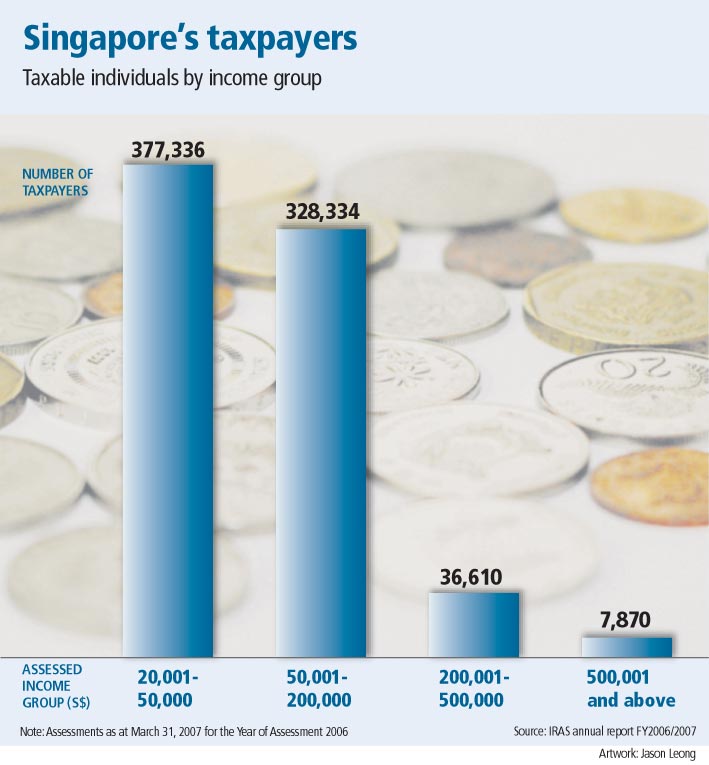
Sizzling real estate sector
Bullish
investors may drive 2007 sales to a record high, while home prices and rents
continue to surge

After years of being in the doldrums,
the Singapore property market has been staging a spectacular recovery in the
past couple of years. The rally is being fuelled by a surge in confidence
from foreign investors as well as local buyers. The real estate sector is
firing on all cylinders, including investment sales, residential and office.
A whopping $24.81 billion worth of
investment sale deals were sealed in the first six months of this year,
according to CB Richard Ellis (CBRE). Investment sale deals - a gauge of
major property players' confidence level in the mid-to-long-term prospects
for the real estate sector - include collective sales, other land deals,
transactions of entire office and other buildings, as well as strata-titled
units above $5 million. The first half of 2007's sparkling investment sale
numbers include some 75 collective sales worth $9.3 billion, higher than
$8.2 billion for the whole of last year.
CBRE expects the full-year investment
sale figure to surpass the record $30.51 billion set in 2006, hitting as
high as $35 billion.
Major deals in H1 this year include the
$1.04 billion sale of Temasek Tower, the collective sale of Leedon Heights
($835 million) and Novotel Clarke Quay Hotel ($201 million).
In the residential sector, the Urban
Redevelopment Authority's (URA) Q2 price index for private homes was up 8.3
per cent from the preceding quarter and 21 per cent higher year on year. And
latest Q2 official figures show that the residential price recovery that
began some two years ago in the high-end segment fuelled by foreign buyers
has started filtering down to other segments of the market, based on URA's
sub-indices.
Prices of non-landed private homes in the
Core Central Region (CCR) - which includes prime districts 9, 10, 11,
Downtown Core (including Marina Bay) and Sentosa - were up 7.9 per cent in
Q2 over Q1, while prices of non-landed homes in Rest of Central Region (RCR)
- which includes areas like Bukit Merah, Queenstown, Geylang, Toa Payoh and
Katong - rose 8.1 per cent over the same period. The Outside Central Region
(OCR), covering suburban mass-market locations like Woodlands, Clementi,
Jurong, Hougang, Tampines and Bedok, posted a 7.2 per cent
quarter-on-quarter rise in Q2.
The rental market has also been sizzling,
with residential rental indices of non-landed private homes rising 12 per
cent in Q2 over Q1 for the CCR, and by 10 per cent and 9.4 per cent
respectively for RCR and OCR in the same period. The Q2 rental indices were
up around 35 per cent from a year ago for each of the CCR and RCR, and by
28.3 per cent for OCR.
In the public housing segment, the
Housing & Development Board's (HDB) resale flat price index rose 3 per
cent quarter-on-quarter in Q2, compared with a 1.3 per cent gain in Q1.
The outlook for the residential sector is
bright. Most property consultants predict that URA's overall private home
price index may surge a further 8 to 15 per cent in the second half,
chalking a full-year increase of 23 to 30 per cent. Analysts generally
expect HDB resale flat prices to post an 8 to 10 per cent full-year
increase.
Interestingly, collective sales have
caused a ripple effect. For instance, those who sell their homes through en
bloc sales are looking for replacement homes, in many cases outside the
prime districts where they sold their en bloc properties because of rapidly
rising prices in the prime locations.
This has helped to spur a recovery in the
other market segments, even HDB resale flats, where a few units have been
purchased at record prices by those who sold their private homes through en
bloc sales.
At the same time, as developers pull down
en bloc sale sites to redevelop them, the resulting shortage of prime
district apartments has helped fuel rental hikes for such homes. In the
industrial property market, average rents for all categories of space
increased in Q2 this year. High-tech space posted the biggest
quarter-on-quarter gain of 11.9 per cent to $2.35 psf per month, as the
office space shortage and rising office rentals led many qualifying
occupiers to move to high-tech properties, according to CBRE. The average
monthly prime retail rent along Orchard Road posted a 1.8 per cent
quarter-on quarter gain in Q2 to $34.40 psf - close to the $35.10 psf
achieved in 1996.
As for the office sector, a shortage of
space in the near term, coupled with strong demand from occupiers including
big-wig international financial institutions have been the key factors
driving a whopping 80 per cent year-on-year rise in CBRE's average prime
rental in Q2 to $10.80 psf a month. This surpassed the 1996 peak of $9.90
psf a month, and is fast closing in on the 1990 historic peak of $11.50 psf
a month. The Q2 office rental figure is also more than double the $4 psf
during the current cycle trough in Q1 2004.
Market watchers expect office rents to
head further north in the next few years because of the supply crunch.
However, the government has been releasing more office sites, including the
maiden 'transitional office' plot which can be built into a low-rise office
building in about a year.
In addition, it has made available more
99-year condo sites, mostly in suburban locations. Besides tackling the
supply side, the authorities have also begun releasing more property market
data so that participants can make more informed decisions. So far, the
indication from government is that it is not inclined to intervene to cool
demand.
Fundamentals for the Singapore real
estate sector remain strong for the next couple of years, at least - barring
unforeseen circumstances.
Of course, a sustained rout in the local
stock market because of the selldown on Wall Street is likely dent sentiment
in the Singapore property market. But there could also be a more direct hit
if the US sub-prime mortgage default fiasco dries up some of the liquidity
that has been powering the local real estate sector's sparkling recovery.
- SINGAPORE
BUSINESS TIMES 9 August 2007 By Kalpana
Rashiwala
UOB tightens up on home loans in face
of dizzy market
Bank imposes caps
on valuations and puts 80% ceiling on loans
Wee Cho Yaw has done it again, though
only time will tell if he was ahead of the curve.
At a time when property prices have
started to touch giddy heights, the chairman of United Overseas Bank (UOB)
has reportedly asked his institution to tighten lending criteria.

Since late last month, UOB has been
lending only 80 per cent of a home's valuation, even though most banks are
willing to stump up 90 per cent of the selling price.
UOB has also decided to put its own cap
on valuations, which appear more conservative than the current market
prices.
Mr Wee, arguably Singapore's sharpest
banker, stepped down as chief executive of UOB in April this year and was
succeeded by his oldest son, Ee Cheong.
UOB's stricter lending criteria mean that
some potential borrowers have been turned away. A UOB mobile sales banker
complained that she has been losing sales but has told prospective customers
that she can try to appeal on their behalf. UOB is believed to be the first
bank to make its lending norms more stringent.
At UOB's second-quarter results on
Tuesday, Eddie Khoo, executive vice-president, personal financial services,
said that less than 10 per cent of the bank's new home loans this year
provided more than 80 per cent financing.
'We require a higher cash portion,' said
Mr Khoo.
He said that more than 80 per cent of
UOB's home loans were for owner occupation and that foreigners accounted for
20 per cent of home loan customers.
For certain hot projects in the prime
districts such as Orchard Residences, Scotts Square or St Regis Residences,
UOB has put a valuation cap of $3,600 per square foot (psf), even though
sales and sub-sales have been reported at much higher prices.
Scotts Square, launched last week, saw
169 units sold at an average price of $3,983 psf. The highest price paid was
$4,430 psf for a one-bedroom apartment on the 41st floor, of the 338-unit
project, said Wheelock Properties, the developer.
The median price for St Regis Residences
on Cuscaden Road, developed by City Developments, is $3,713 psf, according
to Urban Redevelopment Authority data. In June, it was reported that a unit
went for $4,635 psf at the 173-unit St Regis Residences which has only 15
units unsold.
At selected projects in the upmarket
districts 9, 10, 11 and in Marina Bay, UOB is said to have set the valuation
cap at not more than $2,600 psf.
Sub-sales of The Sail @ Marina Bay are
being advertised at prices ranging from $1,900 psf to over $3,500 psf.
Caveats lodged show that units were sold from prices as low as $1,249 psf
for The Sail which was first launched in 2004.
Even for the recently launched Fontaine
Parry near Serangoon, UOB is said to have a valuation cap of $834 psf.
According to sole agent Knight Frank, the first phase of Fontaine Parry,
which was sold out, saw prices starting at $850 psf and some sub-sales are
now going for $900 psf.
For the first half of 2007, UOB grew its
total home loans book 18 per cent, outpacing the industry average, to $20.7
billion. DBS's group home loans rose 8.75 per cent to $26.1 billion. UOB
said Singapore mortgages were up 15 per cent while DBS reported an almost
similar growth of 14 per cent.
In August 1995, Mr Wee said famously: 'I
don't think the property market will collapse but prices have reached a high
and the upside is limited.'
Although still sympathetic to first-time
property buyers or HDB upgraders, he said the bank had more stringent
criteria for speculative buyers and those investing in second properties.
The strategy meant that UOB lost some
market share in property loans.
UOB that year reduced financing to only
65-70 per cent of the purchase price of a property, compared to about 90 per
cent in 1992, just before the height of the property frenzy which peaked in
1996 before crashing.
Singapore's property market subsequently
went into a long depression, which lasted for the most part of the decade
until 2003 and sent many borrowers into negative equity - where the size of
their loan was larger than the value of their property.
The bank is opting for caution again.
Said a spokesman: 'UOB has always taken a
prudent approach in its credit assessment process. A loan application is
assessed on the creditworthiness of the borrower as well as the merits of
the property. We would consider the loan application favourably if the
borrower meets our criteria. From time to time, the bank reviews its home
mortgage policies, and if necessary, adjustments may be made to align with
market conditions.' - by Siow
Li Sen SINGAPORE BUSINESS TIMES 9
August 2007
COMMENTARY
2007 promises to be an interesting year for
Singapore with the euphoric success at Marina Bay and a number of
regional property players collaborating on the orderly playing
field. We have assembled a few key bits of research and
news so one can interpolate as one wishes.
Singapore is experiencing 'flavour' of the season
for even some Western-based real estate investors and hedge funds to get
their feet wet in Asia. This trend started last year with Colony
Capital of New York's purchase of Raffles Hotel with the Fairmont Hotel
group.
No better place than Singapore as a test market
but German and Australian funds have been playing in this market for a
number of years and Hong Kong players are demonstrating that they know how
to cooperate for mutual profit. This hasn't always been the
case as often the cities were competing.
In any event, the developments taking place at
Orchard Turn and Marina Bay is igniting the property market in
Singapore. And Sentosa is finally taking off like wild-fire
after many years of dedicated effort.
Purchasers of luxury condominiums are being asked to turn over blank
cheques for the premium units and luxury residential condos have hit the
$2,500 per sq ft price mark. >> MORE
Much of Singapore property market's success is as
a result of the expectation that more expatat's will be moving to the city fuelling
growth in the luxury sector of the residential market and increased deman
for office
space. Still, as typical of Asian investors, many
are still treating Real Estate as yet another commodity - some of which is
to be traded for profit . - Andrea
Eng
There's upside yet in Singapore
property
Investing in
property requires capital and time but the rewards can be substantial
Singapore's property
market is booming, with activity centred in districts 4, 9, 10, 11and
15. And I believe there is a lot more upside yet. Why? For each key
event listed below, I expect an above average movement of $200 per
square foot for the districts mentioned in the years ahead:
Year 2008: Singapore will host the
world's first Formula One night racing. The world will be invited to
Singapore, interact with and invest in Singapore.
Year 2009: The first integrated resort (IR)
at Marina Bay will be completed with US$5 billion flowing into Singapore
from the first wave of tourists. They will come from the business travel,
meetings, conventions and dexhibitions segment.
Year 2010: The second IR on Sentosa will
be completed with another US$5 billion flowing in from the second wave of
tourists. These tourists will come from destinations beyond a nine-hour
flight radius.
Year 2011: My guess is that there will be
a general election in Singapore which could see some election year goodies.
Year 2015: Singapore celebrates her 50th
birthday and hopefully fulfils Prime Minister Lee Hsien Loong's vision of
Singapore as the jewel of the region.
Can we really profit from investing in
the property market?
While many wealth creation fads come and
go, property investment has consistently created more permanent millionaires
than any other investing strategy in history. Here are what some
of the wealthiest Americans have said:
'Real estate is the basis for all
wealth.' - Theodore Roosevelt
'Eighty per cent of all millionaires
made it through real estate.' -
Andrew Carnegie
'Buying real estate is the best, safest
way to become wealthy.' - Marshall
Fields
The truth is that property investment is
not just for the rich. If done correctly, anyone who has the desire to
succeed can create enough passive income or a lump sum of cash to become
financially free.
According to an annual World Wealth
Report compiled recently by Merrill Lynch and research firm Capgemini,
Singapore has 66,660 millionaires (in US$ terms). They account for about 1.5
per cent of the population, that is, three out of every 200 people here are
millionaires.
Where are the areas to invest? I highly
recommend Sentosa Cove and District 10.
Sentosa Cove offers one of the most
exciting propositions - a residential enclave that shares the island with an
integrated resort. The wealthiest individuals in the world will
be looking to buy your property which will be situated right next to their
favourite entertainment spot.
In district 10, the Duchess area is the
place where you can invest in your child's future. Within a one-km radius,
it offers several premier schools: the Nanyang and Raffles Girls' primary
schools, St Margaret's Secondary School, Nanyang Girls' High, Chinese High
School, Hwa Chong Institution, National Junior College and Hwa Chong Junior
College. -
by Clement Chiang SINGAPORE
BUSINESS TIMES
commentary 4 July 2007
Hot picks in real estate
2007
March 22: It has been quite a
year for the Singapore property market, emerging from the gloom and heading
into uncharted territory. The spark that started the uptrend can be traced
back to late 2004 when foreigners, flush with liquidity, began showing
interest in Singapore's high-end property.
This was boosted by the country's plans
for the Sentosa and Marina Bay integrated resorts as well as government
efforts to make property more appealing by easing the approval process for
foreigners to own land (in the case of Sentosa). Moreover, Singapore's
property market had been lagging behind Asian cities like Shanghai, Hong
Kong and Mumbai.
Capitalising on the government's effort
to revitalise the property market, developers started acquiring prime land
in the core central region (downtown core, Sentosa and districts 9, 10 and
11) in anticipation of rising property prices. It led to a series of en bloc
deals in 2005 and 2006 as developers outbid each other to secure prime land.
This in turn prompted the government to
hike the development charge (DC), with the rates for commercial use and
office space rising by an average 12 per cent, landed residential use by 6
per cent and non-landed residential use by 14 per cent.
Reaping rewards
Savvy investors who saw the glimmer of
light in late 2005 as a buy signal are reaping the rewards of their
investments. In 2006, the Singapore property equities index rose 67 per cent
while the URA property price index for residential and commercial property
increased by 10.2 per cent and 17 per cent respectively. Singapore Reits (S-Reits)
have also done well, appreciating by more than 40 per cent on average in
2006.
Given the buoyant outlook, where should
investors look for the best returns in 2007?
Home prices increased by 10 per cent in
2006, with the bulk of the price increase concentrated in the core central
region. Prices are expected to rise by a further 12 per cent this year.
Residential rents have also risen 14 per cent in 2006.
While the focus has been on the central
region, the mass market could see the filter- down effects this year, for
several reasons. First, the strong economy has led to greater job security
and rising wages. Coupled with a partial restoration of CPF, demand for mass
market projects is expected to rise as middle-income earners, who were most
affected by structural changes, will have greater confidence to upgrade
their properties.
Second, following the wave of en bloc
deals, people who have sold their homes to developers would be shopping for
replacement units. As some of them may be priced out of units in the
original area, they would look for homes in outlying areas.
Third, the government's strategy of
attracting foreign professionals into the country is paying dividends.
Anecdotal evidence suggests many have decided to call Singapore home,
driving up demand for private property. Many Singaporeans are also snapping
up projects close to where the foreigners are working, in hopes of fetching
rich rentals.
This can be seen in the recent launch of
One North Residences at One North Research Hub in Buona Vista, which sold
close to 80 per cent of the units in three days.
On the commercial side, the sharp 30 per
cent spike in office rentals in 2006 was attributed to the shortage of prime
office space. Although the government has released the Business and Financial Centre for
development, no new office supply is expected to hit the market till late 2009. This has
caused office rentals in the CBD to surge past $10 per sq ft with occupancy hitting 98.4
per cent for Grade A properties.
With more multinationals from the
finance, IT and marine industries relocating to Singapore, demand has risen considerably,
while downtown supply has dipped as old commercial buildings are being
redeveloped into apartments. As such, the commercial sector will continue to do well for the
next couple of years, and new records are expected to be set for Grade A
properties. Sub-prime areas will also benefit from spillover demand.
Pockets of opportunities
As property recovers, property stocks
have seen one of the best runs in recorded history, far outpacing the rise in real
estate. While fundamentals are strong and profits should be very healthy, much of
the prospects of property developers may already be in the stock price. However,
there are pockets of opportunities, particularly in stocks exposed to the
commercial sector as well as Reits.
With the crunch in office supply,
commercial real estate landlords will see another stellar year. Given the discrepancy
between rental yields of commercial property and the required returns of commercial Reits,
value can be unlocked by landlords by selling these properties to existing players or
floating a Reit themselves.
S-Reits outperformed their global peers
in 2006 and are likely to see slower growth ahead. Given that it is increasingly
difficult for Reit managers to make yield accretive acquisitions, it is likely that
there will be some merger and acquisition (M&A) activity among listed players.
Smaller Reits like Cambridge Industrial Trust, which typically have more attractive
valuations and higher yields, are likely targets for takeover.
Property is riding high and will continue
to see strong interest in 2007. For investors, this should be a good time to
invest in well-located mass market projects, particularly those close to the city or
MRT stations. Commercial landlords are also expected to enjoy a good run for at least
the next two years. Grade A office buildings have already seen record rentals, and
this is expected to spill over to the lower tiers. While prospects for property
remain bright, property counters may have already priced in much of the good news. As such,
investors should not expect the same gains as before and be more selective.
- Terence Wong is chief executive officer, and Alvin Yong, research
associate, at SIAS Research Pte Ltd SINGAPORE
BUSINESS TIMES 22 March 2007
Overview
These are heady times to be a developer or an
estate agent in Singapore. The city-state is in the grip of a property boom
powered by economic growth, strong employment and a buoyant stockmarket.
Rents, both residential and commercial, are rising fast. And new blocks of
flats are selling even faster, sometimes within hours.
January 5th saw the launch of One Shenton, an
apartment block near Marina Bay, just south of the central business
district. Thousands turned up and virtually all of the 330 apartments on
offer were sold within one-and-a-half days. The developer, City Developments
(CDL), said it had sold the block for between S$1,500 and S$2,200 ($972 and
$1,426) per square foot. The smaller, one-bedroom flats sold for about S$1m
each; the biggest flats went for four times as much.
CDL has delayed selling the 11 penthouse units at
One Shenton in the hope of attracting even higher prices. A few weeks ago
the penthouses at the nearby Marina Bay Residences were sold for a new
Singaporean record of S$3,400 per square foot. The rush has all the
hallmarks of a speculative bubble, but few believe it is anywhere close to
bursting just yet. - 22 January 2007
THE
ECONOMIST
'Property Prices to Rise on Consistent
Demand'
Singapore's high-end property prices may rise by
as much as 10 per cent this year amid consistent investments by overseas
funds and expatriate workers, the chief executive of Southeast Asia's
biggest property company said on Monday.
'2007 will be good year,' CapitaLand Ltd chief
executive Liew Mun Leong told Dow Jones Newswires during a visit to Kuala
Lumpur.
Still, that's a slower growth rate than last year.
Analysts estimate prices of Singapore's high-end property market, which
traditionally attracts rich buyers from Asia and funds looking to invest in
the real estate sector, rose between 20 per cent and 30 per cent in 2006.
Mr Liew said CapitaLand expects medium-end
property prices in Singapore to rise by 5 per cent compared to 2006, while
high-end developments could see an increase of between 5 per cent and 10 per
cent on year.
Mr Liew said the trend of prices rising is
'cascading down' to the other price segments also, driven by rising demand
from expatriate workers in the city-state as well as investment funds that
buy property.
However, the rise isn't creating a speculative
bubble, he said.
'I would say that a bubble develops if there is no
demand. And when I say demand I'm talking about real demand,' he said.
'I think in Singapore the demand is still there,'
Mr Liew said. 'Because there is a lot of growth in expat housing. There are
a lot of companies moving to Singapore and the reality is we need housing,
whether it's (the) financial industry or manufacturing or other industry.'
-- AP
8 January 2007
2006 The Year in Review
Far East Organization the biggest property investment buyer in 2006

Property tycoon Ng Teng Fong's Far East
Organization was the biggest buyer in the property investment market in
Singapore last year with about $1.6 billion worth of deals under its belt,
according to the latest analysis by CB Richard Ellis (CBRE).
CapitaCommercial Trust was the next biggest buyer
with its purchases valued at $1.3 billion. The Singapore-listed real estate
investment trust (Reit) was catapulted to the top buyers' list with its
acquisition of a 60 per cent stake in Raffles City.
Las Vegas Sands was in third spot, with its $1.2
billion purchase of the Marina Bay integrated resort (IR) site.
City Developments, controlled by Kwek Leng Beng
and his family, was in fourth position, with $1.127 billion, according to
CBRE.
Following closely behind was the Riady family's
Lippo Group (inclusive of Auric Pacific and Overseas Union Enterprise), with
$1.067 billion. Other local players making it to the list of top buyers last
year include Ho Bee (about $820 million), Frasers Centrepoint (also above
$800 million), SC Global (about $720 million), GuocoLand ($510 million), MCL
Land (about $420 million) and Wing Tai (about $380 million).
UOL Group bought about $340 million worth of
properties, while United Industrial Corp and its subsidiary Singapore Land
were involved in deals totalling around $240 million.
Also noteworthy was the strong inflow of foreign
investment in the local real estate market last year. Besides Las Vegas
Sands and Genting Group which bagged the Marina Bay and Sentosa
IR plots respectively, other big foreign buyers were Australia's Lend
Lease (over $650 million), CLSA-linked entities (which purchased SIA
Building and HB Robinson), Lehman Brothers, Hong Kong's Park Hotel Group and
Macquarie Global Property Advisors.
Latest updated figures from CBRE show the total
investment sales of property in the Singapore market hit $28.19 billion last
year, more than double the previous historical high of $13.5 billion in
2005.
Investment sales of property - seen as a barometer
of developers' and big investors' mid-to-long-term confidence in the real
estate market - refer to large investment transactions like office buildings
and shopping centres, as well as sites bought for development, including
collective sale deals. CBRE's figures also include sales of strata
residential and commercial units costing $5 million or more.
For Far East's Mr Ng, the property buying spree
last year began right from the word go, when the group placed, on the same
day (Jan 18), top bids for two properties - the former Glutton's Square site
on Orchard
Road ($421.1 million) and Amberville ($183 million) in Katong. The
latter marked the group's first private residential land purchase in
Singapore for almost 10 years. Far East followed that up with a string of
other residential site purchases throughout the year - Angullia Mansion,
Skyline Angullia, Rose Garden, Pacific Court and a group of properties at
Keng Chin Road in Bukit Timah. Mr Ng's Hong Kong arm, Sino Land, also
clinched the coveted Collyer Quay site at a state land tender in December.
Properties sold by the private sector accounted
for $23.6 billion, or 84 per cent of the total investment sales deals last
year. The remaining $4.6 billion originated from public sector sales,
including the land parcels for the two integrated resorts at Marina
Bay and Sentosa.
By sector, the residential market accounted for
the lion's share of $14.5 billion (roughly 51 per cent of 2006's total
investment sales), up 91 per cent from the preceding year. Last year's $14.5
billion figure included a whopping $8 billion worth of collective sales
deals - four times the $2 billion for the preceding year and the highest in
the past decade.
It was also an active year for Good Class Bungalow
sales, with nearly $1 billion worth of deals struck, up 33 per cent from
2005. The commercial property sector saw $9.9 billion of deals last year, up
49 per cent from 2005.
The hotel sector also recorded an unprecedented
level of investment sales at $1.5 billion, reflecting the buoyant mood in
the industry on the back of record visitor arrivals.
In terms of buyer profile, developers were tops
with a total of about $11 billion worth of acquisitions, either done solo or
jointly with other parties. Next were Singapore-listed Reits, accounting for
$6.12 billion or almost 22 per cent of 2006's total investment sales.
- SINGAPORE
BUSINESS TIMES Jan 15, 2007
Broad-based recovery in property seen
Property players polled by Business Times believe the market -
which collapsed 10 years ago - is set for a broad-based recovery following
recent signs that stability has returned.
Ten years after boom turned to bust in 1996, they believe that a sensible
- as opposed to an unrealistic - mindset has taken hold, with sellers
focusing on fair prices and buyers looking for fair value.
Property cycles, by definition, come and go. And many owners, still
hurting from the 1990s, are not sure whether they are coming or going. So BT
polled 13 major players on how things stand. The reactions were mixed - but
mostly optimistic, although three abstained.
Seven of the remaining 10 believe that signs of a broad-based recovery
will emerge this year. Their view also applies to the all-important
residential mass market, which has traditionally been driven by Housing and
Development Board upgraders.
For the high-end market, six of the 10 reckon prices will eventually hit
1996 levels - while four think otherwise.
BT also asked if speculation will make a comeback this year, and apart
from those who said it 'never went away', five said no.
Jones Lang LaSalle's regional director and head of investments Lui Seng
Fatt says property cycles are based on 'historical patterns', and using a
seven-year cycle, 'we may peak in mid-2007'.
Property segments have also become increasingly inter-linked, and Mr Lui
notes that the broad-based recovery is being led by the retail and office
market. 'The retail market in particular has not been affected as much.'
If the mass market has been slow to pick up, it could be because buyers
realise the investment potential of real estate is not what it used to be -
not yet anyway.
Tay Huey Ying, associate director of research and consultancy at Colliers
International, is sanguine. 'Properties are regarded more as consumption
goods now, and there are more investment alternatives offering higher
returns than direct property investments, like Reits and unit trusts,' he
says. 'The number of upgraders has dwindled, as most home-owners are saddled
with properties bought at high prices. Some are still in a negative-equity
situation. Hence, the ability to upgrade is lower compared with 1996.'
But if buyers are wiser, what about developers? They too learned lessons
from the last boom, according to City Developments group general manager
Chia Ngiang Hong. 'Generally speaking, a property bubble with unsustainable
prices is detrimental to the economy,' he says. 'Developers now pace their
launches so as not to flood the market, mindful of the appetite of
different-tier buyers.'
Of course, with prices still considered low, the only way is up. And
that's where United Overseas Land's group general manager Liam Wee Sin
expects them to head. 'With prices of homes, especially for the low to
mid-end, still more than 30 per cent from peak levels, the up cycle is
expected to be sustainable,' he says.
Some of those polled have vastly different ideas on what constitutes
'peak prices' and 'recovery'. Assistant Professor Lum Sau Kim, of the
Department of Real Estate, School of Design and Environment, National
University of Singapore, says: 'Recovery may not be an appropriate term
because we are not far off the market equilibrium path. If you track the
property price index over the past three decades, it would appear that the
price peak in 1996 was an anomaly. The boom in property prices then was out
of sync with the long-term trend in income. Today's price levels appear to
be more in line with long-term income growth.'
The property boom in the mid-1990s was also very much driven by HDB
upgraders, who benefited from new HDB and Central Provident Fund policies
related to housing. According to DTZ Debenham Tie Leung executive director
Ong Choon Fah, 'the boom in the mid-90s was very much a bottom-up
phenomenon. Today's upswing is the first time we have seen the top-end of
the market take off first - but it is happening across the region.'
Foreigners are now a key element of the Singapore property scene - as
recognised by such developers as Far East Organization. Chia Boon Kuah, its
chief operating officer of property sales, says: 'We have begun in recent
years to actively market our projects outside of Singapore. For our newest
project, Orchard Scotts, we expect foreign investors to make up about 50 per
cent of the total buyers.'
Globalisation and the free flow of capital have changed local economies
everywhere, making property highly volatile. So could the pick-up in the
high-end market be an isolated phenomenon - another aspect of globalisation
that the market will have to come to terms with.
Colin Tan, head of research at Chesterton International, for one,
believes that the market has become more segmented and that one prediction
cannot apply to all. Expatriates, for instance, 'prop up prices in certain
areas only'.
Mr Tan notes: 'The level of demand from expatriates from housing does
support prices in the prime locations. When the expats leave en-masse, there
is also a problem. Our economy is also to a certain extent held hostage to
major global economic events, unlike Malaysia or our other neighbours, where
the economy is closed and the impact is less.'
Not surprisingly then, some property experts are taking a more global
macro-economic perspective when it comes to reading property cycles. Knight
Frank's director of consultancy and research Nicholas Mak, who watches US
federal interests rates closely, says: 'US interest rates reflect liquidity
in the market. And this is important because foreign buyers make a big part
of the market here.'
Indeed, global capital follows the actions - so it is worth noting where
this is going. Merrill Lynch analyst Sean Monaghan says: 'Our property
stocks are not Singapore stocks any more. They are increasingly China
stocks, or at least Asia regional property stocks, so the question is not
what the outlook for the Singapore property cycle is, but what is the
outlook for the region.' -
by Arthur Sim SINGAPORE
BUSINESS TIMES 28 January 2006
Latest property figures add weight to recovery story
For the private residential market, the supply glut is abating and is at
its lowest level in nine years. The stock of yet-to-be-sold private homes in
uncompleted projects with the necessary approvals for sale stood at 10,277
units at end-2005, down 9.6 per cent from the preceding quarter and 35 per
cent lower than at end-2004. The last time the figure came close to this
level was in Q4 1996, near the market peak.
On the demand side, developers sold 8,955 private homes last year in the
primary market, or a 55 per cent increase from 2004. The secondary market -
in which properties are bought from home owners, not developers - was also
busy, with 7,582 private homes changing hands, up 38 per cent from 2004.
'With the lack of suburban mass-market residential launches throughout
the year, home buyers turned to the secondary market for better buys,' says
CB Richard Ellis executive director Soon Su Lin.
Another important component of a market recovery - speculation - is also
in play, albeit on a modest scale. The number of sub-sale deals, often taken
as a proxy of speculative activity since they involve sales by home buyers
before project completion, rose 54 per cent, from 261 in 2004 to 402 last
year. The bulk of the increase came in Q4 last year, when there were 167
sub-sale transactions. When speculative fever was at its height in 1995 and
the first half of 1996, sub-sales averaged 1,200 per quarter.
The total 402 sub-sale deals for the whole of last year accounted for
only 2.4 per cent of total private housing transactions in the primary and
secondary markets combined, up only slightly from a 2.3 per cent share in
2004. In Q4 2005, when the sub-sale level was at its peak last year, the
figure was 3.5 per cent.
Some agents say the speculation was largely confined to a handful of
projects, including The Sail @ Marina Bay and The
Azure at Sentosa Cove.
'It's very project specific - iconic, waterfront condos. Speculation is
not rampant now, unlike in the 1990s,' says a seasoned property agent. 'In
any market, whether money market, stocks or property, you need some
speculation. It prices the market...otherwise things will be down.'
In the figures released yesterday, the Urban Redevelopment Authority's
private home price index rose 1.4 per cent in Q4 from Q3 and posted a 3.9
per cent increase for the whole of 2005.
In the public housing segment, too, the Housing & Development Board's
resale flat price index rose 0.4 per cent in Q4 from Q3, although the
full-year figure was down 4.7 per cent, reflecting the declines in Q2 and Q3
last year that resulted from anti-cashback measures introduced by the
government.
The recovery theme was also very much apparent in URA's data for the
other sectors of the private property market - office, industrial retail.
The office rental index gained 6.7 per cent in Q4 and 12.7 per cent for
the whole of 2005, higher than the 3.5 per cent full-year increase in 2004.
The all-industrial rental index was up 2.5 per cent in Q4 and 5.2 per cent
for the whole year.
URA's shop rental index rose 0.6 per cent in Q4 and 3.6 per cent for 2005
as a whole.
The residential rental index rose 0.7 per cent in Q4 and and 3 per cent
for the whole of last year.
Knight Frank managing director Tan Tiong Cheng points out that the
property market recovery was from a low base.
'Sentiment has been lifted by a few niche projects like The Sail and
Azure which led the wave of foreign buying. The hikes in interest rates and
oil prices didn't prove to be as severe as some had feared,' he says. 'And
the government's decision to go ahead with the two integrated resort
projects also boosted sentiment in the property market.'
Consultants are generally optimistic about the various segments of the
Singapore property market this year, thanks to improving demand on the back
of economic recovery and wage increases. CBRE predicts a 5 per cent increase
in the overall URA private home price index this year and reckons luxury
home prices could go up 20 per cent, after rising 15 per cent last year.
Agreeing that the outlook is brighter, DTZ Debenham Tie Leung executive
director Ong Choon Fah says that while Singapore has a high rate of home
ownership because of a successful public housing policy, demand for private
homes continues to be an aspiration. 'A private home is a status symbol of
sorts,' she says. - by Kalpana Rashiwala
SINGAPORE
BUSINESS TIMES 28 January 2006
Singapore's home prices rise 1.5% in
Q1
Singapore home prices saw their biggest increase
in five and a half years, rising 1.5 per cent between January and March, the
Government's real estate planning agency said on Monday.
The Urban
Redevelopment Authority (URA) said its initial estimate of the price
index for private residential homes rose to 120.0 points in the first
quarter from 118.2 points in the fourth quarter of 2005.
The first-quarter gain is higher than the 1.4 per
cent rise seen in the last three months last year.
The URA will release the official price index on
April 28. -- REUTERS
3 April 2006
HKG developers making a comeback in SNG
They are again set to play a major part in
rejuvenating the skyline, but this time as partners of big S'pore listed
developers
More than a decade after they launched Suntec
City, Hong Kong parties are again making waves in the Singapore property
scene.
 |
| Courtesy of SINGAPORE
BUSINESS TIMES |
Property heavyweights from Hong Kong - jointly or
with local partners - accounted for about 90 per cent of the estimated $2.7
billion generated from land sales by the Urban Redevelopment Authority so
far this year, according to a compilation by The Business Times. Hong Kong
parties have been involved in the winning bids for three of eight vacant
sites awarded by the URA in 2005.
Property analysts say Hong Kong developers are
bullish on Singapore, where the real estate market, despite its recovery,
has lagged Hong Kong and other Asian cities.
'Hong Kong parties believe that with improving
regional economic prospects and government efforts to make Singapore a great
place to live, work and play, property prices here will head up,' says
Colliers International managing director Dennis Yeo.
In the recent past, Hong Kong developers have
participated in residential and office developments such as One Raffles
Quay. But the projects they are now going to undertake are seen to be as
significant as Suntec City.
Some of Hong Kong's richest tycoons bought land
from URA in 1988 and developed the iconic Suntec City for around $2 billion.
Li Ka-shing, who is Hong Kong's richest man, shipping tycoon Frank Tsao,
entertainment mogul Run Run Shaw and property tycoons Lee Shau Kee and Cheng
Yu-tung were among the investors in Suntec City.
Hong Kong players are again set to play a major
part in the rejuvenation of Singapore - but this time the charge is led by
big listed property developers.
Winning consortiums for the Orchard Turn and the
Business & Financial Centre (BFC) development sites were Temasek-linked
companies partnering Hong Kong developers, leaving local heavyweights like
Kwek Leng Beng of City Developments and Ng Teng Fong of Far East
Organization on the sidelines.
Earlier this month, Hong Kong's Sun Hung Kai
Properties (SHKP) made a major foray into Singapore property. In that deal,
it is a 50 per cent stakeholder in the winning consortium alongside
CapitaLand for the Orchard Turn site. The partners clinched the site for
$1.38 billion.
SHKP's controlling shareholders - Walter Kwok and
family - are ranked number three in Asia on Forbes' 2005 billionaires' list,
with wealth estimated at US$10.9 billion. The Kwok family partnered
CapitaLand and others in an unsuccessful bid for the BFC site.
Hongkong Land, with Li Ka-shing's Cheung Kong
Holdings and Hutchison Whampoa, partnered Keppel Land to win the tender for
the BFC site. The land cost alone for phase one of the BFC project works out
to around $1 billion.
'Hong Kong developers recognise a prime site when
they see it and are willing to pay prime prices,' says Chesterton
International's head of research Colin Tan.
Colliers' Mr Yeo says that with the emergence of
real estate investment trusts in Hong Kong, developers there can monetise
investment properties and use the money for development opportunities. Also,
with a Reit market developing in Singapore, Hong Kong developers have a
ready exit option for their projects, Mr Yeo notes.
Market players say the resources and
aggressiveness of the big Hong Kong developers have driven their bullish
bids for sites. Analysts expect further interest from them and Hong Kong
investors in Singapore next year.
An SHKP spokesperson says the Orchard Turn project
will be a relatively minor part of SHKP's investment property portfolio, and
does not change the company's strategy of concentrating on Hong Kong and
mainland China.
Hong Kong property heavyweights SHKP and Cheung
Kong have market capitalisations of about $40 billion each, against
CapitaLand's $9.4 billion and CDL's $7.5 billion.
Chesterton's Mr Tan thinks that with Orchard Turn,
SHKP can bring new retailers to Singapore, while with the BFC, Cheung Kong
and HK Land will have little to worry over cannibalising demand from other
office properties.
Hong Kong parties have a good track record in
commercial property in Singapore. Suntec City proves highly profitable. And
HK Land and Cheung Kong are partners with KepLand in developing One Raffles
Quay, which sits on a site fronting Marina Bay bought from URA in 2001.
Besides mega projects, Hong Kong parties have also
been active in other parts of the market. Li Dak Sum's Carlton group won a
URA tender for a Bras Basah hotel site with a bid of $55.6 million in
January. And the Park Hotel Group paid $300 million for the Crown Hotel on
Orchard Road in June.
Other Hong Kong developers, like HKR
International, are reported to be scouting for opportunities. Other
foreigners also appear upbeat on Singapore's property. Malaysia's IOI group
was the second highest bidder for the Orchard Turn site.
Indonesia's Lippo Group, which has a strong
presence in Hong Kong, has also emerged as a major player. Lippo bought a
residential site at Alexandra Road/Tiong Bahru Road with CapitaLand for $180
million in November. Lippo also bought 78 Shenton Way and Newton Heights.
- by Leslie Yee SINGAPORE
BUSINESS TIMES 23 Dec 2005
HISTORICAL
Property Synopsis
Stock prices are now almost double what they were
in second-quarter 2003 - but property prices are up a mere 2.8 per cent, the
Urban Redevelopment Authority's property price index shows.

Many pundits are predicting that the property
market is at the beginning of a multi-year reflation cycle. So let's look at
some of the statistics to see for ourselves how strong their case is.
Just like stock prices, real estate prices are
determined by the cost of capital (that is, interest rates), demand and
supply. But more so than stocks, the property market is affected by
government policies. We'll look at these issues, starting with interest
rates, to see whether the reflation story stands up.
Most people borrow to buy property, so interest
costs and the affordability of monthly mortgage payments are major
considerations. Chart 1 shows the relationship between interest rates and
property prices. From the late 1980s up to 1990, interest rates were going
up. Despite that, property prices were also climbing, albeit very gradually.
Then in 1991 and 1992, when interest rates steadily declined, property
prices took a steep hike. By the mid-1990s, the property fever was running
so hot that the government moved to cool things down.
It introduced anti-speculative measures, including
a requirement for 20 per cent cash downpayments and capital gains tax on
property sold soon after it was bought. The new rules coincided with a surge
in interest rates, as liquidity tightened following the Asian financial
crisis. Combined, these factors caused a perfect storm for the property
market.
From their peak in Q2 1996, property prices have
plunged some 45 per cent, taking them back to 1993 levels. (Compared with
the low in 1998, prices today are only about 17 per cent higher.)
There was a quick rebound after 1998. But despite
falling interest rates, home prices resumed their slide. Whatever the level
of interest rates, buyers were concerned about their future financial
security. Major restructuring was taking place in the employment market in
early 2000.
Guaranteed annual increments were a thing of the
past. Job security itself was a big worry. The iron rice was smashed to
smithereens. Retrenchments were the order of the day.
But for the past two years, things have been
turning around. Economic restructuring is bearing fruit - the job market is
expanding again and so are pay packets. The increased confidence of
Singaporeans and foreigners in the nation's economic prospects has led to a
mild recovery in property prices.
But here's the catch: interest rates are on the
rise. And the rapidity of their climb has taken analysts by surprise. In the
past few weeks, the interbank rate has shot up by one percentage point - a
50 per cent jump - to 3 per cent. That's the highest level in five years.
Some analysts expect the rate to peak at 3.5 per
cent by Q1 next year. If that happens, then interest rates are not likely to
pose too big a threat to property price recovery. But if rates head beyond 4
per cent, all bets are off.
Demand for any item depends on its affordability,
how much it is needed and how buyers expect the price to move, among other
things. I took the average monthly earnings of Singapore residents divided
by the median price of condominiums as a rough gauge of affordability. On
this basis, Chart 2 shows that private property has become much more
affordable.
As for rental yield, this has stayed pretty
constant for the past three years. Charts 4, 5 and 6 show the supply of
properties on the market. Chart 5 presents a rather nice inverse
relationship between the vacancy rates of condominiums and the property
price index. A spike in vacancy rate to above 14 per cent at end-1997 was
followed by a severe downturn in the property prices. In the past two years,
vacancy rates were relatively high at above 10 per cent. But in recent
quarters, the rates have come off. If this continues, it would be a good
sign for landlords.
The market appears to be slowly digesting unsold
private residential units. Meanwhile, moves to build integrated resorts,
rejuvenate the Orchard area and reduce the cash requirement for property
purchase to 10 per cent have combined to unleash a wave of demand from
locals and foreigners.
So all things considered, it would appear that the
outlook for the property market is not bad. And when compared with stocks
which have almost doubled in price in the past two years, property might
seem to be a more attractive asset class right now. -
19
Nov 2005 SINGAPORE
BUSINESS TIMES
Residential property prices have risen two
quarters in a row, the first indication that the local market is on the mend
since Asia's 1997-98 economic crisis. That has prompted a rally, of sorts,
of Singapore property stocks. - Oct 2004
After the Asian financial crisis, it staged a
rapid recovery which peaked in mid-2000. Since then, prices slid due to the
global economic slowdown.
They have remained flat in the last two years and
are now about 20 per cent below the mid-2000 peak. However, home prices made
a modest turnaround in June this year.
What this means is that there is still good upside
potential. For example, the current average price of completed luxury
properties is S$1,300 per sq ft compared to about S$1,600 psf in 2000 and
more than S$2,000 psf in 1997.
Still, investors need to be selective in their
property choices in Singapore's more mature market. Projects considered
better buys are those that are well-differentiated, with a good location,
top-notch design and finishes, that are attractive to foreign buyers and
occupiers.
Rental yields have been fairly stable in the past
few years, hovering just above 3 per cent, while better quality developments
can expect higher yields of 4-5 per cent. While expatriates have
traditionally favoured the prime districts 9 and 10, one other factor that
will influence future rental choices is emerging large-scale business
locations such as the New Downtown at Marina Bay and the high-tech hub of
One-North in Buona Vista, where the 'work-live-play' concept is being
promoted.
The recovery of the residential market should be
sustainable on the back of Singapore's economic growth. Home prices have
mostly kept pace with or outperformed the economy in the 1990s.
As home prices have been underperforming compared
with the economy in the last three years, there is a strong case for a
significant and steady price rebound. - 2004 Oct
SINGAPORE
BUSINESS TIMES
S'pore's rich
forecast to grow by over 100 000
SYDNEY- A new
report from independent market analyst Datamonitor has shown that the number
of wealthy individuals in Singapore has grown by over a quarter over the
last five years.
Singapore is now home to over 415,000
individuals with more than S$86,000 in onshore liquid assets.
Their investible wealth grew from $150b
in 1998 to $193b in 2003.
'Growth in Singaporean affluent wealth
has not been as marked as in some of the other Asia-Pacific countries.
However, the country continues on its way to a full economic recovery after
the global economic slowdown and the Asian economic crisis and future growth
for affluent wealth looks strong,' comments Alan Shields, Financial Analyst
at Datamonitor and author of the report.
Singapore's wealthy population is
forecast to grow by a further 29 per cent to just fewer 538,000 in 2008, and
their liquid assets are forecast to increase at a faster rate, registering a
total rise of 39 per cent over the period.
Singapore's affluents who have seen their
wealth increase in the last five years have not been immune to the global
economic slowdown.
While the amount of liquid wealth owned
by the high net worth population increased in total over the 1998-2003
period, it fluctuated significantly during this period.
In 1998, affluent individuals owned 77.5
per cent of total assets, and then peaked in 2000, when they accounted for
81.1 per cent of total retail liquid assets.
During 2003, affluent individual's wealth
increased as a proportion of total liquid wealth to 78.8 per cent as the
stock market performed better, indicating the level of affluent investors'
exposure to direct equity investment.
The fastest level of asset growth
throughout the 2003-2008 period will be amongst the richest individuals;
those with 510,307.42 or more.
These high net worth individuals are set
to get richer, with average assets increasing from $1.6m in 2003 to just
over $1.7m in 2008.
The wealth of these high net worth
individuals is set to grow at a rate of 7.7 per cent compounded annually
over the 2003-2008 period, versus 5.3 per cent for the mass affluent
segment; those with between $86,000 and $516,000. -
reported 10 Sept 2004 SINGAPORE
BUSINESS TIMES
HK, S'pore property market
gap explained
Official policies behind more stable prices Singapore
Many a property player in Singapore has
been left scratching his head in the past year wondering why the sector here
is still playing catch-up to Hong Kong's, especially when real estate prices
in both economies historically are deemed to follow a similar trend.
Knight Frank, for one, believes the
explanation lies in government policies.
In a report, the real estate consultancy
noted that after the outbreak of Sars in Q2 2003, the Hong Kong government
implemented a series of initiatives to help lift sentiment and boost the
economy, such as the signing of the Closer Economic Partnership Arrangement
with the mainland and the investor residency scheme.
'But it was the relaxation of travel
restrictions for mainland tourists that had the most initial impact,' Knight
Frank executive director Tay Kah Poh said. Essentially, fundamentals - which
reflect the improving global economic environment and are similar in both
markets - have not moulded the real estate sectors in the two cities as much
as government policies relating to home ownership.
Whereas the total number of homes sold in
Hong Kong has been rising gradually since the Sars epidemic in Q2 2003, the
situation in Singapore couldn't be more different, with the number of
private homes sold declining 13 per cent in Q3 last year from Q2.
Subsequently, home prices in the Lion
City declined to a five-year low in the first quarter of this year when the
Urban Redevelopment Authority's private home price index fell a further 0.4
per cent from the last quarter of 2003.
In comparison, housing prices in Hong
Kong are up by about 20 per cent since August last year, with the luxury
segment up 30 per cent. As a developer noted: 'It's like the Singapore
property scene in late 1980s to 1990s, when Indonesian buyers were big in
the market.
'Such buyers went into purchases without
negotiating much, and some paid above valuation, which inflated the entire
market,' he said.
In Singapore, however, a more cautious
take has evolved, due partly to its having attained a 'world-beating' 98.2
per cent home-ownership rate. This, said Knight Frank, has partially
prompted the government, among other moves, to curb the use of Central
Provident Fund savings for property purchase.
The total CPF withdrawal for housing
loans has been gradually reduced, by 6 per cent each year, from a valuation
limit - the value of the property at time of purchase - of 150 per cent in
2003 to 120 per cent by 2008.
Meanwhile, the Hong Kong government has
announced a target home-ownership rate of 70 per cent by 2007, which is a
big leap from the current 56 per cent mark, Mr Tay noted. 'The Home Loan
Assistance scheme is available for those who are eligible and eligible
households are provided either with a lump sum interest-free loan, or
monthly loan subsidy for two years,' he said, even though the annual quota
of 10,000 households has already been filled for the 2003/04 fiscal year.
In addition, the private housing market
in Hong Kong continues to have a wider scope for growth because only over 30
per cent of the population there live in public housing. On the other hand,
86 per cent in Singapore live in government units, Knight Frank noted.
'All these factors considered, Singapore
residential property prices will accelerate at a lower pace than those in
Hong Kong,' Mr Tay said, adding that leading indicators point to a 5 to 10
per cent growth by the end of the year.
Consequently, homes here offer a
different risk-return profile that shows less volatility than those in Hong
Kong, Knight Frank said, though interestingly, there was more fluctuation of
Singapore's private home prices in the early 1990s till 1996.
'Arguably, this can be attributed to the
counter-cyclical policies that the government has consistently pursued, such
as cutting back land supply when prices have fallen, and introducing various
anti-speculation measures in 1996 when the market was over-heating,' it
said.
For now at least, while
Singapore private home prices are likely to be less exciting, its market
will be more stable compared with that in Hong Kong, Mr Tay concluded. 'In
either case, the worse is probably behind us, and investors can look forward
to an improvement in the market's performance,' he said.
- by Vince Chong SINGAPORE
BUSINESS TIMES 27 May 2004
Strait Shooting
Half the world's oil and one quarter of its trade pass
through the Strait of Malacca, which threads between the Malaysian
peninsula and the Indonesian island of Sumatra. More than 50,000 vessels
pass down the strait in a year, giving Singapore, which sits at its southern
tip, the world's busiest trans-shipment port.
Pirates have
operated in the strait for years. Now local governments are increasingly
concerned about terrorists hijacking boats and using them as floating bombs,
or sinking them to block the vital shipping route, 1.5 miles (2.4km) wide at
its narrowest point (the Phillips Channel in the Singapore Strait). Teo Chee
Hean, Singapore's defence minister, said bluntly that security on the strait
“is not adequate”. The American navy offered to patrol the strait; Mr
Teo approved the plan, but Indonesia and Malaysia have rejected it, saying
it would infringe on their sovereignty.
- Economist.com
25 May 2004
Above Board
Malaysia, Singapore's northern neighbour, is well known for
its crony capitalism. A nexus of political patronage and commercial
power drive the country's economy and line the pockets of a select few.
Singapore, by contrast, is relatively clean, and Goh Chok Tong, who will
resign as prime minister later this year, wants to keep it that way.
On April 27th, Mr Goh
ordered MPs in his People's Action Party (PAP) to submit an annual list of
their directorships, plus total fees and stock options to party leaders. PAP
MPs—some of whom sit on as many as 11 boards and receive up to S$70,000
from each appointment—are now banned from sitting on boards of companies
run by political colleagues. While there is still no official cap on how
many boards legislators can sit on, the added scrutiny has already prompted
Wang Kai Yuen, an MP, to resign his directorship of Accord, an
electronics-servicing company. Accord's chairman is one of Mr Wang's
advisors - Economist.com
25 May 2004

| NEWS
ARTICLES |
|
|
| COMMERCIAL |
|
NOTABLE
TRANSACTIONS
- Raffles Square Office
buildings sold Hitachi Tower and Caltex House in Singapore
transacted in December 99 from HPL & Kowa Real Estate (Japan)
and Citibank in Caltex House only for $733 million
representing $1,400 and $1250 respectively for the 99 year
leasehold buildings in Raffles Square.
|
| NEWS
STORIES |
|
|
| RESIDENTIAL |
|
|
| SOME
OF ASIA'S LARGEST |
|
|
China's
juggernaut has region on edge
Singapore nervously tries to reshape its business profile
All
around this orderly, law-abiding country, people are being urged to do what
until now has seemed totally unnatural: Take risks! Be spontaneous! Be
creative!
On billboard ads, young models with devil-may-care
looks jump ecstatically in midair to hawk clothing, sodas and real-estate
developments. Banks sponsor blogger competitions and art festivals.
Television shows lavishly praise tech geeks, musicians and fashion
designers.
Last month, Singapore's government even sponsored
a graffiti contest, allowing schoolchildren to decorate city buses -- a far
cry from the days when such activity would be punished by a painful caning.
It's all part of a wave of nervousness across
Southeast Asia as leading industries face aggressive competition from
Chinese firms. As China emerges as an economic giant, its southern neighbors
are taking a less-adversarial stance than the United States, where Chinese
business deals are viewed with suspicion.
Instead, the so-called Southeast Asian tigers,
which have boomed in recent decades under the umbrella of the U.S. security
alliance, are planning for a humbling task: finding a profitable,
sustainable niche within the new Chinese economic empire.
Singapore officials say that Shanghai is likely to
overtake the island nation within a decade as a corporate headquarters city
for East Asia and is likely to draw away major companies and banks.
Anticipating this change, they say, Singapore must morph further into a
knowledge-based economy, with increased emphasis on high-tech research and
development, as well as design, media, advertising and the arts.
Creativity, Singapore authorities have decided, is
the missing link -- any kind of creativity, but especially the patentable
kinds.
For Singapore, long known for its authoritarian
approach to economic development, this change requires a change in mind-set.
"We must reinvent ourselves," said
Education Minister Tharman Shanmugaratnam, who also is an economic adviser
to Prime Minister Lee Hsien Loong. "China is advancing very fast along
the same value-added path we traveled in recent decades, so we must find new
niches. We have been excellent engineers and managers, but we have not done
enough as inventors and entrepreneurs. We are not producing enough
patents."
Until now, the region has benefited from China's
rising prosperity, as most nations have large trade surpluses with their
northern neighbor, spurred by Chinese demand for raw materials and
manufacturing inputs. Southeast Asia's economies are growing at a healthy
pace, ranging from 5 to 8 percent of gross domestic product per year. But
analysts and government officials say the writing is on the wall.
"In Southeast Asia, we do not see China as a
military threat but an economic challenge, and a large one," said
Noordin Sopiee, chairman of the Institute of Strategic and International
Studies, a think tank in Kuala Lumpur, Malaysia. "Our margins are being
shaved. China is doing to us what we did to Taiwan and South Korea in
previous years. In time, our margins will become too small. So we need to
act ahead of time."
Chinese competition affects Southeast Asia in
varied ways because the nations have wildly different economies, ranging
from the European-level prosperity of Singapore to the African-level poverty
of Laos.
In Cambodia, the issue is apparel. In Malaysia, it
is semiconductors. In Thailand, home electronics. All are facing
fast-growing competition from China.
"Globalization has helped us, but it is now
hurting us," said Loo Took Gee, an economic adviser to Malaysian Prime
Minister Abdullah Ahmad Badawi. "From China, there are a lot of
products coming in at 30 percent to 40 percent below cost here. How in the
world can one compete against that? I don't have an answer."
In the past few years, Malaysia has spent billions
of dollars on an attempt to leapfrog into Silicon Valley status. It has
built Putrajaya, an ultramodern capital city on former rubber and palm-oil
plantations outside Kuala Lumpur, and Cyberjaya, a high-tech corridor next
door to Putrajaya. So far, at least, Putrajaya has been a white elephant,
with large, mostly empty buildings adorned with logos of global technology
firms that have been lured to Malaysia by lucrative tax breaks, yet have
avoided making major investments.
"I believe Cyberjaya will fail, but we need
to try it anyway," said Sopiee. "We need 30 years for that, and in
the meantime we will have to shop around the world for talent. We will have
to hire 10,000 electronics engineers, software developers, violinists,
chefs, furniture designers, fashion designers. That is what the Chinese
won't be doing, so these are the niches we need to fill."
For their part, apparel-producing nations fear
that the expiration of international apparel quotas on Jan. 1, 2005, has
spelled doom for their own industries as China gobbles up the world market.
After the quota system -- known as the Multifiber
Agreement -- expired, Chinese apparel exports to the United States soared by
158 percent during the first five months of the year, far above growth rates
in Indonesia of 23 percent; Thailand, 12 percent; Cambodia, 9 percent; and
Vietnam, a 6 percent loss. Many observers say China would have grabbed even
more market share if the Bush administration had not applied so-called
safeguard limits against Chinese imports -- a capacity that is set to expire
in 2008.
"We have very good relations with China, but
it is true that they are very tough competitors," said Hidayat Nur
Wahid, chairman of Indonesia's upper legislative chamber, the People's
Consultative Assembly. He noted that Indonesia's dilemma has been worsened
by declining oil production and diminishing petroleum reserves, turning the
country into a net oil importer for the first time in decades.
"We no longer are the rich country we were,
because of oil," Wahid said. "We must find an alternative, but
this is difficult. ... Chinese products are too cheap."
In the United States, suspicion of Chinese motives
is widespread, and congressional opposition to the attempt by CNOOC Ltd. to
purchase Unocal Corp. of El Segundo (Los Angeles County) prompted the
Chinese firm to abandon its bid last week. In Indonesia, however, Chinese
investment is considered crucial to help rescue the oil and natural-gas
industry from its slump.
CNOOC is Indonesia's largest offshore oil and gas
producer, and it is scheduled to begin large-scale shipments of liquefied
natural gas to southern China next year. Most industry analysts believe that
CNOOC wanted to buy Unocal in large part because of the American firm's gas
production assets in Indonesia, which CNOOC would have been able to divert
toward Chinese markets.
In Southeast Asia, most eyes are on Singapore, the
hub of the region's economy, where creativity has become the new buzzword.
Education has long been a linchpin of Singapore's
economic success, and the country has ranked No. 1 in some international
surveys of school math and science skills. But Shanmugaratnam, the education
minister, says this achievement may have come at a cost of excessive
conformity. Now, he says, increased attention to the arts is needed to
unleash Singapore's economic potential.
"We are redesigning our concept of
meritocracy to include a broader range of merits, not just results in
standardized exams, to help stimulate creativity and innovation. The arts
are a big factor in this," he said.
Shanmugaratnam said Singapore has adopted arts
education methods from around the world, including San Francisco's School of
the Arts, a high school in the Upper Market area that he visited in 2002.
"That school had high standards and a broad curriculum," he said.
"It was very interesting." Yet he remained confident that
Singapore would win any comparison, adding: "It also had poor
facilities, like the rest of your public school system. Our facilities are
much better."
Despite the region's worries about Chinese
business inroads, attitudes are markedly friendly toward Chinese diplomatic
initiatives, and political leaders vie to be seen as friendly to Beijing.
Part of this sympathy is driven by ethnic loyalty.
In most Southeast Asian nations, local business elites are composed largely
of ethnic Chinese who maintain close ties to their ancestral homeland and
support Beijing's role in the region.
China's diplomatic success may be coming at the
expense of the United States. Washington officials are concerned by the
emergence of a new 16-nation regional trade group, to be called the East
Asian Summit, which will hold its first annual meeting in Malaysia in
December. The members rejected a U.S. request to be admitted as an observer
-- the first time that a regional Asian group has excluded the United
States, and a startling setback for the Bush administration.
"In Southeast Asia, we do not share the
opinion of some Americans that China is a strategic threat," said Chin
Kin Wah, deputy director of the Institute of Southeast Asian Studies, a
government-backed think tank in Singapore. "We view the Chinese role as
very natural. There are certain economic frictions that can be difficult for
us, but it is our neighbor." - by Robert Collier
SAN
FRANCISCO CHRONICLE 7 August 2005
From
father to son

Photo & article: ECONOMIST
Lee Hsien Loong, the son of
Singapore’s elder statesman, Lee Kuan
Yew, became the city-state’s prime
minister on Thursday. Singapore’s economic success, based on an odd
mixture of free markets and state meddling, looks set to continue. But will
its new leader allow a bit more social and political freedom?
It is only the second time
Singapore has changed its leader since independence in the 1960s; and there
will be more continuity than change. On Thursday August 12th, Lee Hsien
Loong was sworn in as prime minister of the South-East Asian city-state, a
job which his father, Lee Kuan Yew, held for 31 years until 1990—since
when he has continued to exert power from behind the scenes. Under the
stern, fatherly guidance of the elder Mr Lee, Singapore won independence
from Britain (via a brief and unhappy period as part of Malaysia) and was
transformed from a third-world colony into a rich, high-technology export
success. Under Goh Chok Tong, who has bridged the gap as prime minister
between the two Lees, Singapore weathered the late1990s Asian crisis and, a
couple of years later, the bursting of the high-tech bubble. Since then its
economy has bounced back.
Even with his 52-year-old son finally in the top
job for which he has long been groomed, the 80-year-old Mr Lee senior will
continue to sit beside him at the cabinet table, enjoying the title of
“minister mentor”. Nor will Mr Goh go: he will stay in government as
head of Singapore’s central bank. Several other senior figures from Mr
Goh’s cabinet will remain, though swapping jobs.
Like Hong Kong, another formerly British-run
city-state, Singapore has built its modern prosperity on free enterprise and
openness to trade. But in Singapore’s case these have been combined with
enthusiastic government backing for favoured industrial sectors. The
government’s main industrial-holding company, Temasek run by the new prime
minister’s wife, Ho Ching, owns stakes in everything from airlines to
banks to the country’s main telecoms firm. (The latter is, in turn, run by
Mr Lee’s brother, Lee Hsien Yang, adding to the impression that Singapore
is essentially a big family firm.) The promotion of industrial “national
champions”, in other countries an expensive disaster, seems to have served
Singapore well—and it seems likely to continue under the next generation
of the Lee family.
While Singapore regularly comes near the top of
surveys of the freest places to do business, its people have to put up with
restrictions on their social and political liberties. Though it is fair to
call Singapore a democracy, the Lee family’s ruling People’s Action
Party (PAP) has long used its unshakeable grip on power to harass its
opponents. And the country’s 4.4m citizens have had to endure constant
haranguing from their government, which only recently
relaxed—slightly—its infamous ban on chewing gum (purchasers must first
register with a pharmacist).
The elder Mr Lee always brushed aside foreign
criticism of his authoritarian style: “If this is a ‘nanny state’, I
am proud to have fostered one,” he wrote. Singaporeans have always seemed
prepared to accept nannying as the price of their prosperity. In the last
election, in 2001, the PAP won yet another landslide, even though this
coincided with the country’s worst recession since independence. The
younger Mr Lee shares his father’s didactic, hectoring style. His speeches
are full of stern injunctions to Singaporeans to tighten their belts against
the hard times ahead.
The economy does indeed face a number of potential
challenges—from the demographic effects of a low birth rate to the risk of
losing jobs to low-cost China. But right now it is booming: in the second
quarter of this year it grew at an annual rate of almost 12%, having bounced
back smartly from last year’s outbreak of the SARS virus across Asia,
which hit various sectors, from manufacturing to tourism.
Much of the vigorous growth is the result of
government-directed diversification into electronic components and, more
recently, pharmaceuticals. Multinational drug firms such as Pfizer and
Schering-Plough are expanding their capacity in Singapore, attracted by its
economic freedoms, reliable legal system, relative absence of corruption and
well-educated workforce. During his stint as finance minister—a post he
held from November 2001 until this week—the younger Mr Lee cut taxes,
reformed pensions and liberalised the financial sector.
Singapore’s pro-government media have lavished
praise on the new prime minister for his courage and strength of character:
he stoically endured the death of his first wife and later survived a bout
of cancer. But while he has demonstrated his credentials as an economic
liberal, he also seems to share his father’s old-fashioned attitude to
social and political freedoms: for instance, he fiercely defends the PAP’s
more underhand tactics, such as threatening to put districts that vote for
the opposition at the bottom of the list for public spending.
Sex and the city-state
Under his predecessor, Mr Goh, some of
Singapore’s strict social controls were eased. Bans on everything from
bungee-jumping to street-busking were relaxed. Singaporean television was
even allowed to broadcast the salacious American sitcom “Sex and the
City”. This cautious liberalisation partly reflects the government’s
realisation that Singapore must now move beyond manufacturing into
“knowledge-based” industries that depend more on individual creativity.
The government recently announced a review of Singapore’s strict sex laws,
under which homosexuality is a criminal offence (though increasingly
tolerated), after official researchers noted that cities with lots of gay
residents tend also to be centres of innovation. Last weekend, the
authorities allowed Singapore’s biggest-ever gay street carnival to take
place, attended by an estimated 6,000 people.
Other signs of gradual social liberalisation
include a reduction in the period of compulsory military service and an
official review of poverty, which may even lead to a reconsideration of one
of Singapore’s strongest taboos: welfare benefits. The elder Mr Lee
abhorred the very idea of state handouts (except to industry, that is) and
his strait-laced son is likely to share this attitude. Thus, as in other
social matters, any changes will be gradual. Still, the younger Mr Lee is
likely to have plenty of time to carry them out.
- ECONOMIST
12 August 2004
Singapore Corporate Structure
Under the new one-tier tax, an operating holding
company has an advantage over a pure investment holding company. Ernst &
Young explains
The one-tier tax system was introduced on Jan 1,
2003. It will not take full effect until the five-year transition period
expires on Dec 31, 2007. What major issues should companies be concerned
about as they approach 2008? Or is 2008 still too far away?
Every CEO and CFO should know something about the
one-tier system and its immediate effects. Most will remember three of
these:
All corporate dividends will be tax-exempt once
the one-tier system comes into full force by Jan 1, 2008
- Any Section 44 tax credits that could not be
used for dividend franking by Dec 31, 2007 will be forfeited
- Interest costs attributable to equity
investments, including investments in subsidiaries and associated
companies, will not be deductible for tax purposes, or if deductible,
will not give a deduction value.
Many may not realise the deeper and continuing
effects of the one-tier system on many aspects of corporate decisions in the
years to come. I see these effects as emerging trends. I share my
observations here and urge you to think about what needs to be done over the
next three years.
But first, a bit of history. The previous system
(called the imputation system) allows the franking of dividend payment with
tax credits. This has been with us since the Income Tax Act was introduced
on Jan 1, 1948.
When it comes to tax planning, our corporate
structures and many transactional processes were based on that system.
Structures and processes that produced the desired tax results under the
imputation system do not produce the same results under the one-tier system.
In fact, companies could be worse off taxwise if they operate as if things
had remained the same. Companies need to abandon the familiar and embrace
the new.
The first emerging trend
After 2007, under a one-tier system, an operating
holding company is likely to be preferred over a pure investment holding
company. If your group holding company is a pure investment holding company,
and it is the main entity responsible for funding the rest of the entities
in the group, then you may have good cause for some concern.
As a pure investment holding company, its
investments in subsidiaries will form a very large percentage of the total
assets on its balance sheet. Let's assume this is 65 per cent of the total
assets. All things being equal, it means up to 65 per cent of the group
holding company's interest cost may not qualify for tax deduction. This is
because the interest cost attributed to equity investments can only be
claimed against the dividend income received.
If no dividend is received, the interest cost is
denied deduction. If dividends are received, the interest cost can only be
deducted against dividend income that is tax exempt. But there cannot be a
value creation if the deduction is against an income that is not taxable in
the first place. The result? The interest expense, while deductible, has no
deduction value!
What if your group holding company also conducts
an active business with its own assets base? The investments in subsidiaries
will be proportionately smaller. Mathematically, the amount of the interest
disallowance also should be proportionately smaller.
This is the clear advantage of an operating
holding company over that of a pure investment holding company.
What if your group holding company provides
management services to the entities in the group? Will this overcome the
concern? I am afraid it does not. The assets in a management service
business are largely intangible in nature. These are not featured as assets
in the balance sheet. So very little help comes from there.
Even if your group holding company has an active
business with a large asset base of its own, your future decisions may have
consequences. Decisions such as those on mergers and acquisitions,
spin-offs, risks management, lease versus buy and the like are good
examples.
Over time, these can change the composition of the
assets in your balance sheet. Therefore, they can change the relative
proportion of the equity investment assets you have in any given year. It is
the composition of the balance sheet assets that gives a good indication of
what might be in store for you.
You may not have a concern with your group holding
company now because you hardly have any external borrowings. I agree. But
you must be quite certain that the company is never ever likely to go into
debt in the future.
In the face of this emerging trend, what should
you do? My suggestion: gather the facts and evaluate your options. Answers
to at least some of these questions should help:
- Based on your current position, what is your
theoretical exposure to interest disallowance from Jan 1, 2008 if you do
nothing?
- What is the likely impact if you should gear up
in the near future?
- Is this issue confined to the group holding
company only or are some of your subsidiaries affected also?
- What are the options you have as you approach
2008?
- What aspects of your corporate decisions might
impact on the future composition of your assets mix, and therefore the
level of the interest expense disallowance?
- by Pok Soy Yoong
SINGAPORE
BUSINESS TIMES 1 Sept 2004
The Economist apologizes to Lee
Kuan Yew
(AP) - The Economist magazine has published an apology andagreed to
pay $229,420 US in damages to Singapore's founding father Lee Kuan Yew and
his son, Prime Minister Lee Hsien Loong, over a reference in an article to
the younger Lee's wife, who heads a government investment group.
The apology, published in its latest issue, says
allegations in a recent article were "false and completely without
merit." The article appeared in the magazine last month and was titled,
"Temasek, First Singapore, Next the World."
Temasek, the Singapore government's investment
arm, is headed by the prime minister's wife, Ho Ching. The Economist said in
its apology that the article meant or was understood to mean that Ho's
appointment was based not on merit but on "corrupt, nepotist motives
for the advancement of the Lee family's interests."
"We admit and acknowledge that these
allegations are false and completely without foundation. We unreservedly
apologize to Prime Minister Lee Hsien Loong and Minister Mentor Lee Kuan Yew
for the distress and embarrassment caused to them by these
allegations," the apology said.
Economist editor Bill Emmott said Thursday that
$123,530 will be paid to Prime Minister Lee and an additional $105,890 to
the elder Lee. Emmott said the magazine received a complaint from the Lees
on Aug. 21 and agreed to pay the damages and issue the apology on Sept. 1.
The Economist also agreed to pay the expenses
incurred by the Lees, said Hri Kumar, director of Drew & Napier, the law
firm representing the Lees in their complaint.
The elder Lee was Singapore's prime minister from
its independence in 1965 until 1990. He still wields considerable influence
under the title of minister mentor.
Emmott said the incident would not affect the
magazine's Singapore operations.
Many foreign publications have run into trouble in
Singapore. Two years ago, the financial news service Bloomberg apologized to
the two Lees and then-Prime Minister Goh Chok Tong over an article and paid
a settlement of $350,000.
Several foreign news publications have had their
distribution limited in Singapore after they refused to print the
government's full response to critical reports. -
Cnews
2 Sept 2004
Singapore's real estate transparency
ranking dips
JLL cites
enhanced survey questions for slide from 9th to 11th position
Singapore and
Hong Kong now rank side by side in 11th position on Jones Lang LaSalle's (JLL)
Global Real Estate Transparency Index 2008, down from joint ninth position
when the index was last revealed in 2006.
However, JLL said the reason is not a
change in market practices but enhancement of the survey questions.
The company's head of research (South
East Asia) Chua Yang Liang said: 'Singapore remains one of the most
transparent markets in Asia alongside Hong Kong. Among the five key
attributes assessed in the survey - performance measurement, market
fundamentals, listed vehicles, legal and regulatory environment, transaction
process - both countries scored very well for their legal and regulatory
environment. Together with Finland, they topped the global ranking for this
sub-index.'
JLL said that in keeping with historical
results, the Australian and US real estate markets remain among the most
transparent in the world and now are joint-ranked second. But with the
addition of new variables relating to the quality and frequency of
valuations, service charge transparency and financing transparency, Canada
now ranks as the world's most transparent commercial real estate market.
The index, which provides a framework for
comparing the level of real estate transparency in 82 markets around the
world, revealed that eight countries moved up a full transparency tier since
the last index in 2006.
Dubai, Romania, Ukraine and Russia showed
the biggest improvements in transparency over the past two years.
A number of countries in the frontier
markets are included in the index for the first time, with Belarus, Sudan,
Algeria, Cambodia and Syria all scored as 'opaque'.
Other new entrants to the index, Bahrain,
Bulgaria, Estonia, Latvia, Croatia, Abu Dhabi and Lithuania, scored in the
'semi-transparent' range, while Oman, Qatar, Morocco, Kuwait, Pakistan and
Kazakhstan all scored in the 'low transparency' range.
The biggest improvers in Asia-Pacific
were India, China and Vietnam. China (Tier-1 cities) showed the greatest
improvement, moving up to the 'semi-transparent' tier to rank in 49th
position.
Not all investors, however, target
markets that are highly transparent.
LaSalle Investment Management global
strategist Jacques Gordon said: 'Many cross-border investors focus on more
mature, open and transparent real estate markets such as the UK, Canada,
Netherlands and Hong Kong. However, opportunistic investors will consider
the emerging, less mature, less open and semi-transparent markets, but will
require higher returns to compensate for the higher risks associated with
lower transparency.'
- 2008 July 1 THE
BUSINESS TIMES






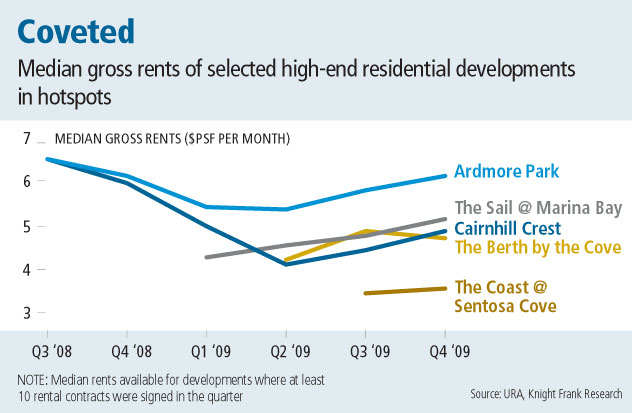
 -- 2011 April 14 PROPERTY
POST
-- 2011 April 14 PROPERTY
POST