Sixty-three percent of Hong Kong
residents have internet connections and spend an average of 2.5 hours
online daily, a 10% increase compared to last year, according to the
Nielsen Media Index. Reading newspapers and magazines online has also
became more popular. Almost half (45%) of Hong Kong's internet users
regularly read newspapers or magazines online, up from 38% in 2006.-
2009 May
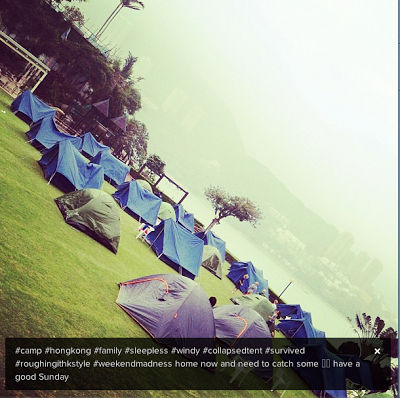
Hehe...organized
chaos. 'Camping' in Hong Kong. Photo courtesy of Glamaross.
Hong Kong Bosses Toughest in
Asia Pacific
Hong Kong
bosses are the toughest in the region and expect staff to work during
their holidays, a study has found - but maybe that's why they are
amongst the world's richest!
A survey
of more than 1,600 professionals in the finance, accounting and human
resources sectors across the Asia-Pacific region found that 68 per cent of
employers in the city expect their staff to be available while on annual
leave or after work hours... "Hong Kong's work ethic is
intense."
Finance
professionals in Hong Kong said they felt they had to stay connected in
case there was an emergency, but also because they could keep in touch
through technology. Some said they just could not switch off.
Hong Kong
bosses expected the most from middle managers, the survey found, with 76 per
cent saying middle managers should be available all the time, compared to 47
per cent for senior managers or directors and 23 per cent for junior or
entry-level staff.
A
positive result for Hong Kong employees was that if they did work during
their holidays or outside office hours, most were compensated.
-- 2011 April 17 SOUTH
CHINA MORNING POST
Hong Kong's number of financial professionals rose
to record level 37,694 in July 2010 eclipsing the previous high
reached in 2008, according to the Securities and Future
Exchange. As a result the demand for luxury housing as well as
premium office space is huge.
The growth is due to the fast paced PRC
growth and the new wealth that ensues. This young audience of
rich millionaires treat Hong Kong as 'Must-Have' in the list of
affluent possessions to accumulate. Its real estate capital
values and its growth.
West Kowloon takes Centre Stage
The site, which is adjacent to the Tsim Sha Tsui shopping hub, will
feature venues including a modern-art museum, opera house, green park, and
shopping malls
Hong Kong's US$2.8 billion plan for an
arts hub in West Kowloon may cement the area's status as a luxury
neighbourhood to rival high-end established suburbs across Victoria
Harbour.
Cultural
centre: About 36% of the real estate in the development
will be venues for visual and performing arts, galleries, and
studios
The 40-hectare West Kowloon Cultural
District, to be designed by Norman Foster, the architect behind London's
Gherkin tower, will be flanked by Hong Kong's tallest skyscraper and the
terminal for an express railway to cities on the Chinese mainland. Mr
Foster's selection ended almost 10 years of wrangling between the
government, developers, and art groups that had held up the area's
transformation.
'If you take into account West
Kowloon's location and all the transportation links that'll be available
in the future, its potential is huge,' said David Ji, Hong Kong- based
head of research for North Asia property consultant DTZ. 'It'll be the
first stop for many mainland visitors to Hong Kong, and their spending
power is enormous.'
Mr Foster's plan for gardens, hotels,
theatres, and restaurants will replace undeveloped reclaimed land that now
mars West Kowloon's harbour frontage. Back from the water, luxury
apartments including Sun Hung Kai Properties Ltd's The Arch and Hang Lung
Properties Ltd's HarbourSide, have been built, along with the
International Commerce Centre (ICC), which lured Morgan Stanley, Credit
Suisse Group AG, and Deutsche Bank AG to move their local headquarters
from Central on Hong Kong Island.
Apartments in the West Kowloon district
cost more than twice those in the east London districts of Canary Wharf
and Wapping, an area that lured investment banks from the City of London
after Britain's tallest office tower was built there in the 1980s.
A 1,000-square-foot apartment in West
Kowloon costs an average of HK$15 million, according to Wong Leung- sing,
a research director at Centaline Property Agency Ltd, Hong Kong's biggest
closely held realtor. A two-bedroom apartment in the east London areas is
£pounds;531,000, according to Savills Plc, the UK's largest
property broker.
Home prices in Hong Kong rose at the
fastest pace globally in the fourth quarter, gaining 20 per cent from a
year earlier, according to the Knight Frank Global House Price Index. UK
home prices climbed 0.7 per cent in the period.
About 36 per cent of the real estate in
the 17-venue West Kowloon harbour-front development will be venues for
visual and performing arts, galleries, and studios, according to Colin
Ward, a Hong Kong-based partner at Foster & Partners, whose master
plan for the project was chosen by a government-appointed committee last
month. The rest will be hotels, housing, and commercial buildings, he
said.
The site, which juts into Victoria
Harbour in front of the ICC and to the east, is adjacent to the Tsim Sha
Tsui shopping hub, will feature venues including a modern-art museum,
opera house, 19-hectare green park, and shopping malls.
'It's not just about culture,' said Mr
Ward in an interview. 'We're making it a place where people want to go to.
We're taking that and putting culture into it so we get a good mix. We
don't want it to be a place just for the enlightened and privileged.' The
project will add to a stable of work by Mr Foster in the former British
colony, including HSBC Holdings Plc's local headquarters and Hong Kong
International Airport.
The area is about a 10-minute train
ride from Central and within walking distance to Tsim Sha Tsui, which
houses some of the city's biggest museums and existing performing arts
venue. The government plans to erect at least two multi-storey office
buildings atop the express railway terminal in West Kowloon when the
project is finished by 2015.
'By the time the art hub is set up
there should already be a critical mass of office spaces, shopping malls,
residential buildings to turn the area into a core commercial and tourist
district,' said Simon Lo, Hong Kong-based director of research at Colliers
International.
Average home prices in West Kowloon are
HK$9,774 per square foot, having caught up with the HK$9,869 for the
Western and Central districts on Hong Kong Island, including Mid-Levels,
traditionally favoured for its proximity to Central.
The development is expected to be
finished in phases from as early as 2015, Hong Kong's Chief Secretary for
Administration Henry Tang said on March 4. The initial proposal was
originated as early as 1998 by the administration of former chief
executive Tung Chee-hwa.
The government began selling reclaimed
land in the district for luxury apartments during the late 1990s and early
2000s, as part of a plan to spruce up areas along the railway and freeway
connecting Central to the new airport on Lantau Island, according to Eddie
Hui, a professor in the building and real estate department of Hong Kong
Polytechnic University.
'There're a real potential for both
commercial rents and residential prices to go up even more with the
addition of all this hardware,' said Mr Lo at Colliers, the Seattle-based
property broker. 'The area has already come a long way.'
West Kowloon lies to the west of Yau Ma
Tei and Mong Kok, former blue-collar areas housing factory, dockyard, and
fruit market workers. Today, they are bustling, middle-class shopping
districts for everything from cooking equipment to sneakers and jewellery,
electronics, and pirated compact discs. Mong Kok, one of the most densely
populated areas in the world, is home to the city's biggest red-light
district.
The government set up the West Kowloon
Cultural District Authority to oversee the development in 2006 after the
project was halted because the three bidding consortiums - including a
joint-venture by Sun Hung Kai and Cheung Kong (Holdings) Ltd, the city's
two biggest developers - failed to agree to the amended plan.
Named 'City Park' primarily because of
the inclusion of the green park and a 2.2-kilometre seafront promenade,
the plan by Mr Foster's London-based firm beat proposals by Hong
Kong-based Rocco Design Architects Ltd and Office for Metropolitan
Architecture, Rem Koolhaas' Rotterdam-based outfit. Mr Koolhaas helped
design the CCTV Tower in Beijing.
The three, each paid HK$49 million
(S$7.94 million) by the government for their designs, were short-listed
from among 12 firms which were in turn picked from a pool of 109. Mr
Foster was also behind the original design shelved in 2006 that featured a
giant canopy covering parts of the art hub. Elements from the two losing
designs may be incorporated to Mr Foster's master plan, said Ronald
Arculli, chairman of the Hong Kong stock exchange and a member of the
committee responsible for the selection.
While the benefits for West Kowloon are
undisputed, the art hub's contribution to Hong Kong's overall economy are
questionable, said Bob McKercher, a professor at The Hong Kong Polytechnic
University's school of hotel & tourism management. 'This will be a
project that will benefit mostly the local population and artists,' he
said. 'Normally, an art hub project of this sort only has limited impact
on tourism unless there're certain thematically driven festivals.'
The number of Chinese visitors rose 26
per cent in 2010 to 22.7 million and is expected to gain another 10 per
cent this year, according to the city's tourism board. Chinese buyers
accounted for more than a third of new luxury home purchases in the second
half of 2010, according to Centaline Property Agency Ltd, the city's
biggest closely held real-estate agency.
'The area is going to get only more
popular among mainland visitors,' said Simon Smith, Hong Kong-based head
of Asian research here at London-based Savills Plc. Luxury home prices in
popular areas such as Mid-Levels and Happy Valley on the Hong Kong Island
'will find it hard to keep up with that of West Kowloon'. --
2011 April 7 Bloomberg
>> ARCHIVE |
BACKGROUND
Sales of luxury goods and prices of
homes jump, on the back of record numbers of visitors from the mainland.
Hong Kong is an international
city, and that shopping atmosphere and environment is fantastic,' said Ms
Ju, 29, who carries a shopping list from her friends in Lanzhou. 'The
stuff in Hong Kong has higher quality. It's so cheap.'
Mainland residents, their wealth
bolstered by an economy that grew at the fastest pace since 2007 in the
fourth quarter, are visiting Hong Kong in record numbers and spending on
luxury. February retail sales rose 36 per cent from a year earlier, the
fastest pace since 1988, the government said. They are also paying record
prices for apartments, prompting the government to warn of a property
bubble.
'The Hong Kong retail market would
absolutely be devastated if Chinese consumers stop visiting,' said Kevin
Lai, economist at Daiwa Capital Markets Hong Kong Ltd. 'Half of the crowds
in those shopping areas would disappear.'
China's economy, the world's third-biggest, expanded by almost 11 per
cent in the fourth quarter of last year after a four trillion yuan (S$815
billion) stimulus programme and US$1.3 trillion in new bank lending at
record-low interest rates. The number of mainlanders worth at least 10
million yuan rose 6.1 per cent this year to 875,000, according to the
Hurun Wealth Report.
The wealthy are finding their way to Hong Kong, a special administrative
region of China with different financial and legal systems. Tourist
arrivals from the mainland gained 49 per cent in February from a year
earlier, driving total visitor arrivals to a record 2.87 million for the
month, the Hong Kong Tourism Board said.
Sales at department stores that month surged 49 per cent from a year
earlier, and sales of luxury goods such as jewellery and watches jumped 48
per cent. China imposes taxes of at least 30 per cent on cosmetics, 20 per
cent on high-end watches and 10 per cent on golf equipment, according to
the State Administration of Taxation. Those items aren't taxed in Hong
Kong.
Ms Ju visited during Lunar New Year in February and bought a HK$6,500
(S$1,170) Gucci handbag and Dior mascara. She said she spends as much as
HK$50,000 each trip on handbags and clothes by LVMH Moet Hennessy Louis
Vuitton SA, Gucci Group NV and Burberry Group plc. She also buys diamonds,
cameras and cosmetics.
The amount Ms Ju said she spends each trip is more than double China's
average urban per capita net income of 17,175 yuan, based on National
Bureau of Statistics figures.
Mainland money has also helped fuel a 45 per cent jump in prices of
Hong Kong luxury homes last year, real estate broker Savills plc said.
About 19 per cent of the people buying luxury properties, or homes worth
more than HK$10 million, were mainlanders, according to Centaline Property
Agency Ltd.
That helped the city's economy grow by 2.6 per cent in the fourth
quarter from a year earlier - the first gain in five quarters.
Henderson Land Development Co sold an apartment for a world-record
price of HK$88,000 per square foot.
The surging prices prompted Financial Secretary John Tsang to warn of a
bubble. Hong Kong's central bank subsequently raised the minimum
downpayment required for homes worth more than HK$20 million, and the
government said it would raise stamp duties on luxury residences and
release more land for development.
Local house hunters Jennifer To and fiance Henry Chan say the
unprecedented prices are spilling into the mass market and putting starter
homes out of their reach.
Ms To, a law student, and Mr Chan, a hedge-fund analyst, said they
shopped for apartments last year and found prices of HK$6,000-HK$7,000 per
square foot. When they returned this year, prices were HK$10,000.
'Property prices in Hong Kong are being pushed up by mainland Chinese,'
said Ms To, 29. 'You've got all these rich people buying up everything and
normal people can only afford to rent.'
Stores also are feeling the effects as rents rise in malls popular with
mainlanders. IFC Mall, connected to the Four Seasons Hotel, said monthly
rents rose 25 per cent last year to between HK$250 and HK$620 per square
foot. Increases of between 10 and 25 per cent are anticipated this year,
Karim Azar, assistant general manager of IFC Management, said in January.
'The mainland's hot money today is blowing a property bubble in Hong
Kong that is similar to the one seen around 1997, only with a much bigger
lung,' said Tao Dong, Hong Kong-based chief regional economist at Credit
Suisse Group AG.
Spending by mainlanders typically makes up about 30 per cent of sales
for stores in the Central district, said David Martin, head of retail at
Hongkong Land Holdings Ltd, which owns the Landmark and nearby malls with
luxury stores.
Mainlanders are more confident that Hong Kong stores aren't selling
forgeries, said Paul Law, financial controller of Luk Fook Holdings
International Ltd, with more than 500 jewelry stores in Asia and North
America.
Hong Kong is the biggest market for Swiss watchmakers, who exported
225.1 million Swiss francs (S$296.5 million) worth of timepieces to the
city in February, 17 per cent more than a year earlier.
'The 'three flows from China', which are goods, visitors and capital
flows, are driving the local economy tremendously,' said Daiwa's Mr Lai.
'Mainland China has so much cash that it can easily push the city's
economy up.' - 2010 April
14 Bloomberg
The government on Aug 13 raised down
payment ratios and said it will increase land supply amid concerns
housing is becoming unaffordable after a 45 per cent surge since the
beginning of 2009.
Kerry Properties Ltd paid HK$1.29
billion (S$223 million) for a plot in the Kowloon Tong district, setting a
per-square-foot record for Kowloon.
Hong Kong's home prices have surged about 45 per cent since the beginning of
2009 on record low mortgage rates and the influx of wealthy
PRC
(People's Republic of China) buyers.
An
active property market in Hong Kong although it has proved in the past to
be volatile but also amongst the first to bounce back and it is
susceptible to the shocks of unexpected flows of international
capital. Having said that though land supply is short and interest rates are low. The past 12 months
have seen a massive 33 per cent rise in the property market, making it the
highest growth rate in the developed world. This
cosmopolitan business centre is famous for doing business.
In 2010 Hong Kong increased a
requirement for down payments on luxury homes from 30% to 40% and cracked
down on deceptive marketing by developers after officials expressed
concern that prices were rising too fast. Developers disagreed as
they are the ones with direct contact to the PRC money that has been
flooding into the territory.
Since
December 2008 property has been something else. The benchmark residential
property index is up by 46 per cent – the steepest trajectory since the
mega-bubble of 1997
The usual factors apply: tight supply,
strong personal balance sheets, plus inflows of speculative capital,
particularly from the mainland. What is new this time is the ultra-low cost
of borrowing, imported through the peg to the US dollar. Rental yields of
between 2.5 and 3 per cent for the luxury segments are at post-97 lows, but
effective mortgage rates are even lower.
The financial logic has proven more
powerful than cooling measures from the Hong Kong Monetary Authority. On
Wednesday, Sun
Hung Kai, the world’s largest developer by market capitalisation
made another significant land purchase, at a higher than expected price. On
Thursday, the best six performers on the Hang Seng were all property stocks.
Hong Kong's powerful property tycoons
exert considerable influence over the city, and there are signs that this
sway is growing with positions they control on advisory and statutory bodies
increasing threefold since the handover. Fortunately we have direct links to the
largest (many who are Friends) ;-)
The South China Morning Post ran a story about the number of
directors of property developers who sit on statutory advisory boards [SABs],
suggesting that they account for 1% of all seats on SABs, and that these
tend to be the more economically important seats.
- 2010 April 13
Another reason PRC like to park money in
Hong Kong is its appeal as a Lifestyle destination and inflation
is high in China.
Tougher-than-anticipated measures to
curb Hong Kong's soaring real-estate prices began rippling through the
market, driving down shares of property developers and prompting forecasts
of declining home sales.
The stamp-duty increases - a 15% charge on property sold within six
months of purchase, 10% for those sold within six and 12 months, and 5%
for those sold between one and two years - could result in lower property
prices, and rents would follow similarly but the shares of the property
developers were affected immediately.
The latest global credit turmoil and
the Hong Kong government's stated intention to crack down on property
speculation might put the brakes on bidding at tomorrow's (May 11)
government land sale, say some analysts.
Up for auction is a 282,000 sq ft waterfront
residential site in Tung Chung on Lantau Island that was expected before the
latest global financial crisis to fetch as much as HK$4.75 billion (RM1.96
billion).
But some analysts have revised their
expectations downwards in the wake of the fresh blow to investor confidence
caused by the debt crisis in Greece, as well as the decline in sales volume in
response to government plan to end rampant property speculation, and alternative
and lower-risk sites up for sale.
"Sales volumes in Hong Kong are falling
as concerns grow that the government here is also poised to curb property
speculation, and the recent volatility on the stock market has also hurt
investment sentiment," said Alnwick Chan Chi-hing, executive director at
property consultancy Knight Frank.
Chan has revised downward his original forecast that the site, which
will provide a total gross floor area of 1.43 million sq ft, would be
sold for HK$4.9 billion, to HK$4.6 billion. He also believes that in the
new investment climate, the attention of developers may be diverted to
more centrally located sites which are less at risk of a sharp fall in
buyer sentiment.
Poorer sentiment has already dented sales, and Tony Poon Chi-kwong,
general manager at Centaline Property Agency's Tung Chung branch, said
sales volumes in the secondary market have plunged by 70% as both buyers
and sellers postponed decisions until the results of the auction become
known.
"Our firm handled just 10 to 12 deals last weekend from 40 over the
previous weekend," said Poon. Bookings for viewing flats also dropped
from 40 to 12 over the weekend, he said. In the present environment
developers could wish to save their ammunition for better sites in more
centrally located and prestigious locations," said Knight Frank's Chan.
Up for tender, he said, was the HK$33 billion Nam Cheong station
commercial and residential project on top of the MTR station in Sham
Shui Po, a residential site in Ho Man Tin, and another at Mount
Nicholson. The tender for the Nam Cheong site closes on May 25, while
the Ho Man Tin site will be offered for auction next month and the
Nicholson site will come under the hammer in July.
Chan said developers would be keen to bid for the Nam Cheong project
and the luxury site at Mount Nicholson, given their prime locations
which would help reduce risk exposure.
But his revised forecast nonetheless remains HK$1 billion more than
forecasts made by less bullish analysts, and Nelson Chan Cheong-kit, a
director at Lanbase Surveyors, is sticking with his original view that
the site will sell for HK$3.6 billion or around HK$2,500 per sq ft, the
lowest among the forecasts.
Lanbase's Chan said he did not believe that the deterioration of
global market sentiment would effect the land sale much as development
of the site would take two to three years to complete.
But he agreed that bidding for the site could be affected by the
increased attraction of alternative choices to developers. "The concern
is that developers may now shift their interest to other sites up for
grabs," he said.
The Tung Chung site was triggered for tender -- the first government
land sale since December last year -- after a developer agreed to pay
the minimum list price of HK$2.87 billion.
But sentiment has been dampened by warnings from the government that
it might introduce tougher measures aimed at curbing property
speculation, including an increase in stamp duty on non-luxury flats, a
ban on reselling unfinished homes -- a practice popular with speculators
who try to "churn" their purchases before taking occupation -- and
requiring developers to put all flats up for sale within a certain
period. – 2010 May 1
South China Morning Post
Prized
location: The
developers - Nan Fung and Wharf - paid HK$32,014 psf ppr for the site in
Hong Kong's Peak district on Mt Nicholson Road; this compares with a record HK$68,200 psf ppr
paid by tycoon Lee Shau-kee's son for a site in May 2010
Foreign investors are increasingly
coming from Mainland China accounting for 10% of total sales and 30% of
pre-sales on new developments. For the Mainland new rich, Hong
Kong is the Geneva of Asia.
Property buyers in the city pay more
than ten times their annual income to purchase an apartment, the highest
of 272 cities surveyed in an international comparison conducted by a
U.S. consultancy commissioned by the South China Morning Post
- 2010 April 20
A
Hong Kong-listed company Sino-tech International Holdings, an electronics
components maker, said it has agreed to buy the 4,650 square foot property
on the Peak for 280 million Hong Kong dollars (35.90 million US), or
60,215 dollars per square foot, as an investment.
A month after the government introduced
measures to cool the city's property market this near-record price
indicates the strength of this property market.
The per-square-foot price is among the
highest paid for a property in the southern Chinese city, after a duplex
was sold by Henderson Land Development in October for an Asian record of
71,280 dollars per square foot.
The Peak property is one of the 22 houses in the luxurious Severn 8
development on Severn Road, which was named by online analysis group The
Wealth Bulletin as one of the 10 most expensive streets in the world last
year. Also on the list were Chemin de Saint-Hospice in the
South of France, Fifth Avenue in New York, and Kensington Palace Gardens
in London.
The near-record price was reached
despite a series of measures the government introduced in February to cool
the white-hot property market, such as increasing residential land supply
and stamp duty for luxury flats. John Tsang, the city's financial
secretary, said the government was worried that the property frenzy,
supported by strong demand from rich mainland buyers and a big inflow of
funds, would create a bubble and affect the stability of the financial
system.
Prices of some luxury flats
returned to the peaks of the 1997 property boom in January, Tsang
said. Stimulus measures by governments
around the world have boosted liquidity, which has lead to large fund
inflows into Asia. China has also seen soaring property prices,
with values rising at their fastest pace in 17 months in December after
Beijing encouraged tax breaks, loans and lower downpayment requirements to
boost the sector during a slump.
- 2010 March 18 AFP
Metro/Urban
Population: 6.8 million
Hong Kong has whopping 39 buildings over 200 meters tall. It also boasts
four of the 15 tallest buildings in the world... that's all in one city!
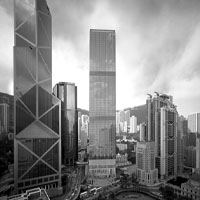
Hong Kong's skyline shows a large selection of distinct sky-reaching towers,
with beautiful night lighting and reflection. This city exemplifies the
post-modern skyscraper and skyline. Finally, the mountain backdrop makes
this skyline one of the greatest on the planet!
A little bit smoggy though but nonetheless no less important as a world
financial centre for the region and entrepot to China. The
city is entrepot for the public markets in the region.
After 150-plus years of British
occupation finally ended in July 1997, Hong Kong these days is a Special
Administrative Region (SAR) of China.
This means China takes care of defence
and foreign affairs, while Hong Kong’s own modern-capitalist government
looks after everything else, including the monetary system.
In terms of job opportunities for young
finance, accounting and business professionals, Hong Kong has the greatest
concentration of corporate headquarters in the Asia – Pacific region.
Between June 2003 and June 2007 the
number of foreign companies with regional headquarters in Hong Kong grew
from 966 to 1246.
Likewise, the number with regional
offices in Hong Kong grew from 2241 to 2644.
Even the magnificent panoramic view from
Victoria Peak, looking over the entire metropolis, would tell you this.
Building upon building stretches across the horizon.
Multinationals are especially attracted
to the region because of its ‘hands-off’ policy in regards to the
financial system.
This is also the main reason why Hong
Kong has been ranked number one on the worldwide Index of Economic Freedom
for the past 14 years.
It also has low taxes and, of course,
unrivalled trading links and access to the mainland.
To be able to take advantage of one of
the multitude of employment opportunities in Hong Kong, if you’re younger
than 30 and you’re an Australian or New Zealander, or Irish, you can apply
for the working holiday scheme.
This gives you the chance to live and
work in Hong Kong for one year. The annual quota is 1000 for Australia, 100
for Ireland and 200 for New Zealand. So get in early!
You could also apply for the quality
migrant admission scheme, which operates on a points system and is also
quota-based.
Applicants are required to fulfil a set
of prerequisites before they can be awarded points under one of two tests,
and then compete with other applicants for quota allocation. >>
HONG KONG
GOVERNMENT
Luxury residential sales outperforms in
Hong Kong's property market
Hong Kong's property market saw a
diverging performance between the sales and leasing sectors in 2Q 2009.
The sales sector across the Grade A
office, luxury residential, industrial and retail markets has been
stimulated by the inflow of ample liquidity into Hong Kong, reflected by the
significant rise in the sales activity. However, the leasing sector in
the four markets remained on the downside since occupational demand was weak
in the midst of the ongoing global and Hong Kong economic slowdown.
These findings were analysed in the Hong Kong Knowledge Report – July
2009, the quarterly report covering Grade A office, luxury residential,
industrial and retail markets in Hong Kong. >> MORE
Grade A Office
With the high level of liquidity in 2Q
2009, investment sentiment was buoyant in the property market and a number
of private investors were bold in acquiring office properties. Since
there was limited whole-block stock available for sale, sales activity
focused on the strata-title office units in 2Q 2009. This has driven
up prices. For example, average asking prices for strata-title office
buildings in Admiralty rose to HK$10,000-HK$13,000 or above per sq ft in 2Q
2009, compared to the HK$8,000-HK$9,000 per sq ft in the previous quarter.
However, office rentals were yet to see
the positive spillover from the resilient sales market, with the average
Grade A office rentals falling further by 12.1% quarter-on-quarter (QoQ) to
HK$41.79 per sq ft per month as at the end of May 2009.
The average vacancy rate across the
various business districts increased slightly from 7.43% in February to
7.86% in 2Q 2009.
"Owing to the sustained trend of
corporate relocations to the less expensive offices, Kowloon East was one of
the very few sub-markets to register a fall in vacancy rates during 2Q
2009," said a Director of Research & Advisory of a local brokerage
firm. One of the benchmark examples is the relocation of
the office of Manulife from Causeway Bay to Kwun Tong, which will take up
247,000 sq ft in Kwun Tong 223. Meanwhile, Central and Admiralty also
registered a marginal drop of vacancy rate from 5.07% in 1Q2009 to 4.90% in
2Q2009.
Looking forward, new demand will remain
weak while existing tenants are expected to look at every possible option to
reduce costs. In the next twelve months, Grade A office rentals are
projected to fall 15% unless the worldwide economic recovery is quicker than
expected. >>
MORE
Luxury Residential In 2Q 2009, there was a distinct growth in sales volume and prices
in the luxury residential market. The number of sales transactions in
The Peak, Mid-levels and South Side increased over 100% during the period,
while the average luxury residential price surged by 21.9% QoQ to HK$12,955
per sq ft as of May 2009. Particularly, the average luxury residential
price growth in South Side outperformed those in The Peak and Mid-levels,
which registered a significant increase of 33.5% QoQ to HK$14,413 per sq ft
in May 2009.
"In addition to the inflow of
liquidity, the strong buying interest could be attributed to the growing
optimism in the marketplace, driven partially by the significant rebound in
stock market prices," said Simon. "Looking forward, luxury
residential prices are expected to see stable growth to edge up 5% or above
in the next twelve months."
In contrast, luxury residential rentals
fell by 4.3% QoQ and the average serviced apartment rentals dropped by 7.8%
QoQ as of May 2009. This could be explained by the uninspiring hiring
expectations by multinational corporations which weakened the occupational
demand for luxury units and serviced apartments. In the next twelve
month, luxury residential rentals are expected to see a downward adjustment
of 3%. >> MORE
Industrial The number of sales transactions of industrial property rose 129%
QoQ from 393 in March 2009, the lowest level since 1999, to 900 in May 2009.
Of the industrial districts, Kwai Chung/Tsuen Wan and Kowloon East saw the
most active sales activity during the period.
However, the leasing market remained
subdued in terms of demand and rental. This could be attributed to the
ongoing global recession and the plunge in intra-regional trade.
The total value of re-exports fell 17.1% year-on-year (YoY) to HK$565
billion during the three-month period ended in May 2009. The
gloomy external trade environment challenges the business outlook for
trading and logistics companies, which are the major occupiers of Hong
Kong's industrial properties.
Although individual warehouse users have
taken advantage of the prevailing market downturn to upgrade their premises
to prime quality warehouse in Kwai Chung with rentals staying similar to
what they paid in other districts, most occupiers remained cautious about
their rental expenses. "New leasing demand was rare, while
existing tenants tried to cut down their rental costs by downsizing or
relocating to less expensive premises".
Although the pace of downward adjustment
of Hong Kong's external trade is expected to taper off, industrial property
occupants will remain conservative in coping with the uncertainties in the
external environment. Industrial rentals are predicted to fall by 5% -
15% over the next twelve months.
Retail In 2Q 2009, locals' spending sentiment was negatively affected by
the contracting economy and uncertain job market. Meanwhile, visitor
arrivals in Hong Kong dropped 3.5% YoY during the three-month period ended
in May 2009. These have dampened Hong Kong's retail sales, which
recorded a single-digit fall in both April and May 2009 compared to the same
period last year.
"Seeing the challenges in Hong
Kong's retail market, some local and international retailers became more
cautious and chose to put their expansion plans on hold," .
"Meanwhile, the retail property market was increasingly segmented.
Although individual retailers are willing to pay premium rentals for prime
units in traditional shopping districts, there were still vacant shops near
those prime units, even in the same street segment."
Average retail rentals in the four
traditional shopping districts – Central, Causeway Bay, Mong Kok and Tsim
Sha Tsui – registered a decrease of 4.7% QoQ in 2Q 2009. Of the four
districts, Central saw the smallest decline of 3.6% QoQ during the same
period.
Looking forward, Hong Kong's retail sales
still face a number of challenges, such as the slowdown in the number of
inbound visitors and cautious spending by local households. As a
result, retail rentals are projected to drop further by 12% in the next
twelve months. - 29 July
09
Hong Kong's stock market has fallen by
more than 50 per cent this year, and analysts expect the economic slump to
continue through at least next year. The Chinese territory is in recession,
yet plenty of people there seem to be taking things in stride.
One reason is that Hong Kong has been
through worse before; the last downturn lasted seven long years, from the
Asian financial crisis in 1997 to the Sars epidemic in 2003. The other is a
belief among some people, in and outside of Hong Kong, that the world
economic order is shifting, from the West to the East, pushed by China's
rapid growth and now the sub-prime financial contagion.
With the US and Europe worse off than
others, there's little doubt that more capital and talent will swing towards
Asia. And few places look as well-positioned as Hong Kong to take advantage
of that. - 2008 November
25 LOS
ANGELES TIMES
Real estate fund puts HK$5.5b assets on sale
Morgan Stanley Real Estate Fund, one of the big winners
in Hong Kong's investment property market over the past few years, has
started to offload about HK$5.5 billion worth of properties in the city.
They include five serviced-apartment projects and the Nexxus Building in
Central. The fund had been approached by potential buyers who had offered
more than HK$4 billion for Nexxus Building, formerly the Hang Seng
Building, sources said.
"It is logical for Morgan Stanley's property
funds to be evaluating such offers given the current market
environment," a source said. Morgan Stanley declined to comment.
Sources said the five properties up for tender included the Shama
apartments in Causeway Bay, Wan Chai, Central, SoHo and Mid-Levels.
Surveyors expect the five properties to be worth about HK$1.5 billion. The
110-room Shama Causeway Bay is the most valuable because of its size and
its prime location.
"The fund has been approached by various parties
who are interested in buying individual properties or a basket of Shama
properties," sources said. If these properties are sold, Morgan
Stanley Real Estate Fund would continue to own and develop the Shama
management company. In addition, the fund would only sell the properties
with Shama management contracts.
The fund bought a more than 90 per cent
stake in Shama, a boutique serviced-apartment operator, in 2006 for an
undisclosed price.
The Nexxus Building has been on the market since early
this year and is expected to generate a gross profit of at least HK$1.15
billion. "The value of the building has appreciated a lot and it is
time to take profit," one source said. The US investment fund, in a
joint venture with pan-Asia real estate fund Pamfleet (HK) and Gateway
Capital, acquired the building for HK$2.25 billion in 2006. The consortium
in September last year kicked off a HK$200 million refurbishment to
maximise rental income. About 60 per cent of the office space has been
pre-leased. These funds would still make a profit even if they offered a
20 or 30 per cent discount from their asking prices, he said.
- 2008 September 25
City
of paranoids
Investors
should be wary against the idea that tight residential supply in Hong Kong
will protect prices, because demand is the key moving part and demand is set
to contract violently as Hong Kong is a city of paranoids who have learned
how wealth locked up in properties got wiped out during financial crisis and
will react quicker this time. We expect residential price to drop by a
maximum of 30% before end 09 and reiterate our UNDERWEIGHT call on Hong Kong
developers. We also expect the turmoil in the financial industry to reduce
demand for office space sharply and we see a 30% decline in Central office
rents in the next 15 months.
What has
changed?
Macro
outlook has worsened markedly since our last sector update "Hong Kong
Property - Devils in the details" in 23 June.
Our new
house view of real GDP growth for Hong Kong in 08 and 09 has been cut to
4% and 2.1% from 4.9% and 2.6%.
The global
credit crunch will eventually filter through in form of hike in HIBOR,
and hike in mortgage rate - a shock the property market is probably
not prepared for.
20-30%
decline in residential prices
We are
downgrading our residential price forecast to a 20% fall for mass-end,
and 30% fall for the luxury segment before end 09.
Prices are
already down 6.8% since the peak in March. Volume has dried up in the
past three months (Jun-Aug) down 46% y-y. Rents have softened, down 1.7%
since July.
Short term
supply will be rising as speculators dump units bought last year onto
the market.
Demand
outlook is grim: hiring is slowing, job security is weakening, and
wealth is being destroyed.
30%
decline in Central office rents
We believe
the bankruptcy of one large investment bank signals just the beginning
of a sharp demand contraction period for the office sector.
The last
time office demand contracted after the dot-com burst, Central office
rents dropped 21% in the two quarters between 1Q01 to 3Q01.
The
situation is looking very shaky, with current spot rent 153% above the
HK$47psf level when the last correction cycle started.
- 2008 September 19 CLSA ASIA PACIFIC MARKETS
PRE-
FINANCIAL CRISES
Consumer spending is at all-time high
On the 10th anniversary of Hong Kong's return to China, there are few
reminders of British rule. Its fortunes are firmly tied to China, both as a
gateway for multinationals to expand in the mainland and as a shopper's
paradise for newly-rich Chinese to buy tax-free designer goods. But
skyrocketing rents and retail prices and growing problems with pollution
threaten its long-term prosperity, as does the growing popularity of
Shanghai and Beijing for foreigners setting up shop in Greater China.
In Asia they think nothing of
redevelopment, the Ritz
Carleton in Hong Kong is good example.
In 2008 (March 21) the
Town Planning Board proposed wide-ranging height limits on buildings
in Mid-Levels in a move that could ease the area's severe congestion
problems.
An influx of foreign institutional
investors competing with local private investors for the finite supply of
premium assets led to brisk activity in the investment market.
Sale prices of scarce luxury residential apartments especially on The Peak
and Island South also surged last year.
Among the notable commercial
transactions during 2007 were the sale of 45 percent of AIG Tower in
Central for HK$3.65 billion, while in the residential sector, Indonesian
fund De Monsa splashed out HK$240 million for a townhouse at Severn 8, which
translates to an accommodation value of HK$55,000 per sq ft.
On top of strong fundamentals driving the
Hong Kong economy, the discount on property prices arising out of the
currency peg to the weakened US dollar will also help push up luxury
residential prices between 20 percent and 25 percent, one analyst
predicted.
Consultancy Knight Frank says
transactions involving office properties last year exceeded the previous
record high set in 1997, with more than 4,000 units changing hands. In the
fourth quarter alone, there were more than 1,400 sales deals. -
2008 February 14 THE
STANDARD
HK home sales may fall on inflation
worries Share slide,
global credit crunch could push property prices down, say analysts
Hong Kong's apartment transactions may
fall to a 10-month low in July, then drop further, on concerns that
accelerating inflation and a slumping stock market may push prices down,
analysts said.
Transactions in 10 of Hong Kong's biggest
housing complexes, used by many analysts as a benchmark, fell to 27 last
week from 33 the previous week, Centaline Property Agency said. Total home
sales in the city may drop to 6,100 in July, the lowest number since
September, from 7,167 in June, it said.
'This will probably continue for the
whole of the third quarter,' said Louis Chan, managing director of
residential properties at Centaline. 'We're looking at between a 3 and 5 per
cent correction in prices within the quarter.'
Home values have tracked Hong Kong's
economy, peaking in the second quarter of 1997, then crashing in the Asian
financial crisis, leaving many homes worth less than their mortgages for
years. The 2000 dotcom bubble burst, the Sept 11, 2001,
terrorist attacks and the 2003 Sars epidemic caused prices to fall as much
as 70 per cent from the peak. The rebound started in late 2003 and prices
doubled in the past four years.
Now, the benchmark Hang Seng Index has
fallen almost a third from its record in October as credit-market losses
climbed worldwide, threatening global economic growth even as inflation
accelerates in Hong Kong. The combination could deter potential homebuyers,
possibly for the balance of the year.
'The Hong Kong residential market will go
into a quiet period for the rest of 2008,' said Cusson Leung, a Hong
Kong-based analyst at Credit Suisse. His July 8 report forecast a 5 to 10
per cent reduction in home prices in the second half.
Overall housing transactions in the
second half may fall between 20 and 30 per cent from a year earlier, said
Patrick Chow, head of research at real estate agency Ricacorp Properties.
'Many people looking to upgrade their properties again have had their
capital drained by the stock market,' Mr Chow said. 'This may seriously
impact the high-end market, in part because many of those homebuyers had
upgraded last year.'
Hong Kong's four
biggest real estate agencies this month fired a total of more than 300
workers in anticipation of a housing slump, according to a July 23
report in the Hong Kong Economic Times.
Hong Kong's inflation accelerated in June
to the fastest pace in four months as food and energy costs climbed. Local
lenders including BOC Hong Kong (Holdings) and Hang Seng Bank last month
raised their mortgage rates for some customers to deflect the squeeze on
lending margins.
'Inflation is giving many people second
thoughts about buying properties,' said Alnwick Chan, a Hong Kong-based
executive director at property research company Knight Frank LLP. 'There's
going to be a correction but it won't be a crash.' Hong Kong has the most
expensive luxury home prices in Asia, US$10,490 to US$14,780 per square
metre, according to the Global Property Guide website. That compares with
US$12,510 to US$22,923 per square metre in Manhattan.
The Hang Seng Properties Index, which
tracks the city's six biggest builders by market value, has dropped 30 per
cent this year on concerns Hong Kong banks may lift rates.
The expectation that the US Federal
Reserve will start raising interest rates in the fourth quarter of this year
has damped Asia's stock markets, according to Credit Suisse.
Sino Land sold almost 70 per cent of the
apartments it made available at the Palazzo, a high-end complex overlooking
the Sha Tin horse track in the first nine days of sales, Sing Tao Daily
reported in May. Billionaire Li Ka-shing's Cheung Kong (Holdings), Hong
Kong's second-biggest builder by value, met full-year sales targets by June,
selling 2,700 apartments for HK$23 billion.
Transactions and prices may rebound in
the fourth quarter if both the US and Hong Kong stock markets show they have
weathered the sub-prime crisis, Centaline's Mr Chan said.
The property affordability ratio,
homeowners' average monthly mortgage payment as a percentage of income, is
32 per cent, 'a very healthy level' compared with 93 per cent at the peak of
the 1990s boom, according to Buggle Lau, chief analyst at Midland Holdings
Ltd, Hong Kong's biggest publicly traded property agency.
'Growth is definitely slowing, but the
fundamentals of the economy are still strong,' Mr Lau said. 'When the
uncertainties go away we're pretty sure buyers are going to come back.'
Midland's shares have plunged 66 per cent this year, after nearly
quadrupling between the beginning of 2007 and January.
- 2008 July 31 BLOOMBERG
US economic woes, rate cuts fuelling
HK property boom
Analysts see prices revisiting the
heady 1997 peak
Back in vogue:
A Merrill Lynch property analyst has predicted a 50
per cent rally in property prices in the next two years, prompting several
Hong Kong employees at the bank to go on an apartment hunting spree
Hong Kong's economy is riding on the
coat-tails of China's boom, but its currency peg with the US dollar forces
the territory to officially track US interest rate cuts. Local banks have
more leeway but have still slashed rates by 100 basis points in the past two
weeks as the US federal funds rate has fallen to 3 per cent.
So the housing downturn and mortgage
crisis that threatens the US economy has indirectly bolstered Hong Kong
property.
Monthly transactions for mass market
housing in the final three months of last year were on average 63 per cent
higher than in the rest of 2007, hitting their highest level for a decade.
Real Hong Kong mortgage rates are now
negative, below inflation of 3.8 per cent and it has become cheaper to buy
than rent, analysts say.
A Merrill Lynch property analyst has
predicted a 50 per cent rally in property prices in the next two years,
prompting several Hong Kong employees at the bank to go on an apartment
hunting spree. UBS has the same forecast.
Geoff Lewis, head of investment services
at JF Asset Management, said property might 'catch fire'.
The expected boom fed a price rally late
last year in Hong Kong's biggest developers, including Sun Hung Kai
Properties, Cheung Kong Holdings and Henderson Land Development, but Hong
Kong's property sub-index has see-sawed this year.
Several Hong Kong developers are also
expected to get an extra kick from their fast growing mainland China
businesses.
But many analysts say buying an apartment
is better than buying shares, as equity markets will probably stay volatile.
Others suggest investors suffering share losses might have less cash to
invest in real estate.
New housing supply in the next three
years is forecast at half levels seen during the 1990s boom, and interest
rates could fall further while inflation heads above 4 per cent, economists
say.
With no control over monetary policy and
inflation on the rise, a 50 per cent appreciation in flat prices could pose
a risk for an economy that saw property prices nosedive 65 per cent when the
last property boom burst 10 years ago.
Economists, however, are not worried about an asset price bubble just
yet.
They think a strong property market will create wealth, spur consumer
spending, and enable the territory to still notch up 4-5 per cent economic
growth even if the US economy tips into recession and hits exports from one
of the world's busiest ports.
Hong Kong's gross domestic product (GDP) has grown an average 7 per cent
annually in the last four years.
'Mass market property prices are still 35-40 per cent below their peak in
1997,' said Nicholas Kwan, Asian head of research at Standard Chartered
Bank.
'So even if they rise 30-40 per cent, prices would only be what they were
10 years ago,' he said. 'It's hard to argue that would be a bubble.'
Hong Kong home prices slid after the 1997 Asian economic crisis. Home
prices were rocked by the bursting of the dotcom bubble and they slumped in
a 2003 outbreak of the Sars respiratory disease, before rebounding about 80
per cent in the last four years.
Clifford Lam at Credit Suisse believes a steady Hong Kong economy could
send home prices up 15-20 per cent this year but warns against complacency.
'If the US goes into recession and China's economic growth slows, Hong
Kong businesses, including exporters and high rollers in the financial
industry, are going to get hit,' he said. 'Some of the home buyers that are
jumping into the market on the assumption property prices will rise 40-50
per cent will be disappointed.'
Prices for luxury property, on a four-year roll, have already returned to
1997 levels, with an Indonesian fund paying US$30 million for a house on
Hong Kong's iconic mountain, the Peak, last month - an Asian record on a per
sq ft basis.
With the pegged Hong Kong dollar's weakening, property has become
attractive to foreigners and mainland Chinese.
- 2008 February 5 BUSINESS
TIMES
RESIDENTIAL
RENT
Pent-up
supply dampening rents
Record
rents are witnessed for some individual apartments, but with an increasing
number of flats previously held back for sale are now released into the
rental market, the general trend is that rents are seeing downward trend for
similar flats.
For
example, a record rent of HK$40psf (versus HK$20psf average rent at The Long
Beach, in West Kowloon) has been transacted for an upper-floor unit of HLP's
The Long Beach. Meanwhile, a mid-floor unit in the same project was
rented at HK$16.1psf, a record low. More flats of Central Park Towers Phase
1 (by Cheung Kong, in Tin Shui Wai) are also released into the market as the
project is being handed over to buyers, and average rents came down from
HK$9.5psf to HK$9psf. A 900sf mid-floor flat has been leased at
HK$9,000 or HK$10psf but some similar units were rented out at circa
HK$15.3psf in June.
- 2008 August 4 CLSA
Hong Kong property market gets hotter
Properties in HK$50m-HK$100m range particularly popular now
Luxury rents in Hong Kong are soaring to
new highs, with monthly payments hitting as much as HK$500,000 (S$97,000),
as demand from financial services professionals shows no sign of abating.
Prime residential sites on the Peak and
the south side of the island are being leased for up to HK$500,000 a month,
with the luxury sector already up around 10 per cent in the first six months
of the year.
According to property experts, there is
still more room for growth this year as supply remains tight and
professionals in the financial services industry with very large budgets
continue to flood into the city.
As Ricky Poon, a director at Colliers
International, explains, it used to be that the top-priced properties were
standalone houses on individual plots.
However, today, houses that are part of a
larger complex of properties are able to hit the HK$500,000 range. 'It's
lack of supply,' Mr Poon says. 'If you want something very grand and super
luxurious - and a house - there's no supply at all.'
Developers have been fast to buy up land
on the Peak over the years and they place up to five or six individual
houses on the plot, rather than just one mega structure. 'They can call this
a single number plot, but it still has five houses on the lot ... but these
are still very expensive houses,' adds Mr Poon.
The property firm is forecasting a rise
in rents of 10 to 15 per cent this year as a whole. There's also a lot of
expatriates coming to Hong Kong, 'so we are seeing a lot more demand', he
stresses.
Summer is traditionally the busiest time
for luxury leasing in Hong Kong as families move to the city in time for the
new school year starting in September.
The issue of school places, however,
still remains a thorny one for policy-makers, as international supply is
tight and families are forced to put their children on waiting lists.
There have also been reports of
million-dollar dividends being paid to secure a place as Hong Kong struggles
with its supply of international school places. The options for families are
either to enrol their child in a private school, or secure a place at the
English Schools Foundation, which is subsidised by the government.
In the past year in particular, as more
expatriates come to the city, places have become scant.
Office rents in the city are likewise
still on a roll: the iconic International Finance Centre 2, which started
leasing at the height of Sars in 2003 at just HK$25-35 per square foot, is
now fetching rents of more than HK$100 per square foot.
Luxury sales are still rising, with
properties in the HK$50 million to HK$100 million range particularly popular
at the moment. 'We're still seeing a lot of buyers out there who like a good
location and get these properties for their own use,' Mr Poon explains.
In terms of the mass residential sector,
the market is slowly improving but still remains up to 30 per cent off the
prices in 1997, when the property sector as a whole last saw its major high.
According to the Land Registry of Hong
Kong, property transactions in July were valued at a total of HK$38 billion,
up 118.8 per cent from a year earlier but still down 3.4 per cent from June.
The number of transactions was up 67 per
cent from a year earlier at 11,121, but down 7.2 per cent on June's figure.
Of the 11,121 sale and purchase agreements in July, 9,188 were for
residential units - a drop of 4.8 per cent compared with June, but a rise of
70.2 per cent over the past 12 months.
- 2007 August 4
SINGAPORE BUSINESS TIMES
Hong Kong apartments most expensive to
rent
Hong Kong's high-end apartments are the
world's most expensive to rent, followed by those in Tokyo and New York,
reflecting the high living costs in those cities, according to a survey on
expatriate accommodations.
An "executive" three-bedroom
apartment in Hong Kong costs more than $8,500 a month to rent, said the
report, released Tuesday by ECA International, a human resources consultancy
in Britain.
Rents for typical expatriate apartments
in Hong Kong rose by an average of 10 percent last year and 15 percent in
2005, thanks to the Chinese territory's robust economic growth, said Lee
Quane, general manager of ECA International's office in Hong Kong.
In addition, the gap between Hong Kong
and other cities was widening, he said.
The survey compared rental prices in 92
locations worldwide, the firm said.
Tokyo rents for expatriates averaged
$7,358 a month. In New York, rents averaged $7,249.
Moscow was ranked the fourth-most
expensive rental city, at $6,526 a month, followed by Seoul, London, Mumbai
and Shanghai, the survey found.
Caracas was ranked ninth because, Quane
said, expatriates there need to live in high-security compounds for safety
reasons. Paris ranked 10th in the survey.
- ASSOCIATED
PRESS 23 May 2007
The residential market in 2006 had
slower transaction volumes than 2005, but still managed to post some slight
pricing gains. The following summarized by CLSA
who has best rated research in the region.
Residential
prices rose 1.9%. Up to 24 December 2006
, the Centa-City Leading Index rose up by 1.9% to 53.94. From the lows
in August 2003 (index level 31.77), the index has risen 70% from the bottom
of the market. However, comparing to the October 1997 peak (Index
level 102.93), the index is still 48% below the peak.
Total
sales activity dropped 20%. The
total number of sales activity was around 98,400 transactions in 2006,
compared with 123,697 transactions in 2005. This was 52% below the
peak of 205,461 transactions in 1997.
Primary
transactions dropped 20%. The
number of primary sales was down 20% to around 12,000 transactions in 2006,
due to the hold back of new launches by developers. Primary sales were
62% below the peak of 31,398 transactions in 1998. In 2007, it is
estimated that developers will launch about 18,000 units in the market.
Still well below long run averages.
Secondary
transactions dropped 21 %. The number of secondary market
transactions in 2006 decreased by 21% to around 69,800 units, compared with
88,337 transactions in 2005.
Sales
activity in non-residential properties decline 18%.
The number of sales activity for non-residential properties (mainly
office/retail/car parking space) was around 16,600 transactions, 18% down
from 20,289 transactions in 2005. Comparing with 26,462 transactions
in 1997, the sales activity was 37% below the peak.
Government
land sales.
Total land sales by the government amounted to
HK$7.06 bn in 2006, down 43% from HK$12.493 bn in 2005. Total GFA of the 5
residential sites sold in 2006 was 1.14mn sf, decreased by 39% compared with
1.87mn sf in 2005. Though the total land sales value has dropped, a new
record price was set with the auction of the site at the Peak at a price of
HK$42,196/sf.
Jones Lang Lasalle referred to a demand-supply
imbalance in Central where tight availability is not serving the ongoing
demand from banking and finance sectors. Although
the Office market started to slow down in October, there was take-up of
152,000 sq ft in November 2006 mainly from banking sector who are expanding
their operations.
The market is also affected by the burgeoning
hedge fund market which doubled from 58 to 118 over the last two years
according to a survey conducted by the Securities and Futures Commission (SFC).
Of the top 20 hedge funds in Hong Kong, ranked by the total value of assets
under management, 13 were associated with hedge fund managers from the US,
UK and Japan, highlighting Hong Kong's position as the leading hedge fund
management centre in Asia.
The Luxury Residential market continues to
experience healthy activity. Recent transactions as
evidenced below indicate larger capital values and unit sizes.
a house at 3 Coombe Road at The Peak sold for
HKD $150 million ($33,814 per square foot);
a house at 15 Gough Hill Road at The Peak sold
for HKd $166 million ($18,444 per sq foot);
a house at 13 Big Wave Bay Road in Shek O sold
for HKD $380 million.
Property
stocks to rebuild steam
Hong Kong property stocks
lagged in 2006 but analysts say the sector could regain momentum next year
albeit at a slow pace.
Major blue-chip developers such as Cheung Kong
(Holdings) (0001), Sun Hung Kai Properties (0016) and Henderson Land
Development (0012) recorded respectable increases of 18 to 20 percent in
their share prices in 2006 but this paled against the Hang Seng Index, which
closed up 34.2 percent at 19,964.72.
Sun Hung Kai Financial strategist Castor Pang Wai-sun
said investors looked not at how much a plot of land was worth or how high
the selling price per square foot was, but rather, whether developers could
sell their projects fast enough. - by Danny
Chung HONG
KONG STANDARD 30 December 2006
HK bank rate rise adds to pressure on
property market
Hong Kong banks raised lending rates to their
highest level in four years yesterday, putting further pressure on what had
been the hottest property market in Asia.
HSBC Holdings plc and its Hong Kong unit Hang Seng
Bank, BOC (Hong Kong) Ltd, Standard Chartered and Bank of East Asia Ltd, are
raising their prime lending rates by 25 basis points to 6.75 per cent from
today. Other smaller banks such as Wing Hang Bank, DBS Bank (Hong Kong),
Citic Ka Wah Bank and Fubon Bank (Hong Kong), are also following suit.
Mortgage rates are under 5 per cent, well below
prime rates, but they have doubled this year and rises in the past couple of
months have punctured a home-buying boom.
However, Vincent Kwan, chief economist at Hang
Seng Bank, said property prices seemed to be holding up. 'The cost of home
ownership is increasing but the economy is improving and incomes are rising,
so I think the property market is unlikely to suffer a significant impact
from interest rates at this stage,' he said.
The Hong Kong rate rises follow a quarter-point
increase in the US fed funds rate on Tuesday.
Hong Kong tends to track US rate moves because of
its currency peg to the US dollar and analysts expect prime lending rates in
the territory to reach 7.0 to 7.5 per cent by the end of the year. The banks
also raised savings rates by 25 basis points, pushing their top deposit
rates up to 1.5 per cent, or slightly higher.
Property is a pillar of the Hong Kong economy and
a bellwether of consumer sentiment. Developers are now selling about 50
units a week, a far cry from the 1,000 units snapped up weekly at the
beginning of April, when leading developer Sun Hung Kai Properties Ltd
launched The Arch, a luxury project where badminton-court-sized apartments
sold for US$1 million. Total transactions fell 30 per cent in July to 8,933
from a month earlier and banks are now offering various sweeteners to lure
mortgage business.
Property prices are still around half their 1997
peak but they have rebounded in the past two years. They are holding up
despite the slowdown in transactions and analysts say more rate rises will
cool but not derail the recovery.
JP Morgan analyst Raymond Ngai said this week that
rising interest rates would hamper projects launched by developers Cheung
Kong (Holdings) Ltd and Henderson Land Development Co Ltd in the next three
months. - Reuters11 August 2005
Hong Kong had a record year in 2004 since the
Asian financial crisis. It saw some 125,000 transactions in the private
residential market and DTZ expects prices there to continue its ascent in
the new year by 30-35 per cent.
The rental market, too, is expected to hold up
with new developments like Three Bays offered at a whopping HK$170,000 a
month and with good response too.
ResearchWorldwide. com said: 'Hong Kong still has
plenty of steam left in its 'catch up' phase. Its strategic location as a
user-friendly city into the lucrative and fast-growing Chinese economy is a
relatively new demand driver.'
Hong Kong was one of the worst-hit markets during
the economic crisis in the late 1990s. - by Andrea
Tan SINGAPORE
BUSINESS TIMES 8 Feb 2005
Hong Kong’s sluggish property market may at last
be on the rise, but recent record-setting deals have some people worried
about a bubble. The luxury-residence sector has led the property rises,
topped by a sale in October in which a mainland property-developer paid
HK$130m ($16.7m) for a luxury apartment, complete with private pool and
terrace. The price—the equivalent of $28,139 per square foot—topped the
prices of the property market's 1997 peak.
Just eight days later, a big Hong Kong property
developer, Cheung Kong Holdings (which is owned by Li Ka-shing, a
high-profile tycoon), paid HK$9.4 billion for an urban residential site.
This was the second-highest price ever for land sold by the government. The
site was sold at auction, and was expected to go for around HK$7 billion.
-
ECONOMIST.com26 Oct 2004
International and particularly American
institutional players have entered the Hong Kong property market as a
toe-hold to entering the fast paced growth of Asia. Hong Kong
provides the stability of Rule of Law from a century of presence by the
Brit's since the Opium Wars and a large labour pool that is versed in
operating in the West.
There are 87 investment banks in Hong
Kong so no need for 'compradors' who claim they can assist Asians in New
York or London. And besides with now at least one generation of
Chinese dynastic wealth who have been educated at Andover, Eton,
Harvard, Stanford etc. families can now count on their own to
counsel on investing globally.
Meanwhile the growing pool of
millionaires from the mainland are rushing to Hong Kong to emulate the
chi-chi life that Hong Kong has honed over the last two decades.
And blue chip developers in Singapore and
Hong Kong are now cooperating for mutual benefit in their respective
marketplaces because the competition in China with local players no longer
makes them the dominant players. A most interesting
time indeed. - ANDREA
ENG is a global real estate strategist in both Asia and the
Americas for over two decades
Foreign funds eye
mid-tier homes
Foreign funds have
always been active players in Hong Kong's property market, but recently they
have changed their appetite to hunt for upscale or even mid- tier housing
estates rather than traditional luxury units in Island South and The Peak.
South Korean fund Mirae Asset started the
ball rolling in mid-October, when it paid HK$1.85 billion for one block of
Bel-Air No 8, the last phase of the residential project of Cyberport in Pok
Fu Lam, held by Richard Li Tzar-kai's PCCW (0008).
The purchase of 102 apartments works out
at about HK$12,500 per square foot, a 16.6 percent discount on the target
selling price of developer Pacific Century Premium Development (0432), the
property arm of the local telecom giant.
Since then, more foreign funds have
joined in the buying frenzy, especially as more new projects are released.
Their interest is not confined to flats on Hong Kong Island, but also
mid-tier projects in less favorable areas.
A US-based fund bought 42 units of The Long Beach in Tai Kok Tsui from
Hang Lung Properties (0101) for HK$400 million, according to media reports.
Henderson Land Development (0012), meanwhile, gained HK$500 million by
selling 96 units in The Sparkle to the same fund. The Sparkle is located in
Cheung Sha Wan, an old industrial district in Kowloon.
Simon Lo Wing-fai, research and consultancy director at property
consultant Colliers International, said the institutions' interest in the
property market is tied to rental levels.
Quality estates are attractive as overall rents have risen sharply. "Rents have picked up at a higher-than-expected speed,"
Lo noted. Rising inflation and decreasing mortgage rates translate into low
financing cost, which is boosting demand, he said, adding that though the
leasing market for luxury units has grown, those stately homes are
"simply out of stock."
He said: "Funds are switching to the mass market because the yield
is still good."
Property agents said the traditional luxury market is changing as top
homes are increasingly being snapped up by the Chinese new rich, who are
pushing prices to the limit.
Alibaba.com's (1688) Jack Ma Yun spent HK$300 million for a penthouse
duplex in the Mid-Levels. The price tag set a record as the most expensive
apartment in Asia.
Hang Lung Properties chairman Ronnie Chan Chi-chung said liquidity has
been accumulating in nontraditional economies, such as Middle East, because
high oil prices are driving up the trading surplus. "But there are few
investment opportunities there so they go elsewhere."
Tony Tse Wai-chuen, general manager for sales at Henderson Land, said
institutional investors choose Hong Kong as they are optimistic about Asia.
They are worried about buying US homes because of the subprime crisis, while
growth in the UK market has been slowing down after years of thriving on
foreign investment.
"Funds will commit to real estate in Hong Kong because of its
political and economic stability, and it being a gateway to China," Tse
said.
The sustained weak trend of the US dollar, and thus, the Hong Kong
currency too, is also causing the city's homes to become cheaper. Financial
institutions prefer to buy whole blocks. When supply is short, as in today's
market, they choose new apartments. Chan said unlike investing in stocks,
institutions will not easily pull out when the market turns around.
"It's difficult to sell dozens of flats at one go."
Tse said these investors usually do not speculate but hold the investment
medium to long term, say for three to five years. He believes the phenomenon
will continue as long as fundamentals for the Hong Kong property market
remains strong. Henderson is in talks with more than one institution
interested in buying the whole of the high-rise City 18 in Jordan, which
consists of 94 units mainly of 372 sq ft to 647 sq ft.
- 2007 November 29 THE
STANDARD
Is Hong Kong's role role as a
fund-raising hub threatened?
The surge of initial public offerings in Shanghai and Shenzhen
last year has caused concern among Hong Kong-based financial services companies
that their IPO-related businesses are about to be snapped up by their Chinese
counterparts. Adding further to these worries, Pricewaterhouse Coopers (PWC) last
week projected that a continued lack of mega IPOs will result in less funds
raised in Hong Kong in 2008 than in 2007.
However, PWC believes Hong Kong will maintain its competitiveness as a
fund-raising platform for global capital in the next five years. It argues that
the equity capital markets in Hong Kong and China are different and that there
is little competition between them.
"Different companies have different aims when they go public", says Edmond
Chan, a partner in PWC's capital market services group. Some companies want
to polish their brands and images, to get access to international capital and to
enjoy higher flexibility of money flow. They will choose to list in Hong Kong.
Companies that list in the A-share market, which is (largely) restricted to
domestic investors and is being operated under an exchange control regime, are
primarily focused on raising renminbi funds to finance their expansion in China.
According to reports issued by the accounting firm, ample liquidity and the
return of Hong Kong-listed H-share companies to the A-share market resulted in a
tripling of the total IPO funds raised on the Shanghai and Shenzhen exchanges
last year to Rmb477.1 billion ($65.7 billion). The Rmb438 billion raised on the
Shanghai Stock Exchange saw the Chinese bourse top the world in terms of IPO
funds raised in 2007, surpassing both the London Stock Exchange and the New York
Stock Exchange. Companies going public on the Hong Kong stock exchange raised a
combined HK$295 billion ($37.8 billion).
Part of the reason for the sharp increase of IPOs in China is that Beijing
has been directing large profitable Chinese companies to list in Shanghai or
Shenzhen as a way of raising the profile of the local equity markets. While the
regulators have issued no formal guidelines in this respect, it is no secret
that several companies that originally sought to go public in Hong Kong changed
their plans and went for a domestic listing instead.
Indeed, Vincent Chan, who is head of China research at Credit Suisse, argues
that there is now real competition between Hong Kong and China, compared with
the situation before 2006 when Hong Kong was the dominant market for Chinese
companies wishing to raise equity capital.
"Companies can raise funds either domestically in Shanghai or
overseas in Hong Kong and the domestic (China) market will be playing a
bigger and bigger role" says Chan. "Right now the A-share market
is commanding extremely rich valuations, which I don't think is sustainable,
and in the near term, when the market starts to correct, there might be a
cooling-down period of A-share listings. But in the longer term, domestic
listings will be a trend, and to a certain extent, the Hong Kong market is
threatened by that trend.
That said, he notes that Hong Kong maintains its edge as an international
fund-raising hub“ for now.
"Currently the A-share market is mainly attracting domestic funds
and H-shares are mainly attracting overseas funds. Gradually the line will
be increasingly blurred, but it will take some time" he says.
One reason for this is that the main way for international investors to
buy A-shares today is through the qualified financial institutional investor
(QFII) scheme and that is still relatively small in scale. Also, until the
renminbi is fully convertible, companies will continue to raise funds in
both markets, he adds.
PWC notes that Hong Kong achieved the highest ever number of new listings
in 2002 with 117 companies going public, including 57 on the Growth
Enterprise Market (GEM). Despite a significant drop in the number of new
listings on the GEM board, the number of new listings remains at 70 or over
each year. In 2007, Hong Kong saw 86 new listings even though there were 125
new listings in Shanghai and Shenzhen combined.
"Based on these statistics and the different roles of Hong Kong and
mainland China stock exchanges, we can conclude that the A-share market has
not affected the Hong Kong market much so far" says PWC's Chan.
The firm expects the number of new Hong Kong listings to increase to 90
in 2008 from 86 last year, but the total capital raised will shrink by about
5% to HK$280 billion. The IPO activity will be driven by new listings of
mid-cap Chinese enterprises with fund-raising targets between HK$1 billion
and HK$5 billion. These will typically be privately-owned entrepreneurial
firms, rather than the state-owned giants that have dominated the Chinese
IPO issuance in the past.
At the same time though, PWC predicts that the Chinese government may
allow Hong Kong-listed red-chips to sell shares in the A-share market this
year, following the mass return of H-share companies last year. Companies
that already have H-shares listed in Hong Kong accounted for 70% of the
total IPO funds raised in the A-share market last year, even though funds
raised by other mainland companies increased by 68% to Rmb154.9 billion.
"We see this momentum continuing in 2008 although most of the
H-share companies have already listed in the A-share market. The market is
looking forward to the next cycle led by A-share listings of the red-chips,
Frank Lyn, China markets leader of PWC, says in a written statement.
Today, red-chip companies are prevented from listing in the A-share
market because they are incorporated outside Mainland China, but the
regulators have indicated that they are considering changing the rules to
make a domestic listing possible. If they get a green light to sell
A-shares in 2008, the total IPO funds raised in the Shanghai and Shenzhen
capital markets are expected to reach Rmb 480 billion, Lyn says.
Perhaps it is too early to draw the conclusion that Hong Kong is losing
its competitive advantage as an international fund raising hub, but it is
quite true that its "Golden Age" with mega state-owned Chinese
IPOs has already gone. According to the PWC reports, there were only
six new H-share listings on Hong Kong's main board in 2007, compared with 17
in 2006.
"On the international fund-raising side, Hong Kong will definitely
maintain the edge for some time, because the domestic A-share market is
still quite distant to attract foreign financing. But the overall pie for
foreign financing is declining. The period after Sars, between 2003 and
2006, was probably the best period for Hong Kong market development.
Competition is definitely rising" , says Vincent Chan at Credit
Suisse. - 2008 February
8 FINANCE
ASIA
Hong Kong's Heart In the
shadow of the highrise forest, the capitalist city is blossoming with soul
Mister Softee ice cream truck stands outside the
entrance to Hong Kong's brand new Heritage Museum, a tinkly Skater's Waltz
wafting from its loudspeaker. It is Saturday afternoon and I have already
passed three wedding parties in the Shin Ha neighbourhood, brides springing
up like flowers, smiling for the cameras beside the jade-green Shin Mun
River.
Four years have passed since the
"handover" of Hong Kong to China. Yet, to the visitor, this
"borrowed place living on borrowed time"-- as The London Times
famously phrased it -- retains its status as the eastern capital of
capitalism: A highrise forest where work is holy, suits out-class Savile
Row, and scarves are pure pashmina. Only the traffic moves on the left.
Still, beneath the capitalist fervour, Hong Kong
is changing. These days it is blossoming with soul; Hong Kong soul. An
oxymoron, surely? Not at all.
Take the case of the Heritage Museum. Patient
locals have directed me here, to a building so new some bamboo scaffolding
still clings to it. Inside, the place is buzzing. Five floors of
family-friendly exhibitions offer an animated glimpse into history:
life-size re-creations of villages, fishing boats, temples, shops stocked
with simple wares. Children surround one computer terminal, playing a game
where villagers in the New Territories fiercely resist British troops in
1898. (Revisionist, but true.) In no time we pass into the Great
Transformation -- the mid-century highrise boom that left village life a
mere memory. Elsewhere, there is art from every dynasty, plus a series of
rooms laden with classical Chinese furniture. Teenagers wearing
jeans and sneakers coolly take their ease on formal ebony and
mother-of-pearl chairs, as if they have just walked into their own past.
Strolling into Hong Kong's past has become much
easier for everyone these days, thanks to the tourism department's Meet the
People program. Sunday morning feng shui, anyone? At 9:30 a.m., at the main
tourist centre, a master of the 6,000-year-old art of "Wind and
Water" sweeps into the room and gets to work. After showing some press
clippings from San Francisco, where he has worked for Fidelity Investments
and Friends of the Urban Forest, among others, Mr. Cheung declares,
"Trees are very good feng shui," adding that "stupid guys in
Canada cut all the trees." A natural entertainer, he happily confides
that "Life is a drama; I don't care what role I play." An
explosion of laughter follows each self-deprecating joke. Showing us feng
shui's curio-like compass, he allows that a "boy scout compass will
do." An hour passes quickly, and though I try to follow his
"easy" lesson about relationships among elements such as fire,
metal, wood, earth and water in order to achieve harmony and good energy
(chi), I suspect it is more complicated than he lets on.
One nugget of a story lodges firmly in my brain,
however. In 1997, the Bank of China commissioned a new building from
architect I.M. Pei. His 70-storey twin towers with a knife edge design
point directly at the colonial governor's residence. Menacing and sharp, the
design was viewed as an attempt to intimidate Hong Kong through powerful
feng shui. A waste of money, is the consensus, since much of the new bank
space is vacant. Today, the governor's residence remains unoccupied -- in
spite of the weeping willow planted by another feng shui master, to absorb
the Bank's "secret arrows." Our little class comes away with new
insight into hyper-modern Hong Kong. And I love the three-part wrap-up:
"Happy memories are best. Don't complain. Travelling is just
memories."
Shopping is a time-honoured Hong Kong pastime,
whether it's jeans, pashminas or antiquities. For me, the phrase "Hong
Kong antiques" recalls the day years ago when I was sold serious fakes
by a wholesaler on Hollywood Road, the heart of the curios and antiques
district. (On the upside, I soon realized I was no businesswoman.) Said
dealer shamelessly sent me cheery Christmas cards year after year. So, I am
interested in meeting Victor Choi, the proprietor of Dragon Culture, another
tourism ambassador, who greets visitors in his shop a few afternoons a week.
An affable gentlemen with two antiques stores, Mr.
Choi boasts more than 30 years in the business. At the low end, he sells
small items for $50, but most of his merchandise, such as his early Tang
dynasty horses and riders, fetch far more. The stuff in the safes downstairs
run to a million bucks, he says.
Fakery in Chinese antiques has a long and
distinguished history. Blue-and-white Ming glazed pottery (1368-1644), has
been faked for over 200 years, allowing for the delightful chance that even
your fake purchase is an antique. For the suspicious buyer, says Mr. Choi,
there is something new, the Oxford Thermoluminescence Test, a procedure that
dates objects within a few hundred years, eliminating the possibility that
your Ming, like mine, came from a Taiwan factory line.
However, spirit should rule when making a
purchase. "Train yourself to have a sense of beauty," counsels Mr.
Choi. "The soul of a piece is difficult to copy." He offers
practical tips too: Avoid [neighbouring] Cat Street-- "it's junk"
-- and don't enter any shop that calls itself a museum. As I leave Hollywood
Road, mildly lusting after a Ming period Kwan Yin, Goddess of Mercy, I
remember a Choi maxim: "Spirit cannot be faked." The goddess was
both genuine and affordable, but her spirit was silent. I feel I've advanced
a rung on the shopping stairway.
My last day begins with a harbourfront Tai Chi
class lead by the ageless Pandora Wu, clad in a red jacket embroidered with
bright flowers. We are outside, and the morning mist has not yet cleared
from a spanking new office tower, still cocooned in green wrappings.
Ferries, fishing boats and barges ply the waters. "Face the bus
station," translates Elke from Germany, as we perform our best
bird-imitations. All over Asia, Tai Chi, done individually or in groups,
opens the day by awakening the spirit. Trying to imitate Pandora's slow,
strong movements, I hold the world in my hands, a great invisible ball. As
the session ends, a cellphone trills. Oops. Chagrined, I talk to a friend
from home. Nobody turns a hair. Was this my quintessential new/old Hong Kong
moment? Absolutely. Connecting with an old friend during a Victoria Harbour
Tai Chi class, bird-wings outstretched to embrace the world.
IF YOU GO:
GETTING THERE I flew Cathay Pacific to Asia. The
flight from Toronto stops in Anchorage, but there is no change of plane. The
flight home to Toronto is non-stop. Business and first-class travellers can
access the lounge in Hong Kong's new airport, with amenities such as hot
showers and free Internet service, plus an on-site spa. Call (800) 268-6868,
www.cathaypacific.com.
EATING Among thousands of places to eat in Hong
Kong, many evoke the city's 'old soul'.
MOST ROMANTIC A drink at The Peninsula Hotel at
dusk. Comfy chairs in the vintage lobby, by white pillars topped with gold,
while a jazz trio and potted palms speak of a gentler age.
BEST VIEW The Lobby Lounge in The Regent Hotel
offers sweeping views of the harbour. Great coffee too.
SHANGHAI CHIC Hong Kong's current fascination with
all things Shanghai continues. Can't spice up your Cantonese with a Shanghai
accent? The Club Shanghai in The Regent Hotel mimics Old Shanghai with opium
pipes, lacy anti-macassars on comfy chairs, cigars and 'aphrodisiacs' in a
wall of pharmacy drawers. Hong Kong Old Restaurant (www.hkoldrest.com. hk),
at three locations, serves Shanghai delicacies such as smoked egg with
candied walnuts, oven-smoked pigeon and bean curd rolls stuffed with
woodsy-tasting mushrooms.
HONG KONG TRADITIONAL Moon Garden Tea House, 5 Hoi
Ping Road, Causeway Bay, offers a free one-hour introduction to the art of
tea. Vincent Li teaches about tea's near-mystical properties in this
restful, antiques-filled oasis.
Luk Yu Tea House, 24-26 Stanley Street. The city's
oldest teahouse also serves delicious dim sum. You might not get inside if
they don't recognize you, but it's worth a try, just to savour what the city
was like before the Great Transformation. Named for the god of tea.
Dai Pai Dong, Stanley Plaza, Stanley. In the
happening Stanley market area, also home to the oldest Tin Hau (Goddess of
the Sea) Temple in Hong Kong, a living reminder of Hong Kong's fishing
village roots. Dai Pai Dong offers coffee and tea, plus egg-dipped French
Toast with peanut butter.
Happy Garden Noodles & Congee Kitchen, 76
Canton Rd, Kowloon. Friendly spot serving excellent soups, shrimp dumplings,
soothing congee. Across from the ferry teminal to the mainland.
BEST HIGH TEA Colonialism is dead, but high tea
lives on. The Repulse Bay offers an excellent version: crustless cucumber
sandwiches, smoked salmon, wonderful pastries, with a side of history.
Canadians and British troops, aided by local Chinese, held out here for
three weeks against Japanese invaders. In 1954, William Holden and Jennifer
Jones rowed across the romantic bay in Love Is A Many-Splendored Thing.
Bonus: the best feng shui in all Hong Kong.
SHOPPING Do not hesitate to ask for shopping tips,
the answers alone are worth it: "Behind the Sheraton, in Far East
Mansions, next to the Fotomat, up the steps, press buzzer number two."
Bargain-seekers take the train or ferry to the mainland city of Shen Zhen,
where they snap up the Fendi knock-offs. Caution: you'll need a Chinese
visa, and customs line-ups take time.