'China
had 340,000 millionaires in 2009, the fourth highest in the world, in
spite of a decrease from the year before, according to the Wealth Report
released by Citi Private Bank.
- 2010
China is poised to replace
Japan as the world's second-largest retail market by 2012, even as
inflation slows some momentum from the consumer giant, a new report by TNS
Retail Forward said.
- 2008 June 27
Middle class in
China keeps market growing. Already worth 12% of global sales
for luxury goods, China will account for one-quarter of world demand for
premium brands by 2016, according to TNS.
A rising middle class is spurring growth.
With 320,000 millionaires,
China is rich territory for luxury brands
About 120 million
people--10% of China's population--are trading on Chinese stock exchanges
in Shanghai and Shenzhen that list more than 1,200 companies with a total
market capitalization of $500 billion as Chinese tap into their country’s
booming financial markets. 44.3% of Chinese think stocks and funds are the
best investment channels, while only 25.3% prefer savings. Source:
China Daily, People’s Bank of China, McCann Worldgroup
China's television
audience in 2007 reached 1.205 billion, counting viewers aged four and
older. That audience has doubled since 1987, and grown by 90 since 2002.
About 99.9% of Chinese households own a television set, with access to an
average of 32 channels including cable and satellite options, twice as
many channels as in 2002. Source:
Xinhua News Agency
Whisky sales have grown
30% annually over the past five years to $115 million in 2006, making
China one of the world's top-ten countries for whisky sales. Source:
AFP, Scotch Whisky Association
Global cognac sales rose
almost 9% to 159 million bottles in the year ending July 31, 2007, due
largely to heavy consumption in China, where sales grew 74.2%.
Source: National Office of Cognac
Producers
China had nearly 156
million vehicles--55 million cars and 85 million motorcycles--by the end
of September, up 7.4% compared with the end of last year. The number of
drivers increased 7% to 160.6 million during the same period. China is now
the world's second largest auto market after the U.S. Source:
Xinhua News Agency - 2007
Tourism is on the rise in
China, particularly among young adults. In 2006, the country welcomed 124
million overseas visitors and 34 million mainland Chinese traveled
overseas. Source: Xinhua,
McCann Worldgroup
An IPO in Hong Kong recently was
2,100 times oversubscribed indicating the volume of wealth with
these new Chinese; and their gaming instinct thru investing in the
stock market
Sales of luxury goods in
China grew 12% in 2009, to $9.6 billion, accounting for 27.5% of
the global market, according to Bain & Co. In the next five
years, China's luxury spending will increase to $14.6 billion,
making it the No. 1 luxury market globally. In 2009, China
overtook the U.S. to become the world's second-largest
luxury-goods market, behind Japan. Roughly half of the luxury
goods purchased in China are bought as gifts
- AD
AGE
This CNY - Year of the Rabbit -
plants and flowers are sold out because all the Mainlanders have
been buying up!! And big
developers are chasing their
money. Talk about buying
power? Its the 340,000 USD millionaires who are the
new rich of China who the world seems to be focussed
on.
Two years
ago, GM was broke and governments bailed them out but now GM had
its IPO and a roaring success and it was because of the Chinese
consumers buying those GM cars in China. Hurrah for
the new Asian middle class who are much more worldly and richer
than the previous generation. We have been
tracking this trend and building this platform as a venue to those
super rich of Asia, for a long time as you can tell by the
press clippings below.
South Korea is emerging as one of the most "luxury
friendly" places in the world, as the country's growing wealth
mixes with a rising tide of shopping-minded tourists, a survey by
McKinsey & Co. shows the survey, which focused on people who have
purchased luxury goods, found that such products appeal more to South
Koreans shoppers than in other countries.
Few South Koreans feel guilty about spending money on luxury-brand
items or think that they are wasting money on them, the survey found.
Only 22% of South Korean respondents said they think that showing off
luxury goods is in bad taste—considerably lower than Japanese and
Chinese respondents.
In part, that's due to South Korea's homogenous culture, which both
encourages people to distinguish themselves with high-end products and
pressures them to keep up with those who do.
Additionally, a deep tradition of craft-oriented trades in the
country has created a "respect for very fine products," says
Aimee Kim, a McKinsey partner in Seoul who specializes in consumer
markets. "Some purchasers may have initially purchased a luxury
item to conform, but after the first purchase, they notice a
difference in quality."
She said the results of the survey show there's still room to grow
in South Korea for luxury brands, which have raced to the country in
recent years. Several Korean conglomerates and investor groups
acquired luxury brands from European owners over the past decade as
well.
Amid the global economic slump, only shoppers in South Korea and
China in the McKinsey survey expressed in sizable numbers that they
spent more this past year on luxury goods than before. Some 46% of
South Koreans in the survey said they spent more in the past 12 months
on luxury items than before, while 44% of Chinese said so. Those
figures were sharply higher than the single-digit rates for Japan, the
U.S. and Europe
South Korea accounts for about 4% of global spending on luxury
goods. Its rise has been slowed somewhat by the concentration of
distribution through department stores and duty-free shops.
But last year, for the first time, big luxury brands could operate
stand-alone stores at new malls in Seoul and Busan. Several other new
shopping centers are planned for Seoul and Incheon that would house
stand-alone stores for big brands.
Also, luxury retailers in South Korea drew tourist shoppers from
Japan and China in huge numbers during the past year, when the Korean
won was sharply lower against other major currencies. -
2010 July 20 ASIAN
WALL ST. JOURNAL
McKinsey & Co. forecasts that
by 2015 China will rank fourth in the world by number of wealthy
households, with a total of 4.4 million. Right now about
80% of wealthy Chinese are aged 18 to 45,
compared to 30% in that age group in the U.S. In a recent
survey by Ruder Finn, 50.3% of consumers in Greater China say they
will not let the global economic downturn affect their purchases of
luxury goods. They also appear to be remarkably loyal, with 89.3% of
respondents saying they will stick to their preferred luxury brand
despite the crisis, with Louis Vuitton and Cartier being two of their
favorites. Sources:
McKinsey & Co.,
Ruder Finn, Harvard Business Review 2009
September 16 AD
AGE
Chinese eclipse super rich in
luxury shopping
(LONDON) Gloom-defying shoppers
from China are flocking to the luxury stores of London's West End,
outspending Arab royalty, replacing Russia's departing super-rich and
lifting spirits after nine months of recession.
Data from tax-rebate companies
suggests Chinese tourists are spending three to four times more than a
year ago in London's chic shopping districts.
On Bond Street, famous for its
designer boutiques and jewellers such as De Beers and Graff, figures
from firms which arrange sales-tax refunds for tourists suggest
Chinese shoppers are now overtaking big spenders from the Gulf states,
Russia, the United States and wealthy Nigerians.
'We are looking for good-quality
branded stuff,' said Lillian Wang, a 28-year-old bank worker from
Beijing, on Oxford Street, one of London's mainstream thoroughfares.
'I'm not as crazy as others, buying a dozen Louis Vuittons (bags), but
I'm sure they are a lot cheaper here than in Beijing. 'A cheaper pound
has also helped.'
Thanks to a four trillion yuan
(S$845 billion) stimulus package and record lending by the country's
state-owned banks, China is likely to hit the government's target of 8
per cent growth this year, by far the fastest rate of any major
economy.
This has offset a slump in export
demand and sustained the rise in incomes that made Chinese shoppers,
especially the well- heeled, a rich seam of profit for Europe's luxury
brands.
'Income growth - particularly the
top end, also driven by wealth accumulation - remains robust in
China,' said Linda Yueh, a fellow in economics at Oxford University.
'Thus, wealthy Chinese may find that the weak pound makes Britain an
attractive place to shop.'
Sterling has recovered from lows
early this year against currencies such as the dollar and yuan, but is
still far short of mid-2008 levels.
Britain has been in recession since
the last quarter of 2008, when GDP shrank at its fastest rate since
1980. A survey by the Confederation of British Industry showed retail
sales fell more sharply than expected in August.
In this environment, tourists from
China and other Far Eastern countries will have little impact on
Britain's economy as a whole, says Richard Perks of market research
group Mintel.
'It's going to have a big impact on
some stores, and it might have a perceptible impact on London's retail
sales. But it is hardly going to be significant for the country as a
whole,' he said.
Ms Wang's shopping bags reflect a
difference in spending habits among Chinese visitors from other
wealthy shoppers: Besides a £900 (S$2,110) suit for her husband, she
had a more modest £50 pair of shoes for herself.
As well as top labels, the Chinese
are drawn to more prosaic items, and they are not as seduced by
lifestyle offerings.
For example, top-end retailers have
employed Mandarin-speaking sales staff to cope with the influx of
Chinese customers but London's chic hotels have yet to benefit, said
Charles Wang of tour operator Travco.
'You still find that the majority
of Chinese shoppers stay at four-star standard hotels in London but at
the same time easily spend thousands and thousands of pounds on brands
like Louis Vuitton, Gucci, Armani and Burberry,' he said.
Anecdotal evidence also points to a
strong Chinese taste for sports equipment and furniture.
Nonetheless certain items seem to
hold universal appeal, according to Bruno Barba, spokesman for
department store Selfridges. 'Chinese, Middle Eastern and Russian
customers all share a love of the luxury accessory - whether handbags,
fine jewellery or watches.'
Jewellery demand in China, the
world's second- largest gold consumer, rose 6 per cent in the second
quarter of 2009 from a year earlier, against a 31 per cent drop in
India and a 9 per cent decline in global demand for gold.
Mr Barba said Chinese customers now
rank among the five top-spending groups at Selfridges, regardless of
the season.
The trend is even more marked
elsewhere.
Global Refund, which arranges
sales-tax refunds for tourists, reported a 164 per cent rise in sales
to Chinese customers on Bond Street in the first seven months of 2009
from a year ago.
Spending by Russians fell 27 per
cent, although at £1,295 their average spend was still higher than
the Chinese shoppers' typical £972.
'In spite of the downturn, the
growth in Chinese spending is a trend we expect to continue to the end
of 2009,' said Global Refund's vice-president of UK sales Nigel Dasler.
'Seventy per cent of their tourism expenditure is on shopping.'
- Reuters 2009 September 02 BUSINESS
TIMES
Wealthy Chinese account for less
than 1% of urban households in the mainland but represent an important
segment that shouldn't be overlooked by marketers. China will have
more than four million affluent households by 2015
- McKinsey
2009
Already worth 12% of global sales for luxury goods, China will account
for one-quarter of world demand for premium brands by 2016, according
to TNS. A rising middle class is spurring growth.
China's luxury-goods market reached $1.145 billion in 2007, accounting
for 18% of global sales. More than 300 tons of gold jewelry a year is
sold in China, second only to India. Of the world's top luxury brands,
80% have already entered China. - Xinhua
The Cult of the Luxury Brand, a book by brand and retail consultants
Radha Chadha and Paul Husband, calculate the global luxury market at
$80 billion, with Asia comprising 37 per cent.
- 2008 Spring FQ MAGAZINE
Just over 16% of affluent Chinese in Shanghai say they are
unaffected by the global recession now creeping into China, according
to a new survey conducted by Touchmedia, an in-taxi interactive media
company in China. - 2009
February 19 ad
age
Millionaires in Hong Kong
have lost HK$660,000 on the average as a result of their investments
in stocks, foreign exchange and other financial ventures.
The loss represents about half their liquid assets, according to a
survey by Citibank.
The findings also found most millionaires expect the Hang Seng Index
will trade in a range between 10,000 and 15,000 points.
About 47 percent of respondents said they will be more conservative
this year while 74 percent said they will cut their investment.
- 2009 February 19 THE
STANDARD
Designer
brands battle for slice of booming Asia market
Luxury brand Chanel's choice of a Hong Kong carpark roof to launch a
global-trotting art exhibition raised some eyebrows, but the
location reflected Asia's growing importance to the fashion world.
Chanel's flamboyant pony-tailed designer Karl Lagerfeld described
the venue, besides the city's famous Victoria Harbour, as stunning.
"Hong Kong is most beautiful at night," he said at
Wednesday's launch of the Mobile Art Museum, a moveable structure by
architect Zaha Hadid that exhibits work by 20 artists based on
Chanel's quilted handbags.
Vincent Shaw, Chanel's president for Asia Pacific, said Hong Kong
was carefully chosen as the best place to launch the exhibition
before it tours other fashion capitals around the world, including
London and New York.
"Asia has a huge population and an incredible liquidity. We
believe that there's huge opportunity and Asia is going to be very
successful," Shaw said. Asian consumers account for more than
50 percent of the annual 80 billion dollar sector, more than the US
and Europe combined, according to Radha Chadha co-author of the book
"The Cult of the Luxury Brand."
"The reason why Asians buy so many luxury brands is that in
Asia you are what you wear. A luxury brand is a symbol that defines
who you are and your social status," Chadha told AFP.
"People judge each other by what brand of handbag they are
carrying."
With Asia being the world's biggest market for Western luxury goods,
international brands are shifting focus from Paris, New York and
London to the fast-growing emerging markets in the region.
Major designer brands, including Christian Dior and Gucci, spent
more than 60 million dollars on advertising in Hong Kong last year,
23 percent more than in 2006, according to a study by market
researcher Nielsen. This Friday, Hong Kong will see Louis Vuitton
step up the battle for a bigger slice of the Asian market with the
re-opening of its massive store after a year of renovation - more
than double the size of its old shop.
The store, across the harbour from Chanel's mobile art gallery, is
Louis Vuitton's second-largest after its flagship building on the
Champs Elysees in Paris.
Jean-Baptiste Debains, Louis Vuitton's president for Asia Pacific,
said the company has recorded double-digit annual growth in Hong
Kong. "The Hong Kong market is quite mature but is still
growing. We have strong potential with the local customers because
of the growth of wealth and the economy as a whole," he said.
Chadha predicts that Hong Kong's neighbour - mainland China, one of
Louis Vuitton's fastest-growing markets - will overtake Japan as
Asia's biggest luxury market in seven years, with India set to storm
ahead too. In mainland China, Louis Vuitton has already 18 stores
located in Beijing, Shanghai and in other smaller cities, with six
more expected to open this year. "There are a lot of cities in
China where we can have stores, maybe not today, maybe in three
years," Debains said. But it is not all about China.
Vietnam has also become a focus for the company, with chief
executive Yves Carcelle quoted in the Financial Times as saying
revenues there grew more than 300 percent last year.
Louis Vuitton will also open stores this year in Indonesia, South
Korea and Taiwan. Coach, the US maker of handbags and accessories,
said it aims to grow its Chinese operation by more than 60 percent
over the next few years and will open a global flagship store in
Hong Kong this summer.
The combination of mainland China, Hong Kong, Macau and Taiwan have
the potential to become the third major market for Coach, following
North America and Japan, it said.
Chadha warned the economic slowdown in the United States, with fears
the world's largest economy is slipping into recession, was likely
to hit luxury goods consumption. But Louis Vuitton's Debains said
growth in Asia looked unstoppable.
"I feel there's a stronger dynamism and energy in Asia. Maybe
that is because we have the economic growth that creates the kind of
spirit that pushes people to go forward," he said.
- 31 March
2008 ASIA
PACIFIC POST
China's
Lust for Luxury
Affluent fluent Chinese once stocked up on fine silks and porcelain. Today it's
Italian leather handbags and premium cognac. If the economy keeps
growing at its breakneck pace, China will soon surpass the U.S.,
Europe, and Japan to become the world's leading market for luxury
goods, says Bernard Arnault, chairman of LVMH Moët Hennessy Louis
Vuitton ,
in an interview with Women's Wear Daily.
- 2007 November 1 BUSINESS
WEEK
Independent
sources estimate China will consume up to 30 percent of all the
world's luxury products by 2015.
- 2007 November 5 THE
STANDARD
Asia Leads
Hermes Sales Rise
PARIS — In
another sign of luxury's vigor, sales at Hermès International rose
12.3 percent in the third quarter to 394.7 million euros, or $542.3
million, from 351.4 million euros, or $446.3 million, a year ago
- 2007 November 9 WOMENS
WEAR DAILY
Sales climb on
Chinese demand for watches
Richemont, the world's
second-largest maker of luxury goods, reported five-month sales growth
Thursday that beat analysts' estimates, with wealthy Chinese and
Russians buying more Mont Blanc watches and Cartier jewelry.
Revenue rose 17 percent from April
through August, excluding currency movements, over the similar period
in the previous year, the company, based in Geneva, said during a
shareholders' meeting. That exceeded the 15 percent median estimate of
12 analysts surveyed by Bloomberg.
The chairman, Johann Rupert, said
his "principal concern" was meeting surging demand for
watches.
Swiss watch exports had their
steepest increase in two years in July. China and Russia have become
the fastest-growing markets for luxury goods.
"We had expected Rupert the
Bear to emerge this morning, and he was more neutral than we would
have expected," a Merrill Lynch analyst, Antoine Colonna, wrote
in a note to investors. "Asia was the most dynamic region. There
is, unsurprisingly, a cautious tone on capacity constraint
issues."
Richemont shares rose 1.60 Swiss
francs, or 2.2 percent, to close at 74.20 francs, or $62.49, in
Zurich. They have gained 26 percent in the past year, less than the 38
percent increase by registered stock in Swatch Group, the world's
biggest watch manufacturer and owner of the Breguet and Blancpain
brands.
"We are addressing the whole
supply question, with plans for further expansion of our watchmaking
capacity," Rupert said during the meeting.
Sales growth accelerated in July
and August as overall Swiss watch exports surged, said the chief
executive, Norbert Platt.
"By the pure law of
statistics, it cannot continue," he said. "If it continues
like this, everyone will need to have 10 watches on their arm in the
next five years or start collecting."
Chinese growth is
"phenomenal," said Alessandro Migliorini, an analyst at
Helvea in Geneva. "That's making up for slower development in
Japan and could make up for a slowdown in the U.S., if that would ever
happen."
Richemont regularly publishes a
five-month sales report at the time of its annual general meeting.
Analysts typically focus on revenue excluding currency movements.
Total revenue climbed 11 percent in
the five-month period over the period in the previous year, higher
than the Bloomberg survey's 10 percent median estimate. Sales rose 14
percent in Europe, which was Richemont's largest market last year,
generating about 40 percent of total revenue.
Revenue increased 11 percent at the
Mont Blanc unit, known for its pens, as the division expanded further
into watches, jewelry and leather goods.
Sales climbed 22 percent in Asia
and advanced 6 percent in the Americas. In Japan, revenue fell 4
percent because of declines by the yen against the euro.
The Americas and Japan account for
about a third of sales at Richemont, which also makes Lancel leather
goods and Purdey shotguns.
Watch revenue climbed 20 percent in
the five-month period, while sales of jewelry gained 8 percent.
Revenue from leather goods was "broadly in line" with last
year, Richemont said, without elaborating. Sales from Chloé, the
luxury fashion brand, rose 12 percent.
LVMH Moët Hennessy Louis Vuitton,
the maker of Dior watches and Chaumet jewelry, is the world's largest
luxury-goods company.
- BLOOMBERG 2007 September 14
Well-off young, elderly are big
luxury spenders: report
They will account for 83% of
spending on luxury goods, services in 10 years
When it
comes to spending patterns, the young and the old have a lot in
common, a new report from MasterCard shows.
Older people in Singapore and the
Asia-Pacific region are expected to increase their spending on luxury
items by 2.7 times to US$800 million by 2016, says the credit card
organisation's latest Worldwide Insights Report.
The other key segment that is set
to boom is the young premium market, which MasterCard said will grow
2.2 times to US$1.1 billion in the same period.
'The
young premium segment is especially important as they are the best
educated and are the primary beneficiaries of Singapore's transition
to a knowledge-intensive and service-driven economy,' the report says.
However, apart from the Asian
giants of China and India with their masses of young people, demand
from the older premium consumers - those above the age of 60 and in
the top third of the market by household assets - is seen as outpacing
growth from the young premium consumers, defined as those in the top
third of income earners with no children.
In US dollar value terms, Japan is expected
to lead with the older premium market growing from US$27 billion in
2006 to US$67.8 billion in 2016.
Japan has a rapidly ageing
population. With their accumulated wealth and more time to spend it,
and with continued good health, the demand characteristics of this
segment are changing too, the report shows.
'Instead of looking for items to
buy, they seek enjoyable experiences,' it said. With many of these
consumers leading active lifestyles and being avid travellers,
MasterCard suggests that they might prefer authentic experiences at
sites of cultural or historical interest instead of places like beach
resorts.
'Their definition of luxury is
therefore very likely to be very different from the usual consumption
of luxury brands, expensive jewellery and related personal items,' the
report says.
In one illustration of this trend,
the report says that in Australia, the average age of Harley Davidson
motorcycle owners was 55 years, suggesting that many of these classic
bike enthusiasts are in their 60s or 70s - and presumably still
seeking active lifestyles.
The report estimates that well-off
young people and their prosperous elders will together account for
about 83 per cent of the US$258.7 billion that will be spent on luxury
goods and services within the next 10 years, making them the two most
important niches to target.
- by Vincent
Wee SINGAPORE
BUSINESS TIMES 2007 September 5
Rising ranks of super-rich Chinese
pushing up prices
China has 150,000 super-rich with
personal wealth of US$5 million or more and their ranks are rising
fast, pushing up prices for golf, yachting, villas and other luxuries,
researcher Rupert Hoogewerf said yesterday.
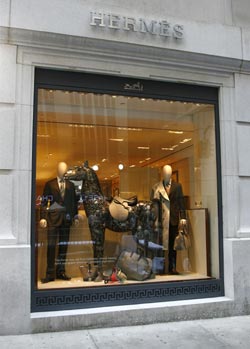
Catering
to the rich: Hermes
International said in June it aimed to triple its stores in
China to 25 in the next five years
'The number of wealthy individuals
in China is growing very fast, based on the economic boom,' Mr
Hoogewerf, who compiles an annual China 'rich list', said in an
interview.
His China Luxury Index, which
tracks 32 items including the Rolls-Royce Phantom EWB and the Louis
Vuitton Speedy Bag, shows prices of luxury products in China jumped
8.7 per cent in the year to this February, compared with a 3.5 per
cent rise in the consumer price index.
Luxury properties, golf memberships
and executive education led the gains, with the price of a 372 sq m
villa in Shanghai rising 18.6 per cent to 19 million yuan (S$3.8
million).
Also fuelling the rise were China's
culture of gift-giving and the implementation in April last year of a
10-20 per cent tax on certain luxury imports, he said.
Although most luxury goods are
imported, they seem to have seen little price relief from the
appreciation of the Chinese currency, the yuan, which rose 4.5 per
cent against the US dollar during the period.
Mr Hoogewerf also said 50
individuals in China had wealth of at least US$1 billion, while 2,000
were above US$100 million and 35,000 exceeded US$10 million.
The growing numbers of China's
wealthy have caught the attention of the world's luxury goods makers.
Richemont's Cartier watch and jewellery brand said last month it
planned to open 25 new shops in mainland China by March 2008, while
Hermes International said in June it aimed to triple its stores in
China to 25 in the next five years.
Overseas lenders such as Citigroup
and BNP Paribas have set up private banking units targeting clients
with investable assets of US$1 million or more and several of their
Chinese peers, including the Industrial & Commercial Bank of China
and Bank of China, are following suit.-- Reuters
16 August 2007
New urban rich Chinese are keen to
travel: survey
Compared with other countries,
China's new urban rich are younger, better-educated and keener to
travel, a survey by international credit card organisation MasterCard
showed yesterday.
China will have 8.5 million
affluent households with annual income above US$25,000 by 2015.
The 25 million members of those
households will have annual discretionary spending power of US$117
billion in constant dollar terms, the card firm estimated.
In 2005, China had 2.9 million such
households with US$18 billion to spend on things apart from life's
necessities.
Yuwa Hedrick-Wong, MasterCard's
economic adviser, said China's wealthy were 'shockingly young'
compared with their counterparts in North America, Europe and other
emerging Asian economies.
According to the survey of 900
people in Beijing, Shanghai and Guangzhou with annual household income
of between US$16,000 and US$50,000, more than two-thirds were under
the age of 40.
'We have never seen such a
phenomenon, that is, affluent families are dominated by young people,'
Mr Wong told a news conference.
The survey found 83 per cent of
China's young urban rich have a university education and nearly 80 per
cent of them travelled abroad at least once in 2006. Their purchasing
power can be felt 'far and wide', Mr Wong said.
In general, Hong Kong and Macau
remain the top two foreign destinations for newly affluent Chinese.
-- REUTERS 14
August 2007
Young working women in China
spend nearly one-quarter of their income, $566 per month, on cosmetics
and hairdressing. They also spend more than 3.5 months' income on
clothes and accessories. Source:
ChinaNews.com, McCann Worldgroup
'Office Ladies' becoming a big force in
China's shopping malls
Spending spree: Shopping
is the favourite pastime of many young, unmarried, working women in China's
eastern cities
(SHANGHAI) Feng
Qi is a marketer's dream. She's young, unmarried, has a stable income, and
says her favourite pastimes are shopping and travelling abroad.
And there may soon be millions like her in
China.
'I spend more than half of my salary on
shopping every month,' says Ms Feng, a 27-year-old advertising manager
who prefers to be known as Amanda Finn, an English name she adopted.
Shopping in China has become more fun with
the entry of growing numbers of foreign retailers, she says as she
strolls through a Zara store in fashionable downtown Shanghai, wearing
a yellow pleated miniskirt and black jacket.
'There are so many brands to buy now,
compared to a few years ago,' said Ms Feng, whose 7,000 yuan (S$1,374)
monthly wage is above the average salary in affluent Shanghai of about
2,000 yuan.
Several decades after the so-called
'Office Ladies' emerged in Japan, and then in Asia's other affluent
countries, they are becoming a prominent feature in China's booming
eastern cities.
Their Japanese nickname, often
shortened to 'OL', described a social as well as economic change - a
modernising economy created white-collar jobs which let women delay
marriage and lead independent lifestyles well into their 20s or
longer.
OLs were an important factor behind
the Japanese economic miracle as they boosted consumption and created
demand for new luxury and leisure goods.
China's sheer size - its large
cities with over one million inhabitants each, contain about 250
million people, which is nearly double the size of Japan's population
- means its OL phenomenon could ultimately be much bigger.
Some say China's OLs could prove
more important to overall consumption because, in contrast to their
Japanese counterparts, they stay financially independent as they
remain in the workforce after marriage.
'In Japan you have an 'office lady'
who goes to work with the express knowledge that her primary objective
is to find a husband and that there is no possible hope of advancement
within the company,' said Tom Doctoroff, who heads advertising agency
JW Thompson in Greater China.
'That is not happening here at
all.'
Many Chinese OLs live with their
parents until they get married, meaning disposable incomes are
relatively high.
'I spend a lot of money in
restaurants and I often buy fashion magazines to get inspiration for
my shopping,' said 25-year-old marketing assistant Xia Yan.
She uses money that she would
otherwise spend on rent, or might a decade ago have spent on family,
for travel. 'I like to go to Hong Kong. Its a good place to get
cosmetics, where prices are at least one-third lower.'
Cao Zheng, 33, who works for a
Japanese bank in Shanghai, generally spends 1,000 to 2,000 yuan each
time she buys cosmetics. Travelling is probably her main expense, she
said.
'I travel at least once a year in
China and once overseas every year. I went to Bali for Chinese New
Year,' Ms Cao said.
With white-collar salaries on the
rise in China, where Credit Suisse projects the value of domestic
consumption could hit US$8.8 trillion by 2020, companies in the retail
sector see potential.
'It's one of our main targets,'
said Victor Herrero, managing director for Zara China, owned by
Spain's Inditex. 'They're really fashion-oriented, they travel a lot,
and they're eagerly looking for trends in the market. -
REUTERS 2007 April 28
HK
has world's biggest shopaholics
Hong Kongers are the world's biggest
shopaholics, heading to the shops twice a week, a survey by market
researcher ACNielsen shows.
The poll showed 93 per cent of Hong Kongers
viewed shopping as a form of entertainment, compared with 74 per cent
of consumers globally. The survey covered 22,000 Internet users in 42
markets.
Hong Kong promotes itself as a shoppers
paradise as the territory is crammed with shopping malls and
competition between retailers is intense.
Asians generally led the rest of the world
in consumption, a reflection of their growing wealth, the survey
showed. In China, 31 per cent of respondents said clothes shopping was
their favourite thing to do and 20 per cent of Indians in the poll
agreed.
-- REUTERS
6 June 2006
The wealth that is emerging in
China is staggering. Many of the foreign banks in Hong
Kong have staffed up with Private Bankers who speak putong hwa.
The luxury stores and developers too are catering to this new class of
rich which is spread as wide as Canada and the United
States. Some significant facts in the articles we've
collected so far.
Oct 19th 2006 |
HONG KONG
From The Economist print edition
A sharp slowdown in the American
economy could be offset by the growing and largely unrecognised power
of Asia's consumers
American consumers have been one of the main
engines of global growth for the past decade. But now, as America's
housing boom threatens to turn into a bust, many forecasters expect
household spending to stall. A few even worry that America could come
perilously close to a recession in 2007. Previous American downturns
have usually dragged the rest of the world economy down, too. Yet this
time its fate will depend largely upon whether China and the other
Asian economies can decouple from the slowing American locomotive.
According to conventional wisdom, American consumers have
single-handedly kept the world economy chugging along, whereas
cautious Europeans and Asians have preferred to save. Yet the
importance of America's role in global growth is often exaggerated.
During the past five years America has accounted for only 13% of
global real GDP growth, using
purchasing-power parity weights.
The real driver of the world economy has been Asia, which has
accounted for over half of the world's growth since 2001. Even in
current dollar terms, rather than PPP,
Asia's 21% contribution to the increase in worldGDP
exceeded America's 19%. But current dollar figures understate Asia's
weight in the world, because in China and other poor countries things
like housing and domestic services are much cheaper than in rich
countries, so a dollar of spending buys a lot more. If you want to
compare consumer spending across countries, it therefore makes more
sense to convert local currency spending into dollars using PPPs
rather than market exchange rates.
However, the doomsayers argue that Asia's growth has itself been
based largely on exporting to America, whereas domestic demand in the
region has languished. Their evidence for this is that Asia is running
a combined current-account surplus of over $400 billion, implying that
it is contributing much more to world supply than to demand. Thus if
America's demand stumbles, the growth in Asia's exports and output
would also plunge.
Asia's export growth would certainly slow sharply, but it is the
change in net exports that contributes to a country's growth rate, not
the absolute size of that surplus. Since 2001 the increase in emerging
Asia's trade surplus has added less than one percentage point a year
on average to the region's average growth rate of almost 7%. Contrary
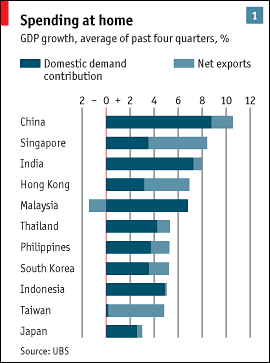
to the received view, the bulk of Asia's growth has been domestically
driven. True, domestic demand (investment and consumption) has grown
more slowly than GDP over the past year
everywhere except in Malaysia (see chart 1). But in most cases the gap
has been small, especially in China, India, Japan and Indonesia. In
contrast, growth in Taiwan, Hong Kong and Singapore has been heavily
dependent on external demand over the past year.
It is true that exports account for 40% of China's GDP,
but those exports have a large import component; only a quarter of the
value of China's exports is added locally. The impact of a slowdown in
export growth would therefore be partially offset by a slowdown in
imports. China's GDP growth has come mainly
from domestic demand, which has been growing by an annual 9% in recent
years.
The idea that China's growth is mainly export-led is not the only
popular myth. Another, says Jonathan Anderson, an economist at UBS,
is that China's consumer spending is feeble. Several recent reports
highlight that according to official figures spending has fallen from
50% of nominal GDP in 1990 to 42% today.
But this partly reflects an even stronger boom in capital spending.
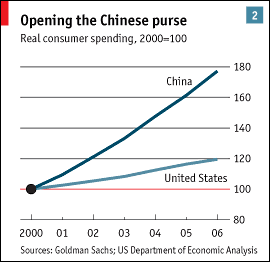
Real consumer spending has been growing at an average annual pace of
10% over the past decade—the fastest in the world and much faster
than in America (see chart 2).
There is also good reason to believe that official figures
understate consumer spending in China because of their inadequate
coverage of services. Purchases of homes by the Chinese have risen
rapidly since they were first allowed in 1998, but these are also
excluded from the figures. If they are added in, Mr Anderson
calculates, total household spending has not fallen as a share of GDP.
How does this square with the common perception that Chinese
household saving is extraordinarily high and rising? The truth is that
it is not. The saving of Chinese households has in fact fallen from
20% to 16% of GDP over the past decade. The
main reason why China's total national saving rate looks so high (at
close to 50%) is that Chinese companies have been saving a much bigger
slice of their booming profits.
Bags and bags of shopping
Across many other Asian countries, the notion of the frugal Asian
consumer is equally flawed, says Mr Anderson. Although consumption has
fallen as a share of GDP in most Asian
countries, this does not mean that households are saving more.
Excluding China and India, household saving has fallen sharply, from
15% of GDPin the late 1980s to 8% today.
The paradox is explained by the fact that wage incomes have risen more
slowly than GDP as production has become
more capital intensive. But this means that Asian consumers are
spending a rising share of their income by borrowing or running down
their savings. Amazingly, the savings rate of Japanese households has
fallen more sharply than that of American households over the past
decade.
Doing
their bit to help the world economy
The IMF estimates that in Asia as a
whole (including Japan as well as the emerging economies) real growth
in consumer spending has averaged a healthy 6.3% a year in 2005 and
2006. This suggests that Asian consumers can help sustain fairly
robust GDP growth in Asia even if America's
economy takes a dive.
Some pundits have predicted a boom in Asian consumer spending over
the coming years, which would help to fill the gap left by American
consumers cutting back on their purchases. But if consumer spending is
already rising strongly in Asia, there is little pent-up demand ready
to explode. On the other hand, spending by firms could pick up. After
the Asian economic crisis in the late 1990s, investment plunged
everywhere except China. It has remained relatively weak. However, as
the overhang of excess capacity and debt has disappeared, capital
spending is now starting to perk up across Asia.
Japanese firms' average return on assets now exceeds long-term
interest rates by 5%, the widest margin for decades, according to
Merrill Lynch. The Bank of Japan's latest Tankan survey of business
confidence found firms to be unexpectedly cheery. Big Japanese
manufacturers now report insufficient production capacity for the
first time since 1991 and plan to increase capital spending by 17% in
the year to March.
Another reason for believing that Asian economies can decouple from
an American downturn is that most of them have small budget deficits
or even surpluses. This means they have plenty of scope to ease fiscal
policy to support domestic demand so as to offset some of the fall in
exports. The main exception is Japan, which has a massive public debt;
Taiwan, where domestic demand is worryingly weak, is also constrained
by a large budget deficit. South Korea, on the other hand, which has
run a budget surplus for seven years, has plenty of scope to ease up.
The United States of where?
Not only is growth in China and the rest of Asia chiefly
domestically led, but America's share of Asia's total exports has
fallen from 25% to 20% over the past five years. Regional trade links
within Asia have also deepened, thanks partly to growing Chinese
demand. Goldman Sachs reports that five years ago China's imports for
domestic use were only half as big as those for the assembly and
re-export of products, but now they are roughly the same size. So
strong domestic demand in China sucks in more imports.
China's exports to America have fallen from 34% of its total
exports in 1999 to 25% now (adjusting for the re-exports which are
made through Hong Kong). Chinese exports to the European Union are now
almost as big as those to America and are growing faster.
"When America sneezes, the rest of the world's economies may no
longer catch a cold"
America takes only 23% of Japan's exports, down from almost 40% in
the late 1980s. However, this understates Japan's total exposure.
Japanese firms (like those in South Korea and Taiwan) send a lot of
components to China for assembly into goods, which are then exported
to America as finished products. On top of this, if a sinking American
economy pulled the dollar down with it, this would further squeeze
Asian exporters.
A recent report by Peter Morgan at HSBC estimates
that slower American growth will hurt China, India and Japan much less
than it will the smaller Asian economies, such as Singapore, Taiwan
and Hong Kong, that are more dependent on foreign demand. China, India
and Japan account for three-quarters of Asia's GDP
and so, given the deeper regional trade links, they should help to
support demand in the whole region. If America's GDP
growth slows next year to 1.9%, from 3.5% in 2006, as HSBC
expects, then Asia's growth is tipped to slow from just above
7% this year to just below 6% in 2007. Weaker exports will badly hurt
some industries, but overall, the region will continue to grow at a
reasonable pace.
Could Asia withstand a sharper American slowdown? Hong Liang at
Goldman Sachs estimates that if America's GDP growth drops to zero by the end of 2007 then China's annual export
growth could plummet from 26% in early 2006 to a decline of 2% by late
2007. That sounds dire. Yet after taking account of the impact of
slower export growth on imports and domestic demand (ie, slower growth
in investment), Ms Liang estimates that China's GDP
would still expand by a respectable 8%. That is significantly down
from this year's growth rate of over 10%, which is still too fast to
be sustained. China is today tightening policy so as to slow down its
runaway economy: weaker external demand could be partly offset by
reversing these measures.
In sum, if America suffers a slump, the economies of China and the
rest of Asia would slow, but they are unlikely to be derailed.
However, a slowdown in America could affect Asia indirectly through
other channels. Most important and least certain of all would be the
impact of an American recession on financial markets. Even if
economies can decouple, global financial markets tend to be more
tightly linked through the investment strategies of hedge funds and
the like. If America's economy hits the buffers, this will surely
trigger a rise in risk premiums and a drying up of market liquidity,
pushing share prices lower in Asia as well as in America. When America
sneezes, the rest of the world's economies may no longer catch a cold;
but if Wall Street shivers, global tremors will still be widely felt -
THE
ECONOMIST Oct 19th 2006
FACT:
China is the third largest market for
luxury goods in the world, behind Japan and the United States. It
accounts for 12 per cent of global sales, and by 2010, 250 million Chinese, 17
times more than today, will potentially be able to afford luxury products. - AFP
2007 March 19
Luxury market elusive
HONG KONG --
China's
luxury market is proving harder to crack than many overseas companies
anticipated, even as incomes soar and economic growth tops 10 per
cent.
Dozens of high-end brands, from Cartier and
Chanel to Hermes and Versace, are chasing the nation's limited pool of
big spenders. That's made profits elusive for most. "China is a
growing force in the luxury business, but the market isn't large
enough yet to accommodate so many players," says Ivan Kwok, a
manager at Boston Consulting Group in Hong Kong. Only about one in 10
overseas consumer-goods companies is profitable in China, he says. The
winners are the ones whose products are seen by Chinese consumers as
obvious symbols of wealth, he says.
-
14 January 2007
(SHANGHAI)
Forget about Paris and New York. Chinese dying for haute
couture gowns or the latest luxury bags can now shop right at home.
Makers of luxury apparel, liquors and other goods increasingly are
looking to China, India and other developing countries for growth they
won't find in older, established markets in Europe.
To meet soaring demand for Asia's newly affluent, venerable names
like Prada and Giorgio Armani are setting up stores as quickly as they
can - and even mulling making some of their products here.
'China is certainly the most prominent and most important market we
have in front of us,' Paolo Fontanelli, chief financial officer for
Giorgio Armani SpA, told a conference on luxury brands held recently
in Shanghai.
Although China, Taiwan and Hong Kong together account for only a
tiny fraction of Armani's sales, the fashion group is quickly adding
stores in the country, both in major cities like Shanghai and in
lesser known ones, like Shenyang in the north-east and Chengdu in the
south-west.
And while the company led the way in setting up a flagship store on
Shanghai's riverfront Bund, just about all the big names now have
boutiques in the trendy districts of Shanghai and Beijing.
China is the latest, biggest frontier in the luxury goods market,
with India and Russia close behind, said Melanie Flouquet, luxury
goods industry analyst for JP Morgan.
'Emerging markets are not only not insignificant but they are
critical for growth going forward,' Ms Flouquet said, adding that
China accounts for 5 to 6 per cent of sales of European luxury goods,
with Russia at about 3 per cent and India at one per cent.
Chinese travellers have also joined the Japanese - long notorious
for their love of name brands - as an important clientele for luxury
shops in Paris, New York and Hong Kong.
Yet although shopping in Paris, Milan or Hong Kong still carries a
certain cachet, buying overseas is no longer the only way for shoppers
to dodge the fakes that are rampant here.
With so much potential growth at stake, Chinese consumers,
especially the wealthy ones, have become the focus of intense analysis
- as are those in India and Russia.
Until recently, men accounted for more than two-thirds of spending
on luxury items in China.
But that's changing as women with rising incomes splurge on ladies
wear, luxury cosmetics and fashion accessories, said Ms Flouquet, of
JP Morgan.
Just
about all the big names now have boutiques in the trendy districts of
Shanghai and Beijing.
Conspicuous consumption is in - the pages of Shanghai's fashion
magazines are plastered with shots of society belles in Dior and
Versace.
Research shows that the Chinese tend to buy luxury products without
a lot of study or research, while many in Europe and Russia tend to
focus on the 'genuine value' of what they buy. - AP
24 May 2005
Luxury goods makers count on
big-spending Chinese
China may save the world's luxury goods
industry, just as it has rescued producers of soybeans and iron ore.
The South China Morning Post reported
yesterday that Chinese citizens last year accounted for 12 per cent of
global luxury goods sales, according to a report by Goldman Sachs.
Demand for such goods by Chinese travellers will grow 20 per cent a
year until 2008 and 10 per cent from then until 2015.
Ten per cent of luxury goods were sold to
Chinese travellers abroad, including in Hong Kong, while 2 per cent
were sold on the mainland.
In Europe, the average Chinese traveller
spent 550 euros (S$1,180), the report estimated - about the same as
Japanese tourists spend. By comparison, the average Russian in western
Europe spent 700 euros, and Americans spent only 450 euros.
By 2010, Chinese could account for nearly 20
per cent of the industry's sales, the report projected. Within 10
years, Chinese luxury consumers will catch up with their counterparts
in Japan, now the biggest spenders, accounting for 41 per cent of
sales.
The numbers are attracting global luxury
goods firms to open outlets in China, such as Giorgio Armani's swank
display at Three on the Bund, says the Post.
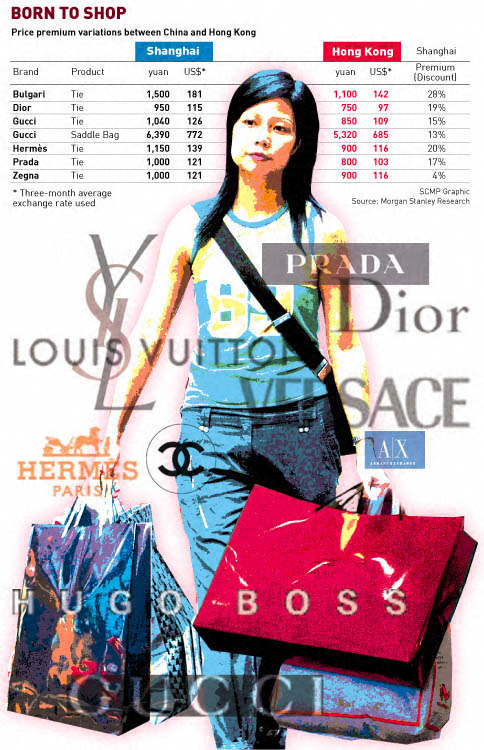
Setting up in the mainland is often a
brand-marketing exercise more than a bid to make huge sales - taxes
and duties make luxury goods 30 per cent more expensive in Shanghai
than in Hong Kong. At Plaza 66, a Shanghai skyscraper with one of the
biggest collections of luxury goods in the city, window-shoppers far
exceed customers.
They are there to decide what to purchase in
Hong Kong, Paris or New York. The companies do not mind: the rent is
considerably cheaper than television advertising.
The lure of the Chinese market is strong
enough to attract Prada chief executive Patrizio Bertelli, Giorgio
Armani chief financial officer Paolo Fontanelli, WPP Group chief
executive Martin Sorrell and other big names to the 'Business of
Luxury' summit here next week. The event is being held at the Shanghai
Exhibition Centre, formerly the Hall of Sino-Soviet Friendship.
The luxury market in China consists of 10-13
million people, mostly entrepreneurs and young professionals working
for multinational firms and living in the major cities of the east.
They travel frequently and have buying habits similar to those of
Japanese, who started to go abroad in large numbers in the 1980s. -
SINGAPORE
BUSINESS TIMES on 13 May 2005
"China, with Hong Kong and
Taiwan, represents 10 per cent of the total business of Christian Dior
couture." -
Pierre Denis, Dior couture and perfume Asian rep AFP
-- A new report portrays Chinese
consumers as a sophisticated, brand-loyal and often dissatisfied lot,
puncturing their longstanding image as fickle and penny-pinching.
In its first report on consumers in China, Kurt Salmon Associates, an
Atlanta-based retail and consumer-products consultancy, concludes that
Chinese shoppers have developed discerning tastes and preferences at
warp speed.
Middle-income residents in four cities said the critical factors in
choosing a brand are trust in its quality, a positive impact on
health, and its care for customers; having a fair price ranked only
fifth. In choosing a shopping destination, quality, service and
variety were the top three factors, with value coming in fifth.
"The conventional wisdom was that the Chinese consumer will buy
whatever's cheapest," says Mohan Komanduri, the consulting firm's
principal and regional director of East Asia. "The fact that they
are putting quality before price means that the Chinese consumer is
becoming more sophisticated."
The report, to be released on Aug. 16, was based on interviews with
600 residents in Beijing, Shanghai, Chengdu in the interior and
Shenyang in China's northeast. The company plans to issue an annual
China report to keep up with rapid changes in the marketplace.
Those surveyed, who had monthly household incomes ranging from $300 to
$1,200, showed a high level of brand awareness. Asked to identify the
products made by a variety of brand names, 83% of consumers on average
were able to do so.
Loyalty to brands is also high. For toiletries, 78% said that they buy
brands they know and that they are unlikely to switch if their brand
isn't available. The study suggests that those who still regard China
as a wide-open market will have to rethink those assumptions.
Preferences for foreign or local brands diverged markedly depending on
the product. Asked whether they preferred to buy a local or foreign
brand offering products of identical price and quality, consumers
overwhelmingly preferred local brands for food, toiletries and
household items. But for consumer electronics and home-improvement
items, they opted for international brands. In clothing, the two
groups were evenly split, though European brands were seen as more
fashionable than Chinese or American labels.
"They're fundamentally Chinese in the things they put in their
body or on their body," Mr. Komanduri says. The message to
multinationals, he adds: "If you're doing consumer goods, try to
look Chinese," rather than emphasizing a product's international
roots in packaging or marketing.
Consumer dissatisfaction also ran high. The report found that people
shop once a month or less for things such as consumer electronics and
clothing, suggesting that shopping isn't a favored leisure activity
for large segments of the population. According to the survey, 48% of
women said they dislike shopping, outnumbering the 30% of U.S. women
who say the same. Meanwhile, 63% of men disliked shopping, putting
them roughly on par with their U.S. counterparts. Chinese shoppers on
average said they found what they were looking for only 5.4 out of 10
store visits, suggesting that retailers need to do a better job
managing inventory and designing store layouts.
The report also shows a retail sector in a state of flux and
fragmentation. For example, consumers do their food shopping at
supermarket chains almost twice as often as they do at traditional
open-air markets or hypermarkets. But hypermarkets are growing in
popularity: About 40% of people are shopping more in these large-scale
stores this year compared with last year. For clothing and shoes,
people favored department stores. But they went to local specialty
stores for consumer electronics, and superstore chains for
home-improvement items.
- by Leslie
Chang Staff Reporter of THE
WALL STREET JOURNALAugust 6, 2004
Real estate boom fuels
China's luxury car craze Newly minted
multimillionaires drive up demand but there are signs of property
slowdown and concerns about wealth gap
BEIJING - Mr James Wang, a 27-year-old
developer of golf courses and luxury homes, was one of China's first
two buyers of the Maybach 62, a 6.1m ultra-luxury sedan marketed as
'the private jet of the road'.
At the Beijing auto show on Wednesday, he
went on stage to accept a crystal model of the keys to a silver
Maybach that had already been delivered to his home.
Mr Wang said that he had bought the car for
the equivalent of US$900,000 (S$1.6 million), including taxes, and had
chosen it because he liked both the driving performance and the
comfort of the rear seats.
But he was vague about how he could afford a
car that costs the equivalent of 1,200 years' wages for a typical
Chinese factory worker.
Mr Wang's riches are a sign of the powerful
economic boom that has gripped China, pushing up property values in
major cities in the country.
His purchase also highlights how a few
Chinese families have accumulated extraordinary wealth, which has led
to some nervousness among the rich themselves and some concern among
China's leaders about the potential for a political backlash over
sharply widening wealth inequality.
Indeed, even as Mr Wang accepted his Maybach
key in person, the buyer of the second Maybach sent a man who refused
to name his employer.
Sales of luxury cars have taken off even
though China has some of the world's highest car prices.
Beyond the basic cost, buyers here pay a 17
per cent value-added tax, an additional consumption tax of up to 8 per
cent and, for imported models, a 32 per cent tariff.
And Mr Wang is just the kind of newly minted
multimillionaire that the world's luxury car manufacturers are eagerly
chasing.
Automobili Lamborghini Holding, a subsidiary
of Volkswagen's Audi unit, signed papers this week to open dealerships
in Beijing, Shanghai and Guangzhou.
'Chinese people love brands and have a good
feeling about extreme luxury,' said Mr Werner Mischke, chairman of
Automobili Lamborghini Holding.
Ferrari and Aston Martin, the Ford Motor
subsidiary that has supplied cars for many of the James Bond movies,
have also announced plans to enter the Chinese market.
Last year, China accounted for more than a
third of worldwide sales of the 760Li, BMW's most expensive model,
which costs US$250,000 here.
Many of the buyers are making fortunes in
real estate.
But for all the wealth apparent now, there
are hints that the boom may not last.
Alarmed by a recent acceleration of
inflation, Chinese regulators have begun urging banks to lend more
cautiously, especially for real estate, and have imposed land use
restrictions. Actual property prices and rents have been falling.
A few car executives are starting to become
nervous.
'The real estate side is definitely slowing
down, and that will affect everybody,' said Mr Bill Begg, general
manager of Ford Motor's Land Rover and Jaguar subsidiaries in China. --
New York TimesSINGAPORE
BUSINESS TIMES 11 June 2004
Armani opens in Shanghai
(SHANGHAI) Giorgio Armani was so impressed
by a fake Armani watch he bought for US$21 in Shanghai, he decided to
make some watches in China at a lower cost. Now the Italian fashion
designer plans to open 30 boutiques there by 2008.
Other than Armani, Prada Holding NV, Cartier
Inc and other luxury brands are also expanding in China, betting that
sales of their goods will rise in line with increasing affluence.
Imitators may not dent profits, according to
analysts such as Eric Wong, of UBS Securities Asia Ltd in Hong Kong.
'There may be a lot of demand for fakes, but there is a lot of demand
for the real thing too,' said Mr Wong.
Armani's sales in China rose 17 per cent in
the first quarter, almost twice the overall gain, the company said. It
did not disclose revenue. Total profit surged 14 per cent to 134
million euros (S$268 million).
Sales by Geneva-based Cie Financiere
Richemont, which owns Cartier, rose 10 per cent in the first quarter
on higher demand in Asia and the Americas, the company said.
Amsterdam-based Gucci Group and Paris-based
Louis Vuitton get about 30 per cent of their combined 4.3 billion
euros in revenue from Asia, excluding Japan, according to data
compiled by Bloomberg.
China's luxury goods market is worth about
US$2 billion, or 3 per cent of the world's total, Xinhua news agency
reported in February. About 210,000 of China's 1.3 billion people are
millionaires in US dollar terms, according to the 2003 World Wealth
Report compiled by Cap Gemini Ernst & Young.
It is impossible to estimate how much
luxury-brand companies lose to Chinese imitators, said Maxime Elgue,
the managing director of Cartier Far East.
Half of the US$100 million in counterfeit
goods seized by US Customs officials in 2002 were from China,
according to the International Chamber of Commerce.
The government must do more to combat
counterfeiting, Mr Elgue said. 'They need to convince the country that
fakes are bad for them.' he said. 'We're spending millions every year
to sue companies, to terminate workshops.'
Meanwhile Cartier, famed for
diamond-encrusted watches, plans to add seven stores in China this
year for a total of 10, Mr Elgue said. The company wants 20 stores by
2006.
'We know it'll be the market for the
future,' he said. 'We need to step ahead of the competition.'
Cartier opened its first Chinese boutique at
the Peninsula Palace Beijing hotel in 1997. It will set up in some of
China's richest cities this year, including Guangzhou, Shenzhen,
Harbin, Hangzhou and Chengdu.
China may overtake Japan as Cartier's
biggest market in 15 years, Mr Elgue said. 'The sky's the limit.'
Armani plans to add two stores in Shanghai
this year to bring its total to eight. He opened his first Chinese
boutique in Beijing in 2002.
'If you look at our competitors, their share
of the pie from Asia is significantly greater,' said Robert Triefus,
Armani's executive vice-president. 'We feel that there is great
opportunity to expand that percentage.'
Prada, a closely held Milan-based Italian
designer of shoes and handbags, said it plans to spend 35 million
euros to open as many as 15 stores in China through next year after
entering a decade ago.
'China is a fast-growing nation, so it's
creating the opportunity to open new stores,' said Giovanni del
Vecchio, Prada's Asian director. - Bloomberg
22 May 2004 Singapore
Business Times
China's
luxury goods market is worth about US$2 billion, or 3 per cent of the
world's total, Xinhua news agency reported in February.
Brands pay premium for value
Never in Hong Kong's history as a
shopping haven has so much prime retail space been devoted to selling
so many expensive non-essentials to so few. Just 8 per cent of its
residents are likely to buy luxury branded items such as Louis Vuitton
bags or Tiffany baubles.
Yet in recent years Central landlord Hongkong Land Holdings has
transformed first Prince's Building, then Alexandra House, Chater
House and now Landmark into miniature A brand cities. Chater House now
boasts 27,000 square feet of luxury retail space.
Causeway Bay has followed suit: there is the Lee Gardens, whose
owner Hysan Development is capitalising on the success of Hysan 1 by
converting the Caroline Centre into Hysan 2.
In Tsim Sha Tsui, Wharf (Holdings) is on the same track with
wall-to-wall designer brands lining Canton Road. And then there is 1
Peking Road.
"It's actually nothing new," said Ian Hawksworth, an
executive director at Hongkong Land. Luxury flagship stores do not
happen overnight. "It started in the mid-to-late 1990s as the big
brands realised they wanted flagship stores in Hong Kong."
Dick Groves, a regional director and retail sector specialist at
Jones Lang Lasalle, said: "What's going on in Central is a very
smart move by Hongkong Land. They spotted the trend in other big
cities of putting luxury outlets on higher floors - retail rents are
higher than office space."
So just how much rent is a brand such as Giorgio Armani, with its
6,000 sq ft emporium, forking out in Central? "About HK$5,000 per
square foot, prime," Mr Hawksworth said, "and increasing in
recent months, but historically smaller locations trade higher."
The impact on rents of the New York World Trade Centre attacks and
of Sars was nowhere near as severe as the 1997 financial crisis, he
said.
Luxury brands would not be squeezed on the rent, FPD Savills
director Nicholas Bradstreet said. "In international tables you
might see Hong Kong topping retail rent tables, but that's not luxury
brands. It's because small spaces at high rents distort the
figures," he said, adding luxury brands preferred to huddle
together in shopping centres, in clusters.
Brands rarely get rent discounts, generally paying market value.
Luxury brand lease structures, for fashion companies, are generally
a base rent plus 12 per cent to 15 per cent of sales, explains Mr
Bradstreet. Leases are typically for three years or six, with a rent
review after three.
So considering the overheads - and what a February 27 Morgan
Stanley equity research report calls "low sales per square
foot" for brands in China - do they really make money, or do they
serve as hugely expensive advertising vehicles to maintain visibility?
Retail property agents admit some brands sink the advertising
budget into their Central rent bill. Squeezing any pertinent figures
out of the brands themselves is fruitless. They are happy to twitter
about their products but shy away from any question that strays beyond
public relations fluff.
Asked why Louis Vuitton was expanding its Landmark emporium, a
spokeswoman said it was because Prada would be opening its Central
store next month.
Since the Italian brand spent US$82 million for its Tokyo Omate
Sando Street store, this could prove a hard act to follow, Mr Groves
said.
How is their business split between mainland and Hong Kong
customers? "We can't reveal that," the Louis Vuitton
spokeswoman said. And a query on the average spending per customer in
their six Hong Kong stores drew a blank.
As to whether the prime objective of these costly flagship stores
is profit or brand visibility - in short, do they make money? - she
retorted: "Your question is a strategic one."
Mr Groves doubts that many flagship brand stores make money. He is
watching the new Louis Vuitton store at 57th and 5th avenues in New
York with interest after previous flagships flopped. "Boss opened
theirs on 56th and 5th in 1997-98, then there was Gap and Brooks
Brothers - they didn't work," he said.
"The brands need to be clear about flagship stores. Do they
upgrade the brand? I'm not sure. I really question if flagships make
money. When a store like Prada in Tokyo costs US$82 million, they are
not looking at profit."
In Hong Kong, Mr Hawksworth believes it is simply that they all
have their eyes on the China market. "As a business group, we're
very excited about the Hong Kong market as a stepping stone for China
and it's the chance to capitalise on the mainland tourists."
But mainland first-timers tended to be intimidated by Central, Mr
Bradstreet said. "It's too formal. They like Causeway Bay because
it's young, happening and casual. They like to shop in Mongkok,
Causeway Bay and Tsim Sha Tsui."
This is reflected in the product offer. "In Landmark, you see
more big-ticket items like frocks and ball gowns aimed at tai tais,
but in Causeway Bay, it's belts, more inexpensive items that appeal to
mainlanders."
Nevertheless, Mr Hawksworth said Central was the destination of
choice for high-end shoppers and a look at Landmark proves him right.
Upmarket London name Harvey Nicholls is coming, so too is Fendi, which
is opening in the third quarter, and Christian Dior, whose new 6,500
sq ft flagship opens its doors in May. Louis Vuitton is upgrading to
18,000 sq ft, on a par with its big New York, Paris and Tokyo stores.
"We've managed to establish Central as a premier world
shopping location now; it ranks with Tokyo, London, Paris. That's been
our strategic objective since the mid-1990s." Going forward,
brands saw their focus was definitely the China market, Mr Hawksworth
said.
"China's developing very nicely for luxury brands," Mr
Bradstreet said. "And places like 1 Peking Road are making money
- mainlanders stay in three-star Mongkok hotels and head straight for
Harbour City to shop."
Hugo Boss would agree, with 50 shops in Hong Kong and China and a
further 10 opening this year.
The Morgan Stanley report sheds light on the mainland shopper
proposition. China domestically and via tourism could become a big
market for luxury goods, it says.
The market could become 100 million - 8 per cent of the population
- although the luxury goods market now is just 1 per cent, or 13
million mainlanders. Japan, the other big, but mature, market for
European brands, offers a useful comparison, the report says. The
population of Japan is 127 million,
Coach says it targets the top 60 per cent of households in Japan.
Therefore, conservatively, a brand could see its potential business in
China to be at least half the figure for Japan.
"Bulgari has stated that it believes China could represent 10
per cent of its sales in 10 years' time," the report says,
compared with 0.05 per cent now and 22 per cent in Japan. Gucci
believes its sales in Asia, excluding Japan, could triple to 30 per
cent of total sales, from 12 per cent now, in 10 years, driven by
China.
Brands report that mainland shoppers like to shop here because
goods are at least 30 per cent cheaper than in their home market due
to the absence of mainland import duties. They also like the assurance
that the merchandise is genuine. The Comite Colbert, an association of
65 French brands, says that this is a crucial part of Hong Kong's
appeal.
Fakes do not tempt Chinese buyers interested in acquiring status
symbols and the genuine article, according to the group's chief
executive, Elisalbeth Ponsolle des Portes, on her recent trip here.
Morgan Stanley concludes the China market is still small but said:
"Investing in China is a brand-building exercise rather than a
profit driver. We see payback for most brands as at least five years
away. Due to low sales per square foot, brands need to be present to
educate consumers." - by Anna Healy
Fenton March 30 2004 South
China Morning Post
Chinese
furor over fortune and fame
BEIJING - Whether
their fame comes from the court, the stage or the silver screen,
Chinese celebrities are beginning to ride the wave of riches, fame and
publicity, largely due to the country's rapidly growing entertainment
industry. And this month, Forbes China, the
Chinese-language edition of US-based Forbes financial magazine, only
added to China's increasing preoccupation with wealth and celebrity.
In the 1980s, paramount leader and reformer Deng Xiaoping told a
skeptical and rigidly egalitarian nation: "Getting rich is
glorious," but today, it seems that getting too rich and too
glorious invites anger, envy, tax audits and corruption probes. A new
atmosphere of political correctness is making some celebrities coy
about their wealth.
The first Forbes China Celebrity List, modeled on Forbes' annual
celebrity 100 list, was published on February 10 - lifting the veil on
the country's sometimes - and sometimes not - publicity-shy
entertainers, and simultaneously causing a storm with its assessment
of growing wealth and fame in an industry once assigned by the Chinese
Communist Party to serve the masses.
The list surveyed the income and popularity of Chinese-born
celebrities in film, sports, media, music and publishing. Basketball
star Yao
Ming, who plays for the Houston Rockets in the United States
National Basketball Association, topped the list with a reported
income of US$14.6 million. Although Yao led the way, his income was
topped by Hollywood star Jet Li, ranked No 10 in popularity, but who,
with earnings of $17 million, had the highest 2003 income among
mainland Chinese celebrities. Rankings are based on popularity, not
strictly wealth.
Chinese actress Zhang Ziyi, star of the Oscar-winning film Crouching
Tiger, Hidden Dragon, came in second with an income of $3 million.
Third place went to Zhao Wei, China's most-interviewed movie star,
whose movies roles last year earned her $2.3 million. Faye Wang, the
Beijing-born diva and one of the Chinese-speaking world's most popular
singers was No 4, and international film star Gong
Li was No 5 at $3.4 million.
The list is ultimately a ranking of celebrities based on their
exposure and popularity, however, much attention is being paid to the
income figures on which their fame now rests. As such, the list has
provoked fury both among China's entertainers and its ordinary
Chinese. A series of state-run publications has denounced the ranking
of wealthy entertainers as ''sheer nonsense'' and quoted some ranked
Chinese celebrities as questioning the figures used to calculate their
incomes.
Embarrassed singer downplays her wealth
Pop singer Han Hong slammed the ranking, which placed her 12th on the
list and calculated her income at $2.4 million a year. ''Even people
with a little knowledge of the entertainment circle in China know it
is impossible for an actor to earn that much in a year,'' the
state-run Xinhua News Agency quoted the singer as saying.
The English-language China Daily carried a report titled:
''Celebrities: Forbes list sheer nonsense'' and quoted dancer Huang
Doudou, actress Deng Jie and actor Zhang Guoli as saying the magazine
had incorrectly assessed their incomes.
An editorial in the Beijing Star Daily went on to accuse Forbes
magazine of ''pursuing its commercial interests by taking advantage of
the fame of celebrities''.
The uproar highlights shifting attitudes toward wealth in what many
claim was once a classless society and where China's affluent elite
are now making a boisterous and ostentatious comeback. At the same
time, it underscores public fear of the government's crackdown,
especially a tax crackdown, on celebrities and business people known
for flaunting their wealth.
A string of fledgling Chinese multimillionaires - many of them
audacious about advertising their wealth, power and independence -
have fallen in the tax dragnet of communist authorities in the past
three years. Many of them had appeared on Forbes magazine's annual
list of the wealthiest people in China - not just celebrities.
One of the most prominent tax "victims" is actress Liu
Xiaoqing, a glamorous starlet-turned-businesswoman, who unabashedly
proclaimed herself to be China's first female billionaire.
Nouveau tax scofflaws to be punished
Even as the Chinese Communist Party has welcomed private entrepreneurs
into its fold and is preparing to enshrine the rights of private
property owners in the country's constitution, Beijing is driving home
the message that the nouveaux riches must pledge obedience to the
ruling party and comply with the laws on the books, just like
everybody else.
A crackdown on alleged corporate malfeasance has caused the downfall
of more than one Chinese capitalist, including orchid tycoon Yang Bin
and Yang Rong (no relation), one of China's richest automobile
businessmen. Yang Bin and Yang Rong were ranked second and third in
the 2001 Forbes rich list.
The publicity, which has accompanied the disclosure of many corruption
and tax fraud cases, has encouraged the wealthy to be coy and quiet
about personal wealth.
''Traditionally, Chinese people like to make known the pride and honor
they have brought to their family by striking it rich,'' said Zhao Wei,
a private practitioner of Chinese medicine, who in the last year
managed to buy a villa and a car - the ultimate symbol of wealth for
China's emerging middle class.
The downfall of some Chinese tycoons also is thought to have been
politically motivated. Zhou Zhengyi, for instance, a Shanghai property
tycoon, has been a prime target of tax investigators now for months,
and experts who asked not to be named say that his influential
political contacts with former president Jiang Zemin may have added to
his woes.
Yet on the whole, the corruption drive has sought to shore up the
ruling party's waning legitimacy by curbing graft and jailing big tax
cheats.
Party cadres the biggest targets in clean-up
A recent report in the state-run media revealed that so far the
biggest number of targets in the party's clean up campaign have been
communist party members themselves.
According to a January report in Wen Wei Po, a Hong Kong-based
newspaper, more than 1,200 communist party cadres killed themselves
and another 8,000 fled overseas during an anti-corruption crackdown in
the first six months of 2003.
When Deng Xiaoping embraced market reforms in 1980s, he discarded
communism's egalitarian code by declaring that ''getting rich is
glorious''. With the unleashing of private enterprise, China's
manifestations of private wealth have increased and self-help books
like Robert Kiyosaki's Rich Dad, Poor Dad have become
bestsellers.
However, there are mounting concerns that all this rapid accumulation
of wealth might be getting out of hand. The income disparity between
the super rich and the poor has expanded to its widest point in more
than a century. In recent months, the capital has witnessed harrowing
scenes of people setting themselves on fire because of poverty and
social deprivation.
Since assuming power last spring, President Hu Jintao and Premier Wen
Jiabao have stressed that the government must put the public interest
first and must always focus on issues that are closest to the public's
heart. They are said to be planning new moves to punish those who have
amassed illicit fortunes.
And in this atmosphere of new political correctness, it's not
surprising that the unveiling of Forbes' list of Chinese celebrities
and their resulting wealth has been greeted by a firestorm of anger -
and envy.
- By
Antoaneta Bezlova 20 Feb 2004 Interpress
Service
Asia's Wealthy Number 55,000
Asia's wealthy swelled their ranks last year, with the number
of high net worth individuals in the region outstripping the global average,
according to Merrill Lynch.
Many of Asia's nouveau riche have risen to their lofty
financial heights on the Internet revolution of the past 12 months, having
already bloated the wallets of Americans and Europeans, a Merrill Lynch report
said.
The investment bank, in co-operation with Gemini Consulting,
found that the number of super-rich in Asia grew from 1.3 million to 1.7
million and they saw their bank balances improve by an average 23 per cent
last year, against a global rise of 12 per cent to US$25.5 trillion.
Much of the rise was attributed to improving global economic
conditions - particularly across Asia, where countries and companies emerged
from 18 months of recession.
Linked to this was the performance of share markets in the
region, where growth averaged 70 per cent compared with the 37 per cent global
rise. In comparison, the US market rose only 29.5 per cent last year.
In its world Wealth Report, Merrill Lynch said if this rate
of growth were sustained, the number of Asian high net worth individuals could
begin to rival those in Europe and the US.
Globally, Merrill Lynch noted the increasing emergence of
younger, active high net worth individuals, who created their wealth through
technology-oriented enterprises. Public listings of Internet companies and the
increasing frequency of related corporate option packages was significantly
intensifying wealth creation.
Of the estimated eight million people holding liquid
financial assets of more than US$1 million, about 2.5 million, or 30 per cent,
were from the United States, while 2.2 million Europeans account for a further
26 per cent.
The report forecast 12 per cent growth per annum in wealthy
individual assets for the next five years, reaching US$44.9 trillion by 2004.
This was not simply because of continued global prosperity
and expansion of existing financial assets, but also because such individuals
were likely to invest a bigger proportion of their assets in higher risk,
higher yielding financial instruments, either equities or venture-capital
projects, the report found.
Head of Merrill Lynch's international private client group
in Hong Kong, Francis Chan, said the rising number of wealthy individuals
presented a new challenge for banks to service their needs properly.
"Success would ride on critical factors such as
innovation, speed, technology platform, identification of specialist functions
in addition to investment - taxation, law and real estate, and increased
personalisation of service," Mr Chan said.
The report also identified 55,000 "ultra" high net
worth individuals worldwide - those individuals who have financial assets of
more than US$30 million, a rise of 18 per cent.
"The relentless rise in [high net worth individuals]
numbers and assets worldwide continued in 1999, boosted by a favourable
economic environment and exceptional stock market performance," global
president of Merrill's private client group, Winthrop Smith, said.
The report found that the ultra-rich take a shorter-term
view of investment strategies and are less risk-averse.
They also accept only top performance and are more demanding
than even normal high net worth individuals. -
David Saunders South
China Morning Post
3 May 2000
Citigroup gives 40 scions from region's most affluent
families a crash course in wealth management
What do you give the children of the world's wealthiest, who
have everything served to them on not just a silver, but a golden, platter? A
crash course on wealth management.
Well, at least that's what one bank here has done - to make
sure the old Chinese saying - that wealth is made by the first generation,
accumulated by the second, and squandered by the third - does not befall their
clients.
Just last week, Citigroup Private Bank in Singapore played
host to 40 scions of super-rich families from the Asia-Pacific ex-Japan, but
including the oil-rich Middle-East. Although figures are hard to come by in
the ultra-discreet world of private banking, clients in this region are
reckoned to have US$1 million to US$2 trillion in investible assets.
But given that the wealth in Asia is still in the hands of
the first generation and with records showing that 95 per cent of family
businesses in the US do not survive the third generation, Citigroup and its
affluent clients are not taking any chances. In what it considers a
far-sighted move, the bank is educating and cultivating the second generation.
Thus it invited 16 daughters and 24 sons of parents whose individual net worth
is above US$10 million to attend a series of seminars on wealth management,
succession and other issues of concern to the super-rich.
'A client is not just the patriarch or matriarch of the
family. A client to us, from a long-term perspective, is the family itself.
That's what differentiates us - our relationship goes across generations. What
the children do today will impact our clients,' Deepak Sharma, regional head
of Citigroup Private Bank, told BT recently.
'So we thought a very good idea would be to bring them in
early to understand the dynamics of how our relationship is going to work and
also for them to understand the financial markets because most of them are at
an age where this exposure will add to their education. A number of them will
inherit the business,' he said.
But financial savviness was not the only skill the bank
imparted. Citigroup provided a 'holistic' approach to wealth management. It
flew in not just financial experts but also specialists like Peter White, a
New York-based expert on psychological aspects of wealth management, to touch
on sensitive issues like inheritance and family dynamics.
The week-long programme which ended yesterday included a
2-day forex trading simulation game, issues of wealth transfer, trusts,
capital market instruments and portfolio construction, as well as 'soft'
issues such as networking, team building and managing family relationships.
Burden of wealth
'When you know you are the beneficiary of a lot of money,
you face difficult issues. There is the pressure to perform better than your
parents for instance,' Mr Sharma said, explaining the holistic approach.
One participant from Indonesia said: 'It is very important
that the next generation learns about wealth management matters early in life
because one day they are going to assume their parents' positions in family
businesses.'
Another from Singapore added: 'Great learning experience. It
enabled me to better understand family wealth, not only in terms of monetary
matters but also in terms of choices and options.'
Such programmes are not new to Citigroup. The bank started
the project last year in New York for its American clients. In fact, the
programme was inspired by an equally successful one conducted for affluent
clients and their spouses. However, this is the first time the programme has
been offered to the children of Asian clients.
Mr Sharma said that due to an 'overwhelming response',
Citigroup had to be selective. Participants, ranging from 19-35 years, came
from 10 countries including Hong Kong, Indonesia, Kuwait, Singapore, Saudi
Arabia, the Philippines, Thailand and Taiwan. Hong Kong is said to have the
highest per capita wealth in the region, followed by Taiwan.
Citigroup's educational programmes are very much part of its
business strategy of building deep relationships with its private banking
clients as well as helping the bank gather feedback on client needs,
difficulties and aspirations. The bank says it is already serving the 4th and
5th generations of some affluent families worldwide.
Despite the economic slowdown, Citigroup's private bank is
optimistic it will continue to grow 20 to 30 per cent this year. 'We have an
outstanding history. Over the last few years, we have been growing at a
compounded growth rate of 20 to 30 per cent. That's even valid this year,' Mr
Sharma said.
'The growth is valid for any financials - net income, assets
under management, number of clients we deal with. To have that kind of
financial performance when the industry is growing nowhere near that rate. . .
and with total wealth being, at best, stable, it shows more people are wanting
to do business with us.
'Our share of the wallet is increasing,' Mr Sharma said.
- By Angela Tan Singapore
Business Times12 July 2003
Survey Chinese yuppies think global, buy local
International companies have made significant inroads
in the battle for the cash of China's urban elite but domestic firms still
dominate, a survey report showed yesterday.
Two out of three Chinese city-dwellers aged 55 and
above prefer to buy Chinese brands, said the study by the Far Eastern Economic
Review.
Younger people also espouse patriotism but are more
divided, with only 54 per cent of under-35s claiming they would opt for domestic
items, according to the report based on a survey carried out in August and
September of 1,091 top-bracket individuals in Beijing, Shanghai and Guangzhou.
'Shoppers of all ages admit to a strong preference for
items with an international image,' the report said.
'Whether a jacket is made in Shanghai or Siena, it
needs to look Italian.
'This is particularly important for younger people, 74
per cent of whom rated international appearance as a key factor in their
decision-making process when shopping.'
The majority of those who responded to the survey had
bank accounts or had performed transactions at a variety of banks.
The top five banks in China are all domestic, with the
Industrial and Commercial Bank of China doing business for almost two-thirds of
respondents, the report said.
The big American computer firms lag behind Chinese
rivals with local brands Legend and Leveno the market leaders for office
computers. The Chinese machines were used by 38 per cent of respondents.
'Still, American firms do get a look in. Intel,
Hewlett-Packard and Dell were widely known and used, with about 12 per cent of
respondents employing items made by those firms in their offices,' the report
said.
Hong Kong is the most popular destination for both
business and pleasure, cornering 36 per cent of the holiday market. Thailand is
the second most popular holiday spot, attracting 28 per cent. -
2003 November 21 Singapore
Straits Times
BMW China sales more than double Rise in incomes generates unexpected demand for 7-Series cars
BMW said in Beijing Friday that it more than doubled its sales in China
in the first 10 months of the year as the country's rising wealth allowed more
people to buy pricier vehicles.
Bayerische Motoren Werke, the world's No. 2 luxury carmaker, sold 11,800 cars in
China, including 900 BMW 3-Series cars made in the northeastern Chinese city of
Shenyang, said the company's chief executive, Helmut Panke.
BMW, based in Munich, exported 10,950 3-Series and 5-Series cars to China. Sales
of the top-of-the-range cars, the 7-Series, exceeded expectations, Panke said
without giving details.
BMW, Mercedes-Benz and other carmakers are expanding in China as a decade of
economic growth averaging 8 percent a year makes their cars affordable to more
people. Luxury makers are also overcoming the stigma of having their vehicles
made in China.
"There is enormous momentum building in China," Panke said in Beijing.
"The key message to our customers in China is if you are interested in a
BMW, you can get the same quality car made to BMW's standards and specifications
here. It is not a question of losing the brand's cachet."
While Beijing's average income last year was 21,852 yuan, or $2,640, per person,
China had 210,000 millionaires in U.S. dollar terms, according to Cap Gemini
Ernst Young's 2003 World Wealth Report.
Luxury cars "are still the most sought-after status symbol" in China,
said Huang Zhizhong, a Beijing restaurateur who said he was considering
replacing his BMW 325i car with a 7-Series model. "Each luxury brand has an
image. The BMW image says, 'I'm making it.'"
BMW started making the 325i in Shenyang last month with Brilliance China
Automotive Holdings, the country's biggest manufacturer of minibuses. The
venture started making the 5-Series cars this week.
The Shenyang plant has the capacity to produce as many as 30,000 3-Series and
5-Series cars a year, with 40 percent of the parts bought locally from Chinese
suppliers.
In July, BMW introduced a new version of its 5-Series to help meet its 2003
profit target: E2 billion, or $2.3 billion. The 5-Series competes with the
Mercedes E-Class and the Audi A6.
BMW sold 1.4 million of the older version of its 5-Series globally before
introducing the newer model. The company expects to sell 192,000 around the
world of the new 5-Series model in its first year, Panke said.
The company also expects China to be the third-largest market for the 7-Series
sedan behind the U.S. and Europe, Panke added. BMW has no plans to make the
model in China.
- by Eugene Tang Bloomberg
News November 27, 2003
Private doctors are planning to woo wealthy
mainlanders to Hong Kong for medical treatment.
The Medical Association has already made
exploratory visits across the border to sell services and promote the concept of
medical tourism to mainlanders, vice-president Dr Wilson Fung said.
The association's target market is the
well-heeled 20 per cent or more individual mainland visitors who are spending an
average of HK$8,000 during their seven-day visits to Hong Kong.
These visitors, so the thinking goes, have
sufficient income to choose to use Hong Kong's superior medical facilities for
treatments they either cannot get or do not trust on the mainland.
In February alone, 25 per cent of the 824,619
cross-border visitors were individual travellers.
Fung told MetroNews that Hong Kong
doctors have so far received about 100 inquiries from visitors at information
desks set up in Ningbo, Zhejiang and Shanghai.
The doctors were among a 20-member delegation
that recently visited the mainland under the banner of the Closer Economic
Partnership Arrangement (Cepa).
The nine-day visit was organised by the Hong
Kong Trade Development Council to promote Cepa.
The medical information desks were located in
hotels and shopping malls.
Fung said the aim is to create a new market
among mainlanders who either have no faith in the quality of their home-town
medical facilities or think they are not getting value for money.
``What we are proposing is to offer our
surgical expertise and professional skill in diagnostics,'' Fung said.
Specialities on offer include treatment for
eye, ear, heart and diabetic problems.
Fung said it was difficult to make medical
cost comparisons between Hong Kong and the mainland, but mainlanders often
complained that they had to pay for the use of ``unnecessary'' drugs.
Patients in Hong Kong pay per consultation
but across the border patients are often charged on the basis of the quantity of
medicines and drugs used.
Fung said he had also heard of patients on
the mainland giving ``red packets'' - slang for bribe - before surgery.
In marketing its medical services, Hong Kong
joins Asian countries, among them Thailand, Singapore and India, who have found
an eager overseas market for medical tourism.
The association plans to organise further
promotional efforts, including visits to the cities of Shenzhen and Guangzhou.
Among other promotional plans to attract
mainlanders, the association is considering an information website and
advertisements in the arrivals hall at Hong Kong International Airport.
Medical sector legislator Lo Wing-lok, who is
also the president of the Medical Association, said Hong Kong aims to export
medical experts and technology to the mainland and import patients.
Lo this week led a 17-member delegation to
Shanghai as part of an exchange programme to promote Cepa.
He said they are working out a joint venture
with the medical authorities there to transfer Hong Kong residents on the
mainland to the SAR for specialist treatment in our hospitals. Lo's delegation
to Shanghai is the biggest undertaken by Hong Kong's private health service
providers. He said another of its objectives is to seek to lower the 20 million
yuan (HK$18,800) deposit that Hong Kong doctors must pay to establish clinics
across the border.
Hong Kong health providers have also called
on the mainland authorities to streamline licensing procedures so they can open
hospitals and clinics in China under Cepa. Medical services are one
of the 18 sectors that are intended to benefit from the Cepa agreement.
- by Marcal Joanilho THE
STANDARD 8 April 2004
Chinese snapping up
designer goods
Cradling his new US$2,000 (S$3,440) Tudor watch, Mr
Pang Hongyan described the timepiece as 'classic and mature', something, he
felt, that suited his personality.
'Buying Tudor is also a manifestation of high status,'
the 34-year-old Shanghai investment banker added.
His purchase of this expensive watch may be a
manifestation of something else as well: the burgeoning of a luxury goods market
in China.
LVMH will open its first 'world store' in Shanghai
early next year, and Cartier will open 15 new boutiques in the next two to three
years, on top of three existing stores.
'Our plans are very ambitious - we are really pushing
in this area,' said Cartier president Bernard Fornas.
China's luxury goods market is now worth about US$2
billion, or 3 per cent of global sales of US$65 billion, said Mr Jacques Franck
Dossin of Goldman Sachs in London, but is larger when the purchases of Chinese
overseas are taken into account.
'LVMH says the Chinese are already the fourth most
important client base; for Gucci, it is the fifth,' said Mr Dossin. 'These
people travel a lot and they spend quite a bit when they travel.'
The picture was very different in the early 1990s,
when the luxury goods companies first began courting seriously communist China,
a market with scant knowledge of international brands and little money to buy
them.
As a result, anomalies developed. Dunhill, for
example, became a prestigious men's wear line, unlike elsewhere in the world,
while Rado began selling its watches as a top-tier brand in the first of what
are now about 180 stores in China.
In the early days, the Chinese customer base,
especially among women, was also very different. 'Many of the customers for
expensive women's clothes were prostitutes - they had a lot of money and needed
to look good,' said a former executive of a luxury goods company.
A decade later, the China market has matured
substantially and top global brands are asserting themselves.
'Luxury goods stand for wealth and cultural value,'
said Mr Yang Qingshan of the Beijing Modern Marketing Research Centre.
The consumers have changed too. Mr Yang identifies the
key buyers as the so-called 'golden collar workers' - senior managers and others
with very high incomes, though government officials were still wary, after
scandals in which senior party apparatchiks were caught with Rolex watches and
the like.
Fakes still remain a problem in China but two big
trends appear to be working in the luxury goods companies' favour.
One, the companies' target customers in China want to
be seen spending money on the real thing.
Two, the central government is trying to help
companies enforce their trademarks. Burberry, for example, after years of
fruitless lobbying, won a recent appeal to have its distinctive checked design
recognised under Chinese trademark law, a decision it has used to sue retailers
for selling fakes. --
2003 November 21 Financial
Times
Mainlanders Bulk of Shoppers in
Hong Kong
Last year, each mainland tourist spent an average of $1,200. That is more than
the average Japanese, American or European
At shopping centres all
over Hongkong, it is the accents that tell the story - mainlanders are making up
the biggest buying contingent on this last weekend before Christmas.
The accents suggest consumers have come from many
parts of mainland China including Beijing, Shanghai, Fujian and Zhejiang
There has been a massive influx of mainland Chinese
here at this time of the year because travel agencies on the mainland, such as
the China Travel Service, have stepped up their promotions of year-end shopping
junkets to Hongkong.
The visitors have been busy snapping up branded items,
gold, jewellery and cosmetics as well as the latest versions of laptop
computers, cell phones and other luxury products.
At a computer games store, two 10-year-old mainland
children scoffed when a Hongkong shop assistant showed them the latest
Playstation games.
'We have these already. What do you have that is new?'
asked one in an easily identifiable Beijing accent.
At the Daniel Hechter clothing outlet in the Pacific
Place shopping centre at 8 pm on Friday, for instance, eight out of 10 customers
were from the mainland.
Sweaters, coats, suits and skirts were marked down to
as little as HK$150 (S$33) apiece with discounts running at 80 per cent on
certain items.
Ms Zhang Xiaofeng, who works for a foreign company in
Beijing and is in Hongkong for a week, said: 'There is a wider range of design.
For the same price paid in Beijing, I can get better value here.
'I'm here to catch the year-end sales. I also like the
decorations and ambience here.'
Mr Yu Pang Chun, chairman of the Hongkong Retail
Management Association, said shops were now holding year-round sales.
Signs for them went up in mid-November as soon as
autumn sales posters, which had displaced summer sales notices, had been taken
down.
Even so, retailers make a special effort to promote
the year-end hoop-la.
For instance, Sun Hung Kai Properties has put up a
giant 4.8-m fibreglass Santa Claus at New Town Plaza in Shatin to attract
shoppers, especially mainlanders.
With an economic downturn in Hongkong but growth on
the mainland, particularly in the private sector, local consumers are tightening
their belts while mainland shoppers are seen as the big spenders and tales
abound of their buying style.
'When they step into the store, they don't ask the
price. They know it is cheaper than on the mainland. They just point to what
they want to get,' said an assistant in a European luxury goods shop.
According to the Hongkong Tourism Board, mainlanders
are now the territory's major shoppers.
Last year, each mainland tourist spent an average of
HK$5,169 (S$1,200) here, more than the average Japanese, American or European.
At Chek Lap Kok Airport, the marketing pitch is being
slanted towards mainland travellers instead of just the Taiwanese and Japanese,
for it is this kind of traveller which now comprises about 17 per cent of the
airport's departures, transits and arrivals.
Another reason for the shift of emphasis is that soon
the Taiwanese might be able to fly direct to the mainland and that could
translate into a 5-per-cent fall in travel via Hongkong. In the first 10 months
of this year, Hongkong received 5.4 million mainland tourists, a 50-per-cent
increase over the same period last year.
Mainlanders comprised 40 per cent of the total of
tourist arrivals from January to October and they are particularly welcome this
Christmas. - Mary Kwang
December 2002
Asian Spending Power
Singaporeans spend only about 20 per cent of their
disposable income on retail items, compared with 35 per cent for England and
30 per cent for Hong Kong.
The figure is also a few points below Malaysia's. Disposable
income is defined as household income after the deduction of taxes and the
addition of benefits.
Adding to an already bleak outlook for Singapore's retail
industry, receipts from tourists are also on the decline.
These findings were revealed at the Singapore Retail
Industry Conference 2002 yesterday in a presentation by Steve Wyatt,
South-east Asia head of the Monitor group, which does advisory business.
The findings were part of a retail industry cluster study
commissioned by Spring Singapore, the Singapore Retailers Association (SRA)
and the Singapore Tourism Board.
Pointing out that the low spending in relation to disposable
income was anomalous, Mr Wyatt said: 'Normally, after people have attained
their houses and cars, spending on retail increases. In Singapore, it seems
that retail items seem much less attractive.'
Jannie Tay, managing director of The Hour Glass and
president of SRA, said Singaporeans' spending patterns may be different from
other countries because they have a greater variety of choices. They may
prefer to spend on holidays or invest their money in equities.
But economists polled by BT said part of the explanation
could lie in the relatively high cost of housing here.
'When we consider that Singapore is a city and that land is
scarce, the figures are not absurd,' said David Cohen, an economist with MMS
International.
Agreeing, Mrs Tay said this is fuelled by government
policies that 'emphasise home ownership so that people feel they have a stake
in the country'.
However, Mr Wyatt pointed out that cities like Hong Kong
also have high property prices and yet Hongkongers spend a full 10 percentage
points more of their disposable income on retail items.
His findings also revealed that the quality of retailers
here is worse than in places like Hong Kong.
The study suggested Singapore retailers could do a lot more
to improve their competitiveness. These included differentiating strategies,
beefing up market sophistication, and improving the quality of trained retail
workers.
Tharman Shanmugaratnam, Senior Minister of State (Trade and
Industry, and Education), who opened the seminar, said: 'Low productivity is
the achilles heel of the retail sector. The productivity of our retail work
force has lagged behind economies like UK, US and Hong Kong. 'Compared with US
retailers, we are almost 60 per cent less productive.'
Retailers were also worried about the decline in tourist
spending. Mrs Tay said tourist arrivals were strong up until the 1980s and
'some of us could look forward to 70-80 per cent of our sales coming from
tourists'. Now, tourists only bring in about 20-30 per cent of business, she
added.
The study noted that the luxury and branded goods retailers
who relied heavily on Japanese tourists needed to reorientate their products
to suit changing visitor patterns.
More tourists are now arriving from China and India. Noted
Mr Tharman: 'Their spending habits are different from other tourists, with
greater expenditure on jewellery and electronic goods.'
The bleak retail outlook has already had some high-profile
casualties.
As Mrs Tay noted in her address: 'By 1996, CK Tang posted a
loss of $28 million. Takashimaya chalked up a net loss of $33.4 million, Seiyu
experienced a net loss of $7.8 million, Yaohan Department Store saw losses of
$4.5 million and later exited the market as did Lane Crawford which
experienced a loss of $36.4 million at the end of December 1995.'
Despite these developments, retail shop space has, in fact,
increased.
Terry O'Connor, managing director of Courts, noted 'an
oversupply of retail space but an undersupply of quality retail space'. This,
he said, was unproductive.
But steps are being taken to reform the retail industry. Mr
Wyatt said 22 initiatives will be implemented to improve such areas as market
knowledge and availability of consumer credit. - by
Grace Tan Singapore
Business Times 15 May 2002
World's US$ millionaires hit 8.7m in 2005
Their combined wealth totals US$33.3t, double that in 1995
Booming equity and property markets have boosted the number of US dollar
millionaires in the world to 8.7 million, holding financial assets worth
US$33.3 trillion, double the level of just 10 years ago.
Not only are the numbers of Asian and other emerging nation wealthy
individuals growing at the fastest rate, but the increasingly sophisticated
investors are pouring money into Asian and other emerging stock markets,
according to a survey by Capgemini and Merrill Lynch.
The 10th Anniversary of the World Wealth Report 2006 shows that the biggest
increase in numbers was in the Asia-Pacific region, followed by Africa, the
Middle East and Latin America.
The surge in stock markets and prices of oil and other raw materials
produced in those regions contributed to the surge.
Inflation helped the increase too, of course - being a millionaire is not
worth as much as it once did.
The ranks of Asia-Pacific millionaires rose 7.3 per cent to 2.4 million
compared with 2.9 million in North America and 2.8 million in Europe. In
Africa, the Middle East and Latin America, the population of millionaires
climbed by 10 per cent to around 700,000.
The Asia-Pacific region overtook Europe to become the most popular region
after North America for wealthy individuals' investment, accounting for 23 per
cent of their total assets.
Specific Asian countries' wealth statistics are to be published in another
report, but the millionaire population grew most dramatically in South Korea,
up by 21.3 per cent, and in India - 19.3 percent. There are 146,000
millionaires in Australia. In the Middle East, Saudi Arabia posted an increase
of 13.5 per cent in the number of millionaires last year, to 80,100, while the
United Arab Emirates now has 59,000.
The survey defines 'high net worth individuals' (HNWIs) as people who have
at least US$1 million to invest in addition to the value of their home. The
study also estimates that the ranks of the super-rich or 'ultra high net worth
individuals' have swelled to 85,400. You have to have at least US$30 million
in financial assets to be counted as ultra-high net worth. These people own as
much as a third of global millionaires' total financial assets - around US$11
trillion.
HNWIs, especially those in the US, Europe and Japan, are placing an
increasing amount of their wealth abroad. The survey found a sharp rise in
allocations into Asia and other emerging markets, which helped push stock
markets to new highs. In recent weeks, many have taken profits.
'Interviews show that HNWIs are very sensitive to the economic environment,
and reallocate their portfolios depending on current and impending economic
conditions,' says the report.
In 2005, the wealthy allocated 30 per cent of their portfolios to equities,
21 per cent to bonds, as much as 20 per cent to private equity, venture
capital and hedge funds and 15 per cent to property, with the rest in the
money markets.
According to the report, 61 per cent of HNWIs around the world are in their
mid-50s. The extent of the wealth contrasts with the poverty of around a
billion people in developing nations who live on less than US$2 a day,
according to the World Bank.
- June 2006