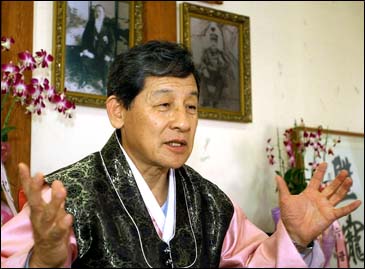 
Former pop singer, vagrant
and failed suicide case Yi Seok says he has overcome his problems and found
peace as South Korea moves towards democracy by becoming a monk.
AFP
The royal prince cuts a handsome dash as
he glides through the streets of Jeonju, South Korea's ancient city, his
traditional robes flapping in the breeze.
He is down-to-earth and friendly, and
shakes hands and poses for group photographs if asked.
Occasionally, a passerby will embarrass
him by bowing to the ground in the traditional Korean kowtow - a homage
reserved for royalty.
```Your highness,' they say. I say `Stop.
No! No!''' Yi Seok says with a quick smile and the slightly puzzled look of
someone surprised by the hand that fate has dealt him.
From anointed prince to Buddhist monk,
from pop singer to homeless vagrant, the last royal son of the Chosun
dynasty still living in South Korea has led a varied life whose ups and
downs mirror Korea's own turbulent recent history of war and poverty, wealth
and industrialization.
Around Asia, many countries, such as
Japan, Thailand and Cambodia, have held fast to their royal families, seen
by their people as anchors of stability in a changing world.
For the Japanese, the royal household is
the most important symbol of Japan to have survived defeat in World War II.
In Cambodia, the royal family is widely credited with holding the country
together through the horrors of rule by the Khmer Rouge. And in Thailand,
the king is revered as a force for stability and progress.
But other parts of Asia, countries such
as Laos, South Korea and its great neighbor, China, have seen royal families
overthrown or cast aside by colonial powers or revolutionary regimes and
rarely look back to what they have lost.
Yi, 63, sees himself as perhaps Korea's
last link through the events of the last century to a past that many Koreans
have turned their backs on.
``The dynasty probably ends with me,'' he
says of the royal house that ruled for more than 500 years from 1392 until
it was overthrown by Japanese colonial occupiers in 1910.
An uncle, who is recognized as the crown
prince of the Chosun household, is 75, childless, lives in Japan and cannot
speak Korean. Yi has two younger brothers and a son and two daughters who
live in the United States.
None has shown any interest in the royal
succession.
``The children don't care.`Come and join
us in America,' they keep telling me,'' Yi says in an interview in Jeonju,
where the royal house traces its origins.
Today, he lives alone and largely
unnoticed in a traditional house in an old quarter of the city.
``Some of the old folks know who I am,''
he says. ``The young ones don't.''
Ten minutes by foot from his home is a
shrine to the founder of the Chosun dynasty and an ancient pavilion where
royal records were placed for safe keeping during a 16th century invasion by
the Japanese.
Proud of a history they trace back
thousands of years, most Koreans are uneasy about the Chosun dynasty's
heritage.
Though period dramas about court intrigue
are TV staples, the dying agony of the dynasty under the heel of the
Japanese, who ruled the country from 1910-1945, still rankles with Koreans
who blame the Chosun elite for failing to modernize the country in time to
prevent its being overrun.
``I am very proud, though I understand
the criticism'' Yi says.
He notes that one of the great Chosun
rulers, the 15th century King Sejong, created Hangul, the Korean alphabet.
Until then, Koreans used Chinese characters to write their own language.
And he says that, for centuries, Korea
lived in peace under benign rulers who valued scholarship above warfare and
promoted artistic and literary endeavor.
But he admits the country's rulers turned
their backs on the outside world, leading Korea to be known as the ``Hermit
Kingdom'' until, by the end of the 19th century, Western and Asian powers
were competing for influence in the region and Korea became a strategic
prize.
``At that time, Korea had no power and we
were small,'' Yi says. ``We could not stand up to the big powers.''
Yi's grandfather, King Kojong, Korea's
last reigning monarch, presided over the country before its collapse under
Japanese rule.
Yi, who remembers a royal palace
childhood living in splendor surrounded by servants and ladies-in-waiting,
was born when Korea was occupied by the Japanese who stripped the ruling
house of all power.
After liberation in 1945, the dynasty's
wealth and property, including five palaces, were confiscated by the new
republic established under Syngman Rhee, South Korea's first president. The
dynasty was effectively destroyed and Yi reckons his family lost land and
property worth US$1.5 billion (HK$11.7 billion) at the time and considerably
more now.
Rhee, a blood relative belonging to a
junior branch of the ruling house, could have chosen at that point to
restore the royal family and establish a constitutional monarchy.
``A restoration could have worked then,''
Yi says wistfully. ``The Chosun dynasty could have survived,'' he says.
``But that is no longer true. A
restoration is out of the question now. The young really couldn't care
less.''
Times grew harder when Rhee was ousted in
a military coup in 1960 and Park Chung Hee took power, tightening the screws
on the royal family.
Worse followed with Park's 1979
assassination and the rise to power of another military coup leader, Chun
Doo Hwan.
Before Chun's takeover, Yi had studied
foreign languages at a top Seoul university and hoped to become a diplomat
but after the first coup in 1960, the flow of money to the royals was
stopped and his hopes were not met.
To pay his way, from his freshman year in
1960, Yi took up singing at bars and nightclubs, and was popular on US
military bases. His popularity soared with the late 1960s hit ballad, House
of Doves. Members of the royal family were upset. Under the Chosun
dynasty, entertainers belonged to the lower rungs of society.
From 1966 to 1969, Yi fought in the
Vietnam War with the South Korean Tiger Division, sent there by
then-president Park in an effort to solidify relations with the United
States. He was wounded in the shoulder by shrapnel.
Years of entertaining, drinking and
womanizing followed. Then life took a turn for the worse again when
then-president Park was assassinated and the new president Chun kicked the
royal family out of its palace in Seoul.
Yi, homeless and penniless, emigrated to
the United States where he worked for 10 years as a day laborer, handyman
and security guard.
He returned home for the funeral in Seoul
of Korea's last queen, his aunt, in 1989, and embarked on a spell of
homeless wandering, trying to revive his singing career and living out of a
minivan. The collapse of his third marriage in 1999 coincided with the
recognition that nightclubs no longer wanted an ageing crooner.
``I was nothing. I had nothing. Life was
nothing,'' he says.
Suffering at various times from
depression, he has made a total of eight suicide attempts in his life and,
at one point, lost several years to whiskey-induced amnesia.
But then, he stopped drinking, stubbed
out his last cigarette and decided to change.
``I shaved my head and prayed for two
years on the top of a mountain,'' he says. He became a Buddhist monk.
With peace of mind restored, he returned
to mainstream life and to Jeonju, the home of his ancestors 240 kilometers
south of Seoul.
With his sharp features and trim figure,
Yi today looks the part of the royal prince and has overcome his problems as
his country has moved to democracy, found peace and developed as a wealthy
Asian nation. He has stopped blaming himself for the sins of his fathers and
the failure of the dynasty and found a purpose in his own life.
``No more tears, no more sorrow. I am
happy,'' he says. His ambition is to establish a museum to one of the
world's longest-ruling royal houses.
On a tour to promote his idea last year,
he went to Jeonju where local officials were ready to listen.
They built a traditional Korean house for
him in a picturesque corner of the city where old-style homes with wooden
frames and tiled roofs were being renovated.
And he himself has become a ``living
museum'', with a unique story to tell, he says. ``I am the only one left who
can tell it,'' Yi says. -
AGENCE
FRANCE-PRESSE 24 January
2005 HONG
KONG STANDARD

|