|

ROBSON
STREET VANCOUVER
Robson @ Richards: Whole Foods
Markets Inc. of Austin, Texas is eyeing the corner of Robson and
Richards in downtown Vancouver for a second B.C. store.
Whole Foods, which is set to open a
36,000-square-foot store at Park Royal Village this summer, has long been
scouting locations in downtown Vancouver and the West Side.
Recent talk in real estate circles pegs
the location as the ground floor of the Robson and Richards condo
development at 488 Robson Street, set for completion next year.
Whole Foods did not return a call
regarding its expansion plans for B.C. -
Peter Mitham BUSINESS IN VANCOUVER
30 May 2004
>> ROBSON
@ GRANVILLE
NEWS STORIES
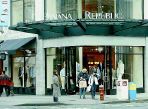 |
Robson
Street has drawn big international names like Banana Republic, A/X
Armani Exchange, Mexx, Tommy Hilfiger. - Richard Lam, Vancouver
Sun photo
In some of the good areas it
can be over $200 per square foot
|
Robson's rents skyrocket
Haute couture and hip fashionistas give
Robson Street its reputation as Vancouver's Rodeo Drive -- a reputation that
comes with the highest retail rental rates in the city.
Rents for streetfront locations have
climbed to an all-time high average of $124 per square foot a year, ranging
between $80 and $168 per square foot in the key two-block section of Robson
between Burrard and Bute, reports retail real-estate broker Royal LePage
Commercial.
That is more than double the $57.50 per
square foot average if you cross Burrard and head east on Robson, and four
times the $31 per square foot average rents on Pender between Burrard and
Bute.
For a 2,500-square-foot store, even the
average rate would push rent up to $310,000 a year -- and that's before
property taxes.
Taxes can add $25 to $35 per square foot
depending on the size of a store, said vice-president and manager of office
and retail leasing at Royal LePage.
"On Robson Street, in some of the
good areas, you can be over $200 per square foot. That's why you have to pay
so much for a Zara dress," he said.
He added that rent averages are a
constantly moving target. He has heard of quotes of up to $200 per square
foot for the Robson Street Cotton Ginny location, which the company has
announced it will close.
Rents have been in the rarefied vicinity
of $100 per square foot for some time, the manager said, but it is only in
recent years that they've climbed into the stratosphere of the high
hundreds.
He added that even at those high levels,
vacant stores don't sit empty for very long in the "key corridor."
Royal LePage calculated a zero vacancy rate on Robson between Hornby and
Jervis in 2002, versus nine per cent in 2001.
"Thirty days would be the longest,
unless somebody is pushing rentals up to an extraordinary rate. That's the
only reason it would take some time," the manager of Royal LePage said.
People pay such extraordinary rents to be
in a place that is the crossroads of downtown's growing resident population
and the "critical mass" of Vancouver's big major hotels, said
retail consultant Blake Hudema.
Downtown retailing, he added, has become
about selling to tourists, with 30 to 40 per cent of sales being made to
visitors.
"[Robson has] distinguished itself
as the centre of the earth and supplanted the Gastowns and Chinatowns of the
world," Hudema said. "People want to be on Robson Street when they
visit Vancouver."
It is a strategy that works for some and
has drawn big international fashion names like Banana Republic, A/X Armani
Exchange, Mexx and Tommy Hilfiger, all of which have opened huge stores to
welcome roaming packs of well-travelled fashionistas.
It is that formula that caused local
yoga-wear phenomenon Lululemon Athletica to endure six months of waiting for
a Robson address to come free, rather than opening sooner in a cheaper
downtown location.
Lululemon general manager Darrell Kopke
said the company opened downtown to meet increasing demand for a location
close to their customers' places of work. It went to Robson to make a bigger
impact and expose its fledgling brand to an international marketplace.
He added that the store has been
successful enough that it is taking over half the space of one of its
neighbours in May, less than seven months after opening, but it isn't an
easy existence.
Lululemon is a hot brand in the local
market, and the company is innovative in bringing out new styles every six
weeks, which Kopke believes helps increase the store's sales.
"Our sales per square foot and
sell-through is a lot better than other stores. That's how we've been able
to exist," Kopke said. "If you ask me how those souvenir shops are
able to exist paying upwards of $20,000 a month rent, I don't know how they
do it."
Some definitely can't. Plum Clothing is
another local chain that bowed out of the Robson Street race almost eight
years ago when its location at Robson near Burrard was redeveloped and rents
climbed from to $90 per square foot from $55.
The local Plum chain has stores in other
popular retail locations like West Fourth, Granville at 12th Avenue and
Lonsdale in North Vancouver. But Plum co-owner Ed Des Roches said Robson no
longer fit the business plan he and wife Kate O'Brien developed due to a
combination of high rents and high foot traffic.
"A lot of people think it's because
of high margins that people pay [high] rents," Des Roches said.
"But it's the turnaround. In industry, you're looking at [making quick]
stock turns and we couldn't keep up with that [on Robson]."
As well, huge crowds of shoppers put
"a lot of wear and tear" on staff and cut into the level of
customer service that is also part of the Plum business formula.
Des Roches said the company wouldn't go
back even after an eight-year breather because Robson's character has
evolved to be younger than its target market and too international for
Plum's local brand.
"It was fun, though, having a
business on the street, but it has to be profitable too," Des Roches
said.
Hudema said high rents are problematic,
shutting out many local specialty shops and attracting big national and
international retailers such as Levi's and Roots.
He added that one of the criticisms of
Robson Street is that the quaint, almost "mom and pop" feel of the
street has been supplanted by an environment that is almost
indistinguishable from other big-city shopping meccas like San Francisco's
Bar Harbour, or the so-called Miracle Mile in Fort Worth, Tex.
"One of the reasons Robson was so
successful to begin with was because it had a lot of unique tenants in
it," Hudema said. "Now, the street has regressed to something
that's a little more known. But that's [also] a success in itself."
- Derrick Penner Vancouver
Sun 19 March 2003
Robson rules retail real estate
A roundup of the Lower Mainland's shopping neighbourhoods
The news in retail real estate begins and
ends on Robson Street. West Side low-rise retail and condo projects are all
but dead, and long-established shopping districts such as South Granville
Street and Denman Street are holding their own, but Robson is driving
business in the retail sector, with lease rates more than double anywhere
else in the city.
Today, nothing on Robson rents for less
than $100 a square foot, said a prominent leasing agent who is likely Robson
Street's busiest agent.
The agent said that as the bankrupt Superstar
Athletic Footwear Ltd. store vacated its former 1088 Robson Street
location, Tommy Hilfiger Corp. pounced on the available more than
four-thousand square-foot, two-storey space.
Just up the street at 1132 Robson, where
the Ghirardelli Soda Fountain and Chocolate Shop failed, new tenants
are close to finalizing a deal for the 4,150 square feet of space pending
construction of a new outside stairwell, said Colliers leasing agent Shane
Epp.
The outside stairwell will lead to
separate tenants on the upper floor, who will be paying $35 a square foot --
a bargain for a Robson Street address. Lower-floor tenants will likely pay
$135 a square foot.
A couple of doors east, Alexander
Chang gave the nod last month to a demolition crew to tear down the
former Buchanan Building at 1124 Robson in a bid to up his property's value.
New tenants are lined up for the new structure, which he said he hoped would
be completed by July, with new stores open for business by the end of
August.
Boy's Co. owner David Goldman
said that while he closed a Yaletown location because that neighbourhood's
foot traffic stopped increasing, Robson Street's rents are worth it because
the store "feeds off street traffic" even though it is also a
destination store for many.
The area farther east on Robson, toward
Homer Street and the Vancouver Public Library, is one of the
fastest-growing downtown retail neighbourhoods.
Another agent said that migration east
along Robson is consistent with Vancouver's history; the library's location
has long prompted increased retail activity. In the early 1900s that meant
increased activity around Main and Hastings streets; later it meant the
corner of Robson and Burrard; now it's farther down Robson Street.
"Think about anchor tenants. The
library is a huge dra,".
No other area's rates come near half what
Robson merchants accept without hesitation.
Street-front rents on Denman by English
Bay, for example, rise to what is still the comparatively cheap $55 range,
as do rents on the increasingly chi-chi South Granville strip.
Citywide, street-front retail rents have
stayed relatively level, rising a total of between three and five per cent
in the past year, according to Colliers research director.
He cited Kerrisdale as an area that has
matured, from Mom and Pop retail outlets to predominantly large chain
stores. Such stores as Gap, Nike, Starbucks, Quiznos
and Rogers Video now drastically outnumber Kerrisdale small operators
such as Forsters Fine Cheeses. And they have pushed up lease rates
into the $40 range from the $25 to $35 range two years ago.
One cut-rate neighbourhood that is
drawing increasing interest is what Haziza calls "the real South
Granville" -- the area around 70th Avenue known as Marpole.
Though it's not a high-end shopping
district, Haziza said the Salvation Army quickly took over the old Blockbuster
Inc. video store location when it became available and Amy's Dollar
Store is paying $20 a square foot for its Marpole location.
One of the coldest retail neighbourhoods
in Vancouver is the corridor along West Fourth Avenue and Broadway between
MacDonald Street and Alma Street, said Haziza. City of Vancouver zoning
regulations requiring street-front retail in condos along those streets have
made for a glut of space, he said.
While the West Fourth strip from Burrard
to Vine Street remains strong, the area farther west has little foot traffic
and has not grown into a retail destination, he said. - by
Glen Korstrom Business
In Vancouver Issue 642:
Real Estate
|


