|

INVESTMENT NEWS
CHINA HOTELS
Room
for improvement at hotels
As the demand for hotels in China grows and operators focus more on
management contracts rather than owner-operated developments, reliance on
local developers has increased.
The problem is that many mainland
developers lack the best-practice processes necessary to deliver an
international project to the levels of quality required by the industry and
expected by the customer.
Delays are common, early overspend
results in cost savings in the finishes, and an overall compromise on the
level of quality is not unusual.
This need not be the case.
There is an opportunity for
operators to turn this situation into a competitive advantage.
Increased business travel,
tourism, and the upcoming Beijing Olympics are fueling the demand for hotel
rooms in China.
At the recent Hotel Investment
Conference Asia Pacific, 77 percent of participants confirmed that China
would be the major source of new developments in the region.
Land prices in China are rising
and it is becoming increasingly difficult to find good sites.
There is a trend towards mid-range
business hotels in secondary cities. Acquisition and rebranding of existing
hotels is one option, but major brands prefer new buildings in China via
local developers.
There is also a trend towards
management contracts and a reliance on developers to build hotels to brand
standards.
Due to the lack of hotel
developments in the mainland over the past 10 years, most developers lack
the necessary hotel experience to successfully deliver the product.
The major brands have developed
their "brand standards" to which developers are obliged to comply.
Compliance with such standards is checked via site visits by the operators'
technical services teams.
However, the developers' lack of
project planning, the tendency to appoint consultants and suppliers based on
price rather than capability and the overall lack of hotel and international
best practice often results in missed opening dates and poorer quality.
The frequent response is to
accelerate the program during the critical fitting out stages through
additional, often unskilled, labor and 24-hour work.
Typically, this results in delayed
opening dates because a large number of unacceptable defects have to be
fixed prior to opening, otherwise there is a risk of tarnishing the brand.
By working alongside hotel
operators and developers at an early stage, consultants can set up the
overall project management, cost management and procurement frameworks that
will enable the project team to work to a clear roadmap that will maximize
the chances of project success.
Commencing with establishing the
project brief, the master program and a well-balanced cost plan, consultants
can assist the developer in the pre- qualification, selection and ultimate
appointment of the team.
In-depth knowledge of the supply
chain enables consultants to develop the optimum package-letting strategy to
secure both time and cost savings from the market.
And the setting up of an efficient
structure for meetings, together with executive "dashboard"
reporting, allows all parties to focus on key deliverables without being
unnecessarily distracted.
The overall management of program,
budget, risk and value will result in time and cost savings compared with
the typical outcomes currently experienced in China.
Such services can be delivered as
an extension of the operators' technical services team.
A major benefit of a well-planned,
transparent and risk-managed approach is that the developer, the operator
and the whole project team are fully aware of the status of the project at
all times, and actions to maintain program and budget are known.
This approach reduces the
likelihood of surprises and the adverse affect of knee-jerk reactions to the
late discovery of bad news. - by Andrew McPherson
THE
STANDARD 17 March 2006
Hotel
investment potential in China bound in red tape: report
International investors looking to pump money into China's
rapidly growing hotel sector are finding few opportunities, according to a
property industry report Tuesday.
A huge gap in the
aspirations of buyers and sellers, and Chinese red tape were acting as a
deterrent, property consultancy Jones Lang LaSalle said.
As China has opened up
over the past decade, its inbound tourism market has consistently
outstripped the world average.
Between 1990 and 2000, international visitor arrivals increased by an
average 11.8 percent a year, compared with the more modest global figure of
4.3 percent.
The country with the
world's largest population, also leads the world in economic growth which is
expected to grow as the benefits of accession to the World Trade
Organization crystallise.
"Hotel investors,
developers and operators alike, are currently scrambling for market presence
in China, especially in the key centres of Beijing and Shanghai," said
Scott Hetherington, the consultancy's hotel executive vice president.
"They
are driven by the desire to benefit from an increasingly affluent domestic
population as well as the influx of foreign corporate travelers."
Beijing's
hosting of the 2008 Olympic Games also offered immense opportunities, both
during the event and in the lead up as foreign corporations establish a
presence in time to win lucrative contracts, he said.
But
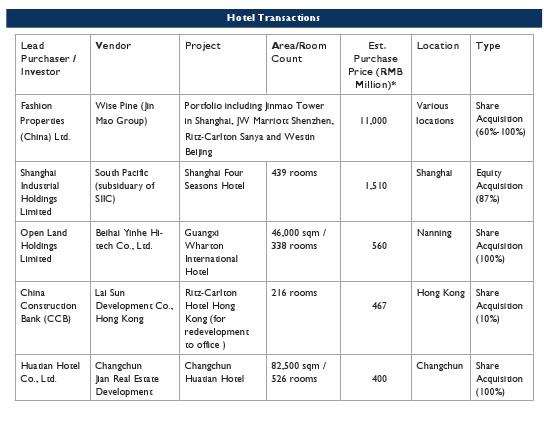
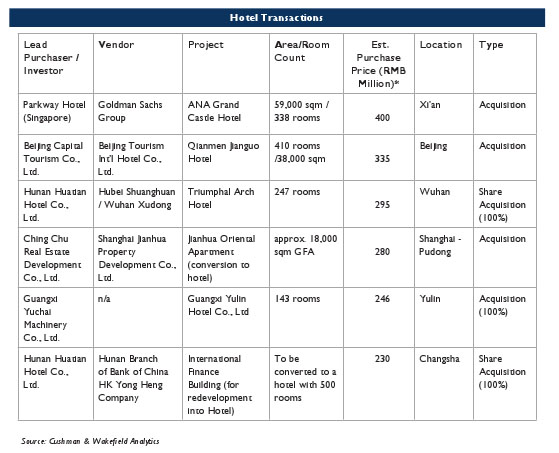
despite the strong investor interest in China, there have been few hotel
transactions.
There is a lack of market
transparency and a "significant pricing gap" between buyers and
sellers in China's key hotel markets, the report said.
Tenure laws, restricting
the maximum ground lease for a hotel to 40 years, concern about the ability
to repatriate earnings out of the country, and the dominance of minority
interests also held back investment, it said.
Hetherington
said the China market needed to follow established practices.
"It
is the balance of supply and demand that determines the profitability of any
hotel investment," he said.
"Potential
investors, developers and operators in China's hotel industry need to look
beyond the obvious attractions to these same hotel market fundamentals that
apply across the globe."
Beijing
and Shanghai were the only Asian markets to record growth last year when
hotels elsewhere in the region had to contend with the global economic
slowdown at the aftermath of the September 11, 2001 terrorist attacks in the
US.
The World Tourism
Organization recently announced China is set to become the world's top
destination by 2020, attracting 130 million visitors.
- ehotelier 1 November
2002
WEST
MEETS EAST - Joint Venture
in China
China's Jin Jiang
International Management Corporation and Europe's Accor hotels have signed a
joint venture agreement in preparation for an April launch of its new
domestic sales and distribution network targeting the China
market under the Mercure brand. Accor
now has 25+ hotels in Greater China.
The rush into China
includes Starwood's opening of the Sheraton Shenyang Lido Hotel
HONG
KONG
Four Seasons Hotel secured contracts to manage two six-star hotels above the
Hong Kong Station. International Finance Centre which
comprise gross floor area of 4.68 million sq ft jointly developed by Sun
Hung Kai Properties and Henderson Land that include 1,000
rooms when they will be completed in 2004 and will be the SAR's largest
luxury hotel to be named Four Seasons Hotel Hong Kong and Four Seasons
Suites.
Britain's
Bass Hotel acquired New World's 100% stake in 514 room Regent Hotel in
Tsimshatsui for $346 million USD in 2001. The hotel has been re
-branded to an Inter- continental. The Bass group also owns Holiday
Inns.
Hong
Kong: Three & Four Star Hotel Demand to Outstrip Supply
Three
to four-star hotel demand will outstrip supply over the next three years in
the wake of increasing numbers of mainland visitors, according to DTZ
Debenham Tie Leung.
DTZ
investment director Mark Hahn said recent hotel transactions included
Harbour Plaza Metropolis in Hunghom, the former Starra Hotel at 133 Leighton
Road and Grandfield Pacific at 18 Percival Street, both in Causeway Bay.
"Investors
are looking for quality hotel properties and this reflects that the market
has confidence in the hotel sector," he said.
Prospects for hotel properties were promising, especially for three and four
-star hotels, which would be in strong demand.
Cheung Kong (Holdings)
paid HK$ 1.19 billion to acquire the 690-room Harbour Plaza Metropolis,
representing an average HK$ 1.73 million per room.
The former Starra Hotel,
with 240 rooms, was believed to have been bought by a Taiwanese investor for
HK$ 260 million, or HK$ 1.08 million per room.
The buyer of Grandfield
Pacific Hotel with 123 rooms is understood to be a Japanese investor who
paid HK$ 190 million, or HK$ 1.54 million a room.
DTZ said the hotel
industry was benefiting from increased visitor arrivals due to the
relaxation of the mainland visitor quota.
It said visitor arrivals
increased 14 per cent to five million during the first four months this
year. Mainland visitors grew 48 per cent to represent 38 per cent of the
total.
Three to four-star hotels
achieved an average 90 per cent occupancy rate in April.
The Hong Kong Tourism
Board projected that demand in late 2005, when Disneyland would be
completed, would grow an average 36 per cent to about 59,000 rooms, assuming
an annual visitor growth rate of 7 per cent to 8 per cent from the expected
14.8 million this year.
There were 80 hotels in
Hong Kong at the end of last year, providing 34,314 rooms.
DTZ said an additional 28
hotels would be completed during the next three years and the rooms
available would increase 54 per cent to 53,080.
However, it said most of
the new supply would be four to five-star hotels in tourist areas, including
Tsim Sha Tsui, Hunghom and Lantau Island. The
Hong Kong Disneyland Hotel will provide 5,000 five-star hotel rooms by 2005
and contribute to a 136 per cent increase for the category, it said.
- June 2002
China
4 months Tourist Arrivals Up 8.26%
Tourist
arrivals in the four months to April rose 8.26 pct year-on-year to 30.99 mln,
the official Xinhua news agency reported.
Foreign
tourist arrivals in the period increased 17 pct year-on-year, Hong Kong
tourists rose 2.43 pct, Macao tourists increased 27.07 pct and Taiwan
tourists increased 4.69 pct, Xinhua said, citing statistics from China
National Tourism Administration.
The
number of tourists from several countries reported two-digit growth,
including South Korea, the Philippines, Mongolia, Malaysia, -eHotelier
31 May 2002
The
China National Tourism Administration on March 29 issued the first
regulation government the hotel industry.
The regulation calls for credibility in hotel management, protection of the
legitimate interests of guests and hotels, and standardization of hotel
operations in line with international practice. The regulation will
first be implemented in 2,500 star membership hotels, and then be spread to
some 8,000 hotels across the country.
Shanghai's
Legendary Astor House Hotel
Situated in an
inconspicuous corner near the Bund, the Pujiang Hotel, formerly the Astor
House Hotel, seems to have lost its bygone glory.
The low-rise
building has been eroded to be dated in colour, which was submerged among
the eminent architecture of the Bund.
Few members of
the city's younger generation are even aware that the hotel exists, let
alone that it is considered the father of the city's luxury hotels.
The hotel was
opened in 1846. In 1861 the two-story hotel was sold to Henry Smith who
renamed it the Astor House Hotel. The building we see today was completed in
1910. In 1959, the hotel name was changed to Pujiang Hotel.
It was once
the most renowned and luxurious foreign-owned hotel in the Far East.
The
Victorian-style design was the work of an Englishman, which can be detected
from the grand columns standing in the halls and arched gates.
The hotel has
witnessed many breakthrough events in Chinese history. The first lamp bulb
in the country was lit here, the first telephone in the country was switched
on here, and the first sound film from the West was projected here.
Plus, China's
first ball was held in the hotel, helping to bring to a close the tradition
that women should not attend social activities.
It is said
that Chiang Kai-shek had his last dinner here before withdrawing to the
island of Taiwan.
A bellboy
picked up a wallet belonging to a Russian at the main entrance to the hotel,
and used one third of it to buy a car, serving as the first taxi in the
country. He was the founder of Johnson, now Qiang Sheng Taxis.
Today, when
you walk on the creaking wooden floor and see the simple furniture, you
cannot imagine the brilliant days of the hotel. It is only a two-star hotel
now.
Some of the
116 guestrooms, in which international celebrities such as Charlie Chaplin
and Albert Einstein once stayed, are taken as historic spots with photos
hanging on the wall to show guests.
The suites
have been redecorated in their original style (except for modern electric
appliances), and some of the furniture has been modeled with guidance from
old photos.
The hotel
still keeps its hulking and slow manual-operating elevators, which work from
7:00am to 11:00pm.
Close to an
international wharf, the hotel changed some guestrooms for young travelers,
known as the youth hostel. Here there are several beds in one room.
It's
the first of its kind in Shanghai, and has been applauded by young student
tourists.
-
By Lu Chang, Shanghai
Star ; South
China Morning Post

|


