|

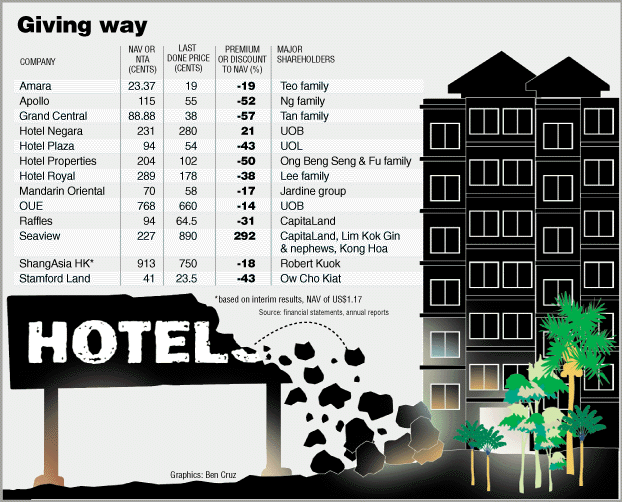
Hotel occupancies, room rates expected to
drop
Additional supply of rooms is likely to
result in further softening of market
 
The hotel industry will continue to see a
downward trend as an additional supply of rooms is injected into the market.
Going by the Singapore Tourism Board's (STB)
forecast of 9-9.5 million visitors this year, hotel occupancies are likely
to drop to 71 per cent, while room rates will fall about 12.5-15 per cent,
said Robert McIntosh, executive director of CBRE Hotels (Asia-Pacific). As
such, revenue per available room (revpar) should decline 23 per cent, he
added.
For 2008, the average occupancy rate was
81 per cent while the average room rate was $246. Revpar was $199.
Singapore has close to 10,000 rooms in
the four and five-star categories expected to come onstream by the end of
2012, representing a 39 per cent jump in supply. 'With declining occupancy
and revpar levels already apparent, the addition of new supply will likely
result in a further softening of the market in the short term,' said CBRE
Hotels senior consultant Alison Poore.
At the same time, Singapore's 'underlying
market fundamentals' such as its infrastructure, steady stream of
attractions and destination marketing initiatives are sound, placing it in
good stead to respond swiftly when the economy starts to pick up. The launch
of the two integrated resorts will also act as a driver.
In comparison, Bangkok will see over
6,000 four and five-star hotel rooms enter the market over the same time
period, bringing the total supply of rooms in these categories to over
31,000. Faced with the double whammy of political upheaval and lower tourism
demand on the back of the economic environment, hotels in Bangkok are likely
to see further declining demand in the short term.
Mr McIntosh also pointed out that the
increasing supply of hotel rooms can also lead to greater demand, thanks to
factors such as additional marketing by individual hotels, reduced prices
and new hotels catering for different segments.
'This has positive implications for
employment, demand for airline seats and expenditure in restaurants and
other tourism attractions,' he said, adding that extra supply can, however,
affect existing hotels negatively as occupancies and room rates tend to
fall. - 2009 April 14
BUSINESS
TIMES
Sunny outlook for S'pore hotel
industry
Underpinned by buoyant tourism markets
and the positive macroeconomic environment, major hotel markets across Asia,
including Singapore, had a stellar year in 2006. Strong investor appetite
for hotel assets in the region led to record levels of transaction activity
with Singapore, Hong Kong and Japan emerging as the most favoured investment
destinations.
  |
| Smooth progress:
Singapore has embarked swiftly on steps to diversify and strengthen
its tourism offerings. Among them is the Singapore Flyer |
Last year also witnessed the successful
listing of two pure lodging real estate investment trusts (REITs) in
Singapore - the Ascott Residence Trust and CDL Hospitality Trust. Given the
inherent capricious nature of the tourism/lodging industry, their successful
listing and subsequent market performance signalled investors' confidence in
the hospitality industry.
With economic and tourism prospects
expected to stay robust, hotels in Singapore and Asia can expect to enjoy
further growth in 2007.
Intense rivalry
Singapore welcomed a record 9.7 million
international visitors in 2006 and the Singapore Tourism Board (STB) is
working towards a new high of 10.2 million visitors this year and ultimately
17 million arrivals by 2015.
To achieve the targets, Singapore has to
keep its tourism and hospitality industries competitive. Its efforts to
revamp the tourism sector are essential in the light of the intense rivalry
in the region: Hong Kong launched Disneyland in 2005; Beijing will host the
Summer Olympics in 2008; Shanghai and Delhi will respectively host the World
Expo and Commonwealth Games in 2010, while Macau is transforming into Asia's
very own Las Vegas complete with integrated casino/entertainment facilities
and world-class hotels.
Many markets, including Hong Kong, Macau,
Shanghai and Bangkok, are also competing with Singapore for the lucrative
MICE (meetings, incentives, conventions and exhibitions) business.
Additionally, emerging markets like Vietnam, Cambodia and India are fast
becoming choice tourist destinations.
Singapore has embarked swiftly on steps
to diversify and strengthen its tourism offerings. The two upcoming
integrated resorts with gaming elements - Marina Bay Sands will provide
world-class MICE facilities, while Resorts World Sentosa will feature a
Universal Studios theme park - cater to distinct yet complementary
clientele.
The construction of the Singapore Flyer
and the remake of Sentosa are also progressing smoothly. The iconic VivoCity,
with an eclectic mix of retail, entertainment and lifestyle concepts,
including St James Power Station, as well as the revitalised Clarke Quay,
has injected greater vibrancy into the local leisure scene.
For the first time, Singapore may also
host the Formula 1 Grand Prix in 2008, the third-most watched sporting event
in the world after the Olympics and World Cup.
With travel becoming more accessible due
to the growing popularity of low-cost carriers (LCCs), Singapore responded
with its first budget terminal in 2006. The move is in line with the
government's strategy to strengthen Singapore's position as an aviation hub
and regional epicentre for the low cost airline network.
In anticipation of an expanding and more
diversified tourist profile, the government has released more hotel sites
for development to supplement the existing hotel stock. Five land parcels
were sold in 2006 under the Government Land Sales programme, with another
eight hotel sites being placed on the reserve list for the first half of
2007 and at least another three more confirmed sites that include a hotel
component.
While the cost of travelling is
decreasing, room rates are increasing which is likely to result in higher
demand growth in the mid-scale hotel segment.
Higher hotel rates
Strong demand in the wake of limited
supply has allowed hoteliers to raise rates in 2006 by an average 20 per
cent on the year, sometimes at the expense of occupancy levels. Market
conditions are expected to remain robust and when considered in combination
with the limited new supply, average daily rates (ADR) has the potential to
increase a further 10 to 15 per cent in 2007.
A comparison of ADR across major
five-star hotel markets in Asia showed that Hong Kong remained the rate
leader in 2006, achieving an ADR of US$312. At US$148 Singapore's ADR is
nearly half of that of Hong Kong. This suggests that there is further upside
potential for room rates in Singapore, particularly considering the limited
supply of new luxury grade hotels.
Around 14,000 new rooms could be added to
the market from 2007 onwards from new projects under construction/proposed
(including the two integrated resorts) as well as the announced government
hotel sites. The increase in room inventory will be easily absorbed by the
additional demand the STB aims to attract - its 17 million visitor arrivals
target for 2015 is almost 75 per cent higher than the 9.7 million achieved
in 2006. The current stock of around 38,000 hotel rooms is already achieving
an average occupancy in excess of 80 per cent, indicating strong underlying
market demand. Within 2007, prominent completions include the 299-room St
Regis and the 120-room Amara Sanctuary Resort Sentosa.
The Singapore investment market reached a
record for hotel transactions during 2006 with eight hotel-related
transactions surpassing US$1.2 billion. Investors remain very bullish about
hotel investments in Singapore with marketed assets attracting unparalleled
interests.
The upturn in hotel trading performance
and overwhelmingly positive outlook are driving investor demand. Investors
polled in Jones Lang LaSalle Hotels' Hotel Investor Sentiment Survey in
December 2006 expressed strong optimism in the short and medium-term hotel
trading performance of hotels in Singapore. In fact, investors are most
upbeat about Singapore's hotel sector over the next 24 months outside of
China and India.
While regional players remain dominant,
there is a growing presence of US, European and Middle Eastern investors who
are looking to park their funds in Asia. Singapore is an attractive
destination given its high market transparency, favourable business and
investment environment, sound governance, low barriers to entry and stable
political outlook.
While the supply of hotel assets is
expected to remain constrained in Singapore as they remain tightly held by
local families, there are still opportunities to purchase both existing
hotels and government hotel land sites in 2007. The crux is speed and timing
as underlying demand for hotel assets/land remains strong. Reflecting their
medium- to long-term confidence in Singapore's tourism and hotel industry,
hotel assets/land placed in the market for sale in 2006 were quickly snapped
up. In total, investors walked away with over $1.5 billion worth of
investments in seven hotel-related transactions during 2006/early 2007 - a
historic high.
Bright days ahead
Growing indifference towards threats of
terrorism and avian flu in Asia, active intra-regional business exchanges,
more affordable air travel fuelled by the proliferation of LCCs in Asia, and
a generally more affluent population in the region will continue to be key
contributing factors towards the sustained tourism growth in Asia, including
Singapore. Other demand drivers include China and India's burgeoning
outbound travel markets and high-yield travellers from Russia and the Middle
East.
In the medium to long term, the
diversification of Singapore's tourism and accommodation product offerings
will also enhance the industry's sustainability and competitiveness in the
region, by providing visitors with an experience that is 'Uniquely
Singapore'. - 27 March 2007
SINGAPORE
BUSINESS TIMES
The writer is the executive
vice-president, Jones Lang LaSalle Hotels

|