 |
| Cloudy outlook: The
value of real estate across Taiwan is expected to shrink further due
to a sluggish economy |
Listed companies that purchased land in
Taipei after the third quarter of 2008 could also suffer a loss of about 20
per cent in the value of the real estate after Taiwan adopted new accounting
rules on Jan 1.
'Things are looking very cloudy for the
real estate sector right now, and the industry will have to decide whether
or not they want to push prices down further,' said Billy Yen, general
manager of DTZ's Taiwan unit. Office rentals in prime Taipei areas fell 2.26
per cent in the fourth quarter from the previous three months, logging the
first decline since late 2004, as the global financial crisis sapped demand
for high-end real estate.
An expected increase in the supply of
office space and weakened demand could push rents down even further this
year, Mr Yen said.
DTZ figures showed that the value of
foreign investors' real estate investments fell to NT$19.9 billion (S$889.5
million) last year from NT$44.5 billion in 2007, and the company was 'even
more conservative' on the sector's outlook for this year.
- 2009 January 7 REUTERS
Taiwan's economy shrank during the third quarter by 1.02% from a year
earlier as the global crisis hit the export-dependent economy.
The island, a leading producer of electronics products, has had two
months of falling exports, helping send its stock market down 40% over the
past six months.
The GDP contraction is the biggest in seven years, and the first since
2003 when the outbreak of the SARS virus battered economies in the region.
![[Weakening Outlook charts]](http://s.wsj.net/public/resources/images/AI-AS279_TAIWEC_NS_20081120154025.gif)

In Taiwan, the government said this week it would give each of Taiwan's
23 million residents a US$120 shopping voucher, as part of an
economic-stimulus program that also includes infrastructure spending
announced in September. The voucher is intended to make sure consumers spend
the money rather than save it.
However, Shu Wang, professor of economics at the National Chengchi
University, said the downturn reflects Taiwan's overreliance on exports.
"It is almost not possible for the government to rescue it," he
said.
Taiwan's government says growth will be 2.12% next year but most bank
economists have lowered forecasts to 1% or minus 1%.
Betty Tsai, a human-resource clerk at a security-guard company, says many
recent job applicants came from the tourism and technology industries.
"About half of the applicants for our company's open positions state
that they were either laid off or lost jobs for company closures," she
said.
On Tuesday, Taiwan
Semiconductor Manufacturing Co., the world's largest contract chipmaker
by revenue and one of Taiwan's bellwether companies, imposed a hiring
freeze. More than 7,000 companies and 3,000 factories have closed this year,
according to government statistics.
President Ma Ying-jeou took office this year on a platform of improving
the economy through better relations with China, including closer trade ties
and increased tourism. But only a fraction of the expected 3,000 Chinese
tourists a day have arrived since tourism limits were eased in July.
Correction & Amplification
Taiwan's decline in gross domestic product in the most recent quarter was
its first such contraction since 2003. Earlier versions of this article
incorrectly stated that the latest contraction was the first since 2001. In
addition, Taiwan's government has forecast 2.12% economic growth for 2009,
not 5% as reported in some editions.
- 2008 November 21 WALL
ST JOURNAL
Taiwan removes foreign ownership
restrictions
The
announcement signals a departure from a decade of closed-door policy.
Regulators hope this will attract foreign investments and listings in Taiwan
Taiwan’s Financial
Supervisory Commission has removed all restrictions on foreign ownership of
Taiwan securities.
The move, which took effect on October 14, is a significant departure from
the protectionist policies that have eschewed foreign M&A buyers since
the original enactment was brought into force in March 1996.
The FSC says it wants to encourage overseas companies to list in Taiwan, and
most importantly, to attract foreign individuals and mainland Chinese to
invest in its securities market.
The FSC has yet to clarify how the lifting of ownership restrictions
specifically affects funds under the Qualified Domestic Institutional
Investor (QDII) programme.
Despite the general difficulty of securing financing this year, there has
also been much noted interest among investors who want to tap into
Taiwan’s infrastructure renewal story. The administration is expected to
follow the UK’s model for private investments. (Editor's note: See the
upcoming November issue of AsianInvestor for further analysis.]
The announcement is in line with Taiwan president Ma Ying-jeou’s vision of
turning the island’s domestically focused financial sector into a
world-class financial services hub on a par with regional competitors, such
as Hong Kong and Singapore.
The promise of world-class market infrastructure is intended to divert
Taiwanese overseas investments back to the island. In the past, the
regulator and the central bank have lamented the fact that the Taiwanese
have put too much money outside of their home market. It has often been
claimed that these institutions have enacted policies and interfered with
the foreign exchange markets to discourage external money flows.
Domestic pension funds, insurers and banking groups have expressed relief in
the lifting of the restrictive policies that have been in place for the past
decade.
It is interesting to note that the regulator’s reluctance to jump on new
financial bandwagons – be it to liberalise markets or sanction innovative
financial products – has probably protected Taiwan from some of the
external shocks caused by global financial market turmoil. However, the
timing of the current deregulation, coming at the height of the current
credit crisis, has raised questions among some sections of the Taiwanese
public. - 2008 October
15 FINANCE
ASIA
Taipei housing market confidence dips
Rising
prices push figure down to lowest in 4 years
Taipei housing market confidence dropped to its lowest in almost
four years because of rising prices, a Taiwan government-sponsored survey
showed.
The housing confidence index for Taiwan's capital fell to 97.55 in the
second quarter, slipping below 100 for the first time since the third
quarter of 2003, the Institute for Physical Planning & Information wrote
in a report. A score lower than 100 means most respondents view conditions
as poor.
Residential property in Taipei cost an average NT$316,000 (S$14,331) per
ping in the second quarter, an increase of NT$54,000 per ping from a year
earlier, the report said. Each ping equals 3.3 square metres.
People paid an average NT$9 million for a home in Taipei in the second
quarter, down from NT$9.3 million a year earlier, according to the report
posted on the institute website. The survey polled 1,233 people who had
already bought a house, 895 people who were looking to buy, and 744 people
looking to rent.
Taiwan's Council for Economic Planning and Development, which sponsored
the survey, decided to cancel its press briefing on the release because it
indicated a slowdown in the island's property market, the Economic Daily
News reported yesterday.
Taiwan's central bank on Sept 20 raised
its discount rate on 10-day loans by an eighth of a percentage point to 3.25
per cent, compared with the 4.75 per cent benchmark interest rate in the US.
That resulted in an exodus of money as
individuals and companies invest in higher-yielding assets abroad.
Taiwan residents invested a net US$17.2
billion in overseas securities in the second quarter, the biggest quarterly
net outflow on record, the island's central bank said in August.
-- 2007 September 25 Bloomberg
Taiwan property prices rose 11 percent last year
amid lower capital gains taxes on land sales and low interest rates, Sinyi
Realty, Taiwan's largest realtor, said in a January report.
- INTERNATIONAL
HERALD TRIBUNE 29 June 2005
Why Taiwan Matters
Want to find the hidden center of the global
economy? Take a drive along Taiwan's Sun Yat-sen Freeway. This stretch of
road is how you reach the companies that connect the vast marketplaces and
digital powerhouses of the U.S. with the enormous manufacturing centers of
China.
The Sun Yat-sen is as bland as any U.S. interstate,
but it's the highway of globalization. Though it snakes along the whole west
coast of Taiwan, the key 70-km stretch starts in Taipei's booming new Neihu
district of high-tech office buildings and ends in Hsinchu, home to two of
Taiwan's best universities, its top research center, and a world-renowned
science park. Along the way, the Sun Yat-sen leads to some of the most
important but anonymous tech outfits in the world: Asustek Computer, whose
China factories spit out iPods and Mini Macs for Apple ; and Quanta
Computer, the No. 1 global maker of notebook PCs and a key supplier to Dell
and Hewlett-Packard. You'll also find Taiwan Semiconductor Manufacturing
Co., the biggest chip foundry on the planet, an essential partner to U.S.
companies such as Qualcomm and Nvidia. Dozens more companies dot the
Neihu-Hsinchu corridor. There's AU Optronics, a big supplier of
liquid-crystal display panels, and Hon Hai Precision Industry, which makes
everything from PC components to Sony's PlayStation 2, and which is a
fast-rising rival to Flextronics International, the world's biggest contract
manufacturer. Taken together, the revenues of Taiwan's 25 key tech companies
should hit $122 billion this year.
Taiwan's success is also China's. No one knows for
sure how much of China's exports in information and communications hardware
are made in Taiwanese-owned factories, but the estimates run from 40% to
80%. As many as 1 million Taiwanese live and work on the mainland. "All
the manufacturing capacity in China is overlaid with the management and
marketing expertise of the Taiwanese, along with all their contacts in the
world," observes Russell Craig, of tech consultants Vericors Inc.
CROSS-STRAIT DRAMA
Impressive stuff. Yet for many people around the world, Taiwan evokes only
one thing: the standoff between the People's Republic of China, which
considers the thriving democracy as just one of its provinces, and Taiwan
President Chen Shui-bian, who has made little secret of his dream of one day
declaring Taiwan independent. This cross-strait drama is now in a tense new
phase, played out with dramatic effect in recent weeks. First Beijing passed
an anti-secession law authorizing an attack on Taiwan in case it moves
towards independence. Taiwan responded with a massive anti-Beijing rally.
Then came the shocker: The late April visit to the mainland by Lien Chan,
Chen's chief political opponent and chairman of Taiwan's Kuomintang (KMT).
As millions of Taiwanese and Chinese watched on television, Chinese
President Hu Jintao shook hands with the opposition leader at a lavish state
reception in Beijing. After Lien returned to Taipei on May 3, Hu's
government sweetened its PR offensive with more goodies, including a plan to
ease restrictions on Chinese travel to Taiwan, lift tariffs on some
Taiwanese agricultural imports -- and send two giant pandas to the Taipei
Zoo. To add even more surprise, Taiwanese President Chen, despite some of
his supporters' fury at Lien's visit, inserted himself into the dialogue.
Chen agreed to send a message to Chinese President Hu through another
opposition leader, James Soong of the People First Party, who was scheduled
to start a China trip on May 5. Hu seems to be counting on his contacts with
the opposition to increase pressure on Chen, forcing him to accept that the
island is part of China. But that's a concession Chen's unlikely to make.
Real reconciliation thus seems a long way off. Yet any serious attempt to
lower the tension would hold huge promise for the executives who run
America's IT industry, which depends on Taiwan for so much of its goods. A
shooting war between Taiwan and China would be catastrophic in human terms.
And for the Western companies that have built their fortunes around Taiwan,
the damage would be a direct hit to the global economy and the Digital Age.
"It would be the equivalent of a nuclear bomb going off," says a
top executive at a U.S. high-tech giant. Couldn't U.S. industry develop
sources of IT supply that don't involve the Taiwanese? "That's like
asking, 'What's the second source for Mideast oil?' says this exec.
"You might find it, but it's going to cost you." Insiders estimate
that it would take a year and a half to even begin to replace the vast web
of design shops and mainland factories the Taiwanese have built. "The
IT model is not one built on second-sourcing," says Ken Wirt, a top
executive for the handheld business of palmOne Inc.
Not that Taiwan and China aren't also extremely pragmatic. Throughout this
turbulent spring Taiwan Inc. hasn't missed a step. For instance, Acer Inc.,
the PC maker, increased sales by 40% in March; its models are among the top
five sellers in the world. Dell and Hewlett-Packard will source $10 billion
and $21 billion respectively from Taiwan this year, estimates Chicago-based
consulting firm THT Research, which tracks contract manufacturing. Apple is
boosting its order book from Taiwan companies by 28% from a year ago, to $5
billion. Quanta on Apr. 8 announced a partnership with the Massachusetts
Institute of Technology to cooperate on research into the next generation of
computing. Despite a cyclical downturn that has hurt profits, TSMC has
embarked on a $2.6 billion ramp-up to produce more custom-designed chips
than ever. Compared with a more specialized chipmaker such as Intel,
"we have maybe 100 times the number of product lines," says TSMC
chairman and CEO, Morris Chang. "It takes a very special
expertise."
China may threaten Taiwan as No. 1 IT supplier. But for now it's Taiwanese
engineers who provide ever-more-ingenious solutions to manufacturing and
design conundrums. "In Taiwan, people say the U.S. understanding of
outsourcing is backward," says Victor Zue, co-director of the Computer
Science & Artificial Intelligence Laboratory at MIT. "It feels more
like the Taiwanese are outsourcing marketing and branding to the rest of the
world."
The island's high-tech industry has had to improve its skills sharply to get
where it is today. Barely a decade ago, Taiwan made components or assembled
machines designed elsewhere, and was only a marginal player in more
lucrative segments of the electronics industry. Today its companies are
increasingly proficient at original design, and dominate manufacturing in
key categories. In LCD screens the Taiwanese have passed the Japanese and
rival the Koreans. Taiwan is tops in routers, notebook computers, and cable
modems. The PC industry "has really consolidated around Taiwan,"
says John A. Antone, Hong Kong-based head of the Asia Pacific region for
Intel Corp., which has 400 engineers at work on the island. "That's
just where the best engineering is done."
How does Taiwan do it? Lower pay helps. "You look at the engineering
costs in the U.S. and compare them to Taiwan's, and we are talking about one
third of the cost," says Kai Hsiao, director of global procurement for
greater China at HP. Visit Taiwan-owned factories on the mainland, and you
will find that assembly line wages average $120 a month.
But Taiwan's advantage goes way beyond cheap labor. The island combines an
entrepreneurial culture with effective government involvement. The Hsinchu-based
Industrial Technology Research Institute is a collection of labs that works
closely with local companies. It has 4,300 engineers striving to match the
best that the West, Japan, and Korea can offer in fields such as
microelectronics and optoelectronics. The government-backed Institute has
alliances with scientists from MIT, the University of California at
Berkeley, and Carnegie Mellon University in the U.S. Companies such as TSMC
and cross-town rival United Microelectronics Corp. have their origins in
ITRI technology.
The result is one of the deepest reserves of high-tech talent in the world.
It starts with figures such as Chang, who was present at the creation of
Taiwanese tech. Walk into Fab 12, TSMC's multibillion-dollar facility in
Hsinchu, and off to your left you'll see a giant portrait of the chairman
sitting, pipe in hand, in an armchair. Surrounding him are scenes from his
life -- as a child in Hong Kong, as a student at Harvard, and as TSMC chief
at the company's debut on the New York Stock Exchange. But the silver-haired
Chang, 73, isn't done yet. He's still working hard to beat rivals UMC in
Taiwan and Semiconductor Manufacturing International Corp. (SMIC) in
Shanghai. He's also pushing Taiwan's politicians to build up the island's
schooling. "I wish we had a world-class university," he says.
Chang and other tech leaders blend Western values -- Chang took liberal-arts
classes at Harvard before studying mechanical engineering at MIT -- with
Asian culture. One minute Jonney Shih, Asustek's 52-year-old founder, will
be discussing Six Sigma best practices and the next minute he'll be evoking
the Changshan snake described in Sun Tzu's Art of War. When attacked
at one end, the serpent counterattacks with the other. "We need that
kind of fast reaction," says Shih.
The quick reflexes of Taiwanese like Shih make all the difference. Unlike
Korea, where Samsung Electronics Co. and LG Electronics Inc. dominate,
Taiwan is composed of smaller and nimbler outfits. When Taiwanese companies
get too large, they tend to spin off businesses and refocus. Hence, in 2001
computer maker Acer Inc. begat consumer electronics company BenQ and LCD
panel maker AU Optronics. The Hsinchu-based chip design houses spun off from
UMC include MediaTek and Novatek, a designer of chips for LCDs.
Some of Taiwan's most important tech companies have also grown by acquiring
technology from elsewhere. Chi Mei Optoelectronics Corp. (CMO) licensed LCD
technology from Fujitsu Ltd. and hired top engineers to come up with the
rest of the expertise it needed to become a leading LCD producer.
All these businesses excel at serving corporate customers. Eighteen months
ago, after Intel had made a big bet on Centrino, the wireless Internet
system for notebook PCs, the American company sought out a partner that
could quickly get Centrino computers to the market. So Intel teamed up with
engineers at Acer. Within three months, says Acer CEO J.T. Wang, they not
only came up with a high-end Centrino notebook sold under the Acer brand but
also mid-tier and even entry-level PCs using Intel's new technology.
Taiwanese companies will do just about anything to please customers. When
Quanta was first working on what promised to be a hot new design for a top
client, it had to work in total secrecy. Quanta executives guaranteed the
U.S. customer that all work would be done in the middle of the night. They
even had the assembly line draped in concealing black. Other Taiwanese
companies combine discretion with an ability to handle even the smallest
orders. HP's Hsiao says he places orders for as few as 10 PCs of a
specialized configuration. The Taiwanese can process and ship such an order
in 48 hours. "They can change direction overnight," says Hsiao.
This do-whatever-it-takes ethos has led Taiwan's businesses to move to the
mainland at astonishing speed. "In 1999 we had about 300
employees" in China, says Alexander Lee, head of operations for Asustek
in Suzhou, China. "Now we have more than 45,000." Issues of
loyalty don't enter the equation. Acer CEO Wang recently asked his own
Taiwanese suppliers if, as good citizens, they'd keep some production in
Taiwan. "Their answer was: 'No way,"' he says.
The Taiwanese also play a vital role for rivals on the mainland. Liu
Chuanzhi, chairman of Beijing computer company Lenovo Group Ltd., which just
completed its purchase of IBM's PC division, says Lenovo sources components
from Taiwanese companies. According to THT Research, Lenovo even buys
notebooks from Quanta, Compal, and MiTAC. Liu says that's not the case.
Most important of all, the Taiwanese are the real developers of China's
semiconductor industry. Chinese companies such as SMIC depend on squads of
Taiwanese executives for knowhow. TSMC is still far ahead but it is starting
to focus on China, too. The Taipei government has allowed TSMC to invest
$900 million for its own plant in China.
In effect, Taiwan is hoping to control design and innovation while giving
over much of its manufacturing to China. When U.S. companies come to Taiwan
today, they say, "'This is what we want. Do you have it?"' says
Billy Ho, president of MiTAC, which makes smart phones, PDAs, and servers.
Increasingly, the Taiwanese do. Two years ago, MiTAC decided to upgrade the
PDAs it sells under its own brand name as well as under several different
names in Europe. In discussions with the sales team, Ho recalled how, when
he lived near Birmingham, England, he would get baffled by the layout of the
city streets. A PDA with GPS, the satellite-controlled global positioning
system often found in cars, was the answer. Today, MiTAC is No. 3 globally
in PDAs, behind only Dell and HP.
The Taiwanese know they're good at such innovations. But they also know they
are being squeezed on price even while they are under relentless pressure to
be more creative. "Margins have come screaming out of the PC business
because products have become very commoditized," says Michael Marks,
CEO of Flextronics Corp. Net margins at Asustek have fallen to 6.4%, from
19% in 2001. The company's 2004 net profit of $484 million was 7% lower than
what it was in 2001, although sales nearly tripled in the same period to $8
billion. Both Quanta and Compal have suffered from falling profit margins
too, despite fast-rising sales.
Some analysts also wonder how long the Taiwanese will have the edge in
chips. "I don't think Taiwan is in the driver's seat anymore,"
says James C. Mulvenon, co-author of a 2004 Rand Corporation study on
Taiwan's and China's chip industries, which concludes that European and
Japanese chipmakers will provide China with technology the Taiwanese refuse
to share.
One way out is to find new markets. "We have to get into the next wave
of products," says Ray Chen, president of Compal. "It can be TVs,
cell phones, home digital media centers. We don't know yet." To do that
better, Compal plans to double its R&D team. Quanta's beefing up too. In
its $20 million partnership with MIT, Quanta is looking at using artificial
intelligence to link digital devices that have different operating systems.
Quanta boss Barry Lam also identifies autos as a promising area. As control
and display systems in cars go digital, the Taiwanese can apply their
expertise in making complex components for small spaces.
The other way to stay ahead for Taiwan is to create its own brands and
maintain solid margins by delivering better performance and design. A leader
in the branding effort is BenQ, which has its own brand of thin-screen TVs
and MP3 players. Since its launch in 2001, BenQ has stressed in-house design
to make its branded products stand out. Manfred Wang, who runs the BenQ
design center, leads a team of 70 designers who have, among other things,
come up with a PC monitor whose base can be folded up against it, taking up
much less space in shipping. "Our designers are aware of the
manufacturing process and that's a big advantage," says Wang, who
learned his skills in Germany and once worked at Porsche.
At the heart of Taiwan's effort to reinvent itself is the government
research institute, ITRI. It's into everything from new wireless networks to
nanotubes that provide backlighting for displays. It's also trying to mix
the hard sciences with something softer. Enter Room 131 of Block 53 on the
main campus, and you'll find the Creativity Lab. The place looks more like
an advertising agency than a high-tech center, with its stuffed animals and
a comfy couch for a staff that includes artists, psychologists, and an
anthropologist, in addition to engineers. The idea is that getting techies
together with liberal arts types will help designers think more broadly,
says Wen-Jean Hsueh, a PhD in mechanical engineering from California
Institute of Technology who is the lab's head. "We know we have strong
manufacturing and engineering," she says. "But we have to look
beyond this."
Even this fresh effort has to build on Taiwan's engineering corps, which
can't expand enough to meet all of Taiwan's needs. With so many companies
expanding research and development, "we have to fight very hard to get
experienced guys," says Hsiao-ping Lin, head of Faraday Technology,
which specializes in chip design services. He hopes to hire Indian
engineers, but adds, "in the long run, we will set up an R&D center
in mainland China."
That shift to China is understandably of great concern to Taiwan's political
and business leaders. But it may be inevitable. "The market here is so
much more important than Taiwan's," says Lawrence Ho, the Taiwan-born
owner of online music startup 8LaNetwork Inc., which has its headquarters in
Beijing's trendy Jianwai Soho district. Ho also appreciates how hard his
mainland employees are willing to work -- as many as 90 hours a week.
Taiwan clearly has lots to worry about, but it's also renowned for its
resilience. Intel's John Antone compares Taiwan to long-distance runners who
are being challenged but who are still in the lead. "As long as they're
committed to run very aggressively," he says, "I don't see anyone
catching them." Competitors be warned: Taiwan will do everything it can
to stay in the race. - By Bruce Einhorn, with Matt Kovac in
Taipei, Pete Engardio in New York, Dexter Roberts in Beijing, Frederik
Balfour in Shanghai, and Cliff Edwards in San Mateo, Calif.
BUSINESS
WEEK 16 May 2005
Taiwan's future still in never-never
land
The recent visits by three Taiwan opposition
leaders to mainland China illustrates the new policy of President Hu Jintao,
which is a marked departure from that of his predecessor, Jiang Zemin.
When Mr Jiang was China's leader, he wanted to set
a timetable for Taiwan's unification with the mainland, an idea that raised
tension in the Taiwan Strait. However, Mr Hu's policy is not to bring about
political unification but merely to frustrate any attempt to bring about a
formal declaration of independence by Taiwan, which already enjoys de facto
independence.
Professor Xu Shiquan, a leading authority on
Taiwan, explained recently in Beijing that the visit by Yok Yu-ming,
chairman of Taiwan's New Party, means that all three opposition parties -
the Nationalist Party (Kuomintang), the People's First Party and the New
Party - who together command a majority in the legislature, have been to
Beijing and met with President Hu. In effect, Beijing has forged an alliance
with the majority of elected representatives of the Taiwan people.
Mr Hu's policy seems to maintain the status quo
for the foreseeable future, something that the United States and many people
in Taiwan also favour. This new stance was confirmed in January by State
Councillor Tang Jiaxuan, who told a group of American scholars that China
was 'patient' where Taiwan was concerned - a new thinking that should be
welcomed.
In fact, even the recently passed Anti-Secession
Law reflects this stance. Previously, Beijing had talked in terms of passing
a Reunification Law. Such a law would imply the necessity to change the
status quo to bring about reunification. An Anti-Secession Law, however,
implies preserving the status quo through opposition to any move by Taiwan
to seek de jure independence.
Just how flexible Beijing has become was reflected
by President Hu's willingness to accept a proposal by Lien Chan, Kuomintang
party chairman, to set up a common market comprising the mainland and
Taiwan, based on the European Union model. Such an idea would previously
have been unacceptable to Beijing because EU members are all sovereign
states, and Beijing insists that Taiwan is not an independent country.
However, Mr Hu was willing to accept the common market idea because Mr Lien
had accepted Beijing's 'one China' principle. As long as the one China
principle is accepted, it appears, Beijing is willing to discuss almost
anything.
China's Anti-Secession Law was widely criticised
in the West because it mandates the use of 'non-peaceful means' if Taiwan
should move towards independence. However, Prof Xu explained that the law
has clarified the situation. Prior to its passage, some people in Taiwan
called China a 'paper tiger' and said the mainland would never carry out its
threats to use military force regardless of what provocative action Taiwan
took. But now, he said, because the law has been enacted, Taiwan knows
Beijing will have no choice but to use force if Taiwan were to declare
independence.
Mr Xu explained that the Anti-Secession Law
enjoyed wide support on the mainland. He pointed out that the law had been
passed unanimously by the National People's Congress, something that is
extremely rare. He recalled eight members had opposed the vote to appoint
President Hu chairman of the Central Military Commission.
Has President Hu found a formula to prevent
pro-independence politicians in Taiwan from moving towards independence? One
sign may be something that Chen Shui-bian, Taiwan's leader, said recently.
Mr Chen, who will serve as president until 2008,
said that he would be unable to bring about Taiwan's formal independence in
the next three years. After all, he said, his predecessor Lee Teng-hui was
president for 12 years and had failed to achieve Taiwan's independence. But
it is likely that he will try, in his remaining years, to strengthen the
sense of Taiwan identity. Already, the government is asking schools to teach
Chinese history as the history of a foreign country, and Chinese culture as
foreign culture.
Unless there are many more exchanges between
Taiwan and the mainland, it will be difficult to expect that the island's
residents in the future will think of themselves as Chinese rather than as
Taiwanese.
This tug of war for the hearts and minds of the
people of Taiwan is likely to continue for many years. In the foreseeable
future, however, it appears that Taiwan's status will remain in never-never
land: Not quite a fully independent country but also very definitely not a
part of the People's Republic of China. - by Frank Ching is a Hong
Kong-based writer and commentator BUSINESS
TIMES 20 July 2005
Taipei sets its sights on foreign
deals
Taiwan plans to give its banking reform and
privatization ambitions a boost this week by selling a story of recovery,
modernization and takeover opportunities to foreign investors.
Finance Minister Lin Chuan and a posse of seven
top Taiwanese banks will lead a marketing blitz, or roadshow, in New York
and London. Potential investors will want more from Lin than the vague
commitments made so far to consolidation incentives, but analysts say the
timing is good.
``The progress they have had in cleaning up NPLs
(non-performing loans) has certainly put the sector on the radar screens of
a lot of global investors,'' JPMorgan strategist and head of research Krista
Yue said.
Taiwan hopes top foreign banks - institutions it
sees as a role model for a modern industry - will buy strategic stakes and
sink in expertise, kickstarting a takeover process that could release cost
savings and reduce cut-throat competition.
It also wants portfolio investors to beef up
demand for the sell-off, maximizing proceeds to help ease a forecast
government budget shortfall of NT$277 billion (HK$69.6 billion) this year,
Taiwan's sixth straight annual deficit.
State holdings of varying size in six listed banks
have a combined market value of around US$7.2 billion (HK$56.2 billion). In
all, 12 state-linked banks are sell-off candidates.
The Taiwan delegation along with investment banks
JPMorgan Chase and UBS is due in New York today and tomorrow, and then in
London on Monday.
Taiwan has so far offered unspecified tax breaks
and speedier regulatory approval for new products as an incentive to banks
that can achieve a 10 percent market share.
It has also frozen issuance of new bank branch
licenses - an attempt to force 48 banks serving a population of 23 million
people into consolidation. In South Korea, 19 banks serve a population twice
as large as Taiwan's.
The state aims to halve the number of
state-controlled banks to six by the end of the year, and investors already
smell profits through cost-savings and reduced competition.
Since a 2004-low reached on August5, the financial
sub-index has gained about 22.5 percent, outpacing both the main Taiex
index's 18.6 percent gain and the 16.2 percent rally on the electronic index
over the same period.
Taiwan Cooperative Bank's shares have soared over
60 percent since their debut in November.
Taiwan banks wrote off a record level of bad loans
in 2003 and continued write-offs last year to nearly halve their overdue
loan ratio to 3.3 percent in the third quarter from 6.1 percent in early
2003. But analysts say investors who may put up US$1 billion or more need
more assurances from the government of full commitment to consolidation.
``One of the primary investor concerns is market
fragmentation,'' Morgan Stanley Financial Institutions group executive
director Willard McLane said.
Yue went further, wanting reassurance the
government was ready to deliver promised incentives and to allow politically
unpopular job cuts.
``Investors need to hear more,'' she said. ``The
government's willingness to sacrifice a bit to get the progress going in
terms of price and allowing staff flexibility for acquirers is key.''
Taiwan state banks have been making provisions for
privatization for years, but labor unions and opposition parties worried
about potential job losses have stalled the plans. While private firms like
Chinatrust Financial Holdings, the owner of Taiwan's largest private bank,
boast foreign equity ownership of some 50 percent, some 60 percent of the
island's banking assets are still controlled by state banks.
Faced with slowing growth elsewhere, lenders such
as Citigroup, HSBC Holdings and Standard Chartered Group are increasingly
turning to Asia for acquisitions and revenue boosts. China has become the
hottest market. HSBC paid US$1.75 billion last year for the mainland's Bank
of Communications.
That kind of direct investment has not happened in
Taiwan yet, but analysts say its close manufacturing links with the booming
mainland economy could help attract overseas lenders.
- Kirby Chien REUTERS
3 Mar 2005
World's tallest building juts above
Taipei's cloud cover
The Pacific Ocean's 'Ring of Fire' doesn't sound
like the best place to put up a skyscraper, and certainly not the world's
tallest. In addition to the earthquakes that give this zone its name, Taiwan
is visited several times a year by typhoons and winds of 100 mph.
'It's probably the worst situation to build a tall
building,' said architect C P Wang. Yet his Taipei 101, a sleek
pagoda-shaped high-rise, has surpassed Malaysia's Petronas Towers to become
the world's tallest building.
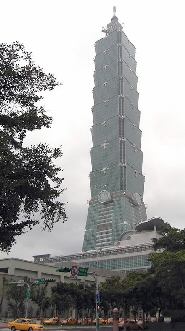 |
The
jade-green building rises in eight slanted sections of eight floors
each. Its shape is inspired by bamboo, which connotes sturdiness and
vigour in Chinese culture.
|
Standing at 507.9 metres, with the upper floors
often jutting above the cloud cover, it has transformed Taipei's skyline and
holds hopes to do the same for Taiwan's economy and identity.
More than one superlative applies to Taipei 101.
According to Emporis.com, a comprehensive database on tall buildings, it is
the world's only supertall building in a highly active seismic zone. Besides
having the tallest structural height in the world, the standard measure used
to determine 'world's tallest', it also has the tallest roof and the world's
highest occupied floor. (The building with the tallest tip is the CN Tower
in Toronto which, with its antenna, stands at 551.7 metres.)
Taipei 101 uses the world's fastest elevators,
whisking visitors to the 89th floor observation deck in just 39 seconds.
According to Emporis.com, each elevator cost more than US$2 million.
Only two of the building's 63 elevators will offer
non-stop service to the top. Yet Taipei 101 will also be one of the few
buildings in the world with double-deck elevators.
The US$1.7 billion project broke ground in 1998
and was topped out last October. The five-story shopping mall adjacent to it
opened last autumn, but Taipei 101 itself will not be completed until late
this year.
Based on the Chinese lucky number eight, the
jade-green building rises in eight slanted sections of eight floors each.
Its shape is inspired by bamboo, which connotes sturdiness and vigour in
Chinese culture.
While the design may be Eastern, it's Western
technology that makes Taipei 101 sturdy, strong enough even to withstand a
direct hit by a jumbo jet, Mr Wang said.
'After Sept 11, we simulated the situation,' he
said. 'We didn't have to change it greatly. We have very big, strong
columns. If an airplane runs into it, it'll probably be stopped. Or at least
people would have a few more hours to get out.'
Even before the Sept 11, 2001, terrorist attacks,
architects had planned two fireproof refuge rooms every eight floors with
emergency supplies and communications. The building also exceeds Taiwan's
stringent seismic standards by five times to withstand the type of
earthquake that comes only once every 2,500 years. But tremblers are not the
biggest worry.
'A building of this proportion is more flexible,'
said Mr Wang, who was born in Beijing and educated in Taiwan and the United
States. 'An earthquake is not the controlling factor. Wind is.'
As in most skyscrapers, a device called a
tuned-mass damper - usually a heavy concrete block - is mounted in the
building to help stabilise it against winds and quakes. Taipei 101 features
the world's largest tuned-mass damper, and in a bold design decision,
architects decided to leave it exposed, allowing visitors to view the
730-tonne ball, painted gold. Although it reduces swaying, the top of the
building will still swing up to 1.5 m in each direction.
Mr Wang thinks there's nothing stopping someone
from building a skyscraper twice as tall as Taipei 101. 'The technology
exists,' he said. 'It's the cost.'
Roughly half of Taipei 101's US$1.7 billion price
tag went to paying the city government for the land use rights. The
developer, the Taipei Financial Center Corp, is a consortium of 14 of
Taiwan's leading banks and insurance companies and the Taiwan Stock
Exchange.
About 20 per cent of the space has been rented.
With 76 floors devoted to office space, Taipei 101 can hold 15,000 office
workers. - NEW YORK TIMES