|

Bounty of luxury units finding plenty of
buyers
Despite an average price of $2.5 million, the
hundreds of luxury condominium units under construction in downtown Seattle
seem to be finding plenty of takers.
Buyers have reserved half of the 500-plus condos
that are for sale in four downtown Seattle ultra-luxury projects, according
to a recent survey by marketing firm Realogics Inc. -- even though the units
won't be ready for at least a year.
Those four luxury projects are toward the front
edge of a wave of about 40 downtown condominium towers that were announced
in 2005.
Many of the earliest developers in that pipeline
snapped up choice sites near the Pike Place Market. Later projects in the
queue tend to be less exclusive. Many of them are bigger buildings, farther
from the downtown core -- in the Denny Triangle and the neighbouring Midtown
area, for example -- and offer smaller and less expensive units.
- SEATTLE
BUSINESS JOURNAL 2007 September 21
PORTFOLIO:
Speiker Properties sold its
industrial portfolio of 14 properties or 3.6 million sq. ft. for $190
million. Speiker announced that is using $53 million of the proceeds
generated from the sale to acquire Lincoln Executive Centre, a 280,000 sq.
ft. office campus in Bellevue, Washington.
Investors bid up apartments
The prices investors are paying to
purchase Puget Sound area apartment buildings are jumping sharply,
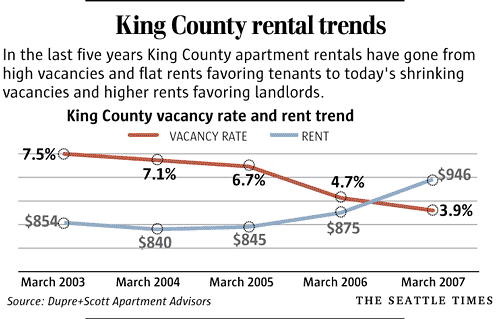
continuing a trend that began early this year despite vacancy rates that
remain stubbornly high.
In a pricing environment that hasn't been
so red-hot since the late 1990s, acquisitions of multifamily buildings by
institutions and other buyers are expected to total nearly $1.1 billion for
the five-county region by year's end. That's just under the 1998 sales peak
of $1.2 billion, and well above the annual average sales volume of $740
million since then, according to Tom Cain, president of Cain Inc., a
Seattle-based apartment brokerage and research firm.
The market surge comes amid heavy
challenges in the fundamentals of the rental business. Roughly two-thirds of
the landlords in the five-county region are still offering rent incentives,
for instance.
Values will continue climbing into 2005,
according to Gregory Wendelken, vice president and regional manager in the
Bellevue office of the real estate investment brokerage firm Marcus &
Millichap. But he added that he expects the rate to slow.
"We see a lot of people
repositioning or re-entering the market in anticipation of strong rent
growth and good appreciation over the next three to five years,"
Wendelken said. "That's what's starting to bring outside money in, the
new money in, and a number of people are just moving up by exchanging and
repositioning their assets for the next (rental market) cycle, which is
probably about 12 months away."
Cain refuses to speculate on just how
long the robust sales market will last. In his latest report, he said
simply, "We cannot make an intelligent forecast on values." But he
added, "We can say, however, the demand for apartment investments shows
no signs of letting up."
In the first half of this year, price per
square foot paid jumped to $101.96, a gain of 17 percent. That compares with
the past four years when prices per square foot for apartments have hovered
between $81.66 and $86.88. The number of building sales is also up, albeit
not dramatically. Some 81 sales have hit the books in the first six months.
That pace compares with a full-year number of 149 sales for last year, and
if the current pace continues, 2004 sales could be up more than 8 percent
over 2003.
A key driver of the shopping spree:
Institutional investors continue to favor real estate as an attractive
alternative to investing in the stock market.
"They feel real estate is solid,
especially apartment investments, because there's always demand for people
to live somewhere," Cain said. Additionally, he said apartment
investments also offer "an inflation hedge and other benefits like
equity build-up and write-off."
Then, too, most institutional investors
feel the apartment market has finally bottomed out after a sustained period
of record low interest rates that enabled many renters to step up into
homeownership.
But paying high prices in a soft market
has its cost. The average capitalization rate, the return on investment for
a property unencumbered by debt, is at 6.7 percent in King, Pierce and
Snohomish counties. That compares with a cap rate of 7.2 percent last year,
and the 8.3 percent cap rate posted in 2001.
Sales price statistics for the first half
of 2004 have been skewed by two factors: strong sales in the region's most
expensive market, Seattle, and sharply higher sales of newer buildings.
The region's 7.4 percent vacancy rate
will keep new owners from boosting rents to offset their outlays for a while
yet. Slightly more than one in four landlords are projecting rent increases
in the five-county region, with an average increase of just 1 percent.
"There may be more motivation to
raise rents," Cain said, "but rents will be based on supply and
demand in the rental market."
Wendelken agrees, "I think we're 12
months from rent growth."
Instead, institutional landlords
will focus on managing their properties efficiently to cut their expenses.
Annual per-unit maintenance and operating costs have been rising about $200
a year since 2001 and now average $3,955 per-unit annually.
- 2004 Nov 8 PUGET
SOUND BUSINESS JOURNAL
|