PROPERTY investments still take pride
of place in high-net-worth (HNW) individuals' portfolios, accounting for a
third of investments, a survey by Knight Frank and Citi Private Bank has
found.
But only 13 per cent of wealthy
respondents said they were planning to buy a new primary residence this
year. While 37 per cent said they would consider a second home, almost
half the respondents said they would not use debt to fund the purchase.
While survey respondents - who are Citi
clients - are cautious, about 70 per cent believe this year will be a good
year to invest in property, followed by 68 per cent in favour of equities.
The least favoured asset class was bonds. The survey was conducted in
January.
No details are available, however, on
how many respondents took part.
Says Aamir Rahim, Citi Private Bank
Asia Pacific chief executive: 'Although equity and property markets have
bounced back sharply, the survey responses suggest wealthy investors
remain concerned about the state of the global economy . . .
'When making property investment
decisions, capital growth prospects are the main driver, followed by asset
stability and then yields.'
He adds: 'Although relatively few
respondents were planning to purchase a new primary residence this year, a
significant proportion do see buying opportunities in the current market .
. . It's clear that the wealthy still see property as a vital part of
their investment portfolios and feel comfortable with it.'
Capital appreciation
Property has a weighting of roughly 33
per cent among the survey respondents, followed by equities' share of 24
per cent. Some 35 per cent of respondents expect equities to be the
best-performing asset class in 2010, followed by hedge funds and property.
Among the types of property exposures,
residential property is expected to fare the best, followed by commercial
property and agricultural property.
The big question is the capital
appreciation potential of some of the real estate markets which rose
significantly last year.
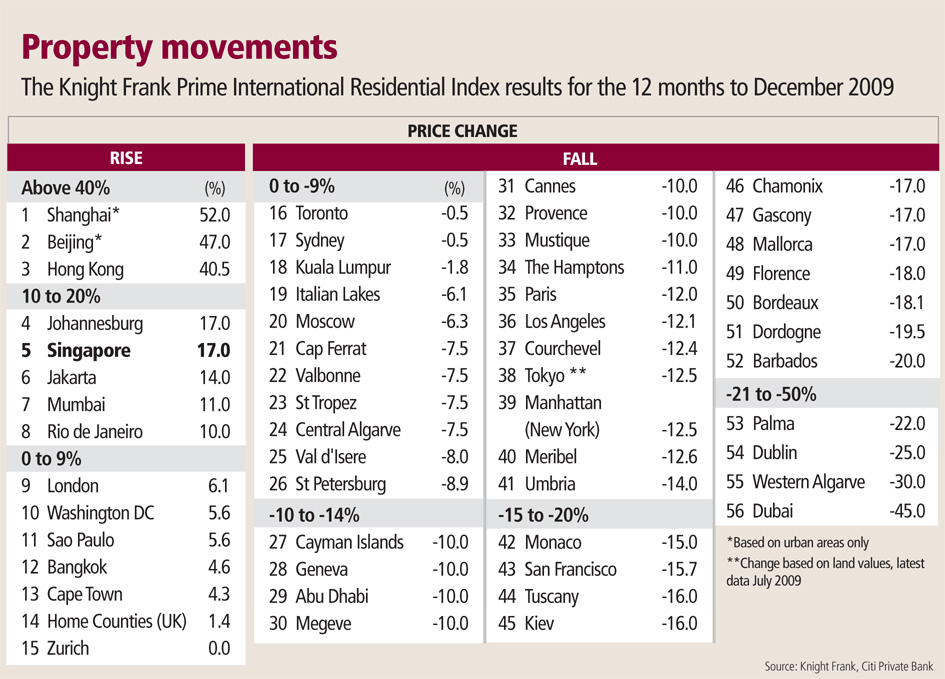
Based on Knight Frank's Prime
International Residential Index, Shanghai real estate registered the
steepest upward trajectory with a 52 per cent rise last year. This was
followed by Beijing's 47 per cent and Hong Kong's 40.5 per cent. Singapore
ranked fifth in terms of the pace of price change, with a rise of 17 per
cent, on par with Johannesburg.
Among other markets, the biggest plunge
was in Dubai where prices fell 45 per cent. This was followed by Western
Algarve in Portugal with 30 per cent.
Liam Bailey, Knight Frank's head of
residential research, said prime residential properties saw a polarisation
last year. Asian cities - especially in China - recovered strongly, but
most other locations continued to fall.
'I do believe that we will see this gap
narrow again in 2010. It seems unlikely that property prices in cities
such as Shanghai can continue to grow at these kinds of rates. In many
(other) locations, there was positive growth in the latter half of 2009.'
New York real estate, for example, rose 2 per cent in the second half, but
fell 12 per cent in the whole year.
Mr Bailey said fiscal intervention by
administrations in Beijing and Washington means those cities are
increasingly viewed as financial as well as administrative hubs - that is,
having an impact on the cities' prime property markets as banks gravitate
towards them.
'Although there are still questions
over the state of the global economy,' he said, 'property remains a core
part of the wealthy's investment portfolios . . . Current price falls will
be viewed by many as a buying opportunity, but as the data from our Prime
International Residential Index shows, these windows of opportunity do not
always remain open for long.'
Boost from IRs
On Singapore property, in particular,
Knight Frank's residential division head Peter Ow expects prime prices to
climb another 10-20 per cent this year and outperform the overall market.
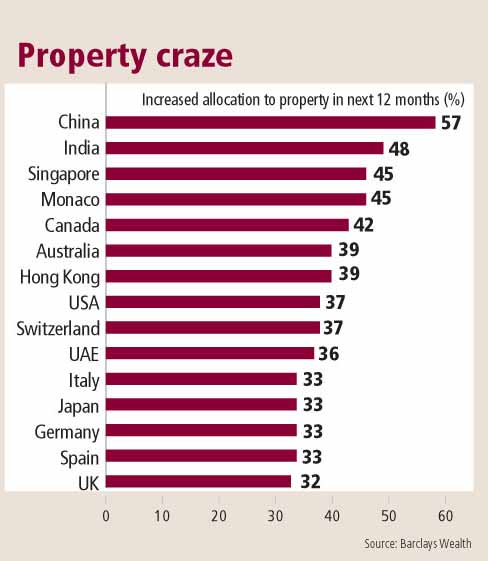
Buying interest is expected from China, India and Indonesia.
'The opening of the IRs (integrated
resorts) will present more leasing opportunities for high-end residential
properties and will help create new residential enclaves, strengthening
the overall living experience of these new clusters,' he said in the
report.
Mr Bailey points out that low interest
costs have protected potentially distressed owners and reduced the supply
of property for sale. At the same time, low savings rates have spurred the
wealthy to move out of cash and into property in search of yields. This
has driven demand for property higher and against the backdrop of tight
supply, has pushed values upwards in some locations.
'Ironically, the unintended consequence
of government economic stimulus packages has been to support demand and
pricing in top-end residential markets - probably not something
governments would readily admit to.'
The obvious question is whether current
pricing is sustainable. 'Our view is that most prime markets are suffering
from an undersupply of stock and this will help maintain prices in the
short term. Looking further ahead, however, it is those locations that
offer a genuine lifestyle attraction to the world's wealthy, rather than
just an investment opportunity, that will prove most sustainable,' he
wrote. - 2010
March 24 BUSINESS
TIMES