Despite the glitz, Macau's retailers doing just ok
Attempts by Macau's casinos to develop malls and retail corridors have
met with mixed results."The malls are boring, there's too much of
the same," said Sean Monaghan, head of Asian gaming for CB Richard
Ellis. "Macau has more Louis Vuittons than McDonalds." -- July 13, 2010
Asia
Times Online
Emergence of the New Macau With the US$2.4 billion Venetian complex in place and many more
integrated resorts to come, a strip of reclaimed land is changing the
complexion of Macau
The former Portuguese colony of Macau is
now a place where superlatives abound, and nowhere is that more evident than
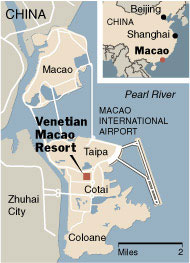
on the Cotai Strip, an area of reclaimed land between the islands of Taipa
and Coloane that is being transformed into Macau's 'new reality' of Las
Vegas-style mega resorts.
Four years after international gaming
operators moved in and showed Macau the future, the once-sleepy enclave is
now teeming with people and glass palaces. While the Macau peninsula has its
fair share of new hotels and casinos, it is the Cotai Strip - where there is
space for developers' imaginations to run riot on a massive scale - that
defines the New Macau.
The major mover and shaker behind the
ambitious multi-phase Cotai Strip project - when completed in several years'
time the US$13 billion development will comprise some 14 resorts and 21,000
rooms, featuring a slew of top-notch hotel brands - is the US-based
integrated resort (IR) developer Las Vegas Sands Corp (LVS), whose flagship
3,000-room property The Venetian towers over the strip in much the same way
that its sister property in Las Vegas has done for close to a decade.
Of course, 'mega' doesn't begin to
describe the US$2.4 billion Venetian complex, which opened a year ago and
has proven to be a quick return on investment for its owners - thanks to its
proximity to the Chinese mainland, 10 million visitors arrived within the
first six months. A Sands spokesman puts it in perspective when he says The
Venetian is merely 'the largest inhabited building on the face of the
earth'.
LVS CEO Sheldon G Adelson says that of
the 30 million people who visited Macau (population: 550,000) during the
past year, 20 million made it to The Venetian. As a result of its
hyper-quick transformation, this special administrative region of China has
outpaced not just Las Vegas, but also the entire state of Nevada - the Macau
Gaming Inspection and Coordination Bureau puts its gambling revenue for the
first quarter of this year at US$3.7 billion.
Adelson and other top brass from the
Sands Group were in Macau this week to preside over the opening of its
newest hotel, the Four Seasons Hotel Macau, Cotai Strip, a 'small' property
with just 360 rooms (introductory rates start at HK$3,400 or S$615) located,
along with a swanky shopping mall, next to The Venetian.
While The Venetian's casino is the
largest in the world with 800 gaming tables spread over 550,000 sq ft, the
new casino at the Four Seasons is positively boutique-sized, with just 175
tables. Both casinos offer membership-based premium private gaming areas for
high-rollers willing to bet a minimum of HK$3,000 a hand - in The Venetian's
main casino, the minimum bet is HK$100.
The Sands' policy of broadening the
consumer base by providing casino-sized meeting and convention facilities,
multi-purpose arena, fancy shopping malls, as well as a huge variety of
non-gaming-based entertainment, is consistent with all their IR properties -
including the upcoming Marina Bay IR due to open in Singapore at the end of
2009.
In keeping with that strategy, The
Venetian also held the premiere of a new Cirque Du Soleil show this week at
a purpose-built theatre within the hotel. Zaia is the 10th show with a
permanent venue for the group and the first in Asia - another opens at Tokyo
Disney Resort in October, while a second, totally different Macau show is
planned for next year, at the Sheraton across the street from The Venetian.
The plot in Zaia - ostensibly about a
young girl who travels into Outer Space in search of new galaxies - is as
thin as the safety wires attached to the performers, but of course that's
not the point. Cirque's reinvention of the circus atmosphere - weaving
elaborate sets, colourful costumes, music and special effects technology
into gravity-defying acts with elements of dance, gymnastics and acrobatics
- has attracted a new generation of fans.
If the opening ceremony at the recent
Beijing Olympics set the new show standard, then the 75 performers in Zaia -
so adept at making the spectacular look routine - certainly belong in the
same arena. Li Ning's Olympic torch-lighting space walk would fit nicely
into a Cirque Du Soleil programme.
The show takes great pains to disguise
what are essentially trapeze, juggling, balancing and clown acts,
culminating in a heart-stopping trampoline display. Each act is beautifully
choreographed and cleverly lit - and while Zaia may not be the best of the
Cirque's productions just yet, it is still impressive and enjoyable enough.
'For $150 million to $170 million, it ought to be impressive,' says Adelson.
In the New Macau, money talks - and plenty of people are listening.
- 2008 August 30 BUSINESS
TIMES
Travel Restrictions Rattle Macau Gambling Stocks Fall
On Talks That China
Could Tighten Access
Major casino operators have
prospered in Macau's fast-growing gambling market. But uncertainty over
Beijing's policies is showing the flip side to that success.
Shares of Las Vegas Sands
Corp., MGM Mirage and others tumbled Tuesday after Portuguese news service
Lusa reported that Beijing might make it harder for mainland Chinese to
visit the one part of the country where gambling is legal. The report
couldn't be verified. China's government has previously taken incremental
steps to limit visitor numbers from the mainland in an apparent effort to
cool Macau's scorching economic growth and keep inflation in check.
Wednesday afternoon in New
York, Las Vegas Sands was off 2.5% after finishing down 11% Tuesday, while
MGM Mirage was down 1.2%, after dropping 9.4% the day earlier. Both stocks
are traded on the New York Stock Exchange. On the Nasdaq Stock Market,
shares of Melco Crown Entertainment Ltd. were down nearly 1% after falling
11% Tuesday, and Wynn Resorts Ltd. shares were down 3%, after shedding 4.3%.
The four companies didn't return calls.
In Hong Kong on Wednesday
casino operator SJM Holdings Ltd. closed up 0.9%, while shares in Galaxy
Entertainment Group finished 1.8% lower, amid a broadly higher market.
Macau generates more
gambling revenue than the Las Vegas Strip and Atlantic City, N.J., combined.
However, the selloff underscores an uncomfortable reality for the casino
operators in Macau: They are vulnerable to political decisions over which
they have no control.
Gabriel Chan, an analyst in
Hong Kong at Credit Suisse, said he believed the market's reaction was
overblown. Many of the casinos rely more on the smaller number of affluent
VIPs than raw traffic, he said.
According to the report,
the central government might soon allow mainland Chinese to visit Macau only
once every six months. Current rules allow them to visit once every two
months.
While travel restrictions
on Chinese mainlanders generally aren't made public, Beijing has already
tightened up on travel to Macau. Until June, mainlanders were able to visit
Macau twice a month, but a new rule that month halved such visits to once a
month. The travel rules changed again in July -- amid unofficial reports of
strong growth in gambling revenue -- to a maximum of one visit every two
months.
"The Beijing
government cannot intervene directly in the gaming market in Macau, but what
they can do is control visitation," Mr. Chan said.
Casinos in Macau will soon
feel the effects of a second and different rule set by the territory's own
administration. Starting Sept. 1, mainlanders who visit Hong Kong will no
longer be able to travel freely from Hong Kong to Macau, an hour's ferry
ride to the west, according to Macau public-security officials.
Nearly 8.2 million of the
27 million people who visited Macau last year traveled there from Hong Kong.
During the first half of this year, Hong Kong arrivals numbered 3.9 million
out of 14.9 million total visitors to Macau. Macau's official Statistics and
Census Service, which compiles these data, doesn't specify how many Hong
Kong arrivals were mainlanders transiting through Hong Kong.
However, the lack of
automatic access for mainlanders to go from Hong Kong to Macau could have an
impact on casino traffic. Hong Kong received 15.5 million visitors from
mainland China in 2007, and 7.9 million during the first half of this year,
according to the Hong Kong Tourism Board. Under the restriction to take
effect in September, none of these people would be able to go freely to
Macau. - 2008 August
21 WALL ST. JOURNAL
Venetian
Macao hopes to kick off the boldest phase of development in Chinese casino
town
The new casinos popping up in Macau in the past
three years have helped the Chinese territory surpass the Las Vegas Strip as
the world's most lucrative gambling center.
This week, the city begins its most ambitious and
perhaps riskiest phase of development with Tuesday's opening of the
US$2.4 billion (euro1.75 billion) Venetian Macao Resort Hotel. It's the
latest mega project from American billionaire Sheldon Adelson, chairman of
Las Vegas Sands Corp.
The big bet is that Macau can be much more than a
playground for day-tripping gamblers mostly from China who spend most of
their time in the casinos.
Developers are hoping the tiny city on the
southern Chinese coast will also be able to attract shoppers, conventioneers
and tourists hungry for gourmet dinners, pool-side sun-tanning and glitzy
shows.
The Venetian Macao is the first mega resort that
will try to bring in the new crowds of visitors willing to spend two or
three days in the city.
With gondoliers sailing down canals, the
3,000-room Venetian tries to recreate the beauty of Venice. The complex also
boasts a 15,000-seat sports arena, retail space for 350 stores, 1.2 million
square feet of convention space, fine dining, and a Cirque du Soleil-produced
show. Everything will be housed in what will be the largest building in Asia
and the second largest in the world, just behind a Boeing Co. plant in the
northwestern U.S. state of Washington.
J.P. Morgan Securities analyst Billy Ng said the
Venetian's plan makes sense to him. The mega resort "will broaden the
customer base,'' he said.
"In theory, it should bring in a lot of
customers who have never thought about going to Macau,'' he added.
Ng and some other observers are also bullish that
Las Vegas Sands can capitalize on its expertise in running trade shows at
casinos in Vegas and replicate that success in Macau. The Venetian's
convention facilities will help fill up the thousands of rooms and boost
weekday traffic, they say.
Business travelers to conventions have a larger
budget to spend on hotels and the Venetian will probably be attractive to
this segment, said Jonathan Galaviz, a partner at Globalysis Ltd., a Las
Vegas-based consultancy.
"Asia has yet to see a multi-billion dollar
integrated resort with a strong convention center component to it like the
scale that the Venetian Macau will provide,'' he said.
William Weidner, president of Las Vegas Sands
Corp., has said that 44 major conventions have already been scheduled at the
Venetian for the next two years.
He also said he expects the average guest to stay
at the Venetian for three to four days, compared to the current average of
just 1.2 days in other Macau hotels.
Some analysts aren't as optimistic. The Venetian
can't transform deep-seated Chinese attitudes to gambling overnight, they
say, and whether Chinese gamblers will be as generous at the restaurant and
at the shows as they are at the casino is still a big question.
"We go to Vegas prepared to splurge. (Chinese
gamblers) come to Macau for reckless gambling. We expect to give but they
expect to take,'' said Gabriel Chan, an analyst with Credit Suisse Hong
Kong.
"There aren't shows on yet,'' he added.
"And you can't shop all day every day. The Venetian is a big property,
but it's not enough to create a critical mass for everyone to stay at least
two nights.''
The lack of alternative entertainment and
transport support in the area will also pose problems in the short term,
analysts say.
The Venetian is just the first property to
kick-start mega-tourism plans for the Cotai Strip, a reclaimed area that,
according to Adelson, will mimic the heart of the Las Vegas Strip upon
completion.
The Sands is set to open more hotels under brands
such as the Four Seasons, Sheraton and St. Regis next door. In all, the
company plans to invest up to US$12 billion and build 20,000 hotel rooms on
the Strip.
That's a lot of rooms, but they won't be
affordable for the average Chinese gambler.
"Chinese visitors may lengthen their stays
only when there are so many hotel rooms on offer that the rates come down,''
said Chan. - AP 26 Aug 2007
Chinese Estates
Hong
Kong listed property firm Chinese Estates Holdings is building 3,500
residential units near the Cotai Strip.
This mega project comprises 24 residential blocks and one block of serviced
apartments to be developed in four phases by 2013. It represents Chinese
Estates' first significant presence in Macau.
Aiming
to create a self-sustained urban centre, the project is also going to offer
around 100,000 square feet of clubhouse facilities and over 700,000 square
feet of landscaped garden as well as other amenities.
The
new project sits on a site which consists of five parcels of land adjacent
to one and other, next to the Macau International Airport. The aggregate
area of the site is around 78,700 square metres, with a total gross floor
area of about 392,505 square metres.
Over the moon The Hong Kong developer acquired the Taipa site early last year
through the purchase of a 70.01 percent stake in Moon Ocean, a limited
company incorporated in the British Virgin Islands that holds the land lease
of the five parcels of land. According to a Chinese Estates' circular filed
with the Hong Kong Stock Exchange last January, the acquisition deal is
priced at HK$ 1,579 million, of which around HK$ 1,328 million went for the
land purchase.
The listed company has secured a HK$1.6 billion syndicated loan to bankroll
the construction of the first phase of the ambitious project. The current
construction cost is estimated to be around HK$ 7,500 per square metre. The
deal itself represents the largest syndicated construction loan in Macau by
a Hong Kong firm.
Upon its target completion date in 2010, phase one will provide around 680
units, with flat sizes ranging from 1,100 to 2,900 square feet for
residential units and 450 to 1,350 square feet for serviced apartments. The
company is expected to launch presale of phase one later this year.
Alex Cheung, General Manager of Oversea-Chinese Banking Corporation, which
is the arranger of the syndicated loan, says that the banking sector has
warmly responded to the financing of Chinese Estates' Macau venture,
indicating "a strong vote of confidence" in the project.
Expat gamble Lau Ming-Wai, Executive Director of Chinese Estates, is equally
confident that the many units provided by their project will be grabbed up
by Macau's growing labour force. "In particular, the high-end luxury
segment is experiencing both pent-up demand and a supply shortage", he
says.
Lau estimates that the residential units will bring the project HKD$ 10.5
million in profit. It is expected that over the next few years, the
Cotai Strip will take in some 60,000 workers, with a high proportion of
cash-rich expatriate professionals.
Chinese
Estates Holding is not alone in the bid to cash in on the property
investment potential presented by the promising new Strip. Cheuk Nang
Holdings, controlled by the flamboyant Hong Kong tycoon Cecil Chao Sze-tsung,
has also placed its stake on a mixed-use project opposite the Cotai Strip,
which will provide more than 1,000 residential units.
Analysts believe property investors will continue to rally around the Cotai
Strip over the next few years considering the numerous casino and resort
projects planned for the area. They also, however, caution that it may be
wise to adopt a "wait-and-see attitude" in the short term to weigh
the true potential of the area after the opening of the Venetian's flagship
project later this year.
Luxury residential properties
are springing up in Macau to do justice to the glitz of the gaming
destination
As wealthy people increasingly come to play in Macau, more of them want to
stay. A new crop of luxury residences are springing up to accommodate them.
As local wages rise on the back of the economic boom and investor dollars
show no signs of waning, high-end residential properties and serviced
apartments are also mushrooming in Macau to satisfy consumers' increasingly
sophisticated tastes.
Privileged location
For the ultimate indulgence, a villa in a secluded location away from the
city bustle, but not too far away, is indispensable.
Penha Hill has long been the abode of Macau's privileged few. Its
dwellers not only have large fortunes to spend, but also enjoy high social
status. Due to Macau's tiny size, plots that are eligible for the
development of villas are quite limited. This makes a Penha Hill address all
the more desirable for people who can afford tens of millions to pamper
themselves just a little.
Flying Dragon Villas, a group of 10 mansions on Penha Hill, have sold out
before their completion. Buyers include well-known business personalities
from Macau and Hong Kong.
Invitation only
According to Flying Dragon developer Trust Construction and Investment Ltd,
the strong response to the new property was no surprise. In fact, they
anticipated oversubscription from the beginning, so sales of Flying Dragon
have been strictly by invitation, ensuring these coveted villas go to
society's top names. This sales strategy helps sustain the success of a
truly top-end property: exclusivity makes a property more attractive to
eminent buyers while eminent buyers make a property more exclusive.
In the words of the developer, Flying Dragon is something so precious that
money alone cannot buy it. But, make no mistake, you'll need a pile of money
to secure an invitation.
Home grand home
Located on Penha Hill's prime location overlooking serene Nam Van Lake,
Flying Dragon comprises a total of 10 three-storey villas. Many prominent
and influential figures have called this area home, including the late Ho
Yin, father of Chief Executive Edmund Ho. Today the site abuts New Bamboo
Garden, lodging for visiting leaders from Beijing.
Flying Dragon villas' useable floor areas range from 8,141 to 13,223
square feet, with price tags of MOP60 million to 70 million (US$7.5
million-8.7 million). Comparable villas in neighbouring Hong Kong would cost
at least twice as much. No wonder Flying Dragon has stirred up considerable
interest in Hong Kong.
Every villa has unique features designed to impress. Each home includes a
semicircular balcony showcasing panoramic views of Nam Van Lake, and four
larger villas include a garden covering more than 2,000 square feet.
Industry observers believe market demand for top-end villas will continue to
swell. So developers are scouring Macau's limited landscape for more sites
to build luxurious homes to satisfy increasingly rich tastes.
Filling the luxury gap
There used to be only a handful of residential properties in Macau that
satisfy international standards for luxury. But extravagant properties are
multiplying to fill the gap.
The Manhattan - A175-unit development being built by MacauLand Holdings
and Citigroup Property Investors. Located right off the Cotai Strip, the
twin tower project is scheduled for completion in January. The Manhattan
will feature a 17,000-square foot clubhouse. The property will be managed by
British company Savills. Since sales of its north tower began in late June,
about one-third of the 85 units have been sold for an average price of
HK$3,200 (US$411) per square foot.
One Central Residences - This mixed-used waterfront project located
between the MGM Grand Macau and Wynn Macau is a joint venture between Shun
Tak Holdings and Singapore-listed Hongkong Land. With a total
site area around 200,000 square feet, One Central includes 800 units in
seven residential blocks of 32 to 38 storeys. It will also feature a
clubhouse with indoor and outdoor pool as well as a landscaped garden.
Though it is due for completion in 2009, two of its entire blocks have
already been sold. London listed Macau Property Opportunities Fund Limited
paid HK$673.4 million, a Macau record HK$4,550 per square foot, for a
59-unit block.
Macau
real estate prices up 31% in 2nd quarter
Macau's property boom is seemingly
persisting, as the real estate prices saw a year-on-year rise of 31 per cent
in the second quarter.
The latest figures released by the
government-run Statistics and Census Service showed that the average
transaction price of residential units per square metre stood at 10,072
patacas (S$2,065) in the quarter.
The boom took root in 2002 when Macau
ended the gaming monopoly held for decades by shipping and gambling tycoon
Stanley Ho.
International gambling sharks have since
been flocking into the 26-sq-km region.
There are currently 17 casinos under
operation, two of which are funded by foreign investors. International
companies including MGM Mirage, however, are pouring over US$12 billion to
build new casinos in Macau.
The special administrative region (SAR),
many analysts predicted, may overtake Las Vegas in 2005 as the world's
biggest gambling centre by revenue.
Officials foresee that some 20 million
visitors will arrive this year, most of whom are assumedly gamblers.
Demand for housing among the visitors,
those from the Chinese mainland in particular, is likely to keep lifting
luxury residential property in the years to come, local real estate agents
said.
New casinos in Macau may also draw around
30,000 foreign employees in the next few years, local observers predicted.
Macau has about 10,000 luxury apartments,
according to official statistics, and may add 5,000 in the next two years
for the flow of gaming industry professionals, they said.
The booming property prices are also
partly due to the rising number of the mainland Chinese approved for
residence in Macau. The number of legal immigrants from the mainland stood
at 6,885 in 2004, three times the previous year.
The SAR grants residency to those who
invest at least one million patacas and the simplest way surely is through
property acquisition.
The way Macau property prices are
soaring, however, has triggered speculation among economists that the
mushrooming casino business is producing a property bubble.
There is hardly any rental market in the
region with a population of merely 470,000, and only around a tenth of new
apartments are lived in, according to official statistics.
Macau home buyers are currently paying up
to 118 months of salary for a flat. At the height of the Hong Kong's
property bubble in 1997, home buyers paid 440 months of salary.
Is that the distance between a boom and a
bubble? - Xinhua30 Aug 2005
Is Macau priming for bubble?
The way Macau property prices are soaring while rows of new apartment blocks
stand nearly empty, investors could be forgiven for thinking that the
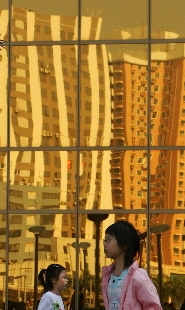
mushrooming casino business is providing the gas for a property bubble. Noveau riche: Rows of residential housing are reflected on the Sands
Macau casino's glass exterior as residents of the former Portuguese colony
come to grips with their sudden wealth. The demands of Macau's glamorous
casino industry is creating the need for service apartments to accommodate
foreign executives, entertainers, and hospitality professionals employed in
the industry
The former Portuguese enclave on China's
southern tip has drawn speculative flows from Shanghai, which is being
officially cooled after an explosion of real estate investment, and Hong
Kong, where rising interest rates are starting to bite.
Macau developers can still sell sparkling
high-rise blocks in just a couple of weeks, but buyers are taking a big
risk. There is hardly any rental market - only around a tenth of new
apartments are lived in. 'There's a tremendous feeling of a gold rush town,'
said Elaine Young, chief executive of Hong Kong serviced apartment firm
Shama, which is looking to expand into Macau. 'The property market has risen
outrageously.'
Apartment prices rose 50 per cent last
year. Property agents predict the same in 2005, and analysts at investment
bank Merrill Lynch expect the cost of an apartment to double in three years.
But the rampant speculation, mostly by
people from Hong Kong and the rest of China, is based on economic
fundamentals.
Gross domestic product (GDP) grew 28 per
cent last year, thanks to a 40 per cent jump in tourists visiting the only
place in China where casinos are legal. Per capita GDP for Macau's 465,000
residents has risen to the level of New Zealand's from that of Slovenia in
just one year.
Officials predict 20 million visitors
will pour in this year, a fifth more than in 2004.
No bubble?
Investors
are betting there will be a bigger boom in 2007, with the opening of the
first phase of the Cotai Strip of opulent casinos, plush hotels and shopping
malls, being built on about 5 sq km of land reclaimed from the silt-clogged
Pearl River delta.
The 60,000-room seven-casino three-phase
project was dreamed up by Las Vegas gaming tycoon Sheldon Adelson. Hoteliers
involved include Hilton Group, Marriott International and Four Seasons
Hotels Inc.
'I don't see a bubble,' said Gregory Ku,
head of property consultants Jones Lang LaSalle in Macau, who has privately
invested in two Macau apartments. 'A bubble means there are no good things
to support the market. But Macau has many.'
China could clamp down on loan sharks
that fund gambling trips, and some analysts say competition from Singapore's
planned casinos could stack the odds against another Macau boom. But the
demands of the industry itself, regardless of its success, are having an
impact. 'Until the casinos raised their glamorous heads, there was no need
for serviced apartments,' said Ms Young. 'Now there will be human resources
people, entertainers, people to run the hotels and convention business,
designers, architects, civil engineers.'
The excitement began in 2002 when Macau
ended a gaming monopoly held by shipping and gambling tycoon Stanley Ho, who
boasts of having once fought off a pirate attack. China then eased travel
restrictions in 2003, prompting a flood of Chinese tourists. The number of
mainland Chinese approved for residency in Macau nearly trebled last year to
6,885 - each bringing mandatory property investment of US$128,000.
Cooling measures
A typical 2,000 sq ft, three-bedroom
luxury apartment costs US$900,000, but that is still only a tenth of some
projects in Hong Kong, an hour away by ferry or 10 minutes by helicopter.
Authorities are considering
market-cooling measures, such as a cut in bank loans to 70 per cent of a
property's value, from 90 per cent, but Merrill Lynch analyst Hillman Wong
points out that similar moves in Hong Kong did little to quell speculation
there in the 1980s and 90s.
He expects Macau home buyers to pay up to
188 months' salary for a flat, against 118 months' worth now. At the height
of the bubble in Hong Kong in 1997, home buyers paid 440 months' salary.
'People in Macau are getting wealthy and
there's big demand for upgrading accommodation,' Mr Wong said.
'Construction workers got 40 to 60
percent pay rises last year. Junior casino dealers will get HK$13,000
(S$2,800) a month', compared with Macau's average of HK$5,500 per month now.
The narrow streets of peninsular Macau
are crammed with greying concrete apartment blocks with a smattering of
mustard and pink colonial buildings, their arches and shuttered windows
remnants of four centuries of Portuguese rule that ended in 1999.
Most of the new construction is on nearby
Taipa island, which is fused by the Cotai Strip to Coloane island, and via a
causeway linking it directly to mainland China.
Only a handful of outside developers,
mostly from Hong Kong, have chiselled a foothold in the tight-knit market,
including Hopewell Holdings, Shun Tak, Kowloon Development and Far East
Consortium.
A joint venture between Morgan Stanley,
Hong Kong-listed Pioneer Global and Wachovia Corp managed to buy a 22-storey
office tower. - 28 June 2005 SINGAPORE
BUSINESS TIMES
Cheuk Nang (Holdings) is the latest Hong Kong developer to jump on the
Macau property bandwagon with a proposed $2 billion residential project on
Coloane.
The small developer, which just reported a full-year profit of $373.29
million after gains from a revaluation of its investment properties, said
it had agreed to pay $800 million for a 97,358 square foot site opposite
the Cotai Strip.
Executive chairman Cecil Chao Sze-tsung said it planned to develop the
site into a residential project with serviced apartment towers and,
subject to the Macau government's approval, a private casino.
The gross floor area will range from one million sq ft to 1.3 million sq
ft, depending on the sizes of the domestic and commercial areas.
Together with construction costs, the firm's total investment was
estimated at $2 billion, he said.
Mr Chao said the purchase was prompted by the city's robust economy and
the prospects for the property market, which would be boosted by a
shortage of new land.
The growth of tourism and gambling, which contributed to an 8.2 per cent
rise in Macau's second-quarter gross domestic product, has already
persuaded Hong Kong property players, such as Henderson Land Development
and Hongkong Land Holdings to make their first forays into the territory.
Mr Chao expects the Macau project will make $3 billion for Cheuk Nang.
"The real estate market in Macau will grow faster than that in Hong
Kong," he said.
Mr Chao explained that the company had no plans to tap capital from the
stock market to fund the new project but that it expected to gain revenue
of more than $500 million from the sale of its Hong Kong project Cheuk
Nang Bridgeview Bay, in Tsuen Wan, next year.
Cheuk Nang's gearing was 44 per cent as of June and it had cumulative bank
borrowings of $358.37 million.
The company yesterday said its net profit had increased by 1,195.44 per
cent to $373.29 million for the year to June after it posted a net profit
of $28.81 million for the previous year.
Cheuk Nang's growth was helped by $463.8 million in gains from the
revaluation of its investment properties. Gross profit was $19.01 million,
compared with $31.58 million in the previous year.
It will pay a final dividend of 15 cents per share.
Looking ahead, Mr Chao said the company would focus on four main markets -
Hong Kong, the mainland, Macau and Malaysia.
"Some of our development projects will be completed in the next two
to three years. We are looking forward to a good harvest in the not too
distant future," he said. - by Peggy Sito SOUTH
CHINA MORNING POST 2005 October 4
HK Land in Macau first with Shun Tak
Shun Tak Holdings, run by casino mogul Stanley Ho, has formed a joint
venture with Central's biggest landlord Hongkong Land to develop a
mixed- use property project in Macau.
Shun Tak, a ferry services to property group, paid HK$665 million for a
51 percent stake in the site, located at the reclamation area on Taipa
Island, according to a stock exchange notice released Friday. The site
is adjacent to the MGM Grand Paradise casino and hotel complex that is
currently being built.
The seller was Ho's daughter, Pansy, executive director of Shun Tak.
Hongkong Land paid HK$639 million for the remaining 49 percent stake,
marking its first foray into the property market in Macau.
The price paid by Shun Tak and Hongkong Land represents a 43 percent
discount to the latest HK$2.3 billion valuation of the site made by
property consultant Chesterton Petty.
Shun Tak deputy managing director Daisy Ho did not answer a question on
why the site was sold at such a large discount to its estimated value,
saying only that Shun Tak agreed to its price only after Hongkong Land
had cut a deal with Pansy Ho.
The project will feature 1.9 million square feet in gross floor area of
residential flats and serviced apartments plus 380,000 square feet of
high-quality retail space and a 320,000 square foot, 210-room luxury
hotel.
The hotel will be run by Mandarin Oriental Hotel Group for 25 years
under a management agreement. There will be no casino on the property.
Depending on government approval, the residential and retail portions
are due for completion in 2008, with the hotel and serviced apartments
following in 2009.
Daisy Ho said ``firm figures'' for total investment on the project are
not available because the building plans had yet to be approved by the
government. She expected approval to take a few months.
However, according to Shun Tak's stock exchange notice, estimated total
development costs attributable to Shun Tak would not exceed HK$2.9
billion, including land costs.
Based on historical construction cost data compiled by construction
consultant Levett & Bailey, total construction costs alone could
total HK$2.7 billion.
Shun Tak will rely on internal resources to finance its part of the
development, Daisy Ho said.
While both companies said there would be no clear division of labor for
tasks in the joint venture, she said Shun Tak would manage the sale of
residential flats and serviced apartments while its partner would manage
the retail mall.
The company gave no indication of when presales of flats would be
conducted. Hongkong Land executive director Robert Wong said it was too
early to say when presales would be conducted.
UBS analyst Eric Wong maintained his ``buy'' rating for Shun Tak, saying
it made a smart move in partnering with expert companies for the
project.
``The most important thing to note is that they appointed two
world-class managers to look after this property,'' he said, adding that
Shun Tak's HK$2.8 billion of cash on hand should be plenty to finance
the project. - 2005 October 1 STANDARD
At the moment, Macau's potential seems
brighter than Vegas neon. Over the first 11 months of 2004, 15.2 million
tourists visited Macau, up 42% from the year before—an amazing number for
a territory with a population of only 450,000 people. More impressive is the
money they blow at the tables and slots. Last year, Macau's casinos raked in
about $5.1 billion, up 34% from 2003. That's about the same as the Las Vegas
Strip's gambling revenues. In fact, Marc Falcone, gaming analyst at Deutsche
Bank in New York City, predicts that Macau will surpass the Strip this year.
With 20% annual growth in gaming revenues expected over the next five years,
Falcone says Macau could overtake the whole of Nevada as the world's biggest
gaming market by the end of the decade.
That would make Macau the gambling center
of the world. And why not? Its potential market is more than a billion
people who live within a three-hour flight from the city. (Vegas, in
contrast, has just 250 million residing within the same radius.) The rise of
Asia's middle class means more and more potential punters have disposable
income to splurge on roulette wheels and slot machines. In China alone,
per-capita income has surged about 8% a year for the past two decades.
Leisure time is expanding, and Asians who are obsessed with getting and
spending are putting less emphasis on the former and more on the latter.
"Modern Chinese are more receptive to Western lifestyles," says
Francis Lui, director of Galaxy Resort & Casino, which is investing $700
million in three hotels in Macau. "Macau is in the right place at the
right time." - by Michael Schuman 31 Jan 2005
more from TIME
ASIA cover story
Fisherman's Wharf - phase II
A flurry of construction has given Macau a handful of themed casinos. Now
tycoons Stanley Ho and David Chow are preparing to double down on their bet
that the SAR is ready for themed dining and shopping too.
In an interview with The Standard,
Chow said that construction on the HK$1.2 billion first phase of his Macau
Fisherman's Wharf joint venture with Ho should be complete by July.
This phase, which is being constructed
between the Hong Kong ferry terminal and the Sands Macau casinos,
encompasses an artificial volcano, an exhibition hall, an amphitheater and a
hodgepodge of buildings designed to invoke ancient China, Venice, Amsterdam,
Cape Town and other cities, and contain restaurants and shops to match. The
venture will now be looking for operators to lease these eateries and
boutiques, with the hope that three-fourths of the project can be opened
simultaneously later this year, Chow said.
In the meantime, Chow said he and Ho have
asked the government for permission to add a HK$1.1 billion second phase to
the end of the first phase.
The extension would include three hotels,
a disco, a marina, an exposition center and new executive offices for his
company, Legend Development. One hotel would go in a building styled to
resemble those in The Rocks, the oldest district of Sydney. Another would
approximate a Mississippi riverboat. The third and largest would have the
theme of Istanbul and include a large spa.
All three would be managed by Fisherman's
Wharf or related companies. Ownership of Fisherman's Wharf is split between
Chow and Ho on a 49-51 percent basis. Current plans for Fisherman's Wharf do
not include a casino, Chow said.
The Pharaoh's Palace casino that Chow
opened two years ago in the Landmark building as the city's first theme
casino is generating twice as much revenue from its 60 tables as originally
forecast, he said. The Landmark, Chow's flagship project, also contains
offices, a hotel and the Legend Club VIP gaming room. Ho's Sociedade de
Jogos de Macau operates the Pharaoh's Palace and Legend Club and Ho holds a
35 percent stake in the complex.
Chow said he expects revenues for the
Landmark to grow 15 percent this year. He said he plans to distribute
Landmark shares to employees this year for a public stock offering next
year.
Chow is working on plans to rebuild the
Estoril Hotel and to set up a slot-machine factory in the new Zhuhai-Macau
Cross-Border Industrial Zone.
Chow said he has started to develop
projects outside Macau.
The first will be a 2.2 billion yuan
(HK$2.1 billion) luxury hotel, to be called the Legend, that is to open in
Beijing before the 2008 Olympics near the Grand Hyatt and Li Ka-shing's
Oriental Plaza development, Chow said.
The next project would be a tourism and
gambling venture in Cape Verde, a former Portuguese colony off the west
coast of Africa for which Chow serves as honorary consul.
- by Zach Coleman
THE
STANDARD18 Feb 2005
Macau's
tourism industry booming Macau
reported a double-digit growth in the number of tourist arrivals from
January to August, led by a huge influx of China's inlanders.
According
to the latest figures from the Statistics and Census Services, tourist
arrivals in the Special Administrative Region ( SAR) jumped 10 percent to
7.61 million in the first eight months of this year.
Hong Kong remained the largest tourist source for
Macao with 3.55 million visitors, but the figure dipped 1.4 percent on a
year-on-year basis.
China's
inland was catching up quickly, providing slightly more than one-third of
tourist arrivals in Macao, while Taiwan tourists made up 13.6 percent of the
total.
In
August alone, visitors from China's interior surged 19.2 percent from a year
ago.
Industry
insiders noted that Macao's tourism industry has benefited greatly from a
sharp rise of travel agencies allowed by the China National Tourism
Administration to manage the SAR-bound tours.
Currently,
the Macao Government Tourist Office is trying to make tourists stay longer
and spend more as the number of same-day visitors reached 3.19 million or 42
percent of the total in the January-August period.
Tourists
to Macao hit a record of more than 10 million in 2001 and the figure for
this year is set to rise further. -
Xinhua
2002
Macau Tower a new beacon for tourists With the long-awaited completion of the Macau Tower Convention &
Entertainment Centre expected by the end of the year, Hong Kong's neighbour
is tipped to become a more important leisure and business destination.
The Macau Tower will soar 338 metres
above the ground, making it the world's tenth-tallest free-standing
structure and Asia's eighth-tallest.
The project, being built on reclaimed
land on the waterfront of the Nam Van Lakes, incorporates both conference
facilities and lifestyle entertainment.
The structure includes an outdoor
observation deck at 233 metres, a 250-person restaurant that completes one
rotation every hour, and a main observation deck with a section of glass
flooring at 223 metres.
On a clear day, some of Hong Kong's
islands can be seen from the tower, in addition to the Macau cityscape,
China and the Pearl River.
Pansy
Ho Chiu-king, managing director of Shun Tak Holdings (0242), hopes the
tower will put Macau on the international tourist map. Yesterday she
announced the company's new travel agency business, Jumbo Vacation Club,
which courts niche travellers looking for theme vacations, and its joint
venture with Asia Travel Network to develop www.smarttravelers.com, a
multilingual online travel reservation system.
In addition to international visitors, Ms
Ho hoped the Macau Tower would become a popular hot spot for local
residents. She expects the tower to become the new icon and attraction of
Macau.
The tower, which was originally planned
to coincide with the Macau handover in November 1999, has a total conference
area of 1960 square metres and a 500-seat theatre.
The tower was commissioned by Stanley
Ho Hung-sun's flagship, Sociedade de Turismo e Diversoes de Macau (STDM),
and will be managed by Shun Tak, which also controls the world's largest
fleet of TurboJETs that runs 24-hour services between Macau and Hong Kong,
Guangzhou and Hong Kong, and Guangzhou and Shenzhen.
Ms Ho estimated about one billion patacas
(HK$971 million) had been invested in the project, headed by a New Zealand
architect firm.
The world tourism industry is booming,
and the Pearl River Delta has not been left behind. Shun Tak has interests
in two luxury hotels in Macau, the Mandarin Oriental and the Westin Resort,
as well as the Macau Golf & Country Club, roads, bridges, the airport,
and other entertainment and recreation facilities.
Jumbo Vacation Club will
specialise in holidays for travellers who want to do more than sightsee.
Golfing, cruising, learning salsa and even meditation are some of the
activities the travel agency is offering to travellers who are not letting
the destination alone dictate the journey. - Vivian Tse Hong
Kong iMail2002