|

Korea's housing market bounces back
A surge in housing prices in recent
months has put Korea's central bank under the spotlight, and has raised
speculation that it might hike interest rates to slow any speculative
bubble. Between April and August, housing prices climbed for five
consecutive months, according to data collected by Kookmin Bank.
Property prices have bounced back from a
slump in the immediate wake of the Lehman Brothers collapse in September
2008, and Tim Condon, chief Asia economist at ING, wrote in a September 28
report: "we think that the Bank of Korea (BOK) views increases of more
than 1% [month-on-month] in the overheating-prone areas like Gangnam [or
Kangnam] as a warning sign".
The BOK has kept its benchmark interest
rate unchanged at a record low 2% since February, having slashed it by 3.25
percentage points since October 2008. But market determined certificate of
deposit (CD) rates, to which most housing loans are tied, rose more than a
quarter of a percentage point between August and September.
But as it made clear in a monetary policy
press conference in September, the BOK watches asset prices closely. And
although the governor, Lee Seong Tae, stressed that there were no reasons
for interest rate hikes based on conventional macro indicators, such as
output and inflation, the central bank might raise the policy rate if asset
prices, in particular housing prices, continued to rise, he said.
Towards the end of September, the local
press reported that a BOK paper to parliament indicated it was ready to hike
interest rates to cool the property market.
Not a bubble, just a recovery
However, Goldman Sachs' Korea economist, Goohoon Kwon, argued in a September
30 report that, "housing price data do not support the notion of a
housing price bubble when compared to the US, historical trends and the
1997-1998 financial crisis".
Despite a 24% increase in nation-wide
housing prices since the 1998 trough, current levels are still 18% below
their 1986 levels in real terms, and the bounce "reflects a recovery
from the 1997-1998 crisis".
And a headline-grabbing 70% rise in real
terms in Seoul apartment prices since 1986 only represents a 2.2% compound
annual growth rate - compared with a 5.5% growth rate for the Kospi index of
stock prices.
This is in sharp contrast to the US, Kwon
pointed out, where metropolitan housing prices doubled in 2005 from their
1987 levels in real terms before losing one-third of their value afterwards.
In August prices were still 1.2% lower than in September 2008, and apartment
prices in Kangnam, where the biggest price gains were reported, were 1.7 %
less. And, he concluded, "the relatively muted housing price increases
in Korea are not a coincidence, but a reflection of concerted policy efforts
to avert housing bubbles".
The International Monetary Fund (IMF)
seems to agree that there are few grounds for worry. In its country
consultation report in August, the IMF said, "despite the fast run-up
in house prices since the Asian crisis, home valuations in Korea do not on
average appear to be significantly out of line with fundamentals".
Korea's gross domestic product grew at a rate of 2.6% more in the second
quarter than in the first quarter of 2009, the fastest quarter-on-quarter
growth among Organisation for Economic Cooperation and Development members.
In August the IMF revised its 2009 growth forecast to a contraction of 1.8%
from a 3% fall estimated in July.
Its conclusion came after an analysis of
house price growth compared to growth in disposable income, short- and
long-term interest rates, credit and equity price growth, and changes in the
working-age population. As Kwon pointed out too, in terms of housing
affordability, the median price-to-income ratio is at a "still
reasonable 4.3 times in 2008, marginally up from 4.2 in 2006 - although the
ratio is higher, 6.9 in the Seoul metropolitan area".
"Moreover, a look at house prices
relative to income over a longer time period shows that they are still more
affordable compared to the early 1990s, even for the faster growing
districts of Seoul," said the IMF.
It noted that although Korea's house
prices have increased by around 25% in real terms since 1999, that is slower
than the Asia Pacific average of around 31%.
But, there is some concern that prices in
Seoul are inflating too quickly. A 60% increase since 1999 is well above the
price increases seen for other metropolitan areas, including Singapore and
Hong Kong.
However, the IMF said that the
government's recent anti-speculation measures are a step in the right
direction.
Pre-emptive Measures
To address a potential re-emergence of upward price pressures in some Seoul
neighbourhoods, the authorities recently lowered the required loan-to-value
ratios for these areas. In July, the government decided to cap the amount of
money home-buyers can borrow to no more than 50% of the value of a residence
in Seoul and nearby areas, down from 60%. Banks were told to look closer at
incomes when granting loans.
This selective approach is appropriate
given the absence of nationwide pressures in the housing market, and could
be pursued further if house prices continue to rise in specific areas, the
IMF added.
Also, the current economic slowdown is
restraining prices as incomes shrink and banks tighten credit standards. The
spillovers from the current slowdown are also showing up in a significant
jump in the stock of unsold homes and steep declines in construction
permits.
"The property market's liquidity is
adequate at this point, so the market is likely to remain steady for some
period," said Park Jang Ho, head of Citigroup Global Markets Korea.
"Recently, the mortgage loan amount has risen to a record high, but
government regulation and the possibilities of further increases in the CD
rate will act as a hurdle [to further price increases]," he added.
As to the wider relationship between
house prices and inflation, and hence by inference the central bank's
response, Goldman Sachs's Kwon is relaxed. "We find the impact of
housing prices on inflation and inflation expectations weak and
unstable," he wrote.
Correlations between inflation and
housing prices were mostly negative for the whole of his sample period
(1994-2009) in sharp contrast to consistently strong correlations between
inflation and the Korean won and US dollar exchange rate. This is in line
with numerous studies on inflation in Korea, including by the BOK. "The
only period where housing prices mattered for inflation was in 2002-2005,
but the linkage seems to have been broken thereafter as housing prices
continued to rise but inflation remained tamed along with Korean won
appreciation," he argued.
Although, ING's Condon considers the
Korean central bank to be "one of Asia's most hawkish", he noted
that "the BOK does not want to be the first major central bank to hike
rates", and would prefer for Australia's RBA to be the first to stick
its head above the parapet.
- 2009 October FINANCE
ASIA
The rich and famous come to Pyongyang
North Korea's austere
capital Pyongyang was set to play host to scores of Western celebrities and
millionaires taking part in an international motor rally. The Gumball 3000
Rally for wealthy car lovers, which kicked off last Saturday in San
Francisco, has scheduled a side trip to the hardline communist state before
finishing up at the Beijing Olympics on Sunday. Ferraris, Bugattis,
Lamborghinis and other luxury marques are being flown directly to
China. But the superstars, minus their super cars, are set to
watch the Arirang propaganda show in praise of communism yesterday evening.
'Social dialogue between the West and
North Korea is very limited,' Maxmillion Cooper, founder of the Gumball
Rally headquartered in London, was quoted as saying by US-funded broadcaster
Voice of America (VOA). 'The invitation means that Pyongyang is beginning to
have non-political talks with Western society.'
Arirang, a major hard currency earner for
the impoverished North, is a showcase of acrobatics, gymnastics, dance and
huge flip-card mosaic animations by some 100,000 children and adults that
typically praise the government.
More than 100 people are participating in
this year's 5,000-kilometre international rally on public roads. It was
unclear how many of them would visit North Korea. VOA said that apart from
the Arirang performance, the visitors will attend a dinner hosted by North
Korea's Ministry of Culture. Some of the musicians taking part in the rally
will reportedly stage a small concert to promote friendship.
-- 2008 August 14 AFP
Global Property Investors Target Asia
Morgan Stanley's (MS) bid to buy a Seoul
office tower for some $1 billion underscores global investors' voracious
appetite for Asian real estate assets. It also reflects fierce competition,
led by investment bankers and fund management companies, for office space in
the South Korean capital, which, until last decade, was shunned by foreign
property investors.
The 1997 Asian financial crisis and
subsequent deregulation opened Korea's real estate markets. But not to the
extent that anyone ever paid as much as $1 billion to buy a Korean office
building -- especially one that's 30 years old. "Prices [for Korea's
commercial buildings] have really launched ahead in the last three to six
months," says Seoul associate director Steven Craig at Jones Lang
LaSalle (JLL), a Chicago real estate consulting and brokerage firm. "We
have a situation now where there are 10 buyers for every seller."
Morgan Stanley, the largest property
investor among U.S. banks, won exclusive rights to buy the 23-story
headquarters of Daewoo Engineering & Construction in late June,
according to bankers familiar with the deal. Although the building is a
landmark overlooking Seoul's main railway station, its drab boxy appearance
would need remodeling if it were to be offered as a modern office tower. New
York-based Morgan outbid Australia's Macquarie Bank, Korea's Kookmin Bank,
and Koramco Reits Management & Trust. Morgan Stanley and Daewoo
Engineering declined to comment [see BusinessWeek.com,12/26/06,
"Biggest Real Estate Deals of 2006"].
To be sure, Asia isn't the only place on
the planet where commercial real estate is hot. On June 30, a Park Avenue
office building in Manhattan sold for $1,589 per square foot -- a new record
price in the U.S. on a per-square-foot basis. And Europe is undergoing a
major boom of its own [see BusinessWeek.com, 5/29/07, "Europe's
Commercial Real Estate Boom"].
Commercial Boom Arrives
Now Asia has joined the boom. If the
Korean transaction comes through, it will be one of the first from Morgan
Stanley's $8 billion property fund -- the world's largest -- recently built
to capitalize on surging demand for real estate in Asia and emerging
markets. Major investment destinations include Japan, China, and India. In
the Asia Pacific region, investment in commercial real estate by global
players reached $94 billion in 2006, up 42% from 2005, according to Jones
Lang LaSalle. In Seoul, Singapore's Government Investment Corp. [GIC] has
been a major property investor, buying the 30-story Seoul Finance Center in
central Seoul for about $460 million in 2000 and a 45-story building, Star
Tower, in a trendy district in southern Seoul for more than $900 million in
2004.
The $1 billion deal, however, isn't the
U.S. investment bank's biggest property foray into Asia. In April, it
concluded Japan's largest real estate deal by a foreign investor by paying
$2.4 billion for 13 luxury hotels, including the flagship ANA
InterContinental Tokyo and the Manza Beach Hotel & Resort in Okinawa,
from All Nippon Airways.
Morgan Stanley is among a host of
overseas investors seeking to profit from Seoul's tight leasing market.
Others include Merrill Lynch (MER), Macquarie, GE Real Estate, Deutsche Bank
(DB), Germany's DIFA, or Deutsche Immobilien Fonds, and Singapore's GIC and
Ascendas.
Demand for Space
It's easy to see why foreign investors
are flocking to Seoul. Real estate researchers forecast demand for quality
office space will continue to outstrip supply for years to come. Jones Lang
LaSalle's Craig says Tokyo and Seoul are the top two Asian cities suffering
from an acute shortage of good-quality office space. Seoul's vacancy rate
for "Grade A" office buildings was 1.3% in the second quarter of
this year following a brief technical uptick to 3.4% in the first quarter --
when five new buildings opened in preferred areas -- from 1.4% in the fourth
quarter of 2006. The vacancy rate was 6.3% five years ago.
One strong driver of growth in demand for
prime office space is the financial sector.
Major global investment banks, including
Merrill Lynch, Morgan Stanley, JPMorgan Chase (JPM), and Lehman Brothers (LEH),
all doubled their presence in Korea in the past two to three years. "We
managed to find one more floor for our office space recently, but we'll soon
have to add more," says one U.S. investment banker in Seoul who asked
not to be identified. "Our real estate team is very actively tapping
into Korea's tight leasing market."
Few new buildings are being developed in
Seoul's central business district because of the difficulty of consolidating
existing land parcels, although ultra-high towers are being built on the
outskirts of the capital [see BusinessWeek.com, 5/29/07, "Europe:
Commercial Real Estate Sizzles"].
Investment Opportunity
Both foreign and local asset managers are
also expanding their offices to cater to a growing number of rich
individuals. A Merrill Lynch report in June said the number of Koreans with
net assets of at least $1 million, excluding their primary residence and
consumables, jumped 14.1% last year to
98,925. U.S. fund manager Franklin Templeton (BEN) said in June that assets
it raised from Korea grew to $6 billion in June from $4.2 billion eight
months ago, and could rise to $10 billion in the next three to five years.
The country's rapidly aging population is
also creating a rising pool of pension funds. "We believe asset
management and investment banking will play an ever bigger role as pension
funds and wealthy individuals seek better returns than stocks and bonds
offer," says Ahn Young Hoe, chief investment officer at fund manager
KTB Asset Management in Seoul. The services sector, which generally requires
better-quality offices, now accounts for only about half the country's GDP
but will likely spearhead future economic growth.
Perhaps more important, local companies
have joined the race to find higher-quality office space. "With Korean
companies competing with multinational firms for the same talent pool, we do
expect in coming years that Korean firms will increasingly try to upgrade
the standard of offices they operate in," says Jones Lang LaSalle's
Craig.
Korean companies are also placing more
emphasis on improving their working environments as they seek to start new
trends or create new products through innovation rather than catching up
with industry leaders as they have in the past.
It all adds up to accelerating rental
growth in Seoul. Jones Lang LaSalle expects average rents in central Seoul
to rise by about 6% annually over the next three years, about double the
growth in the past year. Local vendors are well aware of the trend, and
that's why sales transactions subsided in the past 18 months. Sure, $1
billion is a huge sum, but a remodeled Daewoo building is going to be worth
its weight in gold. - BUSINESS
WEEK 2007 July 2
CDL may seek partners to
expand overseas
City Developments
Ltd (CDL) is looking for opportunities to expand to regional markets like
Korea, and could be seeking new partners in the process.
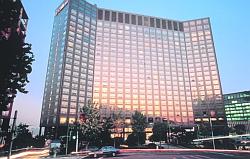  |
| Active in Korea:
Besides the 5-star Millennium Seoul Hilton Hotel, CDL developed and
sold 3 commercial projects. It's set to embark on a commercial project
in Incheon |
CDL announced earlier this month that it
had signed a memorandum of understanding with Korea's DC Chemical Company
Limited (DCC) to develop a large scale integrated commercial centre in
Incheon, Korea.
CDL also said that it was looking to
invest between US$150 million and US$300 million in equity in the
development together with 'affiliates'.
CDL declined to name its affiliates, but
a possible partner could be the Dubai investment company, Istithmar.
In June, CDL and Isthimar each took 40
per cent stakes in Tune Hospitality Investments to develop 30 budget hotels
across South-east Asia.
It was also reported earlier that
Istithmar is planning to buy Asian property assets worth at least US$250
million and expects its real estate portfolio in the region to double in
size by year end.
A spokesman for CDL said that the group
already has overseas investments either directly or through joint ventures,
foreign real estate funds and its hotel investment, and will continue to
explore property investments overseas.
It added that it has 'mobilised its
resources to focus on those markets that it knows best'.
CDL is already active in Korea. Besides
the five-star Millennium Seoul Hilton Hotel, it developed and sold three
commercial projects there. Other non-hospitality projects in Asia include
the Umeda Pacific Building in Osaka and The Exchange Tower in Bangkok.
The Incheon site that it is eyeing
measures 1.55 million sq m and is mostly owned by DCC and its affiliates.
DCC is a producer of carbon black, soda
ash and pitch.
The anchor facility on the 1.55 million
sq m site is an integrated commercial centre on a 281,850 sq m parcel of
land which will comprise a five-star hotel, a Grade-A office tower, a
serviced residence, a retail podium and other mixed-use facilities.
CDL said that another 380,000 sq m parcel
of land north of the integrated commercial centre has been slated for
residential development.
Development work is scheduled to begin in
2009.
Although the property developer is
looking overseas, CDL's spokesman said: 'Given the strong rising domestic
market, the group remains steadfast to its strategy of being the proxy to
the Singapore property market.' - SINGAPORE
BUSINESS TIMES 2007 August 27
Seoul woos investors with lower tax zones
South Korea has vowed to become more competitive than Singapore in an
attempt to stem the decline in foreign direct investment in the country.
Kim Jin-pyo, finance minister, said Singapore was the benchmark for three
special economic zones being set up in South Korea as part of the country's
ambitious drive to become a business, finance and logistics centre for
north-east Asia.
"There will be lower taxes [in the special economic zones] than in
Singapore," said Mr Kim.
Incheon, a port city west of Seoul, was designated South Korea's first
special economic zone in August. There are plans for two more in the
southern port cities of Bus an and Gwangyang.
Companies investing in the zones will receive a range of financial
incentives, including a 10-year exemption on corporate tax. Meanwhile,
personal taxation of executives working for foreign companies anywhere in
South Korea is to be reduced to a flat rate of 17 per cent, compared with
Singapore's planned 18 per cent and Hong Kong's current 16 per cent.
The measures are a reaction to the sharp drop in foreign direct
investment in South Korea from $15.2bn in 2000 to $9.1bn last year, as the
country's competitiveness has been undermined by rising labour costs.
South Korea wants to compensate for the loss of low-cost manufacturing to
China by encouraging multinationals and financial institutions to establish
regional headquarters in the country. Mr Kim wants to attract foreign
expertise in high-technology ventures, to help South Korea become a more
knowledge-based economy. He said South Korea's geographical position between
Japan and China made it an ideal base for investors seeking access to the
fastest-growing part of the global economy. xref Korea report, separate
section - By Andrew Ward
and Francesco Guerrera in Seoul Financial
Times 16 Nov 2003
More NEWS STORIES
Property is hot in Korea
Fearing a bubble, Seoul begins to clamp
down on speculation Lee Chang Hae, one of 1,000 people picked in
a lottery that drew 90,000 applications for the right to buy a new apartment
in Seoul, does not plan to purchase it. Instead, he expects to earn several
thousand dollars by selling the prize itself.
"I can easily make a tidy profit of
up to 10 million won," about $8,300, said the 57-year-old retired
banker. "I don't want to put my money in the bank, or buy stocks or
bonds. I've completely turned to investing in real estate."
Speculators like Lee embody a boom that
has driven up South Korean property prices by 20 percent in 18 months.
President Roh Moo Hyun calls it "the biggest enemy to the lives of
ordinary people." Similar bubbles in Japan and Hong Kong caused real
estate prices to fall as much as 71 percent as growth slowed. To cool the
market, the government late last year banned trading on the right to buy and
sell apartments, raised taxes on owners of multiple properties and tightened
zoning restrictions.
"This property boom is unnatural and
mirrors that of Japan," said Choi Hee Kap, a fellow at Samsung Economic
Research Institute in Seoul. "South Korea's economy may not be able to
withstand a Japan-like bubble."
Home ownership has surged as South Korea
has become a modern economy. South Koreans owned a record 11.9 million homes
by 2001, up from 7.9 million a decade earlier, according to the National
Statistical Office. Per capita gross national income stood at $10,013 as of
2002, up about 40 percent since 1992 and on a par with Portugal.
In Japan, land prices fell by half in the
past 12 years, helping fuel three recessions in that period. In Hong Kong,
where prices have dropped by almost two-thirds since 1997, a third of
homeowners have properties worth less than what they paid, compared with
almost none five years ago, when prices rose to a record ahead of the city's
handover to China.
South Korea's most recent property boom
started in 2001 when the government relaxed tax laws and restrictions on
bank lending. The result: Household loans surged 30 percent last year, and
the national savings rate fell behind Japan and Taiwan for the first time,
suggesting South Koreans are switching funds into the property market.
Another consequence was a surge of
interest in options - the right to buy and sell a property. Construction
companies used the increased demand to sell options, giving them cash to
build more housing. Last year, when such trading was at its peak, options to
sell apartments in Seoul traded as much as a third above their initial
price, fueling property prices even before the contractors finished new
buildings.
A new round of measures to keep prices
from rising, announced on May 23, aims to ban trading on options to buy
apartments built on top of shopping arcades.
Instead of damping speculation, the move
had the opposite effect: Speculators are now applying for what may be the
last chance to reap a profit before government measures kick in in July.
At mockups for Star City, where Lee won
the right to buy a new apartment, people line up to see the residences long
before our doors open at 10 a.m. About 10,000 people visit our displays each
day.
Built by the construction unit of Posco,
the South Korean steelmaker, the new commercial and residential development
comprises four apartment buildings, with a total of 1,310 units, and one
shopping mall in the northern Seoul neighborhood of Jayang-dong.
The government is having some success.
Two-year rental prices have been falling in the past month, according to
estimates from the Construction Ministry that do not include specific
figures.
Option sales are not drawing the demand
they once did, according to a report this month by Kookmin Bank.
Land prices have fallen in 15
neighborhoods in and around Seoul that the government designated in May as
"speculation areas" and imposed taxes on people who sold options
to sell homes in those areas.
Should the government succeed in forcing
down land prices, it risks worsening an economic slowdown. Already, growth
may falter to as low as 2 percent this year from 6.3 percent in 2002,
according to ABN Amro. Last year's pace made Korea Asia's second- fastest
growing economy after China.
Overdue debt is another concern. The
number of people behind on their payments rose for a fifth month in April to
more than 3 million. The delinquency ratio at the country's biggest credit-
card company, LG Card Co., rose to 12 percent in April from 10 percent in
March, the company said. Policymakers, meantime, vow to stabilize property
prices. "Korea is not going through an economic bubble similar to that
of Japan," Bank of Korea Governor Park Seung told reporters after a
seminar in Seoul late last month. "We have acted before property prices
have gotten out of hand and they will stabilize soon."
But homeowners are not convinced.
"The price of the 116-square-meter
(1,100-square-foot) apartment we bought during the IMF crisis has quadrupled
to more than 600 million won," said Bang Hae Joo, a housewife in
southern Seoul, referring to the multi-billion dollar bailout the government
received from the International Monetary Fund in 1997.
"What better investment is
there?"
- Heejin
Koo Bloomberg
News 24 June 2003
South
Korea has seen rapid growth in the market for renovated--or
remodelled--apartments in the past few years. While there has been zero
growth in the construction of new residential buildings since 1997, the
remodelling market has achieved an annual growth rate of between 5% and 7%
over the same period. This year it is worth around 6.3 trillion won ($4.8
billion), according to Yoon Young Sun, senior research fellow at
Construction and Economy Research Institute of Korea, or Cerik. "In the
past, an abundant supply of housing was top priority in our housing
policy," he says. "But now, the market needs to be improved in
quality, not in quantity."
Yoon says he expects to
see a boom in remodelling in the second half of this year, following a
government decision to grant tax incentives to remodelling companies.
Details have yet to be announced, but the Ministry of Transportation and
Construction is expected to subsidize remodelling projects for any apartment
complex built more than 20 years ago.
The government also
expects to save around 7.5 trillion won by remodelling 190,000 older
buildings which were originally scheduled for demolition and replacement.
Housing remodelling comes
in different guises, ranging from maintenance and repairs to extensive
renovations. While thousands of small remodelling companies specialize in
simple interior design, traditional construction companies are beginning to
bid for contracts which involve the complete refurbishment of an apartment
complex. "Smaller remodellers are providing services tailored to
individuals. Our selling point is the technical know-how about
planning," says Shin Hang Bum, senior manager of Hyundai Remodelling, a
spin-off from Hyundai Construction and Engineering.
There is plenty of work
out there. Apartment complexes and tenements make up nearly three-quarters
of the country's residential property market, so the large-scale remodelling
industry is enormous. Nevertheless, competition is fierce between key
players like Samsung, LG, Daelim and Ssangyong. Samsung, for example,
quadrupled the number of employees in its remodelling unit in April in an
attempt to triple its earnings from last year.
Many industry insiders
regard remodelling as a profitable property investment opportunity because
it costs less than construction. But others recommend it only as a way of
improving living conditions in apartments.
While owner-occupiers and
landlords who let their property to tenants will benefit from remodelling
because of the improved physical quality of their apartments, some analysts
say that remodelling does not substantially affect the price of a property.
"It'll benefit investors in a way to improve the standard of dwelling
condition rather than to make profits," says Lee Sang Young, president
of the Seoul-based real estate information agency r114.com.
Yoon of Cerik expects the
remodelling market to transform the housing industry in South Korea. He
forecasts that the remodelling market will expand to take up between 12% and
15% of the residential market by 2005, and 30% by 2020.
SOUTH
KOREA'S REAL-ESTATE MARKET has
taken a roller-coaster ride with the country's economy over the past three
years. It was buoyed in 1999 as information-technology venture companies
helped spur a stunning recovery from the Asian Crisis. Buildings began to
fill up in the commercial district of Kangnam in southern Seoul, crammed
with startups flush with venture capital and hoping to make their millions.
Office vacancies dried up from the 30% peak they hit just after the
financial crisis.
"People were buying
buildings in anticipation of filling them with venture companies," says
Pietro Doran, senior real-estate adviser at Kearney Global in Seoul.
"They were leasing more space than they needed in anticipation of huge
growth."
Those high hopes were
soon dashed. First the venture bubble popped, sending many startups to the
wall. Then came the signs of a sharp downturn in the United States' economy,
which is expected to spill over into a domestic slump this year. By early
January, vacancies started to appear in all sectors of the office leasing
market. Now, industry observers predict vacancies of up to 12% in Seoul's
three main business districts--downtown, Youido and Kangnam on the southern
side of the Han River.
Most of this will occur
in medium-quality office space, but there'll likely be vacancies at top-line
commercial buildings as well, as margins shrink and the high rents become
more burdensome. New buildings coming on line in downtown will help push up
vacancy rates, which should trigger lower rents. That could mean more
problems for owners of older properties as their more successful tenants get
tempted by better buildings offering more attractive terms.
Things aren't much better
on the residential side. From the 1960s to the late 1980s, property
ownership, particularly in Seoul, was a ticket to sure wealth as the market
boomed spectacularly. With the economy entering another trough, however,
home owners are choosing to delay their purchases. As a result, the market
is staring at an oversupply of apartments, particularly at the high end of
the scale. "The economy is not going very well, so we can't expect the
residential market to rise," says Jack Kim, CEO of Prime Appraisal Co.
in Seoul.
Kim explains a verity of
Korean real estate--namely, that there are only two markets: Seoul and the
rest of the country. "Outside Seoul, the real-estate market has
crashed," he says. "There isn't a big enough economic base to
support it." Figures released this month by the Ministry of
Construction and Transportation show that land prices fell 0.46% in the
fourth quarter last year from the previous quarter, with outlying cities
like Pusan the worst hit.
While the real-estate
market slump is bad news for landlords and property managers, it's good news
for buyers. This includes foreigners, who since June 1998 have been allowed
to buy Korean real estate and to take their earnings from that investment
out of the country. In the first three quarters of 2000, the government says
foreigners bought 2,432 properties.
The influx of foreign
buyers is helping spur another great change in the commercial property
scene: The transition from chaebols, or conglomerates, building properties
for their own use to properties being purchased with portfolio investment in
mind. Before the economy began liberalizing in the early 1990s, value was
considered inherent in the land, not the buildings on it, explains Kearney's
Doran. "If a building was constructed, it was considered only a
temporary improvement to the land," he says. "There was no concept
of income coming from it because companies built it for their own use."
The influx of foreigners
has forced the local industry to bring its valuations closer to
international levels by considering income flow. Actually, the process began
in the mid-1990s but was accelerated from 1998 by the influx of foreign
companies willing to buy local property. "The big philosophical change
is that buildings are now seen as a permanent part of the urban
landscape," says Doran. "Korea is letting go of the land."
The internationalization
of Korean real estate will gain speed with the introduction of real estate
investment trust companies set for July. REITs buy properties using capital
collected from investors. The buildings are remodelled before being leased
or sold, and the profits returned as dividends. It should greatly benefit
ordinary investors, as they'll find themselves owning a small part of the
city's prime office real estate.
Doran says REITs
represent the future of Korea's property industry. "The industry is
starting to fracture as the chaebols lose their hold on it," he says.
"Property ownership is being democratized. The Korean people will end
up owning more of it."

|


