|

  Property Conundrum
With credit markets tight, many European
companies are eager to turn property into badly needed cash. Efficient as
the move looks in principle, selling and leasing back commercial property is
now proving hard to pull off. It also comes with long-term costs.
The reason is that Europe's real-estate
market has also hit the buffers, with prices falling and buyers thin on the
ground. As for rental values, they typically lag the economic cycle so
companies could find themselves locked in to long leases at high rents in
return for a short-term cash injection.
At best, companies that successfully
shore up their balance sheets by selling property will sacrifice longer-term
returns. At worst, holding a big property portfolio won't prevent default if
credit conditions don't improve.
It also spells leaner times for
property-advisory firms who've done nicely as sale and leasebacks have
gained in popularity through Europe's property boom and the early days of
the credit crunch. The value of sale and lease-back deals rose to 46 billion
euros in 2007, nearly a seven-fold increase from 2004, according to research
from property firm CB Richard Ellis.
At the top of the market was HSBC's sale
of its 20-storey London headquarters to Spanish property company Metrovacesa
for 1.1 billion pounds in May last year. The bank leased it back for 20
years at a 3.9% yield.
Today, Metrovacesa is struggling to pay
back the short-term loan used to finance the acquisition, as property values
have plummeted and yields have risen to around 6%. Selling the HSBC building
would be possible only at a big loss given the oversupply of property in the
U.K. capital. HSBC's building is a stone's throw away from Lehman Brothers'
empty London headquarters in Canary Wharf.
There are signs that companies keen to
pull off HSBC-like deals are struggling to do so. Regent Inns, under renewed
pressure to reduce debt of 79 million pounds after takeover talks failed
midyear, has got nowhere so far with a plan for the sale and leaseback of
some its 90 U.K. pubs. - 2008
September 22
WALL
ST Journal
J.P.
Morgan opts
for Canary Wharf
Bank rethinks plan to build
major facility in the City
as circumstances change
London's historic financial
center appears to be losing a marquee bank -- to real-estate rival Canary
Wharf. After efforts to build a new headquarters in the City, as the
square-mile area is known, ran into problems, J.P. Morgan Chase said Friday
it would instead move to Canary Wharf, the rival financial district
developed over the past two decades.
There has been a strong
rivalry between the two areas ever since the development in London's old
docklands started winning way large banks, such as Citigroup, HSBC Holdings,
Barclays and Lehman Brothers Holdings.
When J.P. Morgan began
looking to consolidate employees scattered across several buildings into a
new headquarters, local government officials offered a long lease on the
land and agreed to give J.P. Morgan ownership of the building if the bank
helped to redevelop the site.
But circumstances have
changed. J.P. Morgan needs more space following the acquisition of Bear
Stearns this year. Also, owning real estate is no longer so attractive.
London real-estate values have tumbled, and a construction boom promises
that more space will hit the market.
J.P. Morgan also ran into
problems with its plans for St. Alphage, a post-World War II building.
Strict planning constraints limit buildings blocking views of St. Paul's
Cathedral. Residents of the neighbouring Barbican development, a residential
area and public art space, objected to the bank's plans to James Dimon, J.P.
Morgan's chief executive.
J.P. Morgan has a deal with
Songbird Estates -- the Morgan Stanley-led consortium that owns the Canary
Wharf Group -- to move to a single office tower with more than one million
square feet (93,000 square meters) at Canary Riverside South in early 2013.
"Without a doubt, we
are disappointed, as they are a big tenant," said Peter Bennett, city
surveyor of the City of London Corp., as the local government is called. The
City owns some of the land in the district.
The City still has some
major banking tenants: Merrill Lynch, Goldman Sachs Group, Deutsche Bank,
and UBS. And J.P. Morgan's packing plans may not be a done deal. The City
could still persuade the bank to change its mind.
- 2008 August 4 WALL
ST. JOURNAL
Canary Wharf has
received a timely boost with the first major letting at the Docklands office
complex in two years. BP's Integrated Supply and Trading division has agreed
terms to lease 128,000 sf in 20 Canada Square. This firm evidence of
occupier demand could strengthen the Canary Wharf Group’s hand in
negotiations with Brascan, Morgan Stanley and Goldman Sachs, which are
attempting to take the company private.
The lease agreement is for 101,000 sf on
a 20-year term with breaks at 10 years and 15 years. In addition, to allow
for future growth, BP has agreed terms to lease a further 27,000 sf on a
five-year lease, with an option to extend this so it runs concurrently with
the other lease.
20 Canada Square is the only speculative
building currently available at Canary Wharf, although a large amount of
space is available for sub-letting from existing occupiers. The 535,500-sf
12-floor glass and steel building was designed by Skidmore Owings &
Merrill. It offers large floor plates of typically 40,000-45,000 sq ft.
Global information services provider the McGraw-Hill Companies will also be
occupying 266,000 sf at 20 Canada Square and will be moving in during
January 2004. - 12 Sept 2003
Globe
St.
Morgan Stanley bets big on Canary
Wharf
It's a high-risk wager that another banking boom will spur office demand
Morgan Stanley may wager as much as
US$9.2 billion on another banking boom by buying Canary Wharf Group Plc,
builder of a financial district in London's Docklands where rents are
falling and vacancies are rising.
Morgan Stanley, the world's
second-biggest securities firm by capital, on June 9 said its real estate
funds may bid for Canary Wharf, which has about 4 billion (S$11.6 billion)
of debt and a stock market value of 1.5 billion.
An acquirer may have to wait more than
five years for banks to start hiring again, boosting demand for offices at
Canary Wharf, said Jeppe de Boer, an analyst at Goldman Sachs Group Inc in
London. A new owner 'could eventually make quite good returns by building on
the estate, but it would be at high risk,' he said. Investment banks in
Britain have cut about 35,000 jobs, creating surplus space at Canary Wharf.
Morgan Stanley manages US$27 billion of
real estate in collaboration with partners including Catellus Development
Corp in the US and Italy's Pirelli & C Real Estate SpA. Morgan Stanley,
a Canary Wharf tenant and former adviser to the company, may join with
chairman Paul Reichmann and chief executive George Iacobescu, and other
possible bidders such as Canada's Brascan Corp in a buyout, industry
executives said.
Last year Morgan Stanley combined with
management of Saville Gordon Estates, the owner of an aerodrome in central
England, to take that company private for US$785 million in cash and debt.
Morgan Stanley may do the same with Canary Wharf, said Peter Munk, chairman
of Trizec Properties Inc, who works near Mr Reichmann in Toronto's office
district.
Morgan Stanley spokesman Andrew Walton
declined to comment, as did Canary Wharf spokeswoman Wendy Timmons and
Brascan spokeswoman Katherine Vyse.
Canary Wharf on June 6 said it formed a
committee to review offers from 'a number of parties' interested in
acquiring the company, which Mr Reichmann led into and out of administration
in the 1990s. Canary Wharf's stock has dropped 44 per cent from its peak of
478.6 pence in October 2000 as banks cut staff and vacancies in the
financial district more than quadrupled.
'Reichmann believes the shares do not
represent Canary Wharf's proper asset value,' Mr Munk said. 'Reichmann is
72, and he doesn't need to be hassled by young institutional investors' who
are dissatisfied with the stock's performance, said Mr Munk, who created the
second-largest US office real estate investment trust from a company bought
from the Reichmann and Bronfman families.Other contendersBrascan, which
bought New York's World Financial Center in 1996 after Mr Reichmann lost the
property to creditors, acquired 9 per cent of Canary Wharf shares in April
and May.
Morgan Stanley's European real-estate
funds are led by Stephane Theuriau. Such US-based funds have cash and are
seeking large investments, said Tony Horrell, head of Jones Lang LaSalle's
European capital markets unit.
Rents have tumbled at the 34.8 ha office
park built on derelict London docks on the River Thames as banks try to
sublet unwanted offices that they leased during the late 1990s.
Morgan Stanley, which owns and leases
about 1.5 million square feet at Canary Wharf, sublet its Westferry Circus
offices there to Tube Lines, a consortium that maintains London underground
lines, at 35 a square foot, or an 'effective' rent after concessions of
27.50, wrote Citigroup Inc analyst Michael Prew in a research report. Peak
rents in the Docklands were about 45 per sq ft.
The 'near term would not suggest the
outlook for the industry is significantly better,' Morgan Stanley chief
financial officer Stephen Crawford said on a June 18 conference call with
reporters after announcing that the company's second-quarter earnings fell
25 per cent.
Vacancies at Canary Wharf in the next two
years may reach 16.5 per cent if tenants break leases, Morgan Stanley
analyst Martin Allen said in an April 2 report.
Vacancies may reach as high as 35 per
cent in two or three years, Mr Allen said in the report. That would be
enough to accommodate 20,000 employees. The calculations include offices
that existing tenants may try to sublet, such as the 535,000 sq ft that
Morgan Stanley may not need, he wrote.
Canary Wharf collects full rents from
long-term tenants who sublet space. Still, the surplus space might delay an
acquirer's profit on a buyout, analysts said. That's because new tenants
won't pay 45 psf at Canary Wharf with older tenants subletting surplus space
at 35, they said. Until the space is released, tenants will be competing
with their landlord for occupants, said JLL's Mr Horrell.
By the end of next year, Canary Wharf
will have completed 14 million sq ft of offices, including a new building
for Barclays, making it second in size to the 32 million sq-ft La Defense
office district in Paris. After the Sept 11 attacks, CEO Mr Iacobescu said
he would slow construction of an additional 6.5 million sq ft envisaged for
the property.
Those delayed projects would be Morgan
Stanley's opportunity and risk, Goldman's Mr de Boer said. 'Much of the
success depends on the London office market in five to 10 years time.' -
26 June 2003 Bloomberg
The south bank of the Thames has for years been an
underused asset. Recently that has been changing with an air of
prosperity and fine new buildings suddenly available with wonderful
views north over London.
The mammoth Docklands project, 7 km east of the
City of London has seen some of the steepest price rises - an average of £250
per sq ft a year ago now doubled, with a rumoued £750
reached in some locations.
Singapore's Pidemco Land (50%) and Hotel
Properrties (30%) each hold substantial stakes in the 4.6 hectare Canary
Riverside residential apartments on the western riverfront of Canary Wharf.
The Canary Wharf Group, which has developed and manages the area, the
remaining 20%. The buildings comprise 322 riverside luxury apartments, a
sizeable health club, swimming club and a 150-room five-star hotel which
opened in December and is leased to Four Seasons.
Already 70% of the apartments ranging from £362,000
to penthouses of £2.6
million have been sold. Much of the apartment units have been
sold to investors from Asia, Middle East and the US as well as European
buyers.
The area is developing with critical mass with
growing number of executives crowding into sleek, concrete, glass and metal
jumbo-sized buildings of Credit Suisse First Boston, Morgan Stanley,
Barclays Capital, and other investment banks. Nearby
building occupied by Reader's Digest, Daily Telegraph, Ogilvy & Mather,
Texaco, UK Financial Services Authority. Morgan Stanley now occupies
the Canada Square penthouse.
Canary Wharf is flourishing because rents are also much lower than the rest
of London and the improvements are technologically advanced in comparison
and now the infrastructure is complete with completion of the Jubilee
underground line and enhanced train routes. Currently
27,000 work in Canary Wharf and expected to grow more than 50,000 within two
years and will exceed 100,000 in the second half of the decade.
27,000 persons work in the area with all 13
completed office blocks fully let. Readers' Digest, Daily Telegraph,
Ogilvy & Mather, Texaco Ltd. are some of the other tenants who make the
area vibrant. Two office towers for the HSBC Group and
Salmon Smith Barney Citibank are on their way to completion. Office
rents in the dockands range from 30 to 35 pounds, blow the 50 pound per sq
ft in the City and £68
per sq ft for similar top quality buildings in the West End.
Canary Wharf will see another
six million sf of office development in the next few years if the London
Borough of Tower Hamlets approves plans for six new office towers on land to
the north and west of the existing site.
Canary Wharf Chief Executive George Iacobescu
confirmed that planning applications were imminent on the North Quay and
Riverside sites. The projects will extend the life of Canary Wharf Group as
a developer, because the existing masterplan for 14 million sf of
development is almost complete. Roughly seven million sf of offices are
completed and occupied at Canary Wharf, with another 5.5 million sf under
construction, of which only 500,000 sf is speculative development.
On the Riverside site, to the south-west of the
main site, the Richard Rogers Partnership has designed a family of three
buildings totalling 1.8 million sf. net sq ft. And On the North Quay site
another group of three buildings has been designed by Cesar Pelli, who was
responsible for the One Canada Square and HSBC towers at Canary Wharf. This
will provide up to 2.4 million sf of office and retail space, integrated
with a proposed station for London’s new Crossrail fast underground line.
At the same time an agreement has been reached
with British Waterways Board to lift restrictive covenants and allow Canary
Wharf to build another 15.7 million sf within the original Canary Wharf
estate. Iacobescu also said another potential development site had been
identified between Riverside and Heron Quays which is attracting significant
interest.
The news came as canary Wharf unveiled its
preliminary results for the year ended 30 June 2002. Pre-tax profit rose to
£300 million ($470 million) from £95 million ($150 million)a year
previously on turnover up from £159 million ($250 million) to £206 million
($320 million) thanks to a £169 million ($265 million) exceptional profit
on the sale of the one million-sf HSBC Tower to the occupier.
- 12 Sept 2002 Globe
St.
Canary Wharf, the mammoth Docklands
office complex 7km east of the City of London, has proven to be an
outstanding project for Singapore's Pidemco Land and Hotel Properties. The
companies hold a substantial stake in the 4.6-hectare Canary Riverside
residential apartments on the western riverfront of Canary Wharf. The
buildings comprise 322 riverside luxury apartments, a sizeable health club,
swimming club and a 150-room five-star hotel which opened in December and is
being leased to Four Seasons.
"We have already sold 70 per cent of
the apartments ranging from £362,000 (S$944,313) to penthouses of £2.6
million," a Canary Riverside spokeswoman said. Two of the penthouses
priced between £1.4 million and £2.6 million have found buyers. The going
average is £538,000, putting the total apartment value of the project at £173
million. Buyers include Europeans and Asians as well as investors from the
Middle East and the US.
Pidemco holds a 50 per cent stake in the
project, Hotel Properties 30 per cent and Canary Wharf Group, which has
developed and manages the area, the remaining 20 per cent.
Indeed, it is thanks to the remarkable
turnaround in Canary Wharf's fortunes that executives of the two Singapore
companies are smiling. They are looking forward to the next phase of the
residential development due to take place within the next few years on a
parking lot a few hundred metres away.
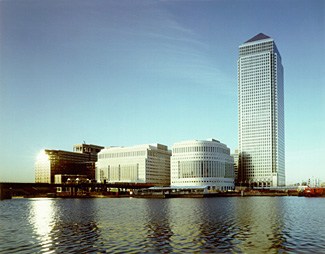
Only eight years ago, Canary Wharf was a
bankrupt development of Canadian real estate tycoon Paul Reichman. Then, the
penthouse of the 50-floor tower block, One Canada Square, was empty,
recalled Jonathan Saxon, a Canary Wharf specialist and associate director of
estate agents Knight Frank. "Shops were either dead quiet or
vacant."
Now, growing numbers of executives and staff are
crowding into sleek concrete, glass and metal jumbo-sized buildings of
Credit Suisse First Boston -- which sports a massive trading floor about the
size of two football pitches -- Morgan Stanley, Barclays Capital and other
investment banks. Nearby buildings are occupied by Readers' Digest, Daily
Telegraph and Ogilvy & Mather, Texaco Ltd, the UK Financial Services
Authority and others. Morgan Stanley now occupies the Canada Square
penthouse.
More than two dozen new shops opened recently, and
all 13 completed office blocks are fully let, said Mr Saxon. Another 1.2
million sq ft building is three-quarters full and nearby, a 500,000 sq ft
building should easily find tenants if the London commercial property sector
remains buoyant, he predicted.
East of Canada Square, overlooking the Millennium
Dome across the water, Canary Wharf is well on its way to completing two
office towers for the HSBC Group and Salomon Smith Barney Citibank. "We
are building them at the rate of a floor every four days," said George
Iacobescu, chief executive officer of Canary Wharf Group plc, the
revitalised management company of the complex that was listed on the London
Stock Exchange last year. "This place is now vibrant because bank
mergers led to demand for the high-tech large-scale buildings which we
supply," he said. "In the meantime, infrastructure and transport
facilities were at last being completed."
The next phase of development will include an
underground shopping mall below parks, he said. "Canary Wharf's
purpose-built large buildings and facilities will continue to suit the giant
financial institutions and as the population grows there and facilities
improve, other businesses will rent space," said Michael Ross, managing
director of Stockton Estates, a London property investment firm.
"But there isn't any room for complacency for
both Canary Wharf and the City," he cautioned. Both areas are highly
dependent on the financial services boom and the test is how they will cope
in a protracted stock market downturn.'
Mr Iacobescu estimated that the 27,000 people who
work in Canary Wharf will grow to more than 50,000 within two years and will
exceed 100,000 in the second half of the decade.
"Previously, business people shunned the area
because they believed it was out of the way," said Michael Hussey, who
is in charge of leasing at Canary Wharf. "Now the Jubilee underground
line and enhanced train routes raise the catchment area for employees to 1.2
million in Greater London from 320,000 and further out in the south-east
commuter belt, three million people find the place easily accessible. Canary
Wharf commuting time seriously competes with the City of London."
Canary Wharf is also doing well because rents are
also much lower than the rest of London. Five years ago rents there were £20
per sq ft. But as demand grew, they jumped and are currently in the £30-£35
range, still competitive with £50 psf in the City and £68 psf for similar
top quality buildings in the West End, added Mathew Oakley, head of
commercial property research at FPD Savills, international agents and
property consultants.
Canary Wharf rates and service charges for the
larger buildings are also lower, he said. But he cautioned that planned
developments around Tower and London bridges, Paddington and King's Cross
will be serious competitors. - Singapore
Business Times 15 June 2000

Canary Wharf, part of the London Docklands region
redeveloped under former prime minister Margaret Thatcher in the 1980s, is
set to embark on a new wave of high-profile construction projects.
The group that manages the site set out plans last
week for a further 3.1 million square feet of development at Canary Wharf
South. When completed, the total development will comprise 13.5 million sq
ft of office and retail space.
Canary Wharf unveiled its lofty ambitions to
Chancellor of the Exchequer Gordon Brown, with Canary Wharf executive
chairman Canadian developer Paul Reichmann and a group of United States
businessmen.
It said Mr Brown had highlighted the area, which
houses a mix of bankers and journalists and is a rival location to the City
of London for financial businesses, as an example of "what business can
do to help achieve regeneration".
"We are pleased to be one of the catalysts
for regeneration in this area," Mr Reichmann added.
The area itself, which hosts Britain's tallest
building - Canada Tower - has a prosperous feel, with its glitzy office
blocks, upmarket wine bars and well-heeled young professionals.
But the surrounding region of Tower Hamlets, in
London's East End, tells a different story.
Tower Hamlets, an area with a high immigrant
population, has an unemployment rate believed to be more than 20 per cent.
Kumar Murshid, Tower Hamlets lead councillor for
regeneration, voiced concern at the effects the office developments in
Canary Wharf could have on the local community.
Tower Hamlets has 16,000 people on its housing
waiting list.
He said there was a danger that as increasing
numbers of affluent professionals such as bankers and lawyers moved into the
area, local property prices would rise and the neighbouring community might
become dispersed.
"We are in favour of Canary Wharf being
turned into an international financial centre but it cannot be at the cost
of the local community," Mr Murshid said.
Mr Murshid also said that although the development
of Canary Wharf would create employment opportunities, many jobs, especially
high-skilled ones, were bypassing local workers.
Canary Wharf said that last year 8.4 per cent of
people working in the area were from Tower Hamlets, a rise of more than 4
per cent from the previous year.
"Current employment at Canary Wharf reflects
approximately 28,000. This is due to increase to 50,000 by [the end of] 2002
and up to 90,000 when the project is complete," Canary Wharf added.
Canary Wharf will welcome Britain's Clifford
Chance, one of the world's largest legal practices, when the firm relocates
to a 30-storey Docklands building from the City of London in 2003.
Clifford Chance will be following in the footsteps
of other leading City institutions, such as investment banks HSBC and
Citigroup which are due to move in by the end of 2002.
The Canary Wharf development is expected to be
completed in the next five years.
A Clifford Chance spokesman said 50 per cent of
its Canary Wharf workforce would be support staff, so "there will
inevitably be opportunities for the local community in the support
area".
He added that, with regard to locals getting more
senior posts within the firm, Clifford Chance would be "eager to
hear" from any suitably qualified lawyers in the Tower Hamlets area.
However, Mr Murshid feels Canary Wharf's new
white-collar residents could do more to provide jobs within Tower Hamlets.
"If the employers coming into the region are
serious about local employment, then they'll have to do a lot better than
they have done so far," he said.
- 12 July 2000 Reuters

|


