East meets West isn't exactly a new romance.
They've been involved for quite some time now.
For example, in the area of architecture and
interior design, Frank Lloyd Wright's Arts and Crafts style shows his love
of Japanese sensibilities many decades ago. And could Art Deco have been
conceived without its flirtation with the East?
"There has been a fascination with the Orient
and the two civilizations of Europe and Asia have been trying to reach each
other for hundreds of years," says Bing Thom, an eminent Vancouver
architect. "When they stumbled across North America hundreds of years
ago, they found the Haida had been trading with Asia for hundreds of
years."
Where the twain differ, he says, is that the West
is linear and logical, whereas the East is more holistic and pluralistic.
"The West has been human-being-centred. In the East, the individual is
part of nature and it shows in the architecture. It's non-linear -- they
don't think either/or. In Buddhism, for example, opposites are accepted as
reality."
The most notable influence of Eastern esthetics on
contemporary homes is the dissolution of the exterior-interior divide or the
nature versus humans boundary. "It's because of the influence from
Asia. Technology allows it, but it initially started as an Asian
influence," says Thom.
In his own work, which has earned him an Order of
Canada, he designs around "flow." "I start with space. The
form comes later," he says. "It's a much more subtle and informal
sense of the hierarchies of space. I'm much more conscious of the in-between
spaces like the hallways, which are experiential spaces."
His brilliant commercial development, the Aberdeen
Centre in Richmond, was formed like a piece of flowing music, he says.
"It's like walking through a garden, experiencing the garden rather
than sitting at a fixed point, looking at it," he says. "Flow
encourages people to move and there's always a certain amount of fluidity
and calmness. There are enough problems in our lives without architecture
adding to them. It's a subtle inspiration towards the enjoyment of life;
it's a naturalness, a calmness, a harmony, I guess you can say, without
being boring. Part of the art is to stimulate and create excitement without
having to shout and scream." He calls this dramatic calm
"breathing in and breathing out," starting from the inside out.
In his own home, which he calls his sanctuary,
he's taken minimalism and peacefulness to a higher order than most. "I
have hardly any furniture and no art. For me, it's just distracting. I'm at
an age where I don't want to accumulate any more than I have to. I find it
much calmer when I come home."
His Kitsilano home, he says, is a series of
pavilions, each looking out to a different part of the city. "It
creates a different context, a different way of looking at things. The
angles force you to look differently." -by Mia Stainsby
VANCOUVER
SUN 6 May 2005
He is tired of tall buildings in the downtown core
that are all the same height. He wants the city's skyline to be dome-shaped,
not flat. He wants to build Vancouver's tallest structure -- a sparkling
glass spike in the heart of the city.
"We need to anchor the downtown," Thom
said from his Burrard Street office Thursday.
"We're not competing with Toronto anymore.
We're in a global market now. We have to show everyone that we are not
afraid of the future."
And the future, according to Thom, lies in taller
state-of-the art buildings.
His views came before city council Thursday night,
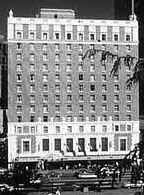
when he proposed building a 183-metre (600-foot) skyscraper behind the Georgia
Hotel -- part residential, and also part of the Georgia Hotel. Council
deferred a decision on the building until Aug. 14.
This is the second time in less than two months
that Thom has gone to city council with his new taller vision for Vancouver.
In June, city council approved Thom's proposal to
build a 154-metre (506-foot) building that would replace a parkade that now
sits behind the Hotel Georgia.
Then -- because of what he claims was
encouragement from his peers and his client, Hotel Georgia owner Peter Eng
-- he decided to stretch the original building, like an accordion, to 183
metres.
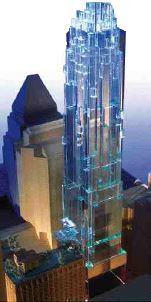
"It will be like a crystal that disappears
into the sky," Thom said.
The number of floors on the glass building would rise to 56 from 50 and the
top of the building would taper, although the floor space would stay the
same.
The ceilings of the residential suites would be
raised, and a window-surrounded "sky lobby" would allow the public
to access a garden that Thom proposes for the roof of the Hotel Georgia. The
top half would be residential, and the bottom would be part of the hotel.
But according to Michael Gordon, Vancouver's
senior central area planner, the 506-foot building that city council
approved in the first place is tall enough.
He said he doesn't see how the additional height
is essential to improve the skyline.
"It's an attractive building, but it's an
attractive building at 506 feet as well. And the mountains are attractive
too. We can have both."
The problem with the building, Gordon says -- and
the major reason city planners oppose it -- is that it will block the view
of the mountains from the downtown core.
In 1990, Vancouver city council approved
guidelines meant to protect the public's view of the North Shore mountains
from a variety of locations around town.
The guidelines also established view corridors --
so-called "view cones" -- in the downtown with height limits to
protect public views of the North Shore mountain backdrop.
Thom's proposal complies with all of those 'view
cones' except one -- the view cone from Cambie and 12th Avenue.
According to Thom, only part of the mountains
would be blocked for about 22 seconds for someone driving down Cambie, past
12th Avenue toward the city centre.
It's a hangup he sees bordering on the ridiculous.
"I think it's a nonsense issue," he
said, referring to the cone infringement. "I think someone's gone
bonkers."
But Gordon says there have to be limits drawn
somewhere, in order to prevent every builder from following suit.
"Our worry is that if we start to say okay
[to Thom's proposal], then somebody else could say 'Well, it's only one,'
too," said Gordon.
Currently the height limit for most downtown
buildings is 137 metres (450 feet), and most of the city's tallest
buildings, including the Board of Trade building and the Hotel Vancouver are
within that height. The One Wall Building is the exception. Standing at 152
metres (500 feet), it is the tallest building in Vancouver.
But a recent decision by city council identified
five locations in the downtown area that can break the 137-metre barrier,
and Thom is the first architect to take advantage of that provision.
"I'm the first kid off the block but I also
have the most important site because it's the only one in the core,"
Thom said.
And although Thom admits it would be nice to have
his name on Vancouver's tallest building, he says the bragging rights have
nothing to do with his plans.
"This isn't an ego trip." he said.
"It isn't. It's about the city."
The biggest problem Thom sees with the city is its
flat skyline, which he says is the result of the 137-metre height limit that
has existed far too long.
He also wants to preserve the downtown core by
making it bigger, better and more spectacular -- to keep up with other
world-class cities.
"Mother Nature gave us a great setting, but
only we can make it a great city," Thom said.
Whatever the opinion of city council, Thom is
confident that if it's left up to the public to decide the height of his
building, people would go with his new proposal.
"I have faith in common sense," he said.
"And this just makes common sense." -
Hayley Mick Vancouver
Sun 3 August 2002
Developers of a planned spectacular glass
skyscraper for the heart of downtown Vancouver want to take the tower 183
metres in the air, making it the highest structure in the city.
Bing Thom, architect for the building directly
north of the historic Hotel Georgia, went before the city's planning and
environment committee yesterday to pitch for the extra height.
"This is the one site in the downtown that is
perfect for a 600-foot building," he said.
Developer Allied Holdings of Vancouver already has
approval for a 155-metre tower featuring a five star hotel, 30 serviced
apartments and 150 luxury condominiums.
Thom said "we are not seeking any extra
density. The added height will give us greater ceiling heights in the
residential units. More importantly, it will allow us to create a public
park on the roof of the Hotel Georgia affording views across the heart of
the city," he said.
It will be the equivalent of adding 10 more
storeys, said Thom. "It will be the same building but just
stretched."
If the committee approves then a public hearing
would be the next step, which Thom welcomes.
The city previously gave Allied unanimous approval
to break through the existing 137-metre height restriction. That would have
just eclipsed the imaginative 150-metre "flat iron-style" Shaw
Tower now under construction in Coal Harbour.
The Allied development co-ordinator, has
said the building will give the city's heart the highly visual architectural
icon it has long sought.
The as-yet unnamed tower, to be marketed by Rennie
Marketing Systems, would be a major triumph for Thom.
He has long had the vision of developing, and has
doggedly pursued, a signature building in the heart of the city for more
than 20 years.
- Ashley Ford The
Province
3 August 2002
Bing Thom says the 560-foot-tall
"crystal" tower he's designed for Peter Eng to build beside his
Hotel Georgia would emblemize Vancouver's recent dramatic development. Such
change is something architect Thom -- who was the only person of Chinese
descent in Magee Secondary's 1960 graduating class -- would understand more
than many. -
Malcolm Parry Vancouver
Sun
16 August 2002
- - -
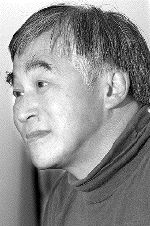
Bing Thom has had a
distinguished career which includes being awarded the Order of Canada for
his contribution to architecture. He headed the Arthur Erickson
partnership in Singapore in the 1970's.
Few have as impressive a portfolio
of international works as Bing Thom. He also has had a long
association with public nonprofit organizations and associations. From 1988
to 1992, Mr. Thom served as Chairman on the Planning and Building Committee
for the new $122 million Vancouver Public Library. Currently he is part of
the Building Committee for the new Cancer Research Center at the Vancouver
General Hospital.
- - -
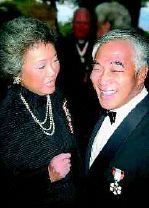
Her Excellency certainly picked a perfect locale
for architect and Order of Canada investee Bing Thom, whom she met when
mutual-friend Arthur Erickson brought the Shanghai Ballet to Canada three
decades ago. The two met again in 1992 in Seville, where Thom had designed
the Canadian pavilion for that Spanish city's world fair. Five years later,
she was reportedly knocked out by the opening of the University of B.C.'s
Thom-designed Chan Centre to make it the locale for the first Order of
Canada investiture to be held outside Ottawa. -
by Malcolm Parry photo & byline Vancouver
Sun 3 September
2002
- - -
We are proud to have been
mentored and associated professionally with Bing Thom. His wife
Bonnie and her late mother, Auntie Tianna were a part of my childhood.
-- 太太



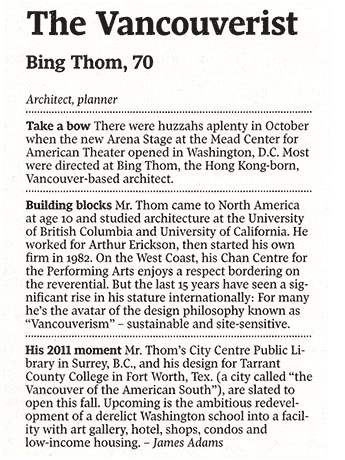 --2011
GLOBE & MAIL
--2011
GLOBE & MAIL