|

Crowning Glory
  |
 |
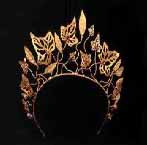
| Tiara worn by Gwyneth Paltrow as Viola
in the 1998 film "Shakespeare in Love." Designed by
Malcolm Morris |
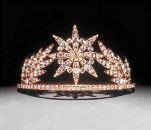
A rhinestone and base metal tiara in the
fo1rm of a star flanked with foliage, owned by Sir Elton John |
Photographs
Courtesy Victoria and Albert Museum
'Tiaras,' a new exhibit at London's Victoria and
Albert Museum, tells the story of one of history's most exclusive
headdresses
The tiara is not back, exactly. For most of us, it was
never in. But it is making a wave or two again. When Victoria
"Posh" Adams married soccer star David Beckham in a tiara, she
transformed herself from faded tawdry pop star into one half of Britain's
reigning celebrity couple; they're now in the papers more than the royals
themselves. Madonna reinstated her pop regality, donning a tiara to marry
Brit film director Guy Ritchie in Scotland (though she donned 78 carats to
Victoria's 18). And Nicky Hilton anointed herself a New York princess by
wearing a tiara last Halloween without marrying anyone at all.
A tiara can recalibrate a woman's status. Gwyneth Paltrow
was positively regal in 2000 when she wore a tiara in Shakespeare in Love,
the movie that won her the Oscar, which she accepted in an almost absurdly
princess-like pink gown by Ralph Lauren. This year, she is self-consciously
princessing down -- wearing fat suits (in Shallow Hal), smudged eyeliner (in
The Royal Tenenbaums), and no (well-needed) bra at last month's Oscars.
In a sense, her self-reinvention was not a choice. As many
royals can attest, there's only one way from up. It's as if Paltrow -- like
the recently dethroned Liz Hurley, who lost ball-gown status after she wore
a tiara in the film Bedazzled, and Naomi Campbell, who wore her tiara
clubbing and now makes headlines for physically abusing personal staff --
needed a stint as an ordinary fool to recover from the royalty thing.
The tiara itself is something of an innocent victim in all
this. It isn't meant to be worn only by royals. It's a sign of formality --
sort of like white ties for men. "It's not the rank of the
wearer," says Geoffrey Munn, the author of Tiaras: A History of
Splendour, "it's the party to which she's invited." And it's a
shame people don't hold tiara-worthy parties much these days. Seen up close
and all crowded together, as they are at a new exhibition at London's
Victoria and Albert Museum, the effect is beyond dazzling.
Tiaras the exhibit gathers 200 pieces worn by royals and
celebrities from different eras, combining sheer spectacle with social
history. The exhibition is softly lit, with dark walls and velvet setting
off the jewellery. The tiaras are displayed in groups: silver and gold,
emeralds and rubies and turquoise. Illuminating their owners, they're
accompanied by placards that tell their stories, and sometimes with their
original display cases, carefully preserved boxes that look like bodies
emptied of their spirits, the gems.
It's hard to picture anyone wearing some of the
headdresses, which seem too precious to be real. Maybe they do simply suit
some people more than others: It's said that Queen Elizabeth is one of the
few who can put on their own tiara -- they are notoriously hard to position
on the head, especially given today's silky, over-shampooed hair. Sometimes,
she's been known to do it while descending a staircase.
But then the tiara's association with majesty is a long
one, preceding its heyday in the 18th and 19th centuries. In ancient times,
wreaths were worn to anoint the head and reflect godliness. After a
falling-off period as Europe became Christian -- tiaras were considered
pagan -- they reappeared as the need arose, as in the case of Napoleon, who
wore a classical gold laurel wreath because he worried he wasn't high-born
enough. Among royal families in Europe, tiaras became popular as dowries. By
the 18th century, these evolved into lavish concoctions -- often separate
interlocking pieces that could be disassembled and reset to suit the
formality of the occasion.
Tiaras passed for generations through a family line.
Before the age of photography, monarchs such as Queen Victoria could be
identified at a distance by their tiaras. Even today, in portraits, Queen
Victoria's tiara seems as important in identifying her as her face.
Some of the tiaras in the V&A show will be
recognizable to the general public. A favourite of the late Queen Mum's, the
"Oriental Circle" (she was photographed in it, at age 48, by Cecil
Beaton), is on display, as is the one Diana Spencer wore when she married
Prince Charles. (In accordance with tiara tradition, Diana wore a Spencer
tiara for the wedding, but after that, always one from her husband's family.
The tiara has long been a symbol of matrimony, and often a gift from groom
to bride. Much of that has changed today -- even Madonna's was borrowed
rather than bought.)
Famous Hollywood tiaras are included in the exhibition,
too, such as Elizabeth Taylor's tiara from the 1957 Oscars and Paltrow's
from Shakespeare in Love. A tiara owned by Elton John -- the inspiration for
the 1997 John biopic Tantrums and Tiaras -- is shown, as is Wonder Woman's
politicized headpiece.
All this -- and the recent sight of designer Vivienne
Westwood cycling around Portobello Market in an orange plastic tiara of her
own design -- is proof that the tiara can adapt. Geoffrey Munn, who runs a
jewellery shop in London's Bond Street, opines that the headdress has had no
choice but to do so.
"Very few can afford to commission the way they once
were," he says. "But new materials are evolving. And anyway, the
compulsion to decorate a girl's head is eternal." - by Jessica Johnson
Saturday
Post 13 April 2002

|