After braving opening-day
crowds to check out Prada's brand-new, $85 million megastore in Tokyo, Takako
managed to snatch the last pair of $290 sunglasses. The 30-year-old secretary
was thrilled: Her friends had to make do with $115 key rings. "I'm
lucky," enthuses Takako, who declined to give her last name.
"Everybody likes Prada."
Well, this week, anyway. In April, everybody apparently liked Coach, as
thousands lined up to buy $625 straw purses -- which sold out in five hours at
the company's new outlet in young and trendy Shibuya. Last September, everybody
liked Louis Vuitton; 1,000-plus people waited in a kilometer-long line for the
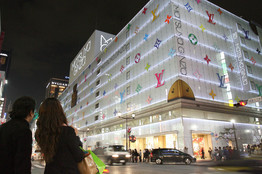
grand opening of the world's largest Vuitton store in the swank Omotesando
district. They spent more than $1 million on Vuitton goods that day, setting the
company's single-day sales record. Other luxury retailers just opening new
stores or planning to do so soon: Salvatore Ferragamo, Cartier, Christian Dior,
and Gucci. "Despite the recession, luxury brands still sell," says
Seiko Yamazaki, associate research director at the Dentsu Institute for Human
Studies.
Sell they do. Even after a decade of economic malaise, Japanese consumers have
not given up the love affair with European luxury goods they began in the go-go
1980s. Recession or no recession, a stunning 94.3% of Tokyo women in their 20s
own something made by Louis Vuitton, according to Saison Research Institute.
Goods made by Gucci sit in the closets of 92.2% of Tokyo twentysomethings; 57.5%
own Prada and 51.7% Chanel.
Problem is, the new shopping shrines are opening just as Japan's luxury goods
market appears to be ebbing. Overall sales are forecast to shrink this year to
$10.32 billion, from $10.75 billion last year and $11.38 billion in 2001,
according to Yano Research Institute Ltd. So why the store-building binge? For
one thing, some of the shops have been in the works since 2000, when retail
deregulation made it easier for luxury brands to move out of their ghettos in
department stores. Cheaper real estate in Tokyo has also helped. The new stores,
though, are cannibalizing sales of luxury goods from department store boutiques.
Sales of most luxury goods at department stores are down as much as 20% this
spring, according to Goldman, Sachs & Co.
That leaves the stronger luxury goods makers scrambling to get a bigger slice of
the shrinking pie. Prada is hoping that its new store -- a five-story building
that looks like it's covered in a fishnet stocking -- will help it grab market
share from Vuitton and other rivals. The store helps Prada "reinforce
itself in this market," says CEO Patrizio Bertelli, who flew to Tokyo for
the June 7 extravaganza. "Louis Vuitton has been working very hard in this
market and has been rewarded for that."
He's right. LVMH Moët Hennessy Louis Vuitton saw its yen sales jump 15% last
year, to $1.16 billion. But Prada didn't do so badly, either: Net profit in
Japan leaped 260% in 2002, to $3.3 million, on a 10% increase in sales over
2001. Bertelli says sales are on track to reach 10% growth in 2003 as well, and
the company reported first-day sales of $240,000 at the new megastore. Japanese
consumers rewarded Coach Inc. for its splashy openings, too. For the nine months
ended Mar. 29, sales in Japan were $123.3 million, about double those of the
year-earlier period. "We're building momentum in Japan," says Coach
Chairman Lew Frankfort.
What makes the Japanese spend their dwindling disposable income on luxury bags,
belts, and shoes, even if they're marked up more than 40% over European prices,
as Louis Vuitton goods are? "Wearing any kind of brand makes you feel more
self-confident," says Mayumi, a 21-year- old dental assistant. Walking
around Shibuya with her friends sporting one of those must-have Vuitton purses,
a Bulgari necklace, and a Gucci watch, she said: "It just makes you feel
good." As long as luxury retailers intent on grabbing market share in Japan
can continue to lure Mayumi, Takako, and their friends, they'll be feeling good,
too. - By Sheridan Prasso in Tokyo, with Diane Brady
in New York Business
Week 30 June 2003