On Monday, April 4, 1949, a package wrapped in brown paper
was handed across a counter, registered, insured, and stamped, which cost
$159.87, and with person-to-person handling guaranteed and guards to dance
attendance along the way, travelled by train from Washington to New York.
There, its addressee, who regularly shipped gems to himself by parcel post,
and who often said, "If you can't trust the United States mails, who
can you trust?" eagerly awaited it.
The next morning, an armoured truck pulled up at a six-storey
greystone mansion at 7 East 51st Street, which bore the sign "Harry
Winston Inc." Inside was the proud, excited new owner of the Hope
Diamond, the Star of the East and the lesser lights of Evalyn Walsh McLean's
collection: 53-year-old Harry Winston.
Only five feet, four inches tall, with a handsome, boyish
face, thick, greying hair, and eyes that normally sparkled with an intense
joie de vivre but that could turn in an instant to cold steel, Harry wore a
dark, impeccably tailored double-breasted suit and, as always, no jewellery.
At the moment Harry Winston Inc. was grossing about
$20-million a year. Harry had interests in South American mines; employed
400 cutters and polishers in New York, Amsterdam, and Puerto Rico; sold
diamonds both wholesale and retail, every grade from world famous down to
those in Montgomery Ward's $37.50 engagement rings (the latter not connected
to his name); would open jewel salons, in 1955 and 1957, in Geneva and
Paris; designed and manufactured jewellery for the super-rich. He sold to
kings and maharajas, billionaire sheikhs and shipping magnates.
Harry Winston had a "genius" -- that was the
word which rested like an invisible crown on his head whenever jewellers and
diamantaires talked about him -- a positive genius for publicity. He'd been
the very first jeweller to hire a full-time public relations person, Jill
Ceraldo. She stood near him now, having just welcomed a group of journalists
and photographers to the main salon, an elegant room furnished with antique
chairs and tables. The press group hushed as Harry ceremoniously unwrapped
the paper parcel and spread its gems out on a large black velvet pad atop a
Louis XVI gilded table not unlike those the Hope had reflected at Versailles
160 years before.
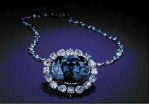
The Hope is the world's biggest dark blue diamond. With
the exception of red, blue is the rarest of all colours for a diamond. (A
diamond may also be green, yellow, pink -- the highly valued hues -- or
brown, grey or black.) Most blues are light in colour and less than 2
carats. The Hope, which measures about an inch long, three-quarters of an
inch wide and an inch deep, weighs more than 40 carats.
Since its discovery in India, hundreds or perhaps
thousands of years ago, the Diamond has followed its owners all over the
world. It became "the Blue Diamond of the French Crown" under
Louis the XIV. The French Revolution's blood tide swept it to England, where
Henry Philip Hope rescued it and adored it. It adorned the Washington
hostess Evalyn Walsh McLean (as well as her dog) in the early 20th century,
and the Hollywood actress Michelle Pfeiffer laid it on her satin skin during
a photo shoot for Life magazine in 1995. But the Hope's malevolent curse is
as famous as its beauty. Some of its owners suffered astonishingly bad luck:
one died a very slow, horribly painful death; another, quite literally, lost
his head; a third lost a young son to a car accident, a daughter to suicide
and a husband to an insane asylum.
At Harry Winston Inc., after the last camera flashed, the
last notebook closed, and the media departed, the gems were taken up to the
third floor, where they were weighed, given numbers, and registered in a
loose-leaf notebook. Then they went further aloft, to a huge walk-in safe on
the sixth floor. In it the tissue-wrapped Hope was laid to rest among
thousands of its kind hiding in waxed-paper pockets inside brown envelopes.
In the late afternoon, after Harry had consumed his usual
lunch of tea and graham crackers at his desk, and as the shadows on St.
Patrick's Cathedral, beyond his office window, deepened to violet, he picked
up the phone on his desk and called his head cutter. "Before you go
home," Winston told him, "bring me down my new babies, the Hope
and the Star of the East; I want to play with them for a while."
The Hope Diamond has always been a star. Harry Winston
would propel it even further into celebrity status. He'd launched his first
publicity campaign in 1940, revolutionizing the ad world with full-page
spreads in glossy fashion magazines like Vogue, sparked by such original
ideas as a close-up of his black cat, Kashmire, furry brow adorned with a
pear-shaped diamond above her gleaming eyes. In 1947, he began the ongoing
tradition of lending Winston jewels to Hollywood movie stars for the annual
Academy Awards ceremony. Now it was time to turn his public relations
wizardry on the Hope.
On Wednesday, April 6, all the big-city U.S. newspapers
gave the Hope's debut at Harry Winston Inc. many columns of type. The next
day, further write-ups and photos appeared. The New York Times showed the
former McLean cache laid out like Ali Baba's loot, with the Hope on its
necklace around a velvet jeweller's bust, being admired by Jill Ceraldo and
another pretty Winston employee. Time magazine compared the size of the Hope
to a robin's egg -- although any robin laying an egg that big would have
exploded on the spot in a burst of feathers. "Though Winston laughed at
the legend that the Hope diamond had brought only trouble and tragedy to its
owners and wearers," wrote the Time journalist, "he soon had his
press agents grinding out new embellishments of the tale." Of course he
did; the curse was as effective a promotion tool as a Hollywood actress;
privately, Harry thought it complete nonsense.
Born March 1, 1896, on the third floor of a five-storey
walk-up apartment building on New York's West 106th Street, Harry was the
third son of Ukrainian immigrants. His father owned a modest retail and
repair jewellery store. One day when Harry was 12, he saw in a pawnshop
window a green stone in a ring, sitting on a tray below a sign: "Take
your pick -- 25 cents." At that moment, the first of a lifetime of
jewels enchanted Harry; he entered the shop and bought the green gem. His
father was astonished to find, after cleaning it, that he was holding a
2-carat emerald, which he was able to sell for $800. How had Harry known?
For the rest of his life, Harry loved to tell the story of
that green stone; as an adult he was a skilled fabulist who mesmerized
listeners with tales of famous rulers and screen goddesses and diamonds he
had known. "I love the diamond business," enthused Harry.
"It's a Cinderella world. It has everything! People! Drama! Romance!
Excitement!" Like Jay Gatsby in Fitzgerald's Great Gatsby, Harry
Winston possessed "an extraordinary gift for hope, a romantic
readiness."
In 1920, Harry struck out on his own, dealing on the Lower
East Side, which then contained New York's Diamond District. He hustled
among the Hassidic Jews in black coats and hats, who gathered on the
sidewalk, holding little folds of paper full of diamonds, looking at them in
the preferred light, which was natural, northern, out of direct sun, and
best around 11 a.m. Other diamond dealers hurried in and out of buildings
where signs painted on windows above proclaimed "Mr. Diamond,"
"Diamond-Rama," "Futura Diamonds," and where the
elevator operator was often a detective. Harry worked in this wholesale
market for long hours each day, accurately reading the diamonds he bought at
a bargain and sold at a profit, each deal concluded with a handshake and
Mazel und Brucha (luck and blessing).
Four years later, Harry opened his own firm, the Premier
Diamond Company. He bought up stones set in massive stomachers, tiaras,
corsage ornaments and dog collars -- all of them out of fashion. A Prospero
figure, he looked into the heart of each diamond and divined its true
potential, hiding under some old, imperfect cut and within a cumbersome
setting.
By 1932, he was able to move to more luxurious quarters in
the British Empire building in the Rockefeller Center, where the Premier
Diamond Company became incorporated under the new name Harry Winston Inc.
He bought his first world-famous diamond -- the 726-carat
rough Jonker -- in 1935. Diamantaires stayed away from the largest stones;
the market for a 50-carater (or bigger) was too small. "If a man thinks
big, he'll be big," Harry told his wife, Edna.
"Harry just can't forget about a diamond once he's
made up his mind he wants it," Edna sighed. She knew he loved her; she
was his confidant, trusted adviser, and model for his jewels; their marriage
was a good one. Yet his incurable romanticism focused on his diamonds; he
fell in love with one beau idéal at a time, as if each were a mistress, and
when passions cooled moved on to the next. He often kept a priceless stone
in his pocket, the world's most expensive worry bead and amulet, so he could
caress it all day long. He became obsessed with owning all the world's
largest, most famous diamonds, and before he was done, one-third of them
would have joined him for a brief liaison, or a longer affair
When, on the morning of April 27, 1947, he read Evalyn
Walsh McLean's obituary in The New York Times, Harry's spirits rose,
Hopeful; they plummeted in early May, when he learned that the McLean jewels
were locked away, out of his reach for 20 years, and soared to the stars in
jubilation when he finally made them his, almost two years later.
A few minutes after his call to the head cutter on that
April afternoon in 1949, the Hope and the Star of India, the two famous
stones that had been together for 38 years, sat on the large square of black
velvet on Harry's desk. Harry picked up the Hope in its circlet of white
diamonds and looked at it through his loupe. "A great diamond should
live, it should talk to you," Harry liked to say, and he felt sure that
the Hope would be no exception.
"Ah, Harry, darling," he murmured to himself,
"what a blue! What a presence!" Twilight sky, mood indigo, a
poignant sense of day's ending, life's ending, regrets, losses, missed
opportunities ... Why was the Hope making him blue? He put down the loupe
and rubbed the stone lightly and slowly, cradled it in his hand, rocked it
back and forth in the light, talking to it and to himself by turns. "No
two diamonds are alike," he once told a reporter. "Each has a
different nature, different problems, and each must be handled as you handle
a person." All at once he knew why he was feeling sad rather than
euphoric. The Hope had suffered in its cutting after it was burgled from the
palace of Louis the XVI in 1792. Man, not nature, had botched it. The
world's greatest blue and most fabled diamond was lopsided; one long side of
its oval was thinner than the other, so it lacked full symmetry and
refraction. Its cut was also a little too shallow for maximum brilliance. If
only Harry could recut the Hope -- but that would be sacrilegious, since, as
he would soon explain to the press, its historical value was more important
"than any minor improvement anyone could make."
Harry Houdini of the diamond trade, Winston the Wizard,
who routinely transformed wallflower diamonds into raving beauties, could do
nothing for the Hope. He could, however, love it, and he did, with all the
passion of his nature. He picked up his loupe again, locked his eye to the
Diamond's bigger one. For a long time, Harry and the Hope communed. Finally
he laid it very gently down onto its black velvet bed. It would never sing.
He was close to tears.
On May 7, 1949, The New Yorker's "On the Town"
reporter noted that, thus far, diamonds had brought Winston "nothing
but good fortune" and that he'd received two legitimate offers to buy
the Hope, and many crackpot ones. "I got a cheque for $5-million in the
mail," he boasted, "and one for $3-million, and both parties
requested that I ship them the stone." He did plan to sell it
privately, he told the journalist, but not before it had been exhibited
"throughout the country for the benefit of local charities."
Always the showman, Harry soon marshalled his troupe of
beloved gems into a circus act called the Court of Jewels, which would open
in New York, tour the country. San Antonio, Texas ... Oklahoma City,
Oklahoma ... if it's Tuesday, it must be Chicago, Illinois. In the Diamond's
blue depths, the cities melted into one grey, skyscraper blur.
By 1953 the tour had ended, but Harry continued to lend
the Hope, for which he hadn't yet found a private buyer, to various charity
events for another five years.
Never Harry's best-loved baby, the Diamond sometimes lay
quietly in a glass case; often it lay next to the soft, pampered skin of
some rich socialite, dancing the night away in a hotel ballroom under
sparkling chandeliers.
On Friday, August 8, 1958, the Hope boarded a plane to
Toronto, where it was transported to the grounds of the Canadian National
Exhibition. The next day, the Ex was opened by Prime Minister John
Diefenbaker. For the next 16 days, close to three million people passed
through the high-arching gates of the exhibition, many of whom went to see
the Hope.
By 1958 Harry Winston Inc. was bigger than it had ever
been. "The British royal family owns the world's biggest collection
of historic jewels," Life magazine had declared on March 17, 1952.
"The second biggest, however, is owned by a U.S. citizen, Harry
Winston," who, when he felt the urge, could roll $12-million worth of
gems across his desk -- the ultimate cornucopia -- feast his eyes, and
gloat.
One afternoon, Harry looked at his appointment book, saw
a blissful blank, called up to the sixth floor and asked to have the Hope
brought down to him. He wanted the storied blue so he could spend time
with it before it moved on to the next chapter in its life. He was going
to donate the Hope to the National Gem Collection at the Smithsonian. His
secret ambition was to make America's gemstones rival Britain's in the
Tower of London. He hoped such a gift would inspire other rich Americans
to donate their own magnificent jewels. (He was glad that some silly,
vain, spoiled woman hadn't bought the Hope. Harry didn't think much of his
female customers; they had "no real feeling" for diamonds, he
said, no real reverence. "They'd wear diamonds on their ankles if it
was stylish!" he once confided to a journalist.)
On Friday, Nov. 7, 1958, sitting in his office with a
brown-paper parcel on his desk, Harry held a press conference, reported in
Saturday's newspapers and on page one of The New York Times. "The
Diamond," wrote Milton Bracker, "will be sent to Washington by
mail today as the gift of Harry Winston Inc." He estimated that while
he owned it, the hardworking Hope had covered about 400,000 miles raising
money for charity and had "brought him no bad luck." It had
instead brought him fame, new clients, and plenty of free publicity.
Yet, if he was really being truthful, he had to admit
that the Hope ultimately was one of his failures. First of all, he knew he
was the world's best diamond salesman, yet he'd failed to sell it; second,
he'd failed -- through no fault of his own -- to do what he loved doing
best: to give such a stone perfect fulfillment of its beauty. His
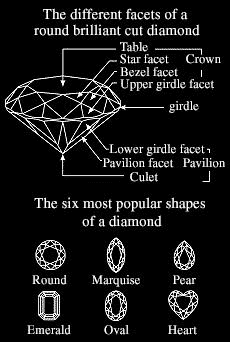
recutting of the culet (bottom) facet in 1958 was too minor an improvement
to do much. The Diamond had come to him lopsided, with flawed refraction,
and thus it would depart.
When the Hope arrived at the Smithsonian, it yielded a
closely guarded secret. The museum's mineralogists weighed the blue stone
that, since it surfaced in England in 1812, everyone had described as
weighing 44 1/4 or 44 1/2 carats. Not at all! The Hope weighed an
astonishing 45.52 metric carats. It had managed somehow to conceal that
extra carat for all of those years.
Adapted with permission from Hope: Adventures of a
Diamond by Marian Fowler, published by Random House Canada, April, 2002.
National
Post 6 April 2002
DIAMOND ESSENTIALS

GRADES
Many Chinese say "I do"
with diamonds
More couples in increasingly affluent
China are opting to say "I do" with a diamond ring, rather than
gold or jade jewellery, according to the world's biggest diamond producer
De Beers.
China is the fastest growing diamond
consumer in the world after India and Asia's second-largest market for the
stones.
According to official estimates,
wealthy Chinese spent almost $2 billion on diamond jewellery last year,
and industry experts expect that figure to rise by as much as 12 percent
this year.
De Beers said diamond wedding rings
represented 32 percent of all diamond jewellery sales in China.
"The foundation upon which we've
developed the current business has been the diamond wedding ring for
consumers," Christina Hudson, marketing director for the De Beers
Group in Greater China, told Reuters.
"More and more consumers are
acquiring diamonds in China. You know when consumers used to ask others
'so did you get a diamond for your wedding?', now they'd ask how big is
your diamond."
Traditionally, Chinese grooms who could
afford it gave their brides yellow gold
or jade jewellery as an engagement present.
China is a lucrative jewellery market,
with a booming economy and growing numbers of fashionable, wealthy youth
helping to fuel demand.
Diamond sales are mainly driven by
young Chinese and got an added boost last year from a reduction in
value-added tax on imported stones last year, jewellers say.
- Reuters
2007.