This month is
the 250th anniversary of the London Season. Well, it might be, anyway.
In
fact, there is no firm record of what year or even in which century it all
began, but if there is an official summer season then it opens with canapés
and Champagne at Queen Charlotte's Ball in May. Unfortunately, this event
has not taken place since 1994. Its demise left the country bereft of any
sort of official or unofficial body with any idea of what comprises the
Season proper, or when it starts and finishes.
There is no royal court or trained
observer to adjudicate on the social whirl. Buckingham Palace claims the
Queen has no interest in it. The Lord Chamberlain's office, which arranges
royal garden parties, abdicates any responsibility for it, while the Ascot
press office will say only: "Royal Ascot is the crux of the
Season."
Jennifer (Betty Kenward), the
society diarist who reported for decades on the fashionable summer months
for Harpers & Queen magazine, has long since sashayed her way to the
Champagne fountain in the sky and the newspaper columnist Nigel Dempster,
who gossiped about debutantes so wickedly in the late 20th century, is now
retired.
All that is left is the charitable
Berkeley Dress Show run by Jennie Hallam Peel and her company, The London
Season, which caters mostly for those who may not be quite top drawer but
who wish to be. Hallam Peel has decided that the Season was born in 1757
and, as a result, the 250th anniversary will be celebrated at this year's
show at the Dorchester Hotel in two weeks' time. Invited guests (an
arbitrary selection of names from the annual publication Debrett's People of
Today) will be presented to royalty (Princess Katarina of Yugoslavia). A
Champagne reception, catwalk show, auction and dinner, followed by
"waltzing in the ballroom", will mark both the anniversary and the
opening of this year's summer of "aristocratic" partying.
The idea of holding a collection of
smart summer parties in London almost certainly began in the late 17th
century. According to Louis Stanley, in his authoritative 1956 book The
London Season, "the aristocracy began to flock back to London from the
country in the early summer after the Restoration of Charles II in 1660 in
reaction against puritanical repression".
In 1780, to coincide with this by
then long-standing fashion for turning up in the capital after the hunting
season had ended, George III held a May ball to raise money for a London
maternity hospital named after his wife, Queen Charlotte. It became an
annual event and was an excuse for the daughters of the well-bred to come up
to town, be formally presented to the Court and, with luck, meet a potential
husband.
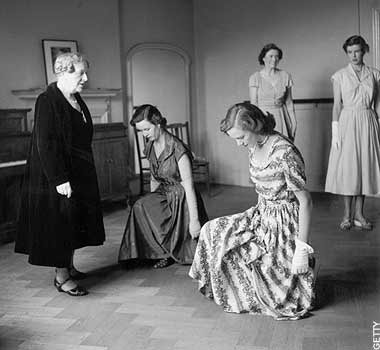
Over the years the ball and the
presentation at Court was formalised into a "debutante season".
The young girls, who had to be sponsored by a lady who had herself been
presented at Court and was not divorced, would meet the monarch, attend the
ball and a host of "coming-out" parties, as well as the opening of
the Summer Exhibition at the Royal Academy, Royal Ascot and the Henley
Regatta. The gaiety ended in the first week of August with Glorious Goodwood,
a race meeting that Edward VII described as "a garden party with racing
tacked on".
During the 20th century other
events attached themselves to the posh summer merry-making, such as the
Chelsea Flower Show, Wimbledon Fortnight and Cowes Week. Despite this
increasingly bulging calendar, the institution began to founder during
wartime and in the more egalitarian post-war era. Instead of curtsying to
Her Royal Highness, blushing debutantes were formally presented to a large
white cake.
In 1958 the Queen, without hue and
cry, abolished the annual Court presentations and the Season, in name at
least, would have died out then and there if it had not been for the former
social editor of Tatler, the late Peter Townend, who was determined that the
debutante would survive. For the next 40 years he continued to promote the
anachronistic institution, filling his little black book with names and
addresses of suitable girls - and their brothers, the so-called "Debs'
Delights" - and arranging parties for them. He alone kept the flagging
flame of the old aristocratic Season alive and when he died at the turn of
this century so, finally, did it.
And so, ultimately, it is left to
Tatler, which describes itself as Britain's most stylish and indispensable
social guide, and which every spring includes a small booklet entitled The
Season, sponsored by Champagne house Veuve Clicquot, to be the mediator on
the matter of the Season. Its current editor, Geordie Greig, has, however,
left it to Veuve Clicquot to administer, a job that it, in turn, has
delegated to its London PR girl Genavieve Alexander. And so the world's most
famous summer party has fallen into the hands of a young press officer who,
with the help of a "trend agency", compiles the list of what posh
"do" is in and what riotous assembly is out. Interestingly, the
2007 booklet does not mention the 250th anniversary or the Berkeley Dress
Show, but does include the sponsored Business Woman of the Year award,
Gumball 3000 Rally and an obscure oyster festival.
"The Season is evolving and
moving and is about a moment in time and therefore can be enhanced and added
to each year," said Ms Alexander.
However, for those of us not bound
by the capricious rules of a social-climbing Champagne house, the gauge as
to whether an event is part of the Season or not is whether it combines the
open air, drinking, royalty and people in hats. For the Season is, in all
but name, an unstructured long-running alcoholic picnic punctuated by horses
and human excess.
MOYRA
MONTAGU DOUGLAS SCOTT (1937)
I came out in 1937 and turned 18 in
March that year. I was not at all a typical deb, coming straight from the
wilds of Kenya. Most of the girls had been brought up in lovely English
country homes and finished off in Paris; many knew each other already.
I was lucky because my aunt, Violet
Astor, married to John Astor, gave a dance for me at Carlton House Terrace.
That meant other people had to invite me to theirs.
At every dance the young people
were given a small, folded, white card with a pencil attached to it by a
thin, silken cord. It was most important to have one's dance card filled.
Good manners required the men to
ask both of their dinner neighbours for a dance, as well as their hostess's
daughter. The circle of people invited to these dances was comparatively
small, so one made friends with certain men whom one could always count on
for a dance. (One of my regulars was Jack Kennedy, later president.)
I chose a dress for Queen
Charlotte's Ball that I thought lovely: it had a close-fitting black taffeta
top with a full skirt, finished with a tartan frill. Pretty as it was, it
was hardly de rigueur for the white-clad virginal debs who were to pull in
the cake! So I had to remain sitting with the grown-ups for the whole
ceremony.
I never heard any talk of husband
hunting, though I dare say a few of the mothers did.
LAURA
SHEFFIELD (1967)
I came out in 1967, when I was 17.
The cocktail parties started in April and my diary from that year shows that
by August 11, I'd been to 32 dances!
My sister came out the year after
me, so we shared a dance at home. At the beginning of it my sister and I had
to stand with our parents and shake hands with every guest.
Although I lived in London, I would
not have been seen dead there at the weekend. Every Friday throughout that
summer we hopped in the car and drove off to parties all over England. We
learnt to map read very well.
Queen Charlotte's Ball was the only
charity ball I remember going to. We had to wear white to it and curtsy to a
cake.
Early on in the Season I went to
the Berkeley Dress Show, accompanied by my mother. The thin girls all
modelled at it; I didn't.
I didn't have a single friend who
lived with a man and knew very few who'd been to bed with one. One always
went out with men at least two or three years older, never the same age.
I hardly knew a girl who went to
university. I'd been at finishing school in Switzerland and Paris before
coming out.
It was all terribly innocent; we
weren't looking for husbands, we were just having fun.
HELEN
MORGAN-REES (2007)
I've only been to one cocktail
party so far, which was at the Bolivian Embassy and was great fun. Every
girl is supposed to host a sit-down dinner or a cocktail party. I might have
mine on a boat on the Thames. As the Season progresses you get to know who
you like and who you don't. There is an understanding that if you don't get
on with someone, you don't invite them to your party.
It costs a lot to do the Season.
You pay £20 to get in, your party can cost up to £5,000 and you have to
pay for tickets to things such as the Winter Ball in December and the
Berkeley Dress Show. I'm modelling at it and get to design my own dress.
If I get invited I would love to go
to Ascot and Cowes Week.
The Season is a difficult concept
for people to understand now. It is quite worthwhile: I'll meet lots of
people from all over the place, who might help me later in life. My
schoolfriends don't get it - they say: 'So, it's a society where you just
party a lot?'
I won't be looking for a husband -
I'm 17 and I want to go to university before settling down - but I thought
it'd be fun to go to all those parties. My sister did it and came back with
such great stories that I asked to do it as well. Some people are invited to
do the London Season. I don't know how anybody knows their names -perhaps
they are from old families who've always done it. - TELEGRAPH
10 April 2007