|

  
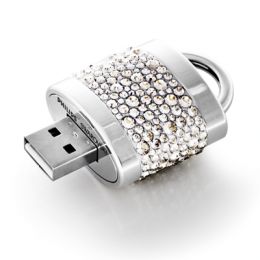
Philips-Swarovski crystal USB flash drive
SWAROVSKI
At 32, Nadja Swarovski is perhaps the only
heiress-cum-fashion mogul in the world who would identify crystals -- glittery
faux diamonds -- as a girl's best friend. Crystals are not forever: They're
breakable and scratchable and usually don't cost anywhere near two months'
salary. But in the past decade, under Nadja Swarovski's watch, her family's
century-old crystal company has managed to become, quite improbably, a
glamourous name in high-fashion.
The recent crystal craze is all the more
remarkable when you consider that, not very long ago, Swarovski was best known
for being the purveyor of those twee little figurines you see perched in
jewellery store windows, often nestled between Royal Doulton porcelain clowns
and ballerina music boxes. Swarovski's high-end knick-knacks were a fixture in
heritage collections -- the crystal clowns rubbed shoulders with prismatic
elephants and swans.
Today, Swarovski crystals are affixed to
everything from Victoria's Secret bra sets and Kawasaki motorcycles, to the
clothing collections of such fashion heavies as Dolce & Gabbanna and
avant-garde vintage revisionists Imitation of Christ. Swarovski was the sole
sponsor of this year's prestigious Council of Fashion Designers of America
Awards in New York City. And celebrities from Hilary Swank to Kate Beckinsale
and Mira Sorvino have flaunted Swarovski accessories at some of the biggest
star-studded events in Hollywood.
The story of Swarovski's metamorphosis is one
of the most unlikely rebranding exercises in recent memory. And the about-face
in the company's image was based on a deceptively simple premise: Invite enough
cool kids to your parties, buy them free drinks, and eventually, you'll become
cool by association. Cool enough that, this year alone, demand for your product
will warrant the opening of 67 new retail stores worldwide -- including one at
Bloor and Yonge in Toronto, slated to open its doors on Nov. 18. All this,
without a single additional advertising dollar spent.
- - -
The Swarovski saga begins in Bohemia in 1892,
when Daniel Swarovski, Nadja's great-great-great-grandfather, invented a
revolutionary crystal-cutting machine that sped up and standardized the
production process. He set up his eponymous company soon after, in Wattens,
Austria.
For close to a century, Swarovski was the
supplier of top-notch crystal for a range of products. The company cut stones
for chandeliers and costume jewellery -- and it catered to the haute fashion
world. It was Swarovski that provided the glitter for Coco Chanel's popular
crystal-embroidered dresses in the 1920s. In 1955, it co-designed Christian
Dior's famed Aurora Borealis stone, a multi-coloured crystal. In 1962, Marilyn
Monroe dazzled the world in a dress affixed with 10,000 Swarovski crystals to
sing her breathy rendition of Happy Birthday to President John F. Kennedy.
(Christie's auctioned off the dress in 1999 for US$1.26-million.)
But throughout that time, the Swarovski brand
was known only within the manufacturing industry. When Tina Turner wore her
famous crystal-mesh dress on her 1994 world tour, the name of the designer,
Gianni Versace, was everywhere. Nobody knew (or cared) who had provided the
crystal.
What Swarovski's name did become synonymous
with, at least since around 1976, was those figurines. Legend has it that,
sometime in the mid-1970s, a couple of Swarovski factory workers noticed that if
you glued several crystal chandelier pieces together, you could make something
that looked like a mouse.
By the 1980s, the twinkling ballerinas and
porcupines, which retail today for anywhere from $50 to $5000, were a booming
business. They were so popular, mostly with buyers of china dolls, commemorative
spoons and the like, that the company formed a collectors' society, which, even
today, has 450,000 card-carrying members.
In 1995, it created a Swarovski Crystal World
in Wattens -- a kind of Disney World for crystal kooks -- that draws over
600,000 people a year, making it one of the most popular tourist destinations in
Austria.
But as a market, this was not exactly a
self-sustaining one. Swarovski figures appealed mostly to older, middle-class
women; they simply didn't resonate with a younger crowd.
It was also not a brand pedigree that
satisfied Nadja Swarovski. The stylish Swarovski has a voice that oozes money,
and, to match, a penchant for the art of doing business. A fifth-generation
Swarovski -- she is the daughter of the company's current CEO, Helmut Swarovski
-- she saw the potential of affixing the company name to something much more
valuable than miniature crystal dolls. The infrastructure was already in place:
All it needed was somebody to point it out.
"Nobody knew that Swarovski was actually
the sparkling ingredient in fashion," says the young blond, in the perfect
pitch of market-speak. The company had always supplied its wares to the likes of
Armani and Oscar de la Renta. Nadja Swarovski was determined to expand on these
connections.
Swarovski's rebranding seems to fit in with
other resuscitative success stories in the fashion world over the past few
years. In the 1990s, numerous companies revitalized their images by zeroing in
on a tiny, recognizable kernel of respectability within their existing pedigrees
and tweaking it just enough to infuse it with new life.
Some of the stodgiest companies did it best.
Hush Puppies loafers went from ultra-nerdy to the peak of cool in a span of six
months, thanks to the help of some down-with-it trendspotters in Los Angeles and
the power of viral marketing. Gucci refashioned an image that had grown dusty,
even grandmotherly, at the start of the 1990s, by bringing in a young American
named Tom Ford. Ford, a designer who remembered the time when Gucci still meant
"jet set," turned the company back into the global fashion powerhouse
it had once been.
Or consider Burberry, the ultra-conservative
London-based clothing retailer, which had become known as the maker of dowdy
raincoats. In 2000, the company launched a famous advertising campaign that
played on the very old-school "Britishness" some held responsible for
its downfall in the first place. With the help of marketing maven Rose Marie
Bravo, Burberry plaid was, in an ironic turn, refashioned into the thing every
fashion victim, from Japan to New York, wanted brandished on a bikini or a
clutch purse. More recently, Pringle sweaters has done the Burberry thing, as
has Bally, a shoe company that, not very long ago, was one step up from
Naturalizer in the hierarchy of hip.
The difference between these success stories
and Swarovski's is that Swarovski really had no public identity in fashion to
draw on in the first place. Its reputation as the manufacturer of schmaltzy
figurines was too off-target to be culled for cool, even by the world's best
branding agencies.
Instead, what Nadja Swarovski did was look to
the company's underside, the history most consumers did not know about. She
created a new public-relations strategy: With the help of professional muse
Isabella Blow, the doyenne of the British-fashion set, Swarovski called upon
some of the fashion names the company had already been doing business with for
years, as well as some new names, and made them offers they could not refuse.
Designers would be supplied with free crystal
to be integrated into their work as they saw fit. All the designers had to do
was say that these crystals were Swarovski crystals, and say it often.
Timing was on Swarovski's side. By 1999, at
the height of the New Economy, high style had gone unrepentantly luxe. Fur was
back. Logos were everywhere. Leather was big. And anything that sparkled was
good. Almost overnight, Swarovski crystals were the new design accent of choice,
for poofy French couturier Christian Lacroix, shoe god Jimmy Choo and bad boy
designers Jeremy Scott and John Galliano.
The company's mandate was to sponsor only
entities who were newsworthy, stylistically groundbreaking, or at least, those
who had attention-drawing personalities. "It was very important who we
aligned ourselves with," Swarovski says.
"Actually, it wasn't difficult to do.
Since we were an ingredient [in their designs], we had the absolute right to
ride their publicity wave."
Swarovski started what she calls a
"crystal re-education program" for designers and established offices
in some of the world's fashion centres -- London, Paris, Wattens, New York,
Milan, New Delhi, Sao Paolo and Dubai. Today, designers from several creative
realms (interior, jewellery, lighting, home and fashion) are brought in to meet
with consultants and are provided with access to a range of Swarovski materials.
This is how the costume designer for Moulin Rouge came to decorate Nicole
Kidman, head to toe, in Swarovski stones.
"We work with a lot of designers who
would've never considered crystal," Swarovski says. "They might have
certain stereotypes about Swarovski. But nonetheless, we still drag them into
the showroom." She says her "trick" is to give them a crystal to
hold. People become so overwhelmed by the way it cuts light and the hardness of
it, she says, they "fall in love with it."
Some radical designs have been born of this
approach. Designer
J. Maskrey created "Skin
Jewellery," elaborate crystal body tattoos that Britney Spears flaunted on
stage for her racy MTV Video Awards performance in 1998. Kawasaki created its
crystal-encrusted motorcycle, the Ninja ZX-12R, which features 50,000 crystals.
(Mariah Carey rode the bike on stage at the VH1 Fashion Awards to promote her
film Glitter.) Adidas came up with "the world's most extravagant
sneaker," the Adidas Crystal Superstar, a limited-edition shoe that sold
for 750 Euros ($1,150 Cdn). And, in his fall, 2002 collection, Jeremy Scott
featured five Swarovski-encrusted New York skyline pieces as a tribute to the
city. In New York City, the Swarovski-studded bikini wax has become the latest
spa treatment.
Sales have skyrocketed -- according to Nadja
Swarovski, they went up by 500% since the campaign started.
- - -
Brand images almost never transition without
a glitch, though, and Swarovski's big challenge now is to reconcile its somewhat
Jekyll-and-Hyde-ish retail personality. The company still caters to a
super-conservative heritage-set collector on the one side, and to the
fashionista on the other.
"I think a lot of people think, my gosh,
the company has really become schizophrenic," Swarovski admits. Dedicated
collectors who are willing to spend $6,000 for a crystal swan because of its
purity and fragility may be turned off by Swarovski's new rock-and-roll image.
Peter White, president of Swarovski Canada. agrees with Swarovski. "There
is a risk of offending people," he says. "There is a slightly mixed
signal."
Another potential difficulty is what Bruce
Philp of Toronto brand-engineering firm Garneau Wurstlin Philp calls
"flaming out" -- as Burberry has with its omnipresent beige plaid. The
plaid has become so ubiquitous it has lost its patina of cool, and rather
quickly.
Fashion, Philp says, is inherently
anti-populist. Exclusivity and individuality -- real or imagined -- is
everything. Once a trend trickles down to reach the lowest common denominator,
those at the top reject it and replace it with a new trend. (Of course, crystal
faces the added difficulty of being one of the most ostentatious materials out
there; at any moment, fickle style-setters could turn on it.)
Nadja Swarovski has thought of that. Already
the company is expanding into new product categories in which the design, not
the crystal, is the main attraction. Swarovski has recently launched a new
housewares line, designed by Darko Mladenovic, in which materials such as metals
and woods are fused with crystal. A crystal fountain pen from the collection
sells for $1,500. A wooden vase with an inch-thick crystal rim costs $1,560.
Swarovski is also working to promote a new line of hyper-designed lighting
fixtures whose designers are given centre stage.
- - -
At the new Swarosvski store, located down the
street from the Chanel and Gucci storefronts in Yorkville, all of the company's
varied products will be on display, side by side. Decorated in Oriental red and
royal blue, the store will feature body tattoos -- as well as sitting areas for
one-on-one consultations with members of the Collectors' Society.
Whether opposing style tribes will enjoy
rubbing shoulders remains to be seen.
On the positive side, the store could unite
consumers from dramatically different demographics, bridging its past and its
present. On the negative side, there's a chance it could come across as a
somewhat jumbled metaphor, alienating both of its constituencies. In the books
of branding, then, Nadja Swarovski's may not be the ideal model to follow. But
it's hard to argue with the evidence that, for her company, at least, it has
already accomplished the near impossible.
- Saturday
Post 2 Nov 2002

|