|

Big, Fat, Hairy Deal
The rare Chinese mitten crab is the best Shanghai surprise of all. We take a
crack at it.
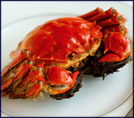 
There are too few food moments in life
that you remember forever: those fried zucchini blossoms in Provence, that
pizza bianca in Florence, the barbecued goat face in Marrakech (albeit for
altogether different reasons). And now this: my first taste of hairy crab.
Of the six people at my table at the gleaming Four Seasons Hotel Hong
Kong’s Lung King Heen restaurant, three launched into spontaneous food
orgasms (myself included), while the others recoiled in horror and refused
to even touch their furry-mittened critters. (No problem; I polished them
off as well.) Little wonder. Slick with naturally occurring neon-orange oil
and roe, this seafood treat, as fatty as foie gras, has as many fanatics as
it has detractors. My ears still get hot just thinking about it, even though
crabmeat is believed by the Chinese to have a “cooling” (yin) effect on
the body. 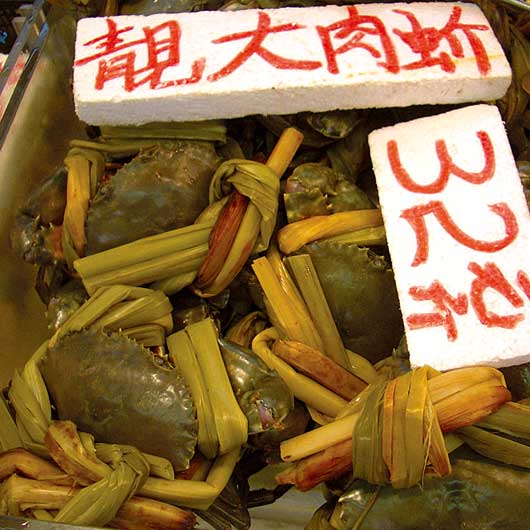
Known alternatively as the Shanghai
hairy crab, the big binding crab and the Chinese mitten crab (Eriocheir
sinensis), these upper crustaceans are found in the coastal estuaries
of Eastern Asia, with the distinguishing feature of disturbingly dense
patches of mossy hair covering their claws. The body of the hairy crab is
about the size of your palm, and, unlike the sweet legs of Alaskan king or
the luscious claws of the Dungeness, it’s the coral-coloured roe within
that makes it the most revered food in Hong Kong. The import of hairy crabs
into Canada has been prohibited for more than a decade for environmental
reasons, so to get your fix, you’ve got to fly to the Far East, where, for
six weeks out of the year, during autumn’s ninth lunar month, the hairy
crab is king. 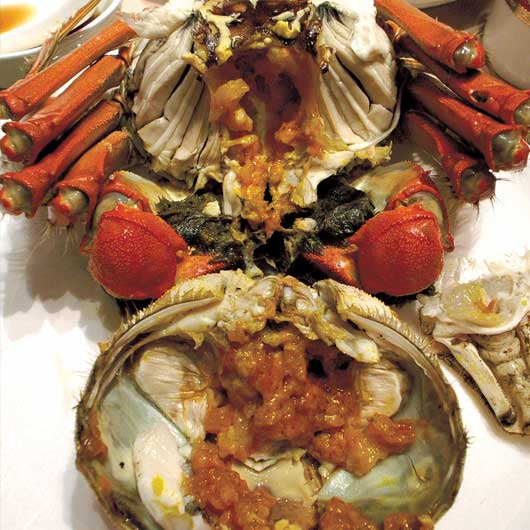
Hong Kong becomes a city obsessed. Taxis
sport Godzilla-sized rooftop replicas heralding its arrival. Food festivals
are launched. Restaurants devote entire menus to it, and denizens spend up
to $120 a pound for the fleeting delicacy. “Since hairy crab is a seasonal
item, you have to wait all year for it,” explained chef Chan Yan Tak of
Lung King Heen before we began our feast. “Among all the varieties of
crab, the roe of the hairy crab is the best. The distinct taste lingers long
after the first bite.”
The wee green hairy crabs are bound with
raffia and stacked high within glass display cases outside of restaurants
like so many freshwater cigars. Not surprisingly, the crab craze has spawned
an underground industry of charlatans. It is thought that only one of every
70 crabs sold as a genuine Yang Cheng Lake hairy crab is the real McCoy. The
Jiangsu area is riddled with small lakes breeding a similar crab species,
making imposters five times cheaper. The difference in taste? Think organic,
free-range chicken versus the Supermarket Brand C.
Which brings me back to my meal at the
Four Seasons. Sort of like a Peking duck meal on crab roe crack, the
six-course extravaganza starts with a baked stuffed hairy crab shell,
followed by the textural bliss of silken tofu soup with hairy crab meat.
Then comes the steamed whole hairy crab, which is perhaps my favourite dish.
Naturally balanced in flavour, inherently salty, sweet and as rich and gooey
as egg yolk, it comes simply sided with a dish of Chinese black vinegar and
minced ginger to cut the fattiness.
Here’s how you eat it. The first step
is strictly visual: Take in the ugliness that only a mother crab could love.
Next roll up your sleeves; this is going to get messy before it gets
delicious. Expert eaters palm the crabs, using special scissors to cut the
body in half, snipping away at the legs and shell casings, the dreamy,
creamy roe flowing out like lava. Get out those chopsticks. Dig for moist
meat, scoop up the roe. Dip it in the sauce and then onto your tongue. Chef
Chan Yan Tak was right: I can taste it still.
- by Amy Rosen ENROUTE
2007 October
Luxe eats, crustacean sensations
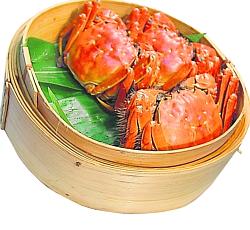
Fresh catch:
A ritual surrounds the feast but the most classic way is still to eat them
steamed
SINGAPORE - In
a culture where anything with four, six, or eight legs (or more) are eaten,
it's only natural to put up a statue for the chap who discovered hairy crabs
were edible in China more than 5,000 years ago. He's the farmer who put a
halt to the seasonal mass migration of these freshwater crabs during Autumn
- then seen as pests - by pouring boiling water on them. His sculpture is
somewhere in Jiangsu, because that's where these crabs come from.
With that, the annual season of hairy
crabs was discovered, and interestingly enough, the Chinese name for the
crab - ta zha xie - refers not to the furry pincers, as you'd imagine it
would, but to the baskets used to catch them.
As with most other kinds of revered
Chinese foods, there's a whole ritual surrounding the appreciation of these
hairy crabs and their roe, including what's the best drink to go with them.
Traditional cooking methods hold sway when it comes to preparing these
crabs, although there's always a new twist or two. The most classic way is
still to savour them steamed, with a dip or two into slightly sweetened
black vinegar mixed with minced ginger and a bit of sugar.
The crab roe and meat is usually so
fragrant and fresh, however, that I find the vinegar unnecessary. And even
though the golden orange lava-like roe is so rich, its full, rounded flavour
is more comforting than cloying. So one can easily have a variety of dishes
with hairy crab meat and roe, the only restraint is in knowing that the roe
is high in cholesterol.
Sheraton's Li Bai chef Chung Yiu Ming is
serving the hairy crab in three different ways besides the steamed version.
There's the braised shark's fin ($68++) which is thick soup that's been
infused with hairy crab roe so it has a golden glow and enhanced taste. New
this year is the crab roe gravy generously ladled over a steamed 'milk
dumpling' wrapped with fried egg white ($22++). The steamed milk, crab meat
with egg white dumpling was a very Cantonese creation, which provided a
simple, neutral base for the crab roe gravy. The other way to enjoy crab roe
gravy is with a homemade Spinach beancurd ($18++). Meanwhile, the Tung Lok
group of restaurants has also come up with a variety of preparations as
well, pairing braised hairy crab roe and meat gravy with special beancurd,
Nameko mushrooms, and vegetables, or noodles (Tung Lok Seafood).
At Noble House, hairy crab has been given
the 'royal' treatment by braising it with bird's nest. Also, drizzled over
bamboo fungus and asparagus. You could also have it stir-fried with rice at
Club Chinois, and possibly, mixed in with dim sum, but you don't get the
full flavour of the crab roe this way. The most delicious ways to enjoy
hairy crab is to have it braised with chicken stock gravy, or with shark's
fin, and simply, steamed with hua tiao wine. Dishes cost from $10 upwards.
After you put down your special crab-cutting scissors used to dig out the
sweet meat, a warming sweetened ginger tea usually signals the end of a
hairy crab meal to counter the 'cooling' effects of the crab. One could of
course be enjoying some warmed Shaoxing wine along with the crab during the
meal. - by Cheah Ui-Hoong
2007 October 29 SINGAPORE
BUSINESS TIMES
The couture of Cantonese cuisine
We pull into the parking lot at Sea Harbour Seafood Restaurant slightly
aghast.
This squat cement bunker festooned with blinking neon lights is supposed
to be one of the most sophisticated Cantonese restaurants in Richmond, B.C.
So what's with the Rising Sun logo out front?
Fortunately, we're here with Lee Man, a Chinese food expert and
contributing writer for Vancouver Magazine. We hope he'll help us navigate
the menu as easily as he did the drive from downtown. The brightly lit
interior is just as flashy as the platoon of luxury cars outside. It's all
marble walls, gold trim and festive chandeliers covered in red organza
rosettes.
The tables are set with white linen and the waiters are dressed in snappy
dark suits.
Think Gianni Versace meets the Orient Express.
The place is alive with the sound of
laughter and boisterous good times. Much of the loud chatter is in Mandarin,
Mr. Man observes.
The restaurant appears to be attracting
the newly moneyed mainland crowd, he explains, which tends to be less
conservative than its Hong Kong counterparts when it comes to splashing out
on the shark's fin, abalone and other pricey seafood specialties for which
Sea Harbour is known.
Whoa, there goes an Alaskan king crab
with a claw span of at least half a metre. It is being borne aloft by a
waiter to a table on the other side of the room.
Our table of five stares in awe at the
magnificent creature, which came straight from the giant seafood tanks
crowded with gruesomely priapic geoducks and bug-eyed rock cod.
"Alaskan crab is almost out of
season," Mr. Man sniffs uninterestedly, kindly saving our wallets from
curiosity.
He also advises against the spot prawns,
though Sea Harbour apparently does a beautiful soy-braised dish.
Mr. Man checked the markets earlier that
day and the local crustaceans were selling for $9 a pound, so the $28 being
charged at the restaurant is much too high a markup.
We are humbled, and give him carte
blanche to order whatever he likes.
After his deep consultations with the
waiter, in Cantonese, a live Dungeness crab is brought to our table
wriggling belly up in a plastic tub.
Mr. Man is suitably impressed with the
specimen's meaty legs and fighting spirit.
We will be having Sea Harbour's famous
kabocha pumpkin hotpot with crab. At $38 for a 2½-pound portion, this is
our one expensive item of the evening. We'll build more modest home-style
dishes around it.
"This is the Hong Kong style of
ordering," explains Mr. Man, who was born there.
Soup of the day is watercress and conch
($28.80). It's a very clean, double-boiled broth with a crisp mineral
aftertaste.
The server brings a heaping platter of
spent ingredients (including pork bones and tiny bitter almonds) to the
table for inspection and nibbling. I'm intrigued by the presentation, but
find the soup kind of bland.
Canton often gets a bad rap for its
less-is-more school of cooking. This cuisine is all about clean, light
flavours and stripped-down preparations that focus on the pristine integrity
of the natural ingredients.
To Western palates, however, it often
lacks the punch of other regional flavours, which are deeper and rounder,
with more spice, sweetness, heavy braising and slower cooking times.
Then there's the whole issue of texture,
which Western palates don't understand at all.
"Hmm," I hesitate, poking
uneasily at a plate of jellyfish and goose webs ($15.80).
These gelatinous delicacies don't really
taste like anything, other than the chili and sesame oils they're tossed in.
It's all about the crunch. I prefer the jellyfish, which look like plump
rubber bands, over the deboned goose feet. Too much ribbing, I suppose.
Pork shoulder char sui ($14.80) are
thinly shaved, roasted filets with a springy texture and slightly grey tint
ringed in red.
Chayote ($14.80) is a crisp, green squash
braised with minced pork and Chinese olive leaf, which gives the sweet
vegetable a nice bitter tang.
Shredded chicken ($13.80) is one of my
favourite dishes of the night. It's just a roasted free-range chicken served
with the bones underneath, a whole, crisped skin pulled over top, and a
gritty sand-ginger sauce on the side. But it's all chicken. No muss, no
fuss.
Ah, so this is Cantonese cooking. Now I
get it. I suppose I can appreciate the purity of the taste simply because
I'm more familiar with the ingredients.
Gai lan with cured meats ($16.80) is
another bright note. The sausage and pork belly give the greens a salty
kick.
Then comes the crab, fried in the shell
with fermented black beans and steamed cubes of Japanese squash. The pot is
simmered on top of a butane burner at the next table until the ingredients
all melt into a briny-sweet stew.
It's not a traditional Cantonese dish,
but man, is it good. By the time we've finished cracking through the crab,
the sauce is splattered all over the table and most of our clothes.
Sophisticated? Definitely not. Delicious?
Indeed.
As we top off the night with decadent
bowls of hot almond cream and coddled egg whites, I keep coming back to the
Versace analogy.
Sea Harbour is the couture of Cantonese
cuisine. The dining room's high-voltage glamour offers luxury dishes for
those who can afford it. Yet connoisseurs will appreciate the kitchen's
finely tailored assembly of quality ingredients.
Personally, I wouldn't want to eat this
way every day. But much like with fashion, I don't necessarily need to
understand the allure to enjoy the thrill.
Sea Harbour Seafood Restaurant: 3711
No. 3 Rd., Richmond; T: 604-232-0816
- 2007 November 7 GLOBE
& MAIL by Alexandra Gill

|


