|

Institutional investors own most of City's
Downtown Property
Downtown
office space is in demand, rents are rising and investors are eager to
join the exclusive club of those who own property in Vancouver’s core,
according to a panel of experts the commercial property association NAIOP
convened in late October.
Small
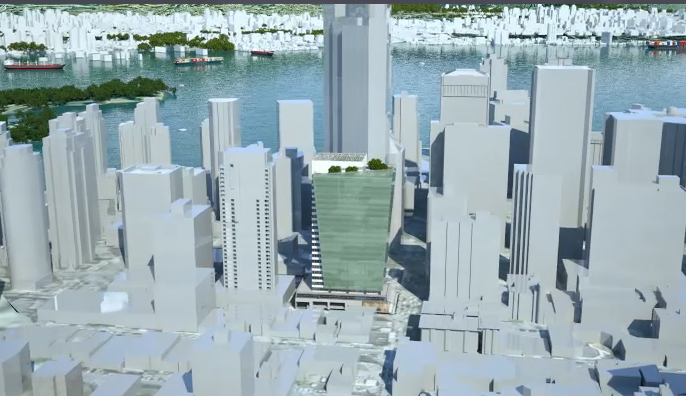
wonder, then, that plans by the Jim Pattison Group and Reliance Properties
to redevelop an assembly of 23 parcels (including the Toyota dealership at
Burrard and Drake streets) to make space for a 13-storey office tower.
A
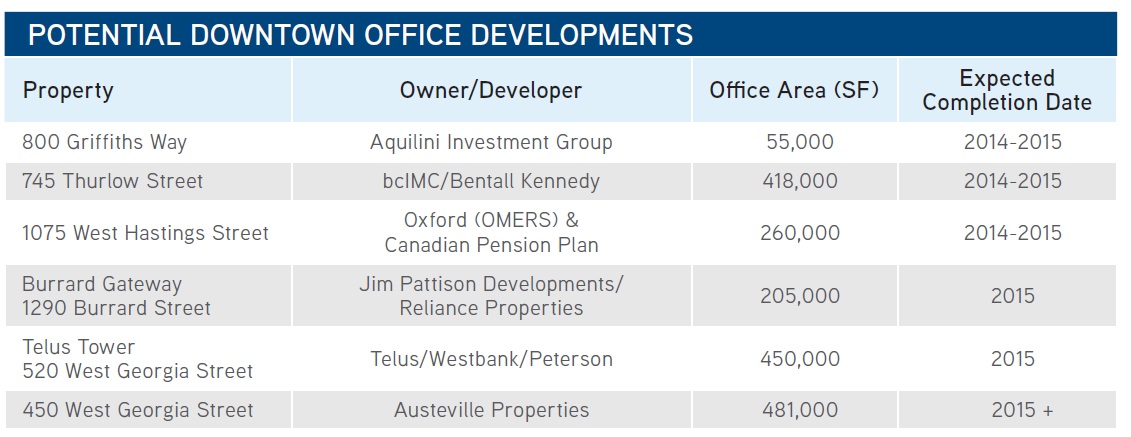
recent Avison Young report surveys a handful of other projects, including
Oxford Properties Group’s plans for 260,000 square feet on the site of
the former University Women’s Club on West Hastings as well as 1133
Melville Street, where Amacon had planned a 42-storey office tower.
Austeville
Properties Ltd. and Telus each have sites being discussed for upward of
one million square feet of space. And let’s not forget the long-standing
proposals by Bentall Capital and the Aquilini Investment Group for
projects at 745 Thurlow Street and 800 Griffiths Way, respectively.
While none of the proposed
towers would complete before 2014, a CB Richard Ellis executive
vice-president told NAIOP he foresees a “broadening” of the office
market by 2020.
“The
market could probably withstand something in the neighbourhood of two,
possibly three office towers downtown in that 700,000 to one million
square feet [range] because they won’t all be done at the same time,”
he said.
- 2010 November 2-8 BUSINESS
IN VANCOUVER
Head
Office Losses Erode City Stature
For
all the efforts the province and city are making to attract and retain
business, on one key front we’re going down fast.
Metro
Vancouver is losing head office jobs at an alarming rate, faster than
any other major city in Canada. According to a study conducted by
PricewaterhouseCoopers LLP (PWC), the number of head offices in
Vancouver dropped by 19% from 2001-09. Head office jobs fell even
further, by 28%, compared with increases in Calgary (7%) and Toronto
(3%).
“Canada,
and in particular B.C., has been losing an economic battle to retain the
head offices of Canadian companies and to attract multinational or
foreign head offices or head office functions,” said Brad Sakich, PWC
tax partner in charge of the B.C. region. “This is often a result of
international mergers and acquisitions that leads to the consolidation
or migration of the Canadian head office or its functions to outside of
Canada.”
Sakich
offers several reasons: few regulatory barriers to takeovers, a weak
Canadian dollar during that period and easier and cheaper access to
capital for acquisitions by U.S. companies with higher price/earnings
ratios.
A
new trend is Chinese companies doing “creeping takeovers” through
joint ventures with Canadian companies, especially in the energy sector.
OK,
but why is B.C. taking such a hit compared with other provinces?
Sakich
noted that the companies that have left B.C. are mainly forestry and
tech-related, where there are no regulatory restrictions compared with
the banks, telecoms and airlines that dominate Toronto and are protected
by Canadian ownership laws.
And
then there’s our “go-for-the-golf” corporate culture, where the
entrepreneurial end game is selling to a world dominator, not becoming
one.
“It
appears that B.C. is unable to nurture a business to a stage where it
requires a fully integrated head office function,” said Sakich.
The
importance of head office jobs – compared with, say, the ESL schools
that are the biggest tenants of our downtown commercial buildings – is
that they are high paying, they attract other head offices and they
contribute a disproportionate share of funding for charitable and
cultural causes.
When
the Celebration of Light or the Vancouver Symphony or the St. Paul’s
Hospital Foundation go looking for a signature sponsor, they start with
the A-list: major B.C.-based head-office corporations.
Their
value was recently underlined by Saskatchewan Premier Brad Wall’s
decision to impede, if not block, the sale of PotashCorp to BHP.
Even
though every takeover results in an earnest followup announcement that
this will not affect local jobs, that’s never the case. The really
attractive jobs, the ones that keep the brightest university grads here,
that make other head offices want to be here, invariably disappear.
“The
loss of these jobs,” said Sakich, “has a dramatic effect on the
character of your city.”
- 2010 November BUSINESS
IN VANCOUVER
Rezoning key to $500 million city tower project
City of Vancouver council to review height limits on six downtown sites by
year’s end
Two
local developers are proposing to spend $500 million to build a
775,000-square-foot mixed-use complex, including a 48-storey tower, at
the northwest corner of Hornby and Drake streets, but the plan is
contingent upon Vancouver city council approving a higher height limit
for the Jim Pattison Toyota site.
Current
zoning limits tower height on the site to 350 feet. That’s 116 feet
shorter than one of the three structures that Jim Pattison
Developments Ltd. and Reliance Properties Ltd. executives envision for
the site.
The
other two proposed structures are a 36-storey, 355-foot-tall tower on
Hornby Street and a 13-storey, 184-foot-tall office tower on Burrard
Street.
When
council ponders raising the Pattison site’s height limit later this
year, it will also consider increasing the height limits for five
other sites in the downtown peninsula:
•on
Seymour Street between Beach Avenue and Pacific Boulevard;
•on
Howe Street between Beach Avenue and Pacific Boulevard;
•on
Burrard Street between Alberni Street and Georgia Street, where there
is a Bell store and a Tiffany and Co. jewelry store;
•on
Burrard Street between Alberni Street and a lane, where there is a
Hermès boutique; and
•next
to the Loden Hotel between Bute and Thurlow streets on Melville
Street.
No
developers have proposed projects for any of the five sites.
Approving
them as locations for future tall towers is not a sure bet because
council has consistently protected view corridors from various parts
of the city to the North Shore mountains.
In
January, council considered and then rejected three other sites as
possible locations for tall towers because they affected view
corridors from Cambie Street and the Cambie Bridge.
The
rejected sites were:
- the
Hudson’s Bay Co. parkade on Seymour Street;
- the
former Greyhound bus depot known as Larwill Park; and
- on
Georgia Street at the western end of the Georgia viaduct.
The
fourth site, for which council deferred its decision in January, was
Jim Pattison Toyota.
“The
Pattison site was always somewhat different from the other three in
January this way,” senior city planner Kevin McNaney told Business
in Vancouver. “The Pattison site only impacts the Queen Elizabeth
Park view corridor, which is allowed to be impacted as part of the
higher building process because the view itself is from far back and
the skyline is part of the view.”
Indeed,
the Shangri-La Hotel and One Wall Centre interrupt the mountain view
from Queen Elizabeth Park.McNaney believes the other five sites, for
which council will consider raising building height limits, similarly
pose little risk to view corridors.
Still,
IBI-HB Architects associate director Jim Hancock is not taking city
approval for granted either for the Pattison site’s rezoning or for
final approval of his working concept.
“The
city will put us through a higher degree of scrutiny because it’s a
tall building,” he said.
Hancock
does not expect shovels to be in the ground on the site for at least
two years thanks to lengthy waits for rezoning, a development permit
and then a building permit.
During
that time there will be extensive consultation with neighbours.
Hancock
envisions that project site amenities will include:
- a
day care;
- a
Toyota car-share program;
- meeting
rooms, pool, fitness centre and outdoor roof decks; and
- 50,000-square-foot, three-storey Toyota dealership that would look
like a glass cube and front Burrard Street with four levels of service
facilities located below ground.
About
75% of the project is expected to be residential. It will include 79
rental units and 550 condos.
The
buildings are expected to be joined on the lower several floors to
form a podium. In the 48-storey structure, offices would occupy three
floors.
Hancock
has recently worked on several other iconic Vancouver structures,
including Three Harbour Green, the Rosewood Hotel Georgia and West
Pender Place.
- 2010 November BUSINESS
IN VANCOUVER
Metro Vancouver's
second-quarter office market vacancy rate rose to 6.4% from 5.7% in 2009's
first quarter, according to a Colliers International report released Monday.
The report said the
region's supply of available office space has surged, especially for
subleased space in the downtown core. A number of large tenants have left
downtown Vancouver for less expensive alternatives in Metro Vancouver.
By the second quarter,
Electronic Arts had surrendered its office at 250 Howe Street and
consolidated operations in the company's Burnaby facility. SAP vacated the
remainder of its space at 855 Homer Street in Yaletown and consolidated its
operations in its Mainland Street location. The report also noted more than
95,000 square feet of contiguous space is now available at 200 Burrard.
As a result of increased
supply, rental rates in the downtown core are dropping compared with what
they were a year ago. Last year, net rates for premium downtown office space
had hit $50 per square foot. The report said that today deals are being done
with rates between $29 and $33 per square foot for Class A and AAA space.
- 2009 July
Colliers
released its Q4 2008 report on the Greater Vancouver office market in mid-Decemer
2008. The overall vacancy rate shot up to 4.6%, a
significant rise in these tough economic times. Rates continue to
remain stable, but with low confidence in the economy, many landlords are
beginning to hesitate to try to hold out for higher rents, especially in
cases of renewals or expansions. There has been a significant rise in
available sublease space, specifically in the Downtown Core. As of
mid-December, there was nearly 850,000 sf available for sublease, double the
amount of sublease space available 12 months ago. Of the 850,000 sf
available for sublease, over 60% of that space is located in the Downtown
market.
Taller, denser, more
economical
Microsoft needed some 180,000 square feet
for its new British Columbia facility, but it needed occupancy in two years.
Vancouver could offer a three-year rezoning process and then two additional
years for development and other permits. Microsoft chose a Richmond office
park, increasing sprawl development, but available in two years.
If Vancouver indeed wants to be a healthy
headquarter locale, these excessive delays will have to be eliminated.
So will the current property tax
disadvantage that offices confront. Prime downtown condominiums are priced
at up to $2,000 per square foot with prime AAA downtown office space worth
perhaps 25 per cent of this. However, property taxes are roughly five times
as much. Reducing this enormous differential would help make the economics
of office space considerably more attractive. Considering a property tax
holiday for unoccupied space (for the empty building space only, not for the
underlying land) would also help. Reducing the huge tax differential would
also reduce occupancy costs to Vancouver's typical small offices and
potentially increase the demand for office space in the process.
Since the greatest disincentives to
downtown office development are related to policy and process, fixing them
can and should be reasonably easy.
Specifically, the planning process could
offer fast and preferential approvals to Vancouver downtown office
development. Densities are absurdly low, with floor space ratios (densities)
at a roughly seven, compared with Calgary's FSRs in the 15-20 range
downtown.
Building heights need to be raised
considerably to facilitate higher densities. Instead of 400-foot limits,
buildings of 600 to 700 feet should be commonplace, not exceptional, in our
land-scarce downtown peninsula. (Calgary has no height limit in the downtown
core.)
To accommodate higher, denser and thus
more economical office buildings, the city must dramatically revise or
eliminate the constraining view corridors that have shackled the development
of tall and large office buildings in the core.
An easy and highly economical way to
accommodate such buildings is to link them directly to existing and planned
SkyTrain stations in the downtown peninsula, but also at such well-served
locales as Broadway and Commercial, Broadway and Nanaimo and Broadway and
Granville (in future) on the Millennium Expo lines and at Cambie and
Broadway and Oakridge on the soon-to-be finished Canada Line. Failure to
exploit this vastly improved accessibility wastes the opportunities for
higher density and lower auto use provided by costly transit investments.
Finally, the downtown office development
process must be crafted on a solid understanding of the needs of the
small-office-plate market where developers need help to reduce risks and
improve profitability to make new downtown office construction attractive to
developers and tenants alike. - 2008 February 6
VANCOUVER
SUN
Downtown Vancouver vacancy rate now 2%
(1Q2008)
- For the first time in over 25 years, the
Downtown Vancouver vacancy rate hit a near-record low, at 2.0% this
quarter. The last time the vacancy rate reached these depths was
mid-year 1981 at 1.8%, when net rates for prime space in the Downtown
Core were an average of $19.00 per square foot. Unlike 1981, no
significant new supply is being added to the Downtown Core in the near
future, whereas from 1981 to 1984, over 3 million square feet of new
office space was added, causing the vacancy rate to rise as the space
remained mostly unoccupied due to the economic downturn.
- As the vacancy rate continually lowers, net
rental rates continue to rise correspondingly. The Downtown Core has
already surpassed the $50.00 net rental rate threshold (for prime Class
AAA space), and the Suburbs are seeing increases at a faster pace as
well. As operating costs and net rental rates are substantially lower in
the Suburbs, several companies are continuing to consider the Suburbs,
as gross rental costs may be half when compared to a downtown location.
>> MORE
Condos, costs squeeze Vancouver office space
Despite lofty rents and little vacancy, there's little
commercial development taking place: 'It takes a lot of nerve to build
today'
The numbers, at first glance, couldn't
look better for a commercial real estate developer.
On the small peninsula that constitutes
downtown Vancouver, there's barely any available office space. The
2.6-per-cent vacancy rate ranks as the lowest of any city core in North
America. And rents are soaring, with the cost of prime office space jumping
25 per cent in just one year to more than $34 per square foot.
Yet hardly any new commercial space is
being built. Just 130,000 square feet is under construction in downtown
Vancouver, which would add less than 1 per cent to what exists. It's a
fraction of what's happening elsewhere: Calgary's downtown is expanding by
5.6 million square feet, or 17 per cent, and Toronto is growing by 3.8
million square feet, or 5 per cent.
Construction costs have risen far faster
than rents, driven by a Western Canadian construction boom that has made
labour scarce and expensive, and the climbing cost of materials such as
steel.
Vancouver developers say they just can't make the
numbers add up for new projects. In Calgary, for example, the energy boom
allows developers to charge $45 a square foot, a third more than they can
get in the Vancouver market.
"It takes a lot of nerve to build
today," said Don Vassos, a senior vice-president at real estate
services firm CB Richard Ellis Ltd. who opened the company's Vancouver
office 24 years ago.
Since then, the downtown has gone through a
transformation that helped produce the current shortage of commercial space.
It's a trend the city now hopes to reverse.
In the 1980s and 1990s, planners and politicians
set about creating the Vancouver that currently exists, one consistently on
best-places-to-live lists. Under the rubric of "living first," the
city heavily promoted residential development downtown, pushing the
population on the peninsula to 90,000, more than double the 40,000 or so in
the mid-1980s.
But the dozens of residential condominiums have
begun to squeeze the commercial core. Four years ago, alarm bells started
going off for planners when Duke Energy sold the landmark Westcoast
Transmission building for a condo conversion. That provoked the city to
impose a temporary halt on such changes in the central business district.
With developers predicting that Vancouver will run
out of space to build new commercial buildings in the next 20 years, city
council is poised to encourage construction of more office space. In July,
it will consider a series of proposals from planners that include an
expanded central business district, tighter rules on condo conversions and
proposals to allow taller towers with more density.
Until things change, however, businesses will
continue to feel the squeeze.
Part of the problem, developers say, is that
condos are far more profitable than commercial space because residential
buyers are willing to pay large premiums for benefits such as views of the
ocean and mountains.
And unlike Calgary and Toronto, where large
corporations drive demand for many storeys of commercial space, the typical
Vancouver tenant is more likely to be a law firm or upstart technology
company requiring far less space. Developers have to sign on many more
tenants to make a project work instead of landing one big name.
Some Vancouver developers say the city has to take
measures to encourage new commercial buildings that go beyond the proposals
city planners have put together.
"They need to address costs," said Tony
Astles, executive vice-president for B.C. at Bentall Real Estate. "And
they need to address the length of time it takes to go through the whole
process, from zoning to approvals.
"It's a clogged-up system. Right now, it's
very difficult to rationalize a high-rise office tower in downtown
Vancouver. The costs of construction have risen so fast that rents - even
though they're at their all-time high - haven't kept up."
***
Disappearing downtown
Vancouver city council pursued a strategy of
"living first" for its downtown in the 1990s, nearly doubling the
number of people residing in the core and creating a city that is lively by
day and night. But the commercial core is now at an extreme premium,
squeezed by condos - and city planners are drafting new rules to ensure
there's room for office space.
Core office space is at record premium
Vancouver's downtown office vacancy rate
shrunk to a new low of three per cent, inching past Calgary as the tightest
central office market in the country, according to commercial realtor CB
Richard Ellis.
Only 645,008 square feet of Vancouver's
21.6 million square feet of offices downtown sit vacant, according to CB
Richard Ellis' third-quarter report.
CB Richard Ellis analyst Chris Clibbon
added that downtown's vacancy "is probably one of the lowest in North
America," when it comes to downtown office availability.
Clibbon added that the opening of the
11-storey, 238,000-square-foot expansion of the Bentall Five building on
Burrard Street will create some flex in the market.
"There are tenants giving back some
large chunks of space," he said.
"Some will be moving into Bentall
Five . . . and there will be some tenant shifts creating some options here
and there, but nothing substantial."
Jeffrey Rank, managing director of
commercial realtor Cushman & Wakefield LePage, said the subleasing
market has provided some relief for the downtown market, providing room for
tenants as companies change locations.
Catalyst Paper Corp.'s planned move from
the PricewaterhouseCoopers building at 250 Howe St. to a suburban
headquarters that will empty three floors in the downtown building is one
example of office space opening up.
However, that space in the
PricewaterhouseCoopers building was almost immediately leased by existing
tenants in the building.
"In some markets, one of which I
think we're in right now, looking at purely the percentage numbers doesn't
always tell you the whole story," Rank said.
"Still, we're in a tight market.
There's no question [about that]."
Cushman & Wakefield's assessment of
downtown's vacancy is slightly higher than its competitor at 3.9 per cent.
Clibbon said Catalyst's decision to move
out of downtown is indicative of another trend market analysts expect to see
as vacancy remains tight.
Suburban office vacancy, according to CB
Richard Ellis, was 10.9 per cent across all markets, although the total
office space in the remainder of Metro Vancouver is only 17.3 million square
feet. By community, vacancy ranged from 8.1 per cent in Burnaby to 22.4 per
cent in Surrey.
Meanwhile, half of all new office
buildings -- some five-million square feet -- being built in Canada are
going up in Calgary, which will dramatically change its vacancy picture.
That city's vacancy rate crept up to 3.1 per cent in the third quarter
compared with 2.8 per cent in the second quarter.
Nationally, the vacancy rate for Class A
space in the third quarter dipped to an "extremely low" 4.7 per
cent, with rents climbing to an average $21.99 per square foot compared with
$20.84 a quarter ago, according to CB Richard Ellis.
Montreal was the only market with falling
prices. Asking rents dropped to $18.09 per square foot per year from $18.83.
"Even with the addition of a sizable
amount of new Class A office space, the Calgary market will still be
relatively tight market for some tenants because much of the new space
coming to the market has already been leased," said CB Richard Ellis
president Blake Hutcheson. - by
Derrick Penner VANCOUVER
SUN
2007 September 19
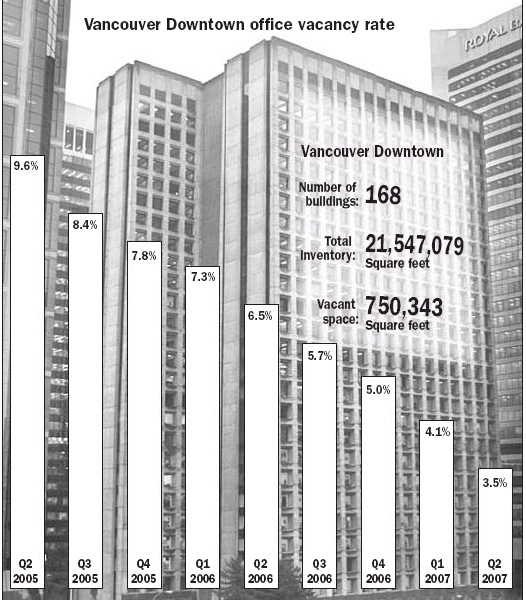
Office vacancy rates, 2007 Q3
Broadway corridor: 2.6%
Downtown Vancouver: 3.0%
North Shore: 5.0%
Burnaby: 8.1%
Richmond: 13.7%
New Westminster: 20.0%
Surrey: 22.4%
Total: 6.4%
Source: CB Richard Ellis
Office
space rents soaring in Vancouver
With space at an
all-time low, rents top $40 per square foot for the first time
Available
Vancouver
office space is at an all-time low, forcing rents for top-of-the-line
properties above $40 per sq. ft. for the first time.
The downtown vacancy rate dropped to 3.5
per cent in the second quarter, according to CB Richard Ellis, a major
commercial realtor. The last time it was close to that level was at the
height of the tech boom in late 2000, when it bottomed out at 3.9 per cent.
Space is even tighter along the Broadway
corridor, where vacancies have fallen to a record low of 2.6 per cent.
Shrinking supply and steady demand have
pushed up downtown rents for Class-A buildings by 17 per cent during the
past 12 months, and nearly 30 per cent over the past two years.
While the average net rent downtown is
$20 per square foot, according to CBRE survey results released Thursday, the
average is $31.77 for AAA-Class buildings like the Bentall 5 tower on
Burrard St. or the Terasen building on West Georgia.
"There are deals now being done in
the mid-$40s for the elite, high-view spaces, and that's a first for this
market," CBRE analyst Chris Clibbon said in an interview. "Two
years ago that same class of space was averaging $25.20, and there were no
deals being done over $30 at that time."
Rising rents are encouraging cost-cutting
companies like Catalyst Paper to move to cheaper suburban office markets,
which also experienced a strong second quarter. Catalyst is relocating its
head office from a triple-A building on Howe St. to Lysander Lane Richmond.
"This is a trend we expect to grow
as rental rates continue to increase in the downtown market," Clibbon
said. " Burnaby and Richmond are poised to do well, particularly Burnaby
because of the SkyTrain. Both markets will grab some tenants from
downtown."
There are currently three office
developments under construction near SkyTrain stations in Burnaby, while Richmond
has two developments under way. Vacancy rates decreased in all suburban
markets in the second quarter, with the exception of Surrey, CBRE said.
Clibbon expects the downtown vacancy rate
to remain tight for the rest of the year. While the second phase of Bentall
5 is nearing completion, the project is fully leased, and there are no other
office projects announced to date that are expected to be complete before
2010.
Lack of new supply is the most notable
feature of the current downtown market.
"In every office cycle where we have
seen vacancy rates drop to new levels, we have always had this bank of new
supply that would counter the vacancy drop. We just don't have it in this
cycle, not yet."
However, there are hints that developers
are poised to submit applications to the city for potential new towers.
"There is a little bit of a race
right now to put a tower up," Clibbon said. "Rates are now
approaching the level required to build an exclusive office tower and make a
profit."
Meanwhile, the City of Vancouver has managed to stall further conversions of office buildings into condo
towers, and forced two condo projects in the core -- the Hotel Georgia and
the Bay Parkade -- to include a small proportion of office space, about
80,000 sq. ft. each. But neither project is due to be complete before the
Winter Olympics. - 2007 June 15
by Michael Kane Vancouver
Sun
New office tower to adjoin GM Place
EDITORS
NOTE: This project is not proceeding
GM Place owners plan to build a 22-storey office
tower that will connect to the arena's northwest corner, Vancouver Arena
Limited Partnership announced Friday.
A formal application has been submitted to the
City of Vancouver for permission to build a 312,000-square-foot building
designed by architect Peter Busby.
Busby said the building will become a signature
Vancouver office tower because of its design and plans to make it among the
most energy-efficient commercial buildings in North America.
Sustainable features will include using
"energy synergies" between GM Place and the connecting office
tower. Heating and cooling systems between the two buildings will work
together so waste heat from one building will be used to heat the other.
Part of GM Place's underground parking, which is
used mostly at night, will be used for the new office tower.
Vancouver Canucks chief executive officer Chris
Zimmerman, who was uncertain about the project's cost and potential opening
date, said the new building will enhance the fan experience by providing new
amenities like restaurants and retail shops.
He noted office tower tenants will be able to walk
from their lobby straight onto the concourse level of GM Place for hockey
games or concerts.
"We always want to have more concourse space
because it gives us the opportunity to create more food and beverage
options," Zimmerman said in an interview. "It will allow for
better flow throughout the arena."
He expects the new tower will attract a lot of
potential new tenants who will enjoy the unique opportunity to be directly
linked with an NHL venue.
"In a highly competitive job market, I think
it gives the primary tenants some wonderful recruiting tools,"
Zimmerman said. "We'll be able to provide some unique benefits around
utilization of the building, the ice surface and probably some inside access
to certain team events. It will be a great way for companies to
differentiate themselves."
He said the current high demand for Vancouver
office space makes it an ideal time to build the new tower. The downtown
Vancouver office space vacancy rate is currently at an all-time low of 3.5
per cent, according to CB Richard Ellis Ltd. -
Bruce Constantineau, Vancouver
Sun 2007 August 18
Highlights of the Fourth Quarter 2006
Greater
Vancouver Office Market Update include:
- The first three quarters of 2006 showed remarkable
activity, with almost 1 million square feet of absorption. The fourth
quarter showed less movement with slight negative absorption at the end of
the quarter for the first time since fourth quarter of 2002. The slowdown in
absorption this quarter can be attributed to less available office space in
the market.
- Greater Vancouver’s submarkets are continuing to see large pockets of
space become available with new product coming to the market. For
larger tenants that do not require a Downtown address, these locations are
ideal. Not only will space requirements be easier to fill, but costs
will be significantly lower in the Suburbs.
- According to Statistics Canada, from 1999 to 2005, Vancouver’s head
office jobs showed the most significant decrease in Canada. Vancouver
held 16,894 head office jobs in 1999, and dropped almost 30% to a total of
11,938 head office jobs in 2005. Come 2007, Vancouver may face the
challenge of foreign acquisitions of Canadian companies. If this is
the case, Vancouver may continue to lose head office locations.
- Colliers
VANCOUVER'S OFFICE SQUEEZE:
Large companies are having trouble finding office space in downtown
Vancouver. Look at where Downtown Vancouver's rate is and
you'll see why so many large companies are looking to the suburbs.
GREATER VANCOUVER OFFICE LEASING VACANCY
RATES, Q4 2005
- Broadway Corridor 5.8%
- Downtown Vancouver 7.8%
- North Shore 12.7%
- Burnaby 14.7%
- Richmond 17%
- New Westminster 20.7%
- Surrey 23.5%
- GVRD average 10.8%
Source: CB Richard Ellis
Downtown office vacancy rate drops
Businesses are having more and more trouble
finding good office space in downtown Vancouver and it's not going to get
any easier as the number of wannabe tenants grows and the number of
buildings doesn't.
The office vacancy rate for downtown Vancouver
fell to 7.8 per cent in the fourth quarter of 2005, the lowest it's been in
almost four years, a report released Tuesday by CB Richard Ellis said.
The vacancy rate is even lower -- 6.3 per cent --
for top quality, or AAA, buildings.
A 10-per-cent vacancy rate is the equilibrium
level for the market, CB Richard Ellis' senior research analyst Chris
Clibbon said in an interview.
When the vacancy rate gets any lower the landlord
controls the market, which usually means higher rents. Rents in AAA
buildings have gone up 25 per cent in the last 12 to 18 months, Clibbon
said, with some office towers charging $35 to $40 per square foot.
And with no new office buildings on the horizon,
there is no end in sight.
"Historically in this market there has always
been new supply which has countered the vacancy trend," Clibbon said.
"Vacancies drop, someone goes ahead and
builds a tower [and] vacancy goes up. It's a cycle that repeats itself. This
is the first time we've seen it where we don't know where the inventory is
going to come from downtown."
It takes about three to four years from start to
finish to build an office tower, Clibbon said.
"[So] we need to get something started right
now."
But there is nowhere to build.
"There are almost no opportunities for an
office developer to build downtown," Clibbon said. "The whole
condominium craze has absorbed a lot of prime sites."
As a result some potential tenants have had to
look elsewhere. The Vancouver Olympic Committee was looking to expand its
20,000 sq. ft. in the downtown core to 220,000 sq. ft. of space by 2009. But
to do that, it had to move away from downtown to near the Burnaby border,
Clibbon said.
Richmond-based Transoft Solutions Inc. was hoping
to find office space in downtown Vancouver to be closer to home for its
largely young workforce that tended to live in areas like Kitsilano, the
company's CEO Milton Carrasco said. The company needed 15,000 sq. ft. to
amalgamate its offices and allow for the rapid growth it was anticipating in
the future. But that turned out to be impossible. The only space available
was on separate floors or otherwise divided up and that wasn't acceptable,
Carrasco said. In the end, the company rented new space in Richmond.
That's not surprising, Clibbon said.
"Large blocks of contiguous space are
extremely rare, especially in the AAA buildings," he said.
Cushman & Wakefield LePage Inc. also released
its numbers Tuesday on fourth quarter vacancy rates. Cushman's numbers show
an even tighter market, with the vacancy rate in downtown Vancouver being
6.9 per cent. Unlike CBRE, Cushman includes government buildings, which are
traditionally 100-per-cent occupied, leading to lower numbers.
Bart Corbett, Cushman's vice-president, office
leasing division, agreed with Clibbon.
"What is most concerning as a representative
of tenants in the downtown core is not only the short-term lack of supply
but the long-term prospects for the delivery of new inventory," Corbett
said in a statement.
"Beyond Bentall V (90 per cent preleased and
also to complete in 2007), there is no commitment or new sites proposed by
developers that could deliver a major new office complex in the downtown
core prior to 2010."
Both studies show the tightest market in the
Greater Vancouver area to be the "Broadway corridor," the area on
Broadway between Granville and Cambie. - by Fiona Anderson
VANCOUVER
SUN 21 Dec 2005
As vacancy rates drop, market shifting
in favour of landlords
The easy ride for downtown office renters,
especially big space users, is over in Vancouver, Cushman & Wakefield
LePage says in its latest office vacancy survey.
"Strong leasing activity in downtown
Vancouver and its neighbouring communities, the Broadway corridor, Burnaby
and the North Shore are starting to shift the market in favour of
landlords," the survey said.
Hendrik Zessel, vice-president of the company's
Vancouver office, says Vancouver and Calgary now have the lowest vacancy
rate in the country.
"In B.C., the activity is driven by its
strong economy, plus there are no new office developments coming into the
downtown core until 2007," he said.
The overall vacancy rates for Greater Vancouver
now stands at 8.4 per cent, a four-per-cent improvement from a year ago.
The downtown Vancouver rate has fallen by one per
cent from a year ago to 6.9 per cent, with the Broadway corridor enjoying
the lowest vacancy rate at 4.6 per cent.
The residential real-estate market is also showing
no signs of weakness.
According to the B.C. Real Estate Association,
7,720 homes, worth more than $2.66 billion, were sold in the province on the
Multiple Listing Service last month, a 34.18-per-cent increase in dollar
volume and a 15.14-per-cent hike in the number of units sold during the same
month last year.
"Typically, this time of year tends to be
somewhat slower for real-estate sales," said BCREA President Dave
Barclay.
"However, the numbers continue to show very
strong market activity as we approach the end of the year."
So far this year 100,586 sales have been made,
eclipsing last year's record of 96,314. -
by Ashley Ford THE
PROVINCE 21 Dec 2005

|


