|

Vancouver
named most liveable
Yet another survey ranks Vancouver as the most
livable city in the world.
In recent years, it seems every few months another
ranking finds Vancouver on the list of the world's most desirable places to
live.
Most of the surveys are done by recruitment or
consulting firms that determine a city's worth so senior executives can
negotiate whether relocating should come with hardship pay.
The latest ranking, by the eminent Economist
Intelligence Unit, found that Vancouver tops 126 other destinations after
assessing such factors as education, stability, culture, environment and
health care.
The Economist Intelligence Unit, the research side
of the magazine based in London, England, found Australia and Canada
dominated the top 10 most livable cities.
Toronto and Calgary were ranked ninth and 10th.
Australia's Melbourne was No. 2 on the list with Perth, Adelaide and Sydney
also making it into the top 10. .
This year, Mercer Human Resource Consulting placed
Vancouver and Vienna in a tie for second place behind Geneva and Zurich,
which were also tied.
"What made Vancouver, other Canadian cities
and Australia so strong was its infrastructure," said London-based Jon
Copestake, editor of the report. "Transportation links,
telecommunication links and supply of gas and electricity, all
contributed."
The only downfall for Vancouver, which received
top marks in all other categories, was the prevalence of petty crime.
That surprises Dan Hiebert, an urban geography
professor at the University of British Columbia, who thought public
transportation would have dragged Vancouver down a bit.
"I've found the public transit in Toronto is
far more efficient, but when you think about it a bit more, Vancouver is
relatively free of gridlock," Prof. Hiebert said.
"Vancouver's two million people don't have
the same volume of traffic. The only trick here is getting across
bridges."
Thousands of commuters may also be cursing the
notion that Vancouver received top marks for its road network. A collision
on the Port Mann bridge brought traffic to a standstill yesterday morning.
But to the growing number of Vancouver residents
who live and work downtown, traffic is no bother. What gets them is the
panhandling and petty thefts.
One executive who moved to Vancouver after 13
years of living in London said despite those minor aches, the quality of
life he found on the West Coast was worth the move. Kirk Hill, executive
director of the Career Management Centre at Simon Fraser University
Business, said he has never regretted his decision to give up weekends
jetting off to Athens in favour of green space and skiing.
"I have probably a more responsible and
demanding job than I had in London and yet I don't have the stress I used
to. Even going home before was stressful, and I know there are small crimes
on the street, but you have to just be aware," he said.
"Life is easy here in comparison."
But Mr. Hill said the big global companies don't
have head offices in Vancouver and immigration policies in Canada have to be
more aggressive and open to draw top talents who will otherwise find it
easier to relocate to countries such as the United Kingdom. And Vancouver's
laid-back attitude in promoting lifestyle does not sell well to employees in
some high-charging sectors, Mr. Hill said.
Vancouver has no problem attracting executives in
the forestry and mining professions and the high-tech and biotech
industries. But Bruce MacKenzie, managing partner of recruitment firm
Chapman & Associates, said the city's downfall is it doesn't rank as a
hub for international finance.
"Any Canadian city has to overcome certain
barriers, which include our tax situation, the dollar compared to other
currencies and this concept that it's out of certain marketplaces. The hubs
remain Chicago, New York, London," Mr. MacKenzie said yesterday.
"Vancouver remains in the periphery."
Mr. MacKenzie said that in his years of
recruiting, he has never met anyone who has not enjoyed the city, but some
don't move here because of the high real-estate prices.
Economist David Baxter, executive director of the
Urban Futures Institute, said Vancouver's outsider role in the global
economy makes the city livable for many people but not the place where
decision-makers choose to make their home.
For livability, the same number of people prefer
Edmonton and Calgary to Vancouver, he said, and until a few years ago,
British Columbia was losing people each year to Alberta where jobs paid more
and were easier to find.
Committed urban dwellers, such as those who live
in Montreal, New York or Paris, will likely find Vancouver too quiet.
Creating a more vibrant nightlife and building a stronger economy would
serve Vancouver better than resting on its laurels, Mr. Baxter said.
"It's a nice thing that people say nice
things about Vancouver. It's like being born good-looking. It's not wise to
build a life plan on being just good-looking."
Top 10 places to live
1. Vancouver
2. Melbourne
3. Vienna
4. Geneva
5. Perth
6. Adelaide
7. Sydney
8. Zurich
9. Toronto
10. Calgary
- by Petti Fong GLOBE
& MAIL.com 4 Oct 2005
VANCOUVER: #1 IN 2006:
Driven in large part by resources and construction
mega projects (such as 2010 Olympics venues, the RAV line and the expansion
at the Vancouver Convention and Exhibition Centre), Vancouver is forecast to
post the largest GDP percentage gain of any major Canadian city in 2006,
moving up from the #8 spot it held in 2005.
TOP 10 CITIES IN REAL GDP % INCREASE, 2005
Edmonton 5.2
Saskatoon 4.5
Abbotsford 4.4
Calgary 3.9
Regina 3.4
Victoria 3.3
Quebec City 3.3
Vancouver 3.3
Winnipeg 3.2
Trois-Rivieres 2.8
TOP 10 CITIES IN REAL GDP % INCREASE, 2006
(FORECAST)
Vancouver 4.0
Calgary 3.8
Toronto 3.7
Abbotsford 3.1
Edmonton 3.0
Halifax 2.9
Ottawa-Gatineau 2.9
Montreal 2.9
Saskatoon 2.9
Hamilton 2.8
Source:
Conference Board of Canada,
Vancouver Sun
Vancouver takes big tourist award
for second year in row
Conde Nast magazine's readers say we're the Best City in the Americas
once again
For the second year in a row, readers of the
prestigious travel magazine Conde Nast Traveler have voted Vancouver the
best city in the Americas.
And for the sixth year running, they have named
Vancouver Island as best island in North America.
"It's all good news. I think it's just
great," Olga Ilich, B.C. minister for Tourism, Sports and the Arts,
said Tuesday in an interview.
"Tourism right now brings in about $9 billion
in revenue to the province, so it's very, very big," she said.
"Conde Nast is probably the most respected
travel magazine -- they have a huge readership," added Rick Antonson,
president and CEO of Tourism Vancouver, pointing out the high-end travel
publication is seen by an audience of about three million readers.
"It is very much a notch of credit to the way
Vancouverites have become hosts to the world," he said.
Featured in the November issue of Conde Nast
Traveler, the 2005 Readers' Choice Awards will include lists of top cities,
hotels, airlines, islands and other travel-related items.
Cities in the competition were divided into five
geographic categories: the Americas -- which covers Canada, Central America
and South America; Asia/Pacific; Africa /Middle East; United States and
Pacific Rim. Cities were scored on ambience, friendliness, culture and
sites, restaurants, lodging, and shopping, to give a final ranking.
In a ceremony earlier this week in New York hosted
by actors David Hyde Pierce and Tim Curry, Vancouver was awarded first place
over San Miguel de Allende in Mexico and Buenos Aires, Argentina.
When asked what Vancouver is doing right, Antonson
said he thinks it is a mix of geography and hospitality, along with a
cultural diversity that, he said, makes travellers feel "at home".
"Visitors feel a comfort coming here,"
he said.
"You can come from any part of the world and
visit Vancouver and you'll be able to, with the ease of a phone call, access
your own language, access your own foods, your own religious interests --
you'll be able to feel very much at home within Vancouver."
Many of Vancouver's hotels were also recognized at
the awards as part of the "Best Canadian Hotel" category.
Yaletown's Opus Hotel was second in that ranking,
followed by the Four Seasons Hotel Vancouver and the Fairmont Waterfront
Hotel.
The Pan Pacific Hotel Vancouver, Sutton Place
Hotel and the Wedgewood Hotel all placed within the top 15.
On Vancouver Island, Dave Petryk, president and
CEO of Tourism Vancouver Island, said this is the sixth consecutive year the
Island has won top honours in the Conde Nast ranking, and the 10th time it
has won over all.
"It's fantastic recognition," he said,
adding Vancouver Island beat out Nantucket, Mass., and Kiawah, S.C., in this
year's competition.
"What it means to us is we are certainly
attracting more and more people to Vancouver Island," he said,
crediting the repeated honour to a mix of "mother nature" and
"the high quality of operators" on the Island.
Islands were broken down into four geographic
categories: Asia/ Pacific; Caribbean/ Atlantic; European and North American
for the award.
Conde Nast has been conducting its Readers Choice
awards for the past 17 years. - by Jonathan
Fowlie VANCOUVER
SUN 19 October 2005

CREDIT:
Stuart Davis, Vancouver
Sun
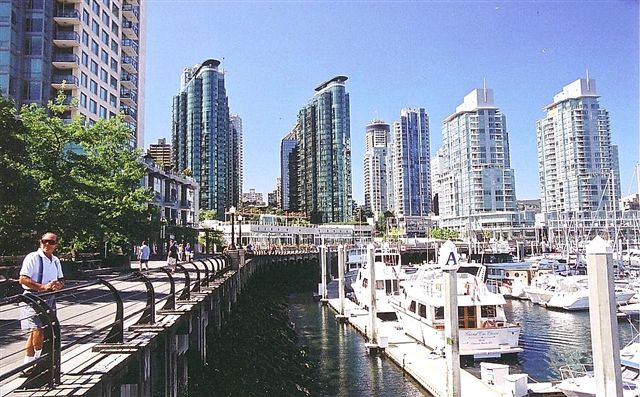
These condominium
developments, with views of Coal Harbour and Stanley Park, are often popular
with international buyers who may only use them for several months each
year. Buyers from the U.S., Europe and Asia are snapping up property all
over the city.
More and more high-end condominiums are
being sold to buyers from all over the world
VANCOUVER - Vancouver isn't
just a Canadian city anymore; it's an international one. For proof, look at
some of the owners of condos in the sparkling new high-rise towers at Coal
Harbour, which real estate brochures proclaim is "Vancouver's Gold
Coast."
At 1710 Bayshore Drive, at least eight Americans
own condos, along with five people whose main residence is in Hong Kong.
There are also owners from London, England, Heidelberg, Germany, and Dubai
in the United Arab Emirates.
A couple of blocks away, the luxurious Bauhinia
(535 Nicola) has owners from San Francisco, Denver and Santa Fe, New Mexico,
as well as Hong Kong, China, Taiwan, Switzerland, Mexico, Germany, Austria,
and Monte Carlo.
Down the street at The Carina, 1233 West Cordova,
international owners from Hong Kong, Mexico City, Hiroshima and Reading,
England, mix with Americans from San Francisco and Campbell in California,
Orlando and Gainsville in Florida, Austin and The Woodlands in Texas,
Denver, Tucson and Annapolis, Maryland.
The catch is, they don't live here.
Like London, Paris or New York, Vancouver has
become a place where the well-to-do like to have pieds-a-terre. These aren't
properties that are bought as an investment and rented out. They may well be
good investments, but in many cases, they sit empty when their owners are
away, which is most of the time.
If you walk around the new developments at Coal
Harbour at night, you'll find that in many buildings, several floors are
dark. Sometimes, more than half a building is dark.
The same can be said for some waterfront buildings
on the Concord-Pacific development, or on Beach Avenue. Check out the condo
tower with the tree on the roof at 1919 Beach: most of the time, only three
or four storeys are lit at night.
Developer Michael Geller thinks there are positive
and negative aspects to the phenomenon.
"I would say overall it's good for the
city," said Geller, who lives in one of the Bayshore towers.
"From a financial point of view, we have a
lot of people who are paying a lot of taxes and yet they are placing very,
very limited demands on services.
"The negative, though, is that if there's too
high a concentration of offshore residents, then you do lose the potential
for vitality in a building or an area. In the case of Coal Harbour, we
sometimes refer to them as 'dark suites,' suites that are literally dark at
night."
One of Geller's neighbours is former Vancouver
mayor Art Phillips. He acknowledges there are dark suites, but doesn't think
it's a huge percentage.
"There's a lot of people [in Coal Harbour
towers] who live in two places throughout the year," said Phillips.
"Then there are some to whom this is a very
occasional place to come to. Most of them are regulars who come in the
summer and go somewhere warmer in the winter. It's just like many people in
Vancouver have a place in Palm Springs or Phoenix. This is the reverse.
"I think it's very flattering to Vancouver to
have this kind of international attention, because these are all people who
could go anywhere, and they're choosing to come here. I don't think there's
anything bad about it at all. It's very flattering for us."
The city's co-director of planning, Larry Beasley,
said Vancouver doesn't have an official position on the large number of
foreign property owners. But he thinks it's part of the city's growing
internationalism.
"It's not a trend that is causing me a great
deal of worry," he said.
"Usually that pied-a-terre also represents a
linkage which may have a variety of business, social, family or personal
connections into the city, that helps to connect the city to the rest of the
world.
"A sophisticated, internationally connected
city is always going to have a portion of the population who come and go,
who are connected to a lot of places, and help to keep us connected. Not
just officially, but from person to person, event to event, business
arrangement to business arrangement, etc."
Foreign ownership in Vancouver is nothing new. The
Lion's Gate Bridge was built in 1937-38 by the Guinness brewing family in
Britain, which wanted to develop its extensive land holdings in West
Vancouver (i.e., British Properties).
In recent times, there was a huge controversy in
1988 when Asian developers offered False Creek condos for sale in Hong Kong
before they went on the market in Vancouver and they sold out before any
locals had a chance to bid.
There are still plenty of offshore owners who
bought before 1997, when Hong Kong residents worried about the looming
takeover of Hong Kong by China seemed to be buying property all over the
city.
Retired promoter Hugh Pickett lives across the
street from two houses owned by offshore interests that have been vacant for
years.
"Nobody lives in them," he said.
"Gardeners come once a week and do the garden. One house now has two
kids going to a private school. The other house has nobody at all.
"[The empty house] has got a swimming pool in
the basement and a garage at the back of the property for seven cars. And
nobody lives there. This has been going on now for six years."
Trying to get a hard figure on just how many
absentee foreign owners there are in Vancouver is tricky. Assessment rolls
sometimes list foreign owners, but foreign owners also may keep local
addresses, or own them through a company.
In any event, realtors say the offshore Asian
market dropped off when China kept the status quo in Hong Kong after it
assumed control in 1997. The foreign buyers now tend to be Americans and
Europeans, who usually buy downtown.
Canada Mortgage and Housing Commission figures
show that since 1992, 16,175 new condo units have been built in the downtown
peninsula.
CMHC's Cameron Muir said a CMHC study found that
47 per cent of downtown condos built in the 1990s were sold to investors,
but many of those were local buyers purchasing one to three units.
A local realtor says Americans tend to go
for the high-end suites in prime locations. This is borne out in property
assessments: you tend to find more American owners in pricier suites, like a
Seattle resident who has a $4,785,000 penthouse at 1777 Bayshore Drive.
"Down on the water, America wants front row
seats,"
"On the waterfront, our towers are running
very steady at about 25 per cent U.S. buyers. But now I'm seeing [Americans
buy at] inner-city projects -- if that's the right term -- at non-signature
projects like Electric Avenue [at Burrard and Smithe] and the Hudson [at
Granville and Dunsmuir]. We're running at about 15 per cent U.S. buyers on
these smaller suites."
Trying to quantify European buyers is harder.
"It's just so scattered," said a local
realtor. "I don't have a number on it, but down on the water, I think
it's 10, 12 per cent."
Shaw Tower on the waterfront, which will be the
tallest building in the city when it is completed - The 25 per cent
U.S./10-12 percent European average is holding true.
"Out of 132 units, I have four left,"
"They were from $400,000 to $5.4 million.
I've got two suites under $2 million and two just over $2 million
left."
Condos in Seattle, which is probably more like
Vancouver than any other city. But there isn't a big
pied-a-terre market in the Emerald City.
"I find that America moves around a lot more,
and America moves around to stay closer to their grandchildren ... ,"
he said.
"But it's not the same, it's all end users.
They're not leaving them vacant, they're moving there."
Why is Vancouver attracting international buyers?
Because it's beautiful, it's cosmopolitan, and it's safe.
"Vancouver is moderate in climate, in
prejudice, in crime," "We don't like the crime, but it's
moderate. That attracts people."
Geller recently sold an apartment in the Bayshore
development to a couple from Florida, who use it six months a year.
"They come up here because they like the
climate, especially in the summer," he said.
"They like the urbanity, they like the clean
air, they like the absence of crime, they love the proximity to the
outdoors.
"I think there's also a certain novelty in
being in a different country, just as we enjoy going to the United
States."
Another realtor also says Vancouver is something
of a bargain, by international standards.
"If you're looking at international people,
if they're comparing to international prices of major cities, Vancouver is
still very favourably priced,"
"For what Vancouver offers in terms of
physical attributes, culture, etc., it offers a wonderful lifestyle and
pricing."
International buyers also like Vancouver's
proximity to Whistler, one of the world's biggest ski resorts. In a sense,
downtown Vancouver is also a resort city for international buyers and
tourists.
"Are we a resort? I don't think so, but
almost," said Rennie. "I think it's good, because it keeps us
sustainable, it gives us jobs. We are a tourist city."
"I think we are perceived as a resort city,
in terms of what we're offering,"
Beasley rejects the resort concept.
"I've heard that characterization before, and
I'm not buying it," he said. "The reason I'm not buying it
primarily as a resort is because of what I know as the linkages that are
occurring in this city on a business and personal basis, to Asia, to Europe,
etc.
"There are some cities, particularly highly
multi-cultural cities or international metropolises, that attract a
component of people that are in residence some of the time, because they're
doing stuff. It's not just coming here to relax or take advantage of the
amenities of the city. It's not just a resort activity."
With the Olympics coming, international interest
is probably only going to increase.
"The Olympics put a spotlight on our
city," said a realtor, who thinks foreign ownership will
"definitely" increase in some areas.
"We saw what Expo did for [Vancouver]. I
think you're going to see that all over again. Given the state of the world,
I think it's going to be magnified."
Beasley agrees.
"There probably will be more of it," he
said. The upside is that "it helps to keep the delivery of our new
residential communities quite buoyant. The downside, of course, is that it
is probably putting some pressure on costs, on price. And that could be a
detriment to local buyers."
Geller does house exchanges with people from other
parts of the world on his holidays.
"We have found is that there is a great deal
of interest from people all over the world wanting to do a house exchange in
Vancouver," he relates.
"We sometimes underestimate how well known
our city is becoming internationally. Although we like to be boastful and we
know we're living in a special place, it is still surprising when you find
how many people also agree we're one of the most attractive cities in the
world. You usually have to leave Vancouver to appreciate how highly people
think of us." - By John Mackie
Vancouver
Sun 23 Feb 2004

Runs
along the Stanley Park seawall in the light of sunrise in Vancouver
One resident summarizes the ethos that typifies Vancouver: "The clubs
empty out early because everyone gets up early in the morning to go
snowboarding or mountain climbing."
- Jeff Vinnick, National Post
photo
Vancouver's number 2 in world ranking
Vancouver is not the best place in the world in
which to live and work --that's Zurich -- but it is tied with Vienna for
second, according to a new report by a consulting firm.
Mercer Human Resource Consulting, which ranks
quality of life and personal safety in about 200 cities for its corporate
clients, announced yesterday that Vancouver repeated its second- place
showing of last year in the quality of life category, down from a tie for
first place the year before.
Toronto came in just ahead of Melbourne at 12,
while Montreal tied for 23 with Honolulu and Dublin.
With Ottawa at 20 and Calgary at 26, all Canadian
cities scored in the top 30. In the United States, only San Francisco
managed the same, tying with Ottawa.
The rankings are compiled with New York as a
baseline, and they compare such factors as political stability,
international relations, economic freedom, culture, transport and access to
schools and health care.
The study's authors said yesterday that Vancouver
and Zurich were neck-and-neck throughout the evaluation.
For example, in the cultural category, which
judges limitations on personal freedom and media censorship, both cities
scored a perfect 10. Vancouver scored very high on ease of entry and exit,
while Zurich's strict employment regulations and the strictness of visa
requirements caused it to score low.
Zurich beat out Vancouver on risk of natural
disasters, on the other hand, because Vancouver lies on a fault line that
puts it at risk for earthquakes.
In one of the more subjective categories,
Vancouver's notoriously wet weather was judged better than Zurich's, largely
because of the warm summers.
"It's a positive message from a retention and
attraction [of employment] perspective," said Ted Singeris, head of
Mercer's Vancouver office. "It confirms to me what we in Vancouver
always knew about Vancouver, that it's a great place to work and live. It
reaffirms that it's a world-class city."
At the low end of the spectrum, Bangui in the
Central African Republic ranked lowest in personal safety, while Brazzaville
in Congo was last in quality of life, just two places behind Baghdad. -
Joseph Brean National
Post 3 March 2003
Vancouver sets pace on health
The city enjoys lowest rates of prostate and breast cancer; Toronto also
scores well
The health-conscious lifestyles of Vancouverites
appear to be paying off, with residents of the mountain city enjoying the
lowest death rates in the country from breast cancer and prostate cancer and
the second-lowest rates of heart disease and lung cancer.
The findings are among the results of an
exhaustive National Post analysis of behaviour and health information that
aims to shed light on the many influences that boost or discourage community
health, to illustrate areas in which cities excel and areas in which they
can improve.
The first part of the project looked at lifestyles
and health outcomes.
Vancouver topped the list when it came to making
the choices that lead to good health. It tied Toronto for first place in
health outcomes -- a measure that includes life expectancy, common causes of
death and medical conditions that affect quality of life, such as diabetes.
The data were drawn from Statistics Canada,
Environment Canada, the 2000/2001 Canadian Community Health Survey, several
special interest groups and our own municipal survey.
A panel of five specialists in community health
helped develop a list of 46 key health measures -- from smoking rates to
green space to life stress -- to rate 14 Canadian cities from St. John's to
Vancouver. An expert at the University of Calgary then produced the overall
rankings.
The 46 indicators are divided into six categories
-- lifestyle choices, health outcomes, socio-economics, children's health,
civic literacy and municipal factors -- that will be explored throughout the
week.
The recent influx of wealthy, healthy Asian
immigrants to Vancouver has been cited as one explanation for the city's
robustness; statistics hint at another. The city enjoys the lowest rate of
obesity among 14 Canadian cities surveyed -- only 7.6% of residents are
significantly overweight, compared with 19.2% in last-place Hamilton. The
rate of smoking in Vancouver is the lowest in the country. And only 18.5% of
residents admitted to often drinking to excess, compared with 28.4% in St.
John's.
Other cities that fared poorly include St. John's,
where nearly 30% of residents smoke and have consumed five or more drinks on
at least one occasion in the past year. It had the highest rate of diabetes,
the highest rate of death from heart disease and the second highest from
cerebrovascular causes.
But it reported the lowest probable risk of
depression -- 4.8%, compared with 9.9% in Edmonton.
Saint John also ranked low on both scales, with a
high rate of obesity and low levels of physical activity. It has the highest
rate of death from lung cancer and one of the highest rates of death from
heart disease.
Charlottetown reported high rates of smoking,
binge drinking and diabetes.
While it had a low percentage of low-birth-weight
babies, those babies had the shortest life expectancy at birth.
Cities that underperformed can take heart that
there are concrete things that can be done to improve health, including
public health campaigns, says Dr. Dana Hanson, president of the Canadian
Medical Association. "A population with a culture of healthiness
becomes healthier."
Dr. Patricia Daly, medical officer of health for
Vancouver, agrees that while health is directly related to socio-economic
factors, there are steps cities can take to improve the health of residents.
Proper housing promotes health; good public transportation reduces air
pollution; municipal smoking bans are important to reduce exposure to
second-hand smoke.
Most of the data on lifestyle choices and health
outcomes is based on responses to the 2000/2001 Canadian Community Health
Survey conducted by Statistics Canada and the agency's death database. The
numbers for each city represent averages for each corresponding health
region, which in some cases extend beyond municipal boundaries and into
surrounding areas. - By
Mary Vallis and Francine Dub
National
Post
16 Oct 2002
The
Land of Looking Good: a case for Lower Mainland secession
Vancouver City's chief planner Larry Beasley was
recently quoted as staying that "our economy is built on good looks, on
being attractive."
Because I have limited personal experience with
either looking good or making a living by being attractive, I have my
suspicions about how much looking good, as contrasted with working hard, can
be relied on as a strategy for a sustainable economy.
If Cosmo and Elle are the
textbooks of economic strategy for this region, then there are fundamental,
and perhaps irreconcilable, differences between it and the rest of the
province. Outside of the Lower Mainland and southern Vancouver Island, most
folks I meet think that the economy is built on working hard, and often this
hard work is in such industries as forestry, mining, farming and fishing,
which don't rank far up on the pretty list.
This in turn led me to reflect on the reality that
no one really planned for the Lower Mainland, or Vancouver Island for that
matter, to be part of British Columbia.
In fact, no one planned for there to be a British
Columbia. Ours is an accidental province, created as a result of a British
colonial governor, fearing that gold-rush prospectors would bring with them
American values and jurisdiction, jumping the gun to proclaim British
sovereignty over the non-Vancouver Island, non-Lower Mainland parts of what
is now British Columbia.
Given the realities that British Columbia came
together in a sort of shotgun marriage, without any deep analysis of whether
the parts belonged together, and what appear to be vastly differing
fundamental economic structures, it's a good time to see if alternative
provincial boundaries, or provinces, might be appropriate.
A nice starting point might be to go back to the
way things were before Governor James Douglas's pre-emptive colonization of
the "empty lands west of the Rockies" by proposing three
intentional provinces in place of the current accidental one:
The province of Vancouver Island. With a
population of 720,000, the original British jurisdiction would be Canada's
10th-largest province, more populous than Newfoundland and PEI,
and with about the same number of folks as live in New Brunswick.
The land of Narcissus. A province where new
technologies would involve tucks, botox and diets. Created from the current
Lower Mainland, the Land of Looking Good would stretch from UBC on the west
to Dino Village at Bridal Falls on the east.
With a population of 2.4 million, this would be
Canada's fourth-largest province, ranking after Alberta's 3.2 million but
before Manitoba's 1.2 million. Freed from the company of the other perhaps
not-so-good-looking regions, and not needing to share in the resource
revenue from these regions' forest, mining, fishing, oil and gas, and
agricultural industries, Narcissus could focus on the important stuff like
accessorizing.
Mackenzie. This third new province would
stretch from the U.S. border north to the Yukon and west from the Rockies
and the 120th meridian to the Alaska panhandle and the Pacific. With a
population of 1.1 million, in the range of the populations of Manitoba (1.2
million) and Saskatchewan (one million), this sixth-largest province could
focus on the hard work that is its legacy.
Who could object? Not the federal government,
which just created two territories out of one, which has no jurisdiction in
provincial affairs, and which might welcome more voices at federal
provincial meetings.
Not other provinces, because they have no
jurisdiction outside of their borders, and they might also welcome more
partners at the table.
Not the B.C. provincial government, because it
would mean that three people could be premiers, not just one.
And certainly not the folks in the Lower Mainland,
who see this region as the engine of the current provincial economy and who
have to focus on their tan lines.
Not the folks up north who think, and I quote,
that folks down south in the "feed lot" are "latte-drinking
concrete-dwelling parasites," nor the folks down here who think that
those up north are "pillaging the environment to support unsustainable
lifestyles" nor the recently elected Lower Mainland MLA who said that
the province's forest industry "wasn't important" - here is a
chance for all of them to walk the walk.
The only folks who could reasonably object would
be those who think that maybe, just maybe, there are some strong and
fundamental benefits to everyone being part of the same province, that the
resource industries are important to everyone and that the economic well-
being of the people in Vancouver and the rest of the province is built on a
lot more than looking good. -
David Baxter is executive director of The Urban Futures Institute, whose
publications on demographics can be accessed at www.urbanfutures. com. His
column appears monthly in BUSINESS IN VANCOUVER August
30-September 5, 2005; issue 827
Never
mind the rain, Vancouver's No. 1
VANCOUVER - This
great city, which recently emerged from a week-long fog bank only to be
pelted by hail and lit by an angry lightning storm that blacked out many
neighbourhoods, is one of the best places in the world in which to live.
Toronto, Montreal and Calgary are close behind,
according to a new global survey of cities, but as everyone in Vancouver
knows, they are all on the wrong side of the Rockies.
William M. Mercer, an international human
resources consultancy, annually evaluates the world's leading cities,
analyzing 39 quality-of-living factors to determine global rankings.
Vancouver scored 106, Toronto 103.5, Montreal
102.5 and Calgary 101.5. Lowly New York could only manage a score of 100.
Toronto was tied for 15th spot with Dusseldorf,
Germany, San Francisco, Oslo, Perth, Australia, and Brussels. Montreal was
in a five-way tie for 24th spot. Calgary was in a five-way tie for 34th.
The Swiss cities of Zurich and Bern and the
Austrian capital, Vienna, all tied with Vancouver for top spot.
The ratings are used by multinational companies to
work out compensation for staff being relocated around the world. But the
survey couldn't have come at a better time for Vancouverites, who need
cheering up as they limp through another typically dull winter, which
frenetically switches from spring-like conditions to ice fog, to driving
snow, to dreary rain.
William M. Mercer did not consider rain.
And it must be said the analysis was highly
tolerant of some of Vancouver's other idiosyncrasies.
Cities were rated on factors such as political
stability, personal safety, health care, crime levels, water quality,
transportation, traffic congestion, education and the availability of public
services.
A top mark for political stability in British
Columbia.
Starting the new millennium, Vancouver is at the
top of the heap, and it feels good. -
by Mark Hume
National Post,
with files from The Canadian Press January 13, 2000

|


