|

 
TRENDS
After
emerging from nearly a decade-long economic slump during 2000, Hawaii was
poised to sustain its recovery in 2001. A weak U.S. economy, however,
coupled with a persistent lag in Asian market recovery, inhibited Hawaii’s
economic expansion throughout the first half of the year, with September 11
bringing Hawaii’s tourism industry to a virtual standstill. Prior to
September, Hawaii’s lodging industry was performing at approximately three
percent above 2000 levels, with Maui experiencing a nearly seven percent
RevPAR growth.
>> full
report
$250M purchase
General Growth Properties made a major addition to its Hawaii
portfolio by acquiring Victoria Ward Ltd. for $250 million in 2002.
The REIT already owns the 1.8-million-sf Ala Moana Center in Honolulu but
adds 65 acres in the Kakaako entertainment district as well as 600,000 sf of
retail space and 700,000 sf of office and industrial. General Growth will
assume $50 million of Victoria Ward's short-term debt. The acquisition will
provide an 8.5% unleveraged return in the year after closing, expected to
occur around July 31 2002. The REIT will borrow $200 million to close the
deal in 2002.
Los Angeles
Couple purchase for $95 million
John E. and Marion Anderson, two of Los Angeles' richest real
estate investors and philanthropists, have agreed to pay $95 million for the
478,000 square foot AmFac Center office complex in Honolulu. One of the
largest office sales in Hawaii this year, the deal also represents one of
the Andersons’ first large real estate purchases outside of Southern
California. The 478,000 square foot waterfront development’s twin towers
rise 20 stories. Eastil Realty began marketing the project on behalf of
Mitsui Fudosan USA Inc. earlier this year, and escrow is expected to close
within a few weeks
Trends
in the Japanese Honeymoon Market;
Hawaii Retains Top Location
Destinations in Thailand, Malaysia and
Indonesia, especially beach resorts, are having virtually no success in
attracting the lucrative Japanese honeymoon market, according to the latest
results of a bi-annual survey carried out by the Japanese tour operator JTB
Inc.
The latest survey, covering October to
December 2002, shows that the only Asian destination to have made it in JTBs
list of top 20 honeymoon destinations is the Maldives, a first-time entrant
in 17th place. First carried out in 1969, the latest JTB survey covered
4,354 couples booking honeymoons with JTBs main offices in Tokyo, Nagoya and
Osaka.
While Asian destinations are proving more
popular with European honeymooners, the latest survey highlighted some of
the interesting trends taking place in the Japanese honeymoon market, which
may be of use to Thai destinations wishing to get a foot in the door.
In spite of poor economic conditions in
Japan, honeymoon couples spent average of 526,000 yen (US$4,383) per couple.
That was a 13 percent increase over 2001 and the first such increase in the
last 12 years, according to JTB.
The report said: "Although the
current survey is influenced by lower incomes caused by the depression and
generally shorter honeymoons, the average expenditure per couple appears to
have increased for the following reasons:
"With overseas travel becoming more
common, the awareness of a honeymoon as a journey to remember is encouraging
couples to choose hotels that have a personal appeal. We are seeing couples
who feel prepared to spend more in order to indulge their personal
preferences and create their own individual journey.
"Particularly for popular Europe,
the proportion of couples spending between 600,000 yen and 800,000 yen has
reached 23.2 percent (a large 7.7 percentage points increase over
2001)."
Hawaii was chosen by 28.1 percent of the
couples and has retained top place every year since 1998. Europe has moved
into second place for the first time in the history of these surveys, chosen
by 18.2 percent of the couples. Australia has fallen from second to third
place, 16.8 percent.
The reasons for Hawaii's unwavering
popularity, according to the survey, is its good climate, rich resources in
hotels, restaurants and shopping, etc., and freedom from language problems.
"Of every four couples visiting
Hawaii, one performs the wedding ceremony there. Variety is added to the
stay by spending time in islands other than Oahu, a popular option that
accounts for some 40 percent of the total honeymooners to Hawaii."
The report said couples who wanted a
honeymoon that reflected their personal tastes chose Europe.
Italy continues to remain very popular,
with some 50 percent of honeymooners (to Europe) travelling within this
country, a proportion that rises to about 70 percent if all those who
combine a visit to Italy with visits to one or two other cities are
included.
"Many Japanese feel attracted by
Italian tastes in food, clothing and dwellings, and by the Italians evident
enjoyment of life," the report said.
Other recent trends include:
--Growing numbers of honeymooners are
using package tours that provide efficient visits to the various main
attractions within Italy, and then staying two days in Rome or Milan, or
tacking on two-day extensions to visit Paris or London when the main tour is
over.
--Rather than leave for their honeymoon
immediately after the wedding ceremony, more and more couples are waiting
until December to make their trips. This is the season for bargains, and
city streets are beautifully decorated in the Christmas season.
--More couples are specifying small,
intimate hotels or high category hotels. A generation of honeymooners that
has become accustomed to overseas travel is increasingly going for things
that appeal to them personally, staying in the hotel of their choice in a
city they know and love at a season when it will look its best.
Of those honeymooners who choose
Australia, 80 percent stay on the eastern seaboard, particularly the Gold
Coast. In the honeymoon season of the northern autumn 2001, Australia
achieved a major increase in its market share as those who had intended
going to the US mainland diverted to Australia. The fact that travel to the
US is beginning to recover has slightly reduced its share, but overall the
trends are healthy.
Two rapidly rising destinations are
Tahiti, up from 17th place in the Top 20 list to 10th place in the northern
autumn 2002, and the Maldives which did not even figure in 2001, but has now
entered the Top 20 list at 17th place.
"The perfect accommodation for the
fullest possible enjoyment of a marine resort is a cottage over the water.
Among the many marine resorts, Tahiti and the Maldives are attracting
attention as those offering stays in such cottages. These support the desire
to get away from all the mad rush and just relax near the sea," the
report said.
The average length of an overseas
honeymoon is 7.0 days (half a day less than in 2001). The continuing
reduction in the length of honeymoons had seemed to be levelling off after
1999, but now the decline has resumed. Certainly, the economic effects of
Japan's depression are making it difficult to take long holidays, the survey
said.
At the same time, the recovery from the
reluctance in 2001 to visit Guam/Saipan and Hawaii means that larger shares
are now held by shorter honeymoons, 10.1 percent being four days or less (up
7.5 percentage points over 2001), 15.3 percent of six days or less (up 0.8
percentage points).
Moreover, most honeymooners have
travelled abroad before their marriage, and "with foreign travel now a
part of their lifestyle they feel less inclined to take a long holiday for
their honeymoon".
The average age of the grooms in the
couples surveyed was 30.1, and of the brides was 28.3. (The Japanese census
for 2001 gives the average ages of marriage for the entire population as
30.6 and 28.4, respectively.) - by Imtiaz Muqbil, Bangkok
Post, Thailand Knight
Ridder/Tribune Business News
2002
National Lodging Forecas
t
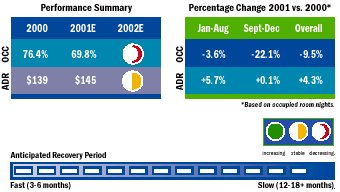
After emerging from nearly a
decade-long economic slump during 2000, Hawaii was poised to sustain its
recovery in 2001. A weak U.S. economy, however, coupled with a persistent
lag in Asian market recovery, inhibited Hawaii’s economic expansion
throughout the first half of the year, with September 11 bringing Hawaii’s
tourism industry to a virtual standstill. Prior to September, Hawaii’s
lodging industry was performing at approximately three percent above 2000
levels, with Maui experiencing a nearly seven percent RevPAR growth.
Post
September, Hawaii’s lodging market experienced performance declines not
seen since the Gulf War period as RevPAR declined more than 50 percent the
week following the events. Hawaii’s lodging supply far exceeds demand from
both westbound and eastbound travelers. Ohau has been particularly impacted
due to its reliance on Japanese tourism, which accounts for approximately 50
percent of Hawaii’s total visitors. Faced with softening leisure demand, a
weak domestic economy, a reduction in air-routes, and a reduction in
eastbound demand, Hawaii’s lodging industry is anticipated to face
significant challenges in 2002.
Source:Smith Travel Research,Ernst &Young LLP
Major
Demand Changes
After
September 11, eastbound travel weakened considerably. Japanese arrivals,
accounting for approximately 75 percent of Hawaii’s international air
arrivals, are approximately 60 percent below the prior year. Eastbound
visitors are crucial for the Hawaiian lodging market, spending nearly 50
percent and 27 percent more than U.S. west coast and east coast visitors,
respectively.
Westbound
travel has rebounded more rapidly than eastbound travel, but lags last
year’s results by approximately 15 percent. The impact of the prolonged
tourism sector decline on related industries is evident in the recent
bankruptcy of American Classic Voyages and closure of its Hawaii office. A
reduction in flight routes to Hawaii following September 11 also threatens
the tourism industry’s recovery pace, as air travel is the region’s
primary demand facilitator. Hawaiian Airlines and Aloha airlines announced a
20 percent and 25 percent reduction in flights, respectively.
Several
proposed developments are anticipated to enhance Hawaii’s attractiveness.
Construction of Outrigger’s $300 million Waikiki Beach Walk development is
anticipated to begin in 2003, including a retail promenade featuring a
multi-level entertainment complex. On the Big Island’s Kona coast, the
$300 million Hokulia development project, is anticipated to feature an
18-hole Jack Nicklaus signature golf course and 730 ocean view residential
units, estimated to cost up to $2 million each. The Hokulia project is
anticipated to enhance the Big Island’s infrastructure, adding roadways
and public parks.
Major
Supply Changes
Due
to land and financing scarcity, operators are focusing on purchasing and
renovating existing sites. Hilton recently opened the 453-room Kalia Tower
at Hilton Hawaiian Village Beach Resort & Spa in Waikiki. The $30
million renovation of the 719-room Aston Waikiki Beach Hotel is anticipated
to be completed July 2002. The Waikiki Beach Marriott Resort, recently sold
to CNL Hospitality for approximately $130 million, is undergoing a $60
million renovation with completion anticipated by May 2002.
Renovations
of the former Sheraton Makaha Hotel on Oahu are anticipated for completion
by early 2002. Fairmont Hotels and Resorts acquired and began managing the
450-room all-suite Kea Lani Resort in Maui and Ritz-Carlton purchased the
548-room Ritz-Carlton Kapalua in Maui from the Nissho Iwai Corporation for
approximately $143 million.
On
the Big Island, the Royal Kona Resort is undergoing an expansive renovation
with completion anticipated by early 2002. Negotiations are underway for
development of a new hotel on the site of the vacant Kona Lagoon Hotel. In
Maui, the Outrigger Wailea’s $25 million recent renovations include a new
4,000 square foot spa, refurbished guestrooms, and the addition of a 32,000
square foot garden court and a water activity area.
The
Maui Marriott’s recent $70 million renovation includes refurbished
guestrooms, the addition of an extensive water park, new restaurants, and
improvements to the hotel’s common space areas. In Oahu, the Kahala
Mandarin hotel recently announced plans for construction of a
13,000-square-foot-spa and fitness center anticipated to open in 2002.
Ongoing capital investment projects in Hawaii’s premier lodging properties
should help induce both leisure and business demand.
Political/Economic/Legal
Changes
Tourism
represents a quarter of the Hawaiian economy and approximately a third of
its jobs. Consequently, unemployment in Hawaii’s air transportation
industry is seven times last year’s levels while hotel-related
unemployment is at 20 times last year’s levels. In addition, arrivals to
Hawaii are anticipated to be 15 percent to 20 percent less than previous
year’s levels during the coming months. To stimulate tourism and encourage
hotel development, government officials have recently approved tax breaks,
launched a $45 million marketing plan, and began taking steps to enhance
airport security.
Tax
break legislation provides a 10 percent tax credit for hotel construction
and renovations and enables hotel investors to qualify 10 percent of their
investment amount against upcoming tax liabilities. Hawaii’s government
officials are hopeful that this legislation will induce new investment
capital to the islands, help create new jobs, and turn around the slumping
economy.
- Jeff Dallas, Los Angeles & Alfred Fernandes,
Hawaii
eHotelier.com
The Jano Arms building bought for less
than 50 percent of the price it fetched a decade ago
An 89-unit, 11-story rental apartment
building near Ala Wai Canal in Waikiki has been sold to a Seattle real
estate firm for about $6 million, less than half the price the property sold
for a decade ago.
GFS Jano Arms LLC closed its purchase of
the Jano Arms building from Tokyo-based Misawa Homes Co. last week,
according to filings with the state Bureau of Conveyances.
GFS Jano is managed by John Goodman,
chairman and founder of Pinnacle Realty Management Co., a $4 billion
property manager and broker based in Seattle.
Goodman did not return calls seeking
comment yesterday.
Misawa had purchased the fee-simple
high-rise from its affiliate, Misawa Resort Co., which originally bought
Jano Arms for $14.5 million in 1989, according to state records.
Jano Arms, built in 1961, sits on a
16,124-square-foot piece of land bordered by Ala Wai Boulevard, Kuhio Avenue
and Kaiolu and Launiu streets.
The midranged apartments, which go from
about 600 to 800 square feet, are almost completely occupied, said Misawa
attorney Carol Asai-Sato.
Misawa had spent just under $1
million to renovate the building in the mid-1990s, Asai-Sato said. She did
not know of any other Misawa real estate holdings in Hawaii. The stock price
of the publicly held home, resort and golf course developer has fallen 22
percent in the past year. -
By Tim Ruel Star
Bulletin
3 October 2000
|